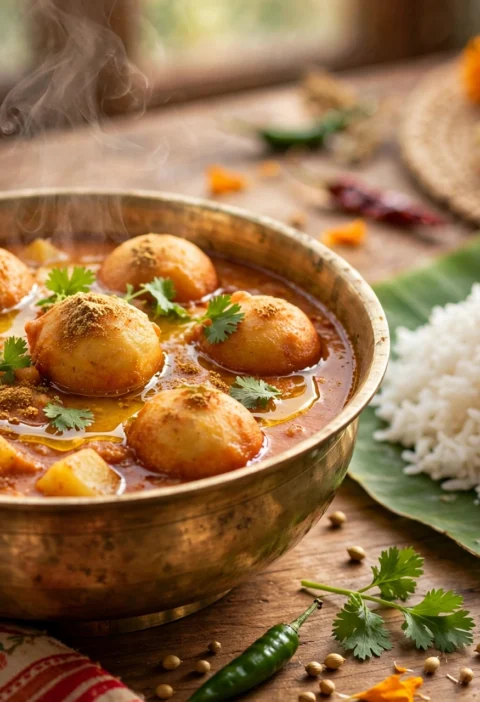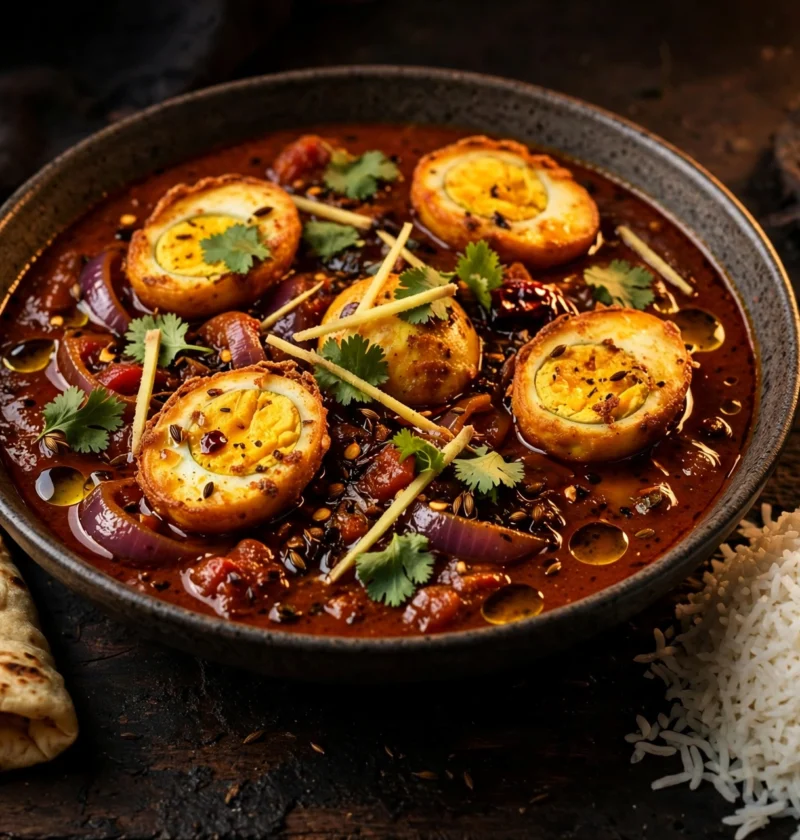
Every egg curry recipe in my life begins the same way: with a nearly empty fridge at the end of the month. When we were newly married and the salary had five days left to stretch, my wife would survey the bare shelves, find the one constant — a tray of eggs — and announce egg curry with the confidence of someone planning a feast. She was right every time. Onions, tomatoes, oil, and spices were always in the house, and forty minutes later the kitchen smelled like a celebration, with golden eggs standing in a deep red gravy that had no business coming from such poverty of ingredients. This egg curry recipe is hers, and it remains the dish I cook whenever the fridge is empty and the mood needs feeding.
It was not always this polished. My own early versions dropped plain boiled eggs straight into a curry base, and they emerged exactly as they went in — smooth, sealed, politely refusing the gravy, so every bite was a bland white mouthful followed by a spoonful of masala that had arrived too late. The fixes are small and they are everything: fry the boiled eggs in spiced oil until their whites blister gold, so the surface turns thirsty and textured; score each egg with shallow cuts so the gravy can travel inward; and let the eggs simmer in the finished gravy long enough to stain. Do those three things and any egg curry recipe becomes a dish people ask for by name, not by budget.
Why This Egg Curry Recipe Works
Eggs are the most uncooperative protein a gravy can meet — smooth, sealed, and quick to sulk. This egg curry recipe works because every step is about persuading the egg and the masala to actually meet:
- The boiled eggs are fried golden before they ever see gravy. A raw boiled egg’s white is glassy and closed; the gravy slides off it. Rolled in hot oil with a dusting of turmeric and chili, the white blisters into a golden, slightly wrinkled skin that grabs and holds sauce like a sponge. This single step is the difference between an egg curry recipe and eggs merely visiting one.
- Each egg is scored so the masala can travel to the yolk. Three or four shallow slits with the tip of a knife, cut before frying, open paths into the egg’s interior. During the simmer, gravy seeps into those channels and seasons the white all the way through, tinting even the outer rim of the yolk. No more two-tone bites of plain egg and separate sauce.
- The gravy is built rich, because it has no meat to lean on. A chicken curry borrows depth from bones and juices; an egg curry recipe must manufacture its richness honestly — onions cooked long past golden into a deep mahogany sweetness, tomatoes reduced until the oil separates, and the spices bloomed in that order. The gravy is not a backdrop here. It is half the dish.
- The eggs simmer in the finished gravy, but never boil in it hard. Fifteen gentle minutes is enough for the exchange of flavors; a rolling boil toughens the whites into squeaky rubber and clouds the sauce. The curry should barely tremble — a bubble breaking the surface every few seconds is the correct tempo for this egg curry recipe.
- It rests before serving. Ten minutes off the heat lets the eggs keep drinking gravy as everything cools a degree, and the sauce settles into its final gloss. Egg curry eaten straight off the flame tastes assembled; rested, it tastes married. That patience is built into this egg curry recipe on purpose.
Ingredients
Serves 4
For the eggs:
- 8 large eggs
- 2 tablespoons neutral oil, for frying the eggs
- 1/4 teaspoon turmeric powder (haldi)
- 1/4 teaspoon red chili powder
- 1/4 teaspoon salt
For the gravy:
- 2 large onions (about 300g), sliced very thin
- 1/3 cup (80 ml) neutral oil or ghee
- 3 medium tomatoes (about 300g), pureed or finely chopped
- 1 tablespoon ginger-garlic paste
- 1 teaspoon salt, or to taste
- 1/2 teaspoon turmeric powder
- 1 tablespoon ground coriander (dhaniya)
- 2 teaspoons red chili powder, or to taste
- 1 teaspoon ground cumin (zeera)
- 3-4 fresh green chilies, slit
- 1 1/2 cups hot water
- 1 teaspoon garam masala
- 1/4 cup fresh coriander leaves, chopped
- 1-inch piece fresh ginger, cut into matchsticks
An egg curry exists wherever eggs and spice traditions meet — across Pakistan and India, into Bangladesh, Burma, and the Caribbean — because it solves the oldest problem in home cooking: how to make a satisfying main dish from the one protein almost always on hand. It belongs to the wider world of curry, yet it keeps its own identity, since the eggs are cooked separately and married to the gravy rather than simmered raw within it. That two-part structure is what defines an egg curry recipe, and it is why the frying and scoring steps matter more here than in any meat curry.
How to Make This Egg Curry Recipe – Step by Step
Step 1: Boil the eggs firm, peel them clean.
Set the eggs in a pot, cover with cold water, and bring to a boil. The moment it boils, take the pot off the heat, cover, and leave for 10 minutes — this gives firm whites and yolks without the grey-green ring of overcooking. Cool the eggs under running water and peel them under a trickle, which lifts the shell away without tearing the whites. Pat them completely dry; wet eggs spit violently in hot oil.
Step 2: Score the eggs and fry them golden.
With the tip of a small knife, cut 3 or 4 shallow slits around each egg, about a quarter-inch deep — seasoning channels, not wounds. Heat the 2 tablespoons of oil in a wide pan over medium heat, stir in the turmeric, chili powder, and salt, and immediately add the eggs. Roll them gently for 3 to 4 minutes until the whites blister and turn an even, appetizing gold on all sides. Lift them out and keep the spiced oil in the pan for the gravy.
Step 3: Build the gravy on long-cooked onions.
Add the remaining oil to the same pan over medium heat and fry the sliced onions for 12 to 15 minutes, stirring and scraping, until they reach a deep golden brown — darker than feels safe, stopping just short of burnt bitterness. Stir in the ginger-garlic paste for a minute, then the tomatoes with the turmeric, chili powder, coriander, cumin, and salt. Cook for 8 to 10 minutes, mashing as you go, until the mixture is thick, dark, and the oil rings the edges. This slow base is the backbone of the whole egg curry recipe.
Step 4: Thin the gravy and simmer the eggs in it gently.
Pour in the hot water and stir the gravy smooth, then let it come to a bare simmer. Slide in the fried eggs and the slit green chilies, spooning gravy over the tops. Cover and simmer at the gentlest bubble for 12 to 15 minutes, turning the eggs once halfway, until the gravy has thickened around them and stained deep into the scored slits. The surface should glisten with little pools of oil — the sign this egg curry recipe has arrived.
Step 5: Rest, finish, and serve.
Take the pot off the heat and stir in the garam masala. Rest the curry, covered, for 10 minutes — do not skip this; the eggs finish absorbing flavor as the gravy settles. Scatter the coriander and ginger matchsticks over the top and serve this egg curry recipe hot, halving the eggs at the table if you like so the golden yolks show against the red gravy.
Serving Suggestions
Egg curry is gravy food, and it wants the gravy-soaking partners: plain steamed basmati, torn pieces of naan or roti, or — my wife’s end-of-month classic — simple boiled rice with a green salad of onion and cucumber on the side. The sauce is generous by design, so cook a little more rice than you think you need. A spoonful of plain yogurt or raita alongside cools the chili warmth for anyone at the table who needs it.
On the bread question, this egg curry recipe is equally happy with my homemade roti, rolled thin and puffed over the flame in the everyday way, or with the rice route done properly by learning how to boil rice perfectly — separate, steaming grains that carry the gravy without dissolving into it. Either way, serve the curry in a wide, shallow bowl so the golden eggs sit up in the sauce and show themselves.
Storage and Reheating
This is one curry that genuinely improves overnight: the eggs keep marinating in the gravy inside the fridge, and the second day’s plate is deeper-flavored than the first. Store leftovers covered in the refrigerator for up to 3 days. Reheat in a covered pot over the lowest heat with a splash of water, turning the eggs once, until everything is steaming — a hard boil at this stage will toughen the whites you fried so carefully. Freezing is not recommended; thawed egg whites turn spongy and weep into the gravy, undoing the texture this egg curry recipe works to build.
Frequently Asked Questions
Why do my eggs taste bland inside the curry?
Because the gravy never got in. A smooth, unscored boiled egg is sealed, and plain simmering only flavors its outer skin. The two fixes in this egg curry recipe — frying the eggs so the whites blister and grip, and cutting shallow slits so the sauce travels inward during the simmer — solve it completely. The overnight rest helps even more; bland eggs are usually just eggs that were served too soon.
How do I stop the yolks from turning grey-green?
That grey ring is iron and sulfur reacting during overcooking, and it is decided at the boiling stage, long before the curry. Start the eggs in cold water, take them off the heat the moment the water boils, and let the covered residual heat do the work for 10 minutes. Cooling them promptly under running water stops the cooking and keeps the yolks the bright gold this egg curry recipe wants to show off at the table.
Can I make the gravy ahead, or the whole dish for guests?
Both. The onion-tomato gravy base keeps in the fridge for 3 days and freezes for a month, so a cook can fry fresh eggs and simmer them in the reheated base on the day. The finished egg curry recipe also holds beautifully — make it in the morning, refrigerate, and reheat gently for dinner, when it will honestly taste better than it did fresh. Just add the coriander and ginger after reheating, not before.
Can I use this same gravy for other proteins?
Certainly — it is a fine all-purpose onion-tomato curry base, and paneer, potatoes, or chickpeas all simmer happily in it. But understand what makes it an egg curry recipe rather than a generic one: the eggs are fried separately and married to the gravy late, so each component keeps its character. Use the base freely, but keep the fry-and-score ritual for eggs, because that is where this dish’s identity lives.
Recipe Summary
- Prep time: 25 minutes
- Cook time: 40 minutes
- Total time: About 1 hour 5 minutes
- Servings: 4
- Cuisine: Pakistani
- Course: Main