Some breakfasts you eat quietly. This is not one of them. My mother’s closest friend from her college days was Sindhi, and whenever we stayed over at her Karachi home, morning announced itself with a sound — a dry, happy crackle from the kitchen as crisp pakwan met their topping of dal. Aunty would carry the plates in herself, warning us to start before the base went soft, and we would break off shards with our fingers, scooping up lentils and chutney before it could vanish. It took me years of Sunday visits and one patient afternoon in her kitchen to learn the daal pakwan recipe properly, and it remains the loudest, happiest breakfast I know.
For anyone meeting it fresh: daal pakwan is Sindh’s beloved morning plate, built on a deliberate argument between crisp and soft. The pakwan is a thin disc of seasoned flour dough, rolled flat and fried until it behaves like a sturdy cracker. Over it goes a ladle of chana dal — split Bengal gram cooked tender but still itself — followed by sweet-sour tamarind chutney, green mint chutney, raw onion and a snowfall of sev. You eat it by cracking the base into pieces and using each as an edible spoon — the whole plate lives or dies in the five minutes after assembly.
Why This Daal Pakwan Recipe Works
Plenty of versions of this dish disappoint in the same three ways — a limp base, a dal cooked to baby food, chutneys that arrive as an afterthought. This daal pakwan recipe is built to dodge all three:
- The dal stays whole, soft and separate. Chana dal cooks until each grain gives under a fingertip but keeps its outline — that resistance is the point, because a mashed dal would slide off the base and turn the plate into porridge.
- Every pakwan is pricked before it fries. A fork pressed across the dough lets steam escape in the oil, so the disc fries flat and shatter-crisp instead of ballooning into a hollow puri — a level stage for everything on top.
- The discs are fried to a deep, confident gold. A pale pakwan tastes raw in the middle and surrenders to the dal within a minute; taken a shade darker, it stays crunchy through the meal.
- Two chutneys do two different jobs. Tamarind brings the sweet, dark tang; mint and green chilli bring the fresh heat. With amchur already inside the dal, the plate hits sour notes at three depths — exactly what keeps a rich, fried breakfast tasting bright.
- Assembly happens at the table, seconds before eating. Nothing is assembled until everyone sits down, and that last-minute construction protects the one thing the dish is famous for — the crack on the first bite.
Ingredients
Daal pakwan belongs to Sindhi cuisine, the food of the Indus valley, where a serious breakfast is a point of family pride. Its other pillar, chana dal, is the split and hulled form of the chickpea — smaller and denser than the whole bean, with a nutty sweetness that stands up to bold seasoning. Buy dal that looks bright and even, rinse it well and give it its soak; unsoaked grains cook unevenly, with chalky centres hiding inside soft skins. For this daal pakwan recipe, everything else is ordinary market shopping, and the chutneys can be homemade or good shop-bought ones, no shame either way.
Serves 4 (makes 8 pakwan)
For the pakwan:
- 2 cups all-purpose flour, plus a little extra for rolling
- 1 teaspoon cumin seeds
- 1/2 teaspoon ajwain (carom seeds), rubbed between your palms
- 1 teaspoon fine salt
- 3 tablespoons neutral oil or melted ghee, worked into the flour
- About 3/4 cup water, poured in gradually
- Neutral oil, about 3 cups, for deep-frying
For the chana dal:
- 1 1/2 cups chana dal (split Bengal gram), rinsed and soaked for 1 hour
- 3 cups water, for boiling, plus a little more if the pot runs dry
- 1/2 teaspoon ground turmeric
- Salt, 1 teaspoon or as your taste runs
- 2 tablespoons ghee or neutral oil
- 1 teaspoon cumin seeds
- 2 dried red chillies, snapped in half
- 1 pinch asafoetida (hing), optional
- 1 teaspoon red chilli powder
- 1 teaspoon amchur (dry mango powder)
- 1/2 teaspoon garam masala
For the toppings and assembly:
- 1/2 cup tamarind chutney, pourable
- 1/2 cup mint-coriander chutney
- 1 medium red onion, chopped fine (about 3/4 cup)
- 1 medium tomato, deseeded and chopped fine (optional)
- 1 cup fine sev
- 2 tablespoons fresh cilantro leaves, roughly chopped
- 1 teaspoon chaat masala, for sprinkling over
- Lemon wedges, for the table
How to Make This Daal Pakwan Recipe – Step by Step
Step 1: Cook the dal until it is tender but still itself. Drain the soaked chana dal and tip it into a pot with the 3 cups of fresh water, the turmeric and half the salt. Bring it up to a rolling boil and lift away the pale scum that gathers on the surface in the opening minutes, then drop the heat and let it simmer, half-covered, for 25 to 30 minutes. Start testing early: a grain pressed between finger and thumb should squash with gentle pressure and show no white, chalky heart. If the pot dries before the dal is ready, add hot water by the spoonful. You want the finished dal moist and loose — sitting in a little of its own cooking liquor, never swimming and never stiff.
Step 2: Knead the pakwan dough and roll thin discs. While the dal simmers, tip the flour into a wide bowl and mix through the cumin, ajwain and salt, then work the oil in with your fingertips until the mixture resembles coarse crumbs — this moyan is what makes the fried disc crisp rather than tough. Pour the water in slowly and work the dough for 6 to 7 minutes, until it comes together firm and smooth — a dough with body, tighter and less giving than one you’d roll for rotis. Cover and set it aside for 20 minutes. Then split the dough into 8 equal balls, and roll each one into a thin round, roughly 6 inches across, then prick it all over with a fork, so no pocket of steam can lift it in the oil.
Step 3: Fry the pakwan until deeply golden and crisp. Pour the oil into a wide karahi or heavy pan to a depth of about 1 1/2 inches and heat it to 350°F — a scrap of dough should sizzle and rise within seconds, busy with bubbles. Slide in one disc at a time, two if your pan is generous, and fry for about 2 minutes per side, pressing the disc down with a slotted spoon so it cooks evenly and stays flat. Lift out each pakwan at a rich, even gold — it should sound hard when tapped — and drain it upright on a rack so oil runs off instead of pooling.
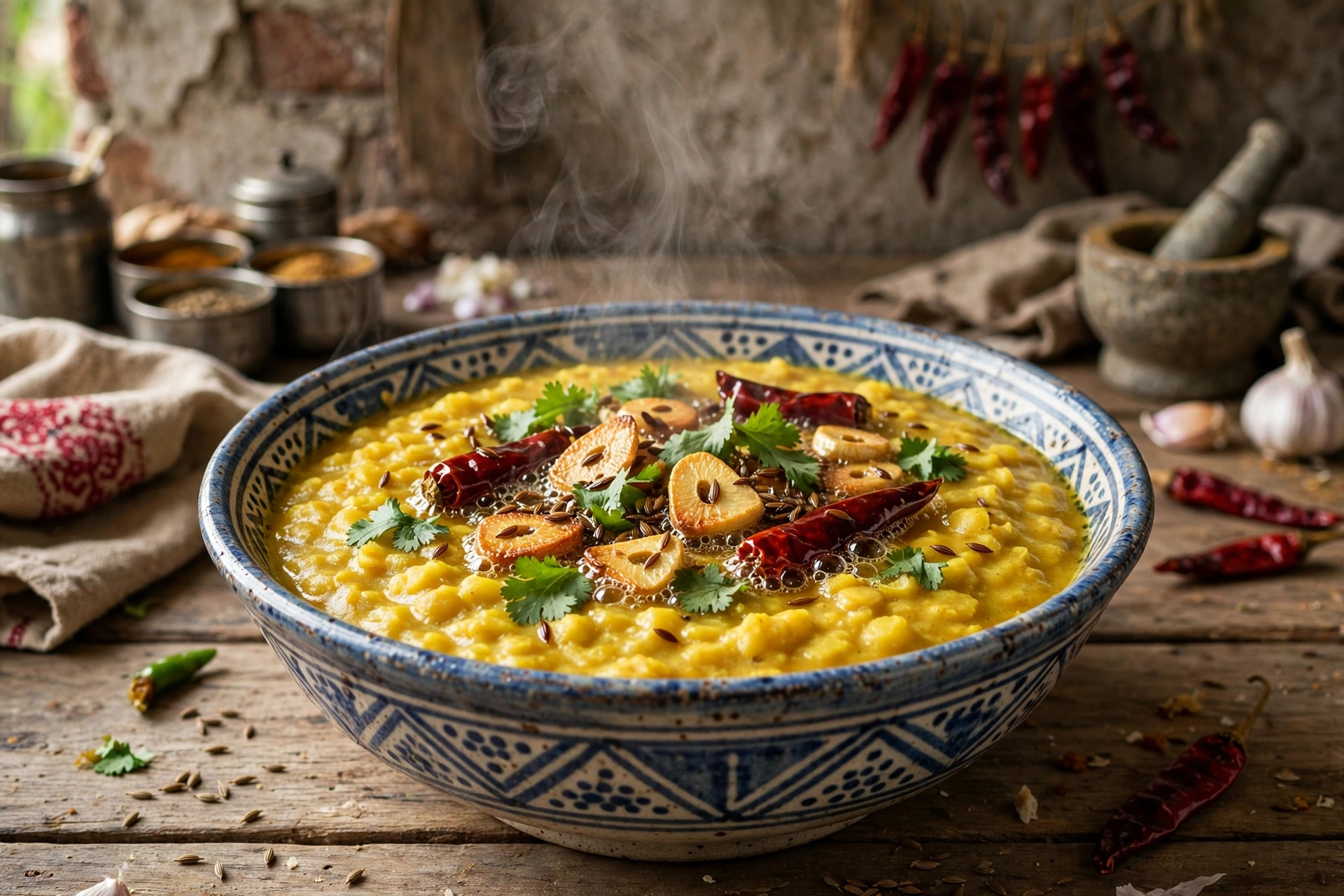
Step 4: Temper the dal and give it its final seasoning. Warm the ghee in a small frying pan until it melts glossy and loose, then scatter in the cumin seeds and the dried red chillies and give them about 20 seconds to crackle and darken. Stir in the asafoetida if you are using it, pull the pan off the heat, and swirl in the red chilli powder so it blooms in the fat without scorching. Pour this fragrant tadka over the cooked dal, add the amchur, garam masala and the remaining salt, and fold everything through gently — you are dressing the lentils, not mashing them. Warm it through for 2 minutes; it should spoon easily, like a thick, scoopable stew.
Step 5: Assemble the plates and serve immediately. Set two warm pakwan on each plate, whole and overlapping slightly. Spoon a generous ladle of hot dal over the centre of each disc, letting it spread almost to the edges. Follow with ribbons of tamarind chutney and mint chutney, a spoonful of chopped onion and tomato, a pinch of chaat masala, and a handful of sev over everything. Finish with cilantro and carry the plates straight out — this daal pakwan recipe waits for nobody, and the first crack should happen within minutes of the dal landing.
Serving Suggestions
Serve daal pakwan the way Sindhi homes do: as the centre of a slow breakfast, with glasses of strong milky chai alongside and everyone eating with their hands. Assemble one plate at a time rather than lining up all four — a finished plate waiting in the kitchen is a plate losing its crunch. Extra chutneys, onion and sev belong on the table so people can rebuild their corners as they go, and lemon wedges for anyone who likes the sourness turned up further.
For a full Sindhi morning, this daal pakwan recipe sits happily beside my koki, the thick onion flatbread Sindhi families fry on the tawa — one crisp plate, one soft and chewy one, and nobody reaches for the cereal box. If the same crowd is staying for lunch, follow the theme through with my sai bhaji, the spinach and lentil mash that is Sindh’s other great gift to the table. Breakfast loud, lunch gentle: that is a day of eating I can recommend without reservation.
Storage and Reheating
The golden rule with this daal pakwan recipe is that the components keep beautifully and the assembled plate does not keep at all. Once dal meets pakwan the clock starts, so store everything separately and build only what will be eaten. The cooked dal goes into the fridge in a covered container for up to 3 days, or the freezer for a month; it will thicken as it sits, which is normal. Fried pakwan, cooled completely, keep crisp for 3 to 4 days in an airtight tin at room temperature — never refrigerate them; the fridge softens that hard-won crust. Both chutneys hold in the fridge for 4 to 5 days.
To bring it all back: warm the dal on the stove over low heat with a splash of water, stirring until it loosens and steams, and taste for salt, since cold lentils hide their seasoning. Refresh the pakwan in a 300°F oven for 4 to 5 minutes and they will crackle again almost like fresh. Then assemble exactly as before, with the onion chopped fresh if you can manage it — yesterday’s onion is the one topping that never quite recovers its bite.
Frequently Asked Questions
Why did my pakwan puff up like a puri or turn soft?
Puffing almost always means the dough was not pricked enough, or the oil was a little too hot, so steam inflated the disc before the crust could set. Dock it thoroughly, keep the oil near 350°F, and press the disc under the surface gently as it fries. Softness afterwards has a different cause — the pakwan were under-fried or stacked while hot, trapping steam. Fry to a deep gold and drain them upright on a rack, never in a pile.
Can I bake or air-fry the pakwan instead of deep-frying?
You can, and for a weekday version many people do. Roll and prick the discs exactly the same way, brush both sides lightly with oil, then bake at 400°F for 10 to 12 minutes, turning once, until crisp and golden; an air fryer at 375°F takes about 7 to 8 minutes. The result is a respectable crunchy base, though a shade less shattering than the fried original — for guests, I still reach for the karahi.
My chana dal turned to mush. What went wrong?
It simply cooked past the point this dish needs. Chana dal varies by brand and age, so start testing grains at 20 minutes rather than trusting the clock, and stop the moment a grain squashes cleanly with no chalky centre. Two things push it over the edge: boiling it hard instead of simmering, and adding baking soda to speed things up — soda breaks the grains down, which is lovely in other dals and a disaster in this daal pakwan recipe.
Can I make everything ahead for a weekend brunch?
Ahead is the smart way to do it. Cook the dal the day before and refrigerate it, make both chutneys up to two days ahead, and fry the pakwan either the morning of or the day before, storing them in an airtight tin. In the morning you only reheat, chop the onion and assemble in front of your guests — the cracking, at least, should always happen live.
Recipe Summary
- Prep time: 30 minutes, plus 1 hour soaking the chana dal
- Cook time: About 40 minutes
- Total time: Roughly 2 hours 10 minutes
- Servings: 4 (makes 8 pakwan)
- Cuisine: Pakistani
- Course: Breakfast