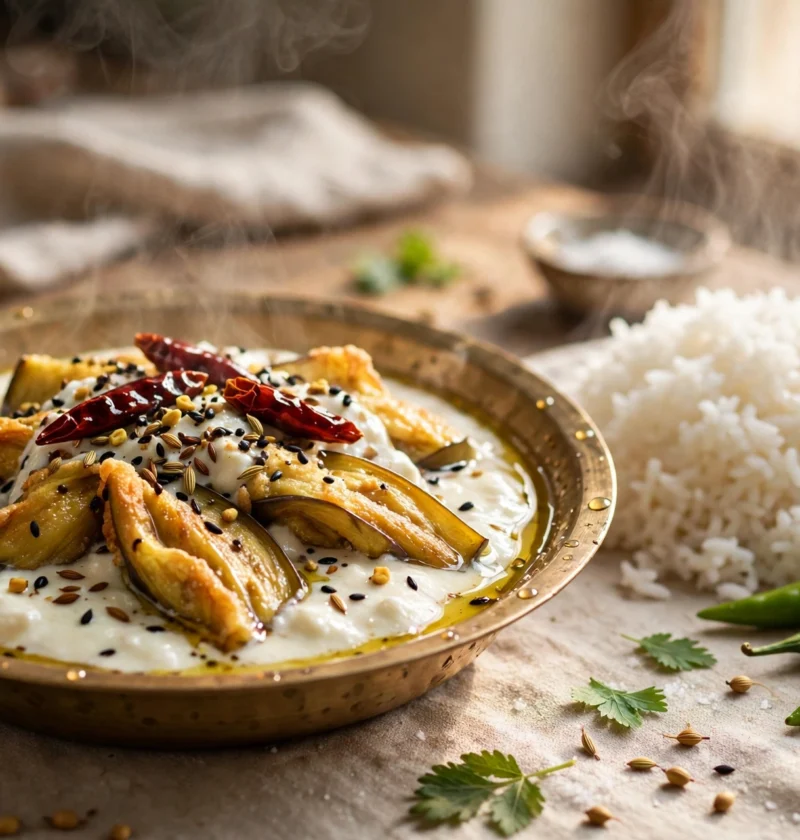
The first time I ate doi begun at home rather than in a restaurant, it was a grey, rain-heavy afternoon at my aunt’s flat in Dhaka, the kind of day when the power flickered and everyone drifted toward the kitchen anyway. She fried the eggplant in mustard oil the way her mother had taught her, in unhurried batches, until each slice slumped into something between gold and silk. Then came the part that surprised me: instead of a heavy onion masala, she tipped in a bowl of plain whisked yogurt, and the whole dish turned pale, tangy and far lighter than anything I expected from fried eggplant. This doi begun recipe is the one I have cooked ever since, written down after many phone calls home — her no-measure cooking patiently translated into cups and spoons for my own kitchen.
Doi means yogurt and begun is the everyday Bengali word for eggplant, and together they name one of the most quietly beloved vegetarian curries in Bengal. It is not a festive dish; it is a weekday one, the kind cooked when eggplants are cheap and plentiful and the cook wants something that tastes like real effort without requiring any. Unlike bagara baingan, the Hyderabadi eggplant curry enriched with peanut and sesame, doi begun keeps its slices whole and its gravy thin and bright — there is no nut paste, no long masala fry, nothing to weigh it down. A good doi begun recipe is really about restraint: mustard oil, a five-spice tempering, a pinch of sugar, and yogurt handled gently so it stays smooth, glossy and pourable from the first spoonful to the last.
Why This Doi Begun Recipe Works
Eggplant and yogurt can both go wrong in careless hands — one turns greasy and spongy, the other splits into grainy curds. This doi begun recipe works because of five small disciplines that protect them both:
- The eggplant is salted and rested before it fries. Twenty minutes with salt pulls out the bitter juices and collapses the eggplant’s spongy air pockets, so the slices absorb far less oil in the pan and come out silky and rich instead of sodden and heavy.
- Mustard oil, heated until it just begins to smoke. That brief moment of heat takes the raw harshness off the oil and unlocks its pungent, almost horseradish-like perfume — the unmistakable background note of Bengali home cooking that plain vegetable oil simply cannot imitate.
- The yogurt is whisked completely smooth and used at room temperature. Cold, lumpy yogurt is what splits in a hot gravy. Beaten with salt and a pinch of sugar until it pours like cream, and warmed gradually rather than shocked, it stays glossy and unified.
- Panch phoron goes in whole, never ground. The five seeds — cumin, nigella, fennel, fenugreek and mustard — crackle in the hot oil and season the gravy in little bursts as you eat, instead of disappearing into a uniform, dusty masala.
- The fried eggplant returns for only a few minutes at the end. The slices are already fully cooked when they meet the gravy; a short, gentle simmer lets them drink in the tang without falling apart, so each piece still holds its shape on the plate.
Ingredients
Everything here is built around the eggplant itself, so choose well: look for firm, glossy purple begun with tight, unblemished skin that feel heavy for their size and have few seeds inside, because old, seedy eggplants turn bitter and spongy no matter what you do to them. The second pillar of this doi begun recipe is plain, full-fat yogurt — nothing sweetened and nothing fat-free, because lean yogurt splits eagerly and tastes thin and sharp. Everything else is a short pantry list: mustard oil, the five whole spices of panch phoron, ginger, turmeric, and one pinch of sugar to round out the tang.
Serves 4
For the eggplant:
- 2 medium eggplants (about 1 1/2 pounds total), cut into 1/2-inch rounds
- 1 teaspoon fine salt, for salting, plus more to taste
- 1/2 teaspoon Kashmiri red chilli powder (or sweet paprika)
- 1/2 teaspoon ground turmeric
- 3 to 4 tablespoons mustard oil, for frying
For the gravy:
- 1 1/2 cups plain full-fat yogurt (take it out of the fridge 30 minutes ahead)
- 1 tablespoon mustard oil
- 1 teaspoon panch phoron (equal parts cumin, nigella, fennel, fenugreek and brown mustard seeds)
- 2 whole dried red chillies
- 1 tablespoon fresh ginger, finely grated (or ginger paste)
- 1/2 teaspoon ground turmeric
- 1 teaspoon sugar
- 3/4 teaspoon fine salt, or to taste
- 1/2 teaspoon ground cumin
- 1/2 cup warm water, plus a little more as needed
- 2 green chillies, slit lengthwise
- 1/4 cup fresh cilantro leaves, roughly chopped
How to Make This Doi Begun Recipe – Step by Step
Step 1: Slice, salt and season the eggplant. Rinse the eggplant rounds and toss them in a colander with the teaspoon of salt, rubbing it over both sides of every slice. Leave them for 20 minutes — you will see beads of brownish liquid gather on the surface, and that is exactly the bitterness and excess water you want gone. Rinse the slices quickly, then pat them very dry with a clean towel; wet eggplant spits in hot oil and steams instead of frying. Lay the dry slices on a tray and dust both sides with the turmeric and chilli powder.
Step 2: Fry the slices until golden and completely silky. Heat the mustard oil in a wide, heavy skillet over medium-high heat until it shimmers and the faintest wisp of smoke rises — that moment mellows the oil. Drop the heat to medium and lay in the eggplant in a single layer, working in batches if your pan is small; crowding is what makes eggplant soggy. Fry for 3 to 4 minutes per side, until the edges are deep golden and crisped and the centres have gone soft and translucent. Lift the slices onto a plate as they finish, and top up with a little more oil between batches if the pan runs dry.
Step 3: Whisk the yogurt and bloom the panch phoron. While the last batch fries, whisk the yogurt in a bowl with the sugar, salt, turmeric and ground cumin until it is perfectly smooth and pourable, with not one lump left — this whisking is the cheapest insurance your gravy will ever get. In the same skillet, heat the remaining tablespoon of mustard oil over medium heat. Add the panch phoron and the dried red chillies and let them crackle and dance for about 30 seconds, until the kitchen smells warm and nutty. Stir in the grated ginger and cook for 1 minute, just until its raw smell softens.
Step 4: Build the yogurt gravy on the gentlest heat. This is the step where the dish is won or lost, so slow down. Take the skillet off the heat and let it sit for a full minute. Stir a few spoonfuls of the warm spiced oil into the whisked yogurt to raise its temperature, then pour the yogurt into the pan in a slow stream, stirring constantly in one direction. Set the pan back over the lowest heat you have, stir in the warm water, and let the gravy come to the barest simmer — lazy bubbles at the edges only, never a rolling boil, which would break it. Cook for 4 to 5 minutes, stirring often, until it thickens slightly and a sheen of oil glistens around the edges. Taste and adjust the salt.
Step 5: Bring the eggplant back, rest, and finish. Slide the fried eggplant slices into the gravy in a single layer as far as the pan allows, spooning sauce over any slice that sits proud of the surface. Drop in the slit green chillies, cover the pan, and simmer on the lowest heat for 3 to 4 minutes, just long enough for the eggplant to drink in the tangy gravy. Switch off the heat and let the dish rest, covered, for 5 minutes — the slices soften a breath further and the flavours settle into each other. Scatter over the torn cilantro and serve warm, straight from the pan.
Serving Suggestions
Doi begun belongs over plain steamed white rice, and very little else is required: the thin, tangy gravy is made for soaking into rice a spoonful at a time, and the soft eggplant needs no support. A simple masoor dal, a wedge of lemon and a crisp cucumber-and-onion salad on the side are the classic weekday Bengali plate, and on a monsoon evening I honestly cannot think of a better one. Soft rotis or luchi work too, torn and used to scoop up the slices and sauce together.
For a fuller spread, doi begun has one famous sibling you should know: my doi maach, where fish steaks are poached in the same kind of silky, never-boiled yogurt gravy — serve the two together and guests get to taste how one gentle sauce flatters both fish and eggplant. And if you want the eggplant’s other great destiny on the same table, make my smoky baingan bharta as well: charred, mashed and onion-rich, it is everything this pale, delicate curry is not, and the contrast between them is half the pleasure of the meal.
Storage and Reheating
Leftover doi begun keeps well for up to 3 days in the fridge, stored in a lidded container with the slices kept submerged in their gravy, and I would argue it tastes even better on the second day, once the eggplant has spent a night drinking in the tang. I do not freeze it: yogurt gravies turn grainy as they thaw, and frozen eggplant collapses into mush.
Reheat it the same gentle way you cooked it. Set a wide pan over the lowest flame you have, tip the curry in with a spoonful or two of warm water stirred through to loosen the sauce, cover it, and give it 5 to 6 minutes to come up to a gentle steam — never let it boil, or the gravy may split and the slices will disintegrate. If you microwave it, use half power in short bursts with a stir in between, and stop the moment it is hot through.
Frequently Asked Questions
Why did my yogurt gravy split and turn grainy?
Three usual culprits: the yogurt was fridge-cold, it went into a pan that was too hot, or the gravy was allowed to boil after the yogurt went in. The fix written into this doi begun recipe — room-temperature yogurt, whisked smooth, tempered off the heat and never boiled — prevents all three. If a sauce does split, take it off the heat and whisk briskly for a minute; a barely split gravy often comes back together, and the flavour is unaffected either way.
Can I use Greek yogurt instead of regular yogurt?
Yes, and its thickness makes it fairly split-resistant, but whisk it with 3 to 4 tablespoons of warm water or milk first so it pours like regular yogurt, and expect a slightly tangier finish. What you should avoid is fat-free yogurt of any style: it curdles eagerly, and the gravy ends up thin and sharp instead of smooth and rounded.
Why does my eggplant always soak up so much oil?
Because its flesh is a sponge full of tiny air pockets, and cold or wet slices in lukewarm oil just sit there drinking. Salting and resting collapses those pockets, drying the slices well matters just as much, and the oil must be properly hot before the first slice goes in — and do not crowd the pan, which crashes the temperature. For a lighter version, brush the salted slices with oil and roast them at 425°F for about 20 minutes, turning once, then finish them in the gravy as written.
What if I cannot find mustard oil or panch phoron?
Any neutral oil will cook the dish perfectly well, but you will lose the pungent background warmth that makes doi begun taste Bengali, so it is worth one trip to a South Asian grocer if you can manage it — and always heat mustard oil until it just smokes, which mellows its raw bite. Panch phoron is sold ready-mixed at the same shops; failing that, stir together equal parts of cumin, nigella, fennel, fenugreek and brown mustard seeds at home, which takes two minutes and keeps for months in a jar.
Recipe Summary
- Prep time: 15 minutes, plus 20 minutes salting the eggplant
- Cook time: 30 minutes
- Total time: About 1 hour 5 minutes
- Servings: 4
- Cuisine: Pakistani
- Course: Main Course