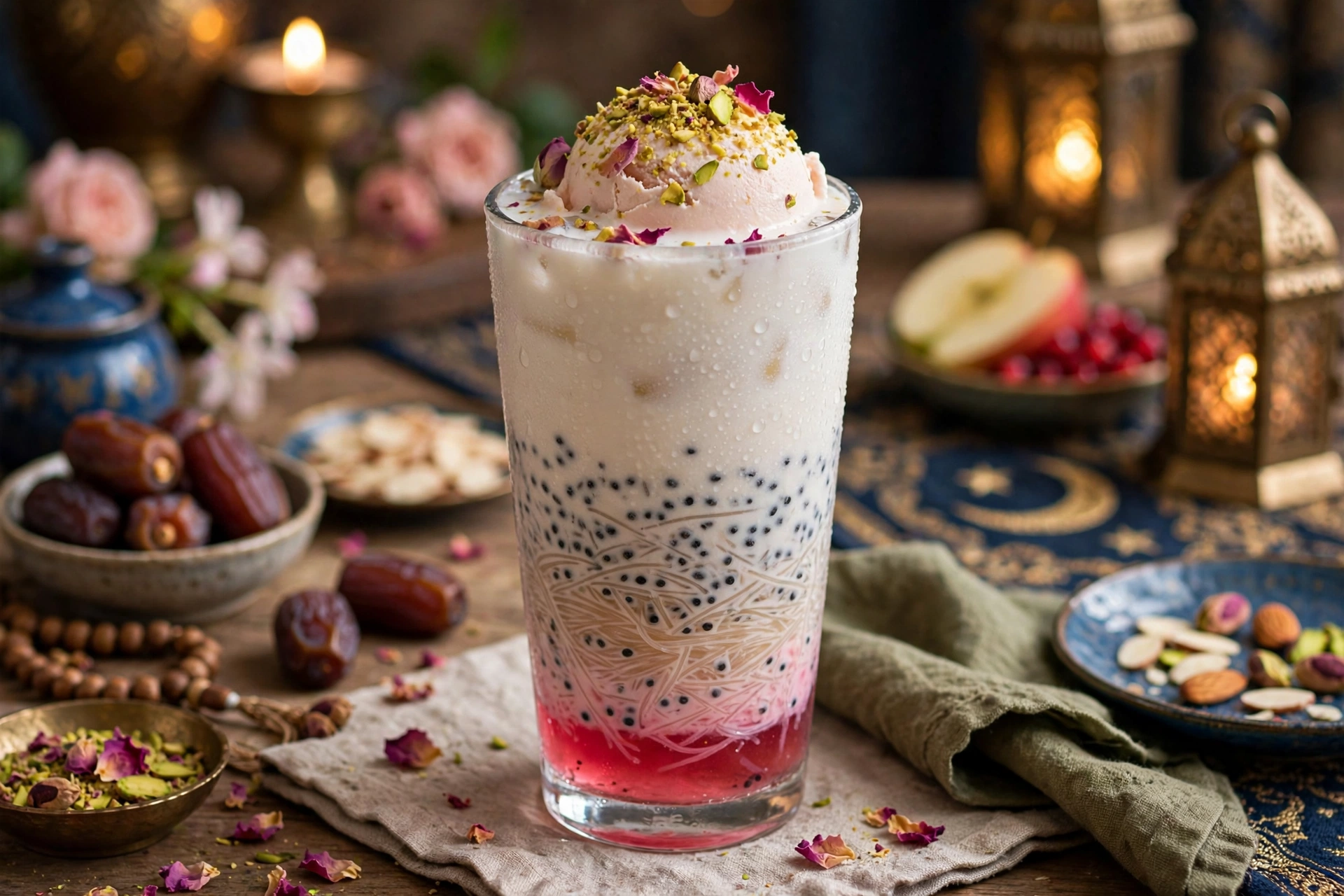
There’s a particular kind of silence that falls over a table when the falooda arrives. I remember it from Ramadan iftars at my nani’s house: the roza would open with dates and pakoras, everyone would eat, and then nani would emerge from the kitchen carrying a tray of tall glasses, each one striped pink and white, crowned with something pale and creamy, a long spoon sticking out at a jaunty angle. The chatter would stop. Someone would always say “wah” under their breath. And then we’d all pick up those long spoons and dig down through the layers, because falooda is not a drink you sip — it’s a dessert you excavate.
What makes falooda special is that it’s really several desserts sharing one glass. At the bottom: rose syrup, floral and sweet. Then silky vermicelli noodles, then little pearls of basil seeds suspended like jewels, then ice-cold milk, and on top — the crown — a scoop of dense kulfi, with pistachios and dried rose petals scattered over everything. It came to the subcontinent from Persia with the Mughals, and it still tastes like something emperors would argue over. This falooda recipe uses smart shortcuts (good store-bought rose syrup, quick-cooking vermicelli) so the whole royal production takes 20 minutes — but the glass that lands on your table will look like it took all afternoon.
Why This Falooda Recipe Works
A great falooda is architecture: distinct layers, contrasting textures, and everything ice-cold. Here’s how this falooda recipe gets the structure right:
- Basil seeds bloomed fully, never rushed. Tukh malanga needs a full 15–20 minutes in water to swell into those translucent pearls with the little dark centers. Under-soaked seeds stay hard and gritty; properly bloomed ones turn soft, slippery, and jewel-like. They’re the texture that makes people ask “what IS that?” — in the best way.
- Vermicelli cooked just to silky, then shocked cold. Falooda sev cooks in minutes and goes from perfect to mushy fast. Four to five minutes in boiling water, then straight into cold water to stop the cooking and rinse off the starch. You want slippery, separate strands — not a clump, and definitely not porridge.
- Rose syrup in two places. A generous pour at the bottom of the glass flavors the milk as you dig down, and a final drizzle over the kulfi means the first spoonful hits floral-sweet immediately. One or the other leaves half the glass bland; both means every layer carries the rose.
- Everything assembled ice-cold. The milk should be fridge-cold, the glasses chilled, the kulfi frozen solid until the moment of assembly. Falooda served even slightly warm tastes muddy and flat; served properly cold, each layer stays distinct and the whole thing tastes electric. Temperature isn’t a detail here — it’s structural.
- Kulfi on top, not regular ice cream. Dense, slow-reduced kulfi sits on the glass like a crown instead of melting into a puddle in two minutes. Its caramelized milk flavor also belongs with the rose and basil in a way vanilla ice cream never quite manages. Homemade is glorious; good store-bought kulfi is completely respectable.
Ingredients
Makes 4 tall glasses
For the layers:
- 1/4 cup (40g) basil seeds (tukh malanga)
- 1/2 cup (50g) falooda vermicelli (thin wheat sev; rice vermicelli works too)
- 4 cups (1 liter) whole milk, thoroughly chilled
- 1/2 cup (120 ml) rose syrup (Rooh Afza or similar), plus more for drizzling
- 1–2 cups ice cubes
For the crown:
- 4 generous scoops kulfi (homemade or store-bought)
- 1/4 cup (35g) pistachios, roughly chopped
- 1 tablespoon dried rose petals
- 4 teaspoons soaked basil seeds, reserved for topping (optional)
A note on the rose syrup: Rooh Afza is the classic shortcut and honestly tastes like childhood to most Pakistanis — floral, sweet, unmistakable. If you’d rather make your own, simmer 1 cup sugar with 1/2 cup water, 2 tablespoons rose water, and a drop of pink coloring until syrupy. And on the vermicelli: look for packets labeled “falooda sev” at South Asian grocers — they’re thinner than Italian vermicelli and cook in half the time. In a pinch, the thinnest rice sticks from the Asian aisle work fine. Getting these three components right — syrup, sev, and seeds — is honestly 90% of this falooda recipe.
How to Make This Falooda Recipe – Step by Step
Step 1: Bloom the basil seeds.
Put the basil seeds in a bowl with 2 cups of room-temperature water and walk away for 15–20 minutes. They’ll swell to three or four times their size, turning into soft translucent pearls. Drain off any excess water. They should look like tiny jewels and feel slippery between your fingers — if any seeds are still hard and dark, give them 5 more minutes.
Step 2: Cook the vermicelli, then shock it cold.
Bring a pot of water to a rolling boil and add the vermicelli. Cook 4–5 minutes until just tender — bite a strand; it should be soft with no hard core, but not mushy. Drain immediately and rinse under cold running water until completely cool, tossing gently to separate the strands. A drizzle of cold water left clinging to them is fine; a starchy clump is not.
Step 3: Chill the glasses and lay the rose base.
If you have time, put your four tall glasses in the freezer for 10 minutes — frosty glasses keep everything colder longer. Pour 2 tablespoons of rose syrup into the bottom of each glass. Tilt and rotate the glass so the syrup coats the lower walls in streaks; those pink swirls against the glass are half the visual drama.
Step 4: Build the layers.
Divide the cold vermicelli among the glasses, then spoon in the bloomed basil seeds — about 2–3 tablespoons per glass. Add a handful of ice cubes to each, then pour in the chilled milk, leaving about an inch of space at the top. Watch the layers settle: pink at the bottom, white milk, the dark-centered basil pearls floating like a galaxy. This is the moment people take photos — and the moment this falooda recipe is built for.
Step 5: Crown with kulfi and finish.
Place a generous scoop of kulfi on top of each glass — it should sit proudly above the rim, not sink. Drizzle a teaspoon of rose syrup over each scoop, scatter the chopped pistachios and dried rose petals, and add a final spoonful of basil seeds on top if you like the jeweled look. The crown should look almost too beautiful to disturb. Almost.
Step 6: Serve immediately with long spoons.
Falooda waits for no one — the kulfi starts melting, the layers start mingling, and that’s actually part of the pleasure, but you want to be there for it. Serve with long iced-tea spoons (and wide straws if you have them) so your guests can dig, scoop, and slurp their way down through every layer. This falooda recipe is a 20-minute build for a 10-minute demolition.
Serving Suggestions
Falooda is the grand finale — it follows the meal, never accompanies it. The classic setting is after a heavy dawat or a spicy barbecue night, when something ice-cold, milky, and floral is exactly what the table is begging for. At Ramadan iftars it works beautifully as the sweet landing after dates and samosas. Serve it in the tallest, clearest glasses you own; half the pleasure is watching someone’s eyes go wide when the striped glass lands in front of them.
For the full royal treatment, top this falooda recipe with my homemade kulfi — the dense, slow-reduced kind that holds its shape on the glass and tastes like the matka cart of your childhood. And if you’re planning a whole summer-drinks lineup, add my mango lassi to the menu too; the thick, fruity lassi and the layered, floral falooda together cover every possible summer craving.
Storage and Reheating
Falooda is an assemble-to-order dessert — a fully built glass does not keep, full stop. The layers bleed into each other within an hour, the kulfi melts, and the whole architecture collapses into sweet pink milk (still tasty, but no longer falooda). The components, though, are excellent keepers: bloomed basil seeds last 2 days in a sealed jar in the fridge, cooked vermicelli keeps 2 days refrigerated (toss with a teaspoon of cold water before using to loosen), and rose syrup keeps for weeks. So for a party, prep everything ahead, keep the milk and kulfi ice-cold, and build the glasses when guests are ready — the 5-minute assembly becomes part of the show.
Frequently Asked Questions
Can I use chia seeds instead of basil seeds?
You can, and the texture is similar enough that most guests won’t interrogate you. But tukh malanga is the traditional choice for a reason: the pearls are slightly larger, the flavor is milder, and they don’t develop chia’s faint gelatinous coating. If basil seeds aren’t available, chia works as a stand-in — bloom them the same way. Just know the chaat-shop purists will notice.
Can I make falooda without kulfi?
In a pinch, a scoop of good vanilla ice cream will do the job visually — but it melts fast and the flavor pairing isn’t as natural. Kulfi’s dense, caramelized-milk character was practically designed for rose syrup and basil seeds. If you can’t find kulfi, freeze sweetened condensed-milk ice cream (or even just very thick rabri) as the closest substitute. But try my kulfi recipe once and you’ll never go back.
Is Rooh Afza the same thing as rose syrup?
Close enough for falooda purposes. Rooh Afza is a rose-based sharbat with additional floral and herbal notes — it’s what most Pakistani households actually use, and it tastes like nostalgia in a bottle. Pure rose syrup is simpler and more intensely floral. Either works beautifully in this falooda recipe; use whichever you can find, and adjust the quantity to taste since sweetness levels vary.
Can I prepare falooda ahead for a dawat?
Prep ahead, assemble fresh — that’s the golden rule of this falooda recipe. Bloom the basil seeds, cook the vermicelli, chill the milk and glasses, and keep the kulfi frozen solid. When it’s time, the actual layering takes about 5 minutes for four glasses. Assembling early is the one mistake that ruins falooda: the colors bleed, the textures merge, and you lose the whole point of the layers. Your guests would rather wait 5 minutes than eat a muddy glass.
Recipe Summary
- Prep time: 15 minutes
- Cook time: 5 minutes
- Total time: 20 minutes
- Servings: 4 tall glasses
- Cuisine: Pakistani (Mughlai)
- Course: Beverage