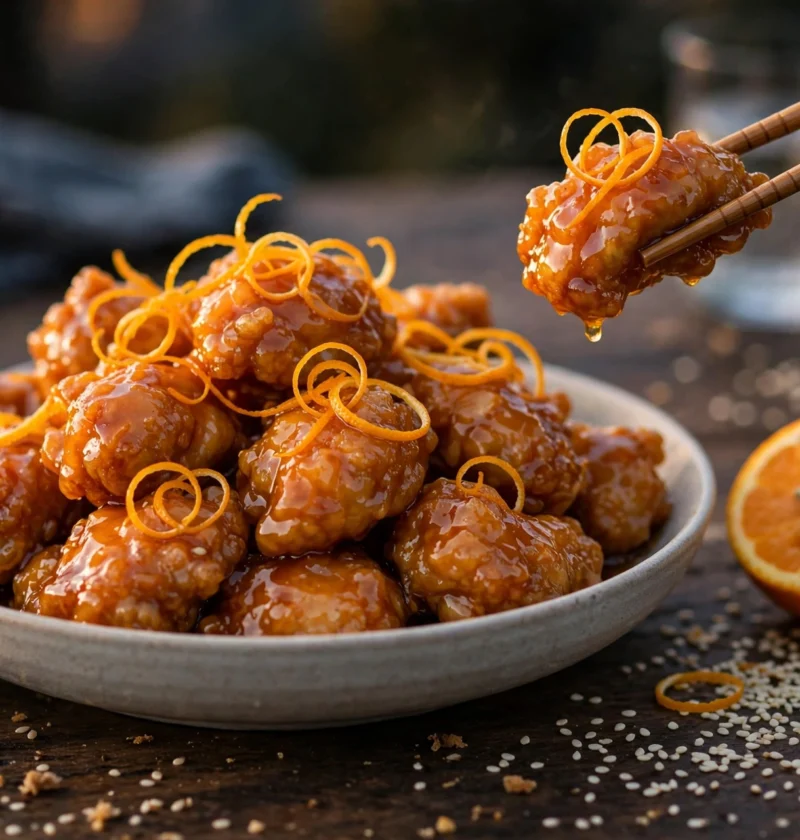
The first time this orange chicken recipe entered my life, it arrived on a steel tray in the food court of a Lahore shopping plaza, squeezed between a burger counter and a stall selling kulfi. I was seventeen, killing time while my mother shopped, and I ordered it mostly because the boy at the Chinese counter was spooning something over fried chicken that glowed like bottled sunset. One bite and I understood: underneath the shine there was actual orange — not the flat, sherbet sweetness I expected, but a proper citrus brightness that woke up my whole mouth, followed by the gentlest warmth of chilli. I went back to that counter four weekends in a row, trying to memorise what I was tasting.
What I eventually worked out, years later in my own kitchen, is that the dish lives or dies on how you treat the fruit. Most failed versions lean on bottled juice cooked down until it tastes like marmalade’s tired cousin. The counter I loved clearly did something else: you could see flecks of zest in the glaze, and the aroma hit you before the tray even landed. So my orange chicken recipe is built around citrus discipline — zest handled carefully so it never turns bitter, juice kept away from a long hard boil so it stays vivid, and the fried chicken meeting the sauce only at the very last moment.
Why This Orange Chicken Recipe Works
A glossy citrus glaze sounds simple, and it is — but it punishes carelessness in very specific ways. This orange chicken recipe is organised around the five habits that keep it bright instead of dull:
- The zest is added in two stages. Half goes into the sauce while it warms, so the citrus oils melt into the glaze; the other half is scattered raw over the finished plate, where its perfume arrives untouched by heat. That double hit is what makes the dish smell like a freshly peeled orange.
- The juice never gets a long, rolling boil. Orange juice boiled hard loses its sparkle and drifts toward jam. Here the sauce thickens first on soy, sugar and stock, and the juice joins near the end for barely a minute — long enough to marry, short enough to stay alive.
- Only the orange skin of the zest is used. The coloured outer layer carries all the fragrant oil; the white pith beneath it carries bitterness. A light hand with the grater — stopping the moment white shows — keeps every batch clean-tasting.
- The batter rests before the chicken fries. Ten quiet minutes lets the flour and cornstarch hydrate and cling, so the coating stays wrapped around each piece through the fry and the final toss instead of shedding into the oil.
- The sauce is fully thickened before the chicken goes in. The glaze should ribbon off a spoon before a single piece is added. Chicken tossed into a thin sauce steams and soggs; chicken folded through a finished glaze comes out lacquered, with the crunch intact underneath.
Ingredients
The dish itself has travelled a curious road: orange chicken is a Chinese-American invention, loosely adapted from a Hunanese tangerine-peel chicken, and when it reached Karachi’s Chinese restaurants it picked up local habits — a dried chilli or two in the wok, a heavier hand with the zest, and no patience at all for bottled juice when kinnow season fills the markets. The fruit matters more here than in almost any dish I know, so buy oranges that feel heavy for their size and smell fragrant through the skin; everything good in this orange chicken recipe begins with the orange itself. Out of season, a mix of whatever sweet oranges you can find plus a squeeze of lemon still works well.
Feeds 4 people
For the battered chicken:
- 1 1/2 pounds boneless, skinless chicken thighs, cut into 1-inch pieces
- 1/2 teaspoon fine salt
- 1/2 teaspoon white pepper
- 1 teaspoon soy sauce
- 1 large egg, beaten
- 1/3 cup cornstarch
- 1/3 cup all-purpose flour
- 1 teaspoon baking powder
- 4 to 5 tablespoons ice-cold water
- Neutral oil, for frying (about 3 cups)
For the orange sauce:
- 1 cup fresh orange juice (from 3 to 4 oranges), strained
- 1 tablespoon finely grated orange zest, divided — half for the sauce, half to finish
- 1/4 cup sugar
- 2 tablespoons rice vinegar (or white vinegar)
- 2 tablespoons soy sauce
- 1/4 cup chicken stock or water
- 1 tablespoon cornstarch, stirred into 2 tablespoons cold water
- 2 dried red chillies, snipped in half (or 1/4 teaspoon chilli flakes)
- 2 garlic cloves, finely grated
- 1 teaspoon fresh ginger, finely grated
To finish:
- 1 teaspoon toasted sesame seeds
- 2 spring onions, green parts thinly sliced
- Extra orange zest, from the reserved half above
How to Make This Orange Chicken Recipe – Step by Step
Step 1: Zest first, juice second. Wash and dry the oranges, then grate the zest before you cut a single one in half — zesting a juiced orange is a wrestling match nobody wins. Work the grater lightly, rotating the fruit as you go, and stop wherever the white pith starts to peek through. Juice the oranges, strain out the seeds and pulp, and measure a full cup. Set the zest aside in two small piles, one for the sauce and one for the plate.
Step 2: Batter the chicken and let it rest. Season the chicken pieces with the salt, white pepper and soy sauce. Whisk the egg, cornstarch, flour and baking powder in a wide bowl, then splash in the ice water a spoonful at a time until the batter runs off a spoon in a slow, steady sheet — closer to thick cream than to pancake batter. Fold the chicken through until every piece is coated, then leave the bowl alone for 10 minutes. That rest is unglamorous and non-negotiable: it is what makes the coating grip.
Step 3: Fry in small, uncrowded rounds. Heat 2 inches of oil in your wok or a deep, heavy pan and bring it up to 350°F; test the heat by dropping in a small cube of bread, which ought to colour in roughly half a minute. Fry the chicken a handful at a time, never a bowlful, because crowded oil drops its temperature and the crust drinks grease instead of crisping. Give each round 4 to 5 minutes, turning now and then, until deeply golden all over. Drain on a rack, and if you want takeaway-counter crunch, return every piece for a second 1-minute fry once the whole batch is done.
Step 4: Build the sauce — zest early, juice late. Pour off all but a tablespoon of the frying oil and set the wok over medium heat. Add the dried chillies, garlic and ginger for 20 seconds, just until fragrant. Pour in the stock, soy sauce, vinegar and sugar with the first half of the zest, and let it bubble gently for 2 minutes so the citrus oils bloom into the liquid. Now stir in the orange juice, bring it back to the merest simmer — a minute, no more — and drizzle in the cornstarch slurry, stirring as the sauce turns clear, glossy and thick enough to coat a spoon.
Step 5: Glaze, finish with raw zest, and serve. Tip the fried chicken into the wok and fold it through the sauce for no longer than a minute, until every piece gleams. Slide it onto a warm serving plate straight away. Scatter over the reserved raw zest, the sesame seeds and the spring onion greens — the heat rising off the chicken wakes the fresh zest up, and that last-minute orange perfume is the whole signature of this dish. Serve it while the glaze is still shining.
Serving Suggestions
Plain steamed rice is the traditional landing pad, and it earns the spot — the grains catch every runaway ribbon of glaze. Egg fried rice makes it a fuller plate, and a bowl of clear chicken-corn soup beforehand turns the whole thing into the food-court meal of my memory, except the kitchen is yours and nobody is charging by the tray. A quick cucumber salad with a pinch of salt and a squeeze of lemon refreshes the palate between bites of something this rich and sweet.
Citrus night at my house usually runs as a small tasting menu of Karachi’s Chinese counters. This plate goes out first, and my sweet and sour chicken follows — the older, pineapple-led cousin, all sunset colour and vinegar snap — while my sesame chicken closes the evening, darker and nuttier under its shower of toasted seeds. Put the three side by side and you can taste exactly how each glaze found its own personality: one fruity and sharp, one honeyed and nutty, and this one walking in smelling of fresh oranges.
Storage and Reheating
Store any leftovers in a covered container in the fridge for up to 2 days. Be honest with yourself about what changes: the crust softens as it sits in the glaze, and the citrus top notes fade a little by the second day, though the plate remains deeply enjoyable — more mellow, less sparkling. Freezing is not recommended; the sauce separates on thawing and the oranges’ brightness does not survive the trip.
The best way back is a hot oven or air fryer at 400°F for 5 to 6 minutes, which dries the surface and brings a good measure of the crunch home. If the pieces were stored already sauced, warm them gently in a wide pan over medium heat with a teaspoon of water, letting the glaze loosen and shine again rather than scorch. And if you planned ahead and kept the chicken and sauce apart — the move I recommend for dinner parties — re-crisp the chicken, warm the sauce separately, and toss them together fresh; nobody will ever guess it was not all made to order.
Frequently Asked Questions
Can I use bottled orange juice instead of fresh?
You can, and the dish will still be good — but choose a not-from-concentrate bottle with no added sugar, and taste before you add the full measure of sugar, because most bottled juices run sweeter than fresh. What bottled juice cannot give you is the zest, and the zest is where the real orange character lives, so buy at least one fresh orange for the grating even if the juice comes from a carton. A small squeeze of lemon stirred in at the end helps bottled juice taste awake again.
How do I keep the chicken crispy under the glaze?
Crunch survives when three things go right: the pieces were fried until genuinely crisp — ideally with the second short fry — the sauce was thickened to a ribbon before the chicken entered it, and the tossing took under a minute with serving straight after. A glaze that coats thinly clings; a sauce that pools soaks. If you are feeding a crowd, glaze the chicken in two waves rather than letting the first batch sit and steam while the second fries.
Why does my orange sauce taste bitter?
Bitterness almost always traces back to the fruit, not the cooking. Zest grated too deep pulls the white pith with it, and pith is bitter no matter what you do afterwards; long-simmered juice can also turn harsh. Grate with a light hand, keep the juice’s time on the heat to a minute, and if a batch has already gone slightly bitter, a pinch more sugar and a tiny pinch of salt will pull it back toward balance. Choose sweet, ripe oranges to begin with and the problem rarely appears.
Can I make this orange chicken recipe spicier, or with chicken breast?
Both, happily. For heat, add a third dried chilli, or stir half a teaspoon of chilli garlic sauce into the glaze — the citrus stands up to it well. Chicken breast works in place of thigh if your pieces are cut evenly and fried for a minute less; breast dries faster, so pull the rounds the moment the crust is deeply golden rather than waiting for a shade more colour. The velvet of this orange chicken recipe is in the batter, so either cut comes out tender as long as the oil stays hot.
Recipe Summary
- Prep time: 25 minutes, plus 10 minutes resting the batter
- Cook time: About 20 minutes
- Total time: Roughly 55 minutes
- Servings: 4
- Cuisine: Pakistani
- Course: Main Course