In my father’s family — UP people who settled in Lahore two generations ago — lunch was not really lunch unless a small steel katori of arhar sat next to the rice. Not the thick, masala-built daals my mother’s Punjabi side made for dinners, but this one: pale gold, thin enough to sip from the edge of the bowl, tasting of turmeric and ghee and garlic. When I set up my own kitchen, this arhar daal recipe was the first thing I phoned home for, because my husband eats daal the Punjabi way, thick enough to stand a spoon in, and I needed to convert him gently.
My first pots converted nobody. I cooked the toor for twenty-five minutes, the way I would masoor, and the grains looked melted but bit back with chalky, raw hearts — toor is a liar that way; it slumps long before it softens. Then I overcorrected, building a heavy onion-tomato masala beneath it and reducing it to a thick stew, and my father tasted it and said, with great kindness, that I had made a very nice salan. The fixes turned out to be almost disappointingly plain: soak the lentils for half an hour, cook them until they have completely surrendered — a good forty minutes, not twenty-five — keep the pot free of masala and the consistency honestly soupy, and let one small, fierce tadka do all the talking at the end. This arhar daal recipe is those fixes, in that order.
Why This Arhar Daal Recipe Works
Arhar fails in two directions: undercooked, it is chalky at the center; overworked, it becomes just another heavy curry wearing lentils. This arhar daal recipe threads between the two:
- Toor cooks until it disappears. Most lentils on this site are praised for holding their shape; arhar is praised for the opposite. A toor grain is done only when nothing of it remains — no core, no bite, just a pot of lentils melted into their own broth. Anything less leaves that telltale chalkiness on the tongue, which is why this arhar daal recipe gives it a full, patient simmer where quicker daals get twenty minutes.
- The half-hour soak takes the fight out of it. Toor is the most stubborn of the fast lentils, dense and slow to drink. Thirty minutes in water before the pot softens its resolve, evens the cooking from grain to grain, and shaves the simmer down to something a weeknight can hold. Skip it and the last ten grains in the pot will still be holding out when the rest have melted.
- Soupy is not a flaw here — it is the specification. This daal is built to pour: four and a half cups of water to one cup of lentils, so it flows over rice the way it does in UP homes, coating every grain instead of sitting on top in a heap. It thickens as it stands, as all dissolved daals do, so this arhar daal recipe is served looser than instinct suggests and loosened again at the table without apology.
- There is no masala in the pot, and that is deliberate. Turmeric, salt, and two slit green chilies are the entire seasoning of the boil. No onion, no tomato, no ginger-garlic base. Arhar has a clean, faintly nutty flavor of its own, and a built masala buries it — the daal ends up tasting like everything except itself. Here the lentils arrive at the tadka nearly naked, which is exactly how this arhar daal recipe wants them.
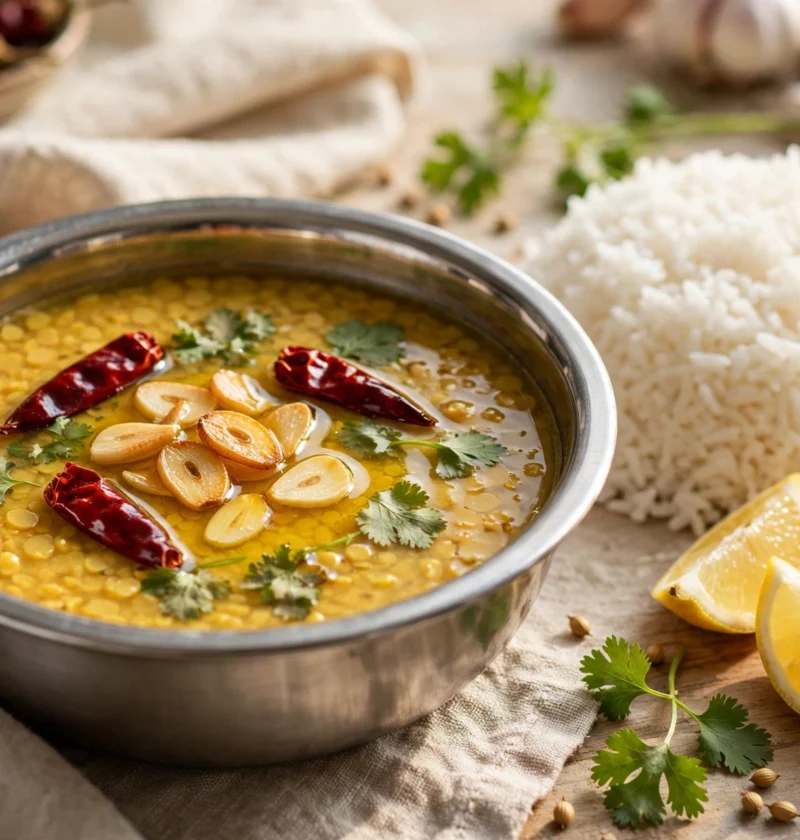
- The tadka carries the whole dish, so it is built like it matters. Ghee, cumin seed, whole dried red chilies, and a generous hand of sliced garlic, fried to pale gold and poured over at full sizzle with the chili powder bloomed in the residual heat. Ninety seconds of work that seasons an entire pot — get the garlic right and this arhar daal recipe tastes like it simmered all afternoon in flavor instead of water.
Ingredients
Serves 4-5
For the daal:
- 1 cup (200g) arhar daal (toor daal / split pigeon peas), rinsed and soaked for 30 minutes
- 4 1/2 cups water, plus hot water for loosening
- 1/2 teaspoon turmeric powder (haldi)
- 2 green chilies, slit lengthwise
- 1 teaspoon salt, or to taste
For the tadka:
- 2 tablespoons ghee
- 4 garlic cloves, thinly sliced
- 1 teaspoon cumin seeds (zeera)
- 3 whole dried red chilies
- 1/4 teaspoon red chili powder
For serving:
- 2 tablespoons fresh coriander leaves, chopped
- Lemon wedges
- Steamed basmati rice or soft rotis
The lentil itself is the split, husked seed of the pigeon pea, a hardy legume that traveled from Africa to the subcontinent centuries ago and became the default daal of the Gangetic plain — the quiet bowl standing behind a thousand everyday thalis. Its color here is borrowed from turmeric, which does double duty in the pot: an earthy warmth in the flavor, and a yellow so characteristic that you can recognize an arhar daal recipe across a table before the tadka even lands.
How to Make This Arhar Daal Recipe – Step by Step
Step 1: Rinse, soak, and start the pot.
Rinse the arhar in a few changes of water until the cloudiness fades, then leave it soaking in fresh water for 30 minutes. Drain it into a pot with the 4 1/2 cups of water, the turmeric, and the slit green chilies, and bring it to a boil over medium-high heat. Skim off the grey-white foam that gathers in the first minutes — left in, it dulls both the color and the taste of this arhar daal recipe.
Step 2: Simmer until the lentils give up completely.
Drop the heat to a steady, gentle simmer and cook for 40 to 45 minutes, stirring now and then so nothing settles and catches. Test the way my father does: press a grain against the roof of your mouth — no, better, between finger and thumb. It should smear to a puree without the faintest chalky resistance. If a core remains, the pot is not done, whatever the clock says; this arhar daal recipe is judged by the grain, not the timer.
Step 3: Whisk briefly and set the soupy consistency.
Take the pot off the heat and run a wire whisk through it a dozen times — just enough to break the last soft grains into the broth and turn the surface silky, not so much that it turns to glue. Stir in the salt. Now judge the pour: it should run off a ladle in a steady stream. Too thick, whisk in hot water a little at a time; this arhar daal recipe should always err on the side of soup.
Step 4: Fry the tadka hot and fast.
Warm the ghee in your smallest pan over a medium-high flame until the surface shimmers. Add the cumin seeds and the dried red chilies; the moment the seeds crackle and darken a shade, slide in the garlic slices and stir constantly for 30 to 45 seconds, until they turn the pale gold of weak tea. Pull the pan off the heat, stir in the chili powder so it blooms in the hot ghee without scorching, and move straight to the daal pot — a tadka waits for no one, least of all in this arhar daal recipe.
Step 5: Pour, rest, and take it to the table.
Pour the entire tadka — ghee, garlic, chilies, all of it — over the surface of the daal and give the pot one slow swirl, so ribbons of the tempering stay visible in the gold. Let it sit for five minutes; the resting pot lets the garlic perfume work its way through every layer. Scatter the coriander, set lemon wedges alongside, and serve this arhar daal recipe the UP way: poured generously over plain steamed rice.
Serving Suggestions
The classic plate is a mound of steamed basmati with this arhar daal recipe ladled over it until the grains are swimming, eaten with a spoon or torn pieces of roti, and a supporting cast that stays politely small: a spoon of mango achaar, a few slices of raw onion, a crisp papad if the day allows. It is reset food — the lunch a household turns to after a run of rich dinners — and it rewards being eaten slowly, with extra lemon squeezed over halfway through.
Within the lentil shelf of this site, arhar holds the middle seat. My masoor daal is the sprinter, red lentils on the table in twenty-five minutes for the tiredest of Tuesdays, while my kali daal is the slow elder, whole black urad simmering half an afternoon into natural cream. This arhar daal recipe asks for an honest hour and returns the taste of an ordinary UP lunch — neither rushed nor ceremonial, which is precisely its charm.
Storage and Reheating
Arhar keeps happily in the fridge for 3 to 4 days, but be warned that it sets almost solid as it cools — dissolved lentils gel in the cold, and reheating begins as excavation. Warm it on the stove over low heat, stirring in hot water a splash at a time until it runs off the spoon in a stream again, then wake the tempering up with one sliced garlic clove fried in a teaspoon of ghee. It also holds in the freezer for a good two months; let it thaw in the fridge overnight, then loosen it, re-temper it, and this arhar daal recipe comes back within a whisker of fresh.
Frequently Asked Questions
Why is my arhar still grainy or chalky in the middle?
It is undercooked — the single most common failure with toor. The grains slump and look melted long before their centers soften, which fools everyone once. Give the pot its full simmer, test grains between your fingers rather than trusting appearances, and suspect the age of the lentils if an extra fifteen minutes changes nothing — arhar that has spent a year forgotten at the back of the pantry can stay stubborn no matter how patiently you simmer it. A pressure cooker, covered in the next answer, is the surest cure.
Can I make this arhar daal recipe in a pressure cooker?
Yes, and plenty of UP homes do exactly that on busy days. Cook the soaked daal with the water, turmeric, and green chilies at high pressure for 10 to 12 minutes (about 3 to 4 whistles), let the pressure release naturally, then whisk and adjust the consistency on the stove. The tadka is made separately and stays exactly as written — pressure cookers cook lentils beautifully and tempering not at all.
Should arhar daal be thick or thin?
Thin — at least, thin by the standards of the thick Punjabi daals. In UP homes this arhar daal recipe is served pourable, closer to a rich soup than a stew, because it is meant to flood a plate of rice rather than sit on it. If your table prefers it thicker, simmer it uncovered for ten extra minutes, but serve it looser than you think you should: the pot thickens noticeably between stove and table, and again in the fridge.
Can I add tomato or onion to the pot?
You can, and some families do add a single chopped tomato — but understand that you are walking the dish toward masala-daal territory, where several other recipes on this site already live. The classic this arhar daal recipe follows keeps the boil to turmeric and green chili, so the lentil’s own flavor survives and the garlic tadka lands on a clean surface. Try it plain once; most people who do, stay.
Recipe Summary
- Prep time: 10 minutes (+ 30 minutes soaking)
- Cook time: 45 minutes
- Total time: About 55 minutes (+ soaking)
- Servings: 4-5
- Cuisine: Pakistani
- Course: Main