The karahi that rearranged my thinking about cooking arrived at a rough wooden table in Peshawar’s Namak Mandi, where the shops stand open to the street and every cook works in full view of his customers. I watched mine set a slab of white fat melting in an iron pan, add a chicken chopped into small pieces and a modest handful of tomatoes — and nothing else I could identify. No onion went into that pan. Not one. Twenty minutes later I was tearing naan through the glossiest, most honestly chicken-tasting karahi of my life, and this chicken shinwari karahi recipe is the version I have been refining at home ever since, trying to leave out everything he left out.
Shinwari cooking comes from the Shinwari Pashtuns of the Khyber hills, a people whose food is famous for what it refuses: no onion, no garlic-heavy masala, no cupboard of ground spices competing with the meat. Their celebrated mutton karahi is traditionally cooked in dumba — the rich fat of the fat-tailed sheep — with tomato, green chili and salt standing guard. The chicken version keeps exactly the same discipline and lets ghee or oil deputise for the tail fat. It sounds almost too plain to count as a recipe at all, until you taste how much room that plainness leaves for the chicken itself.
Why This Chicken Shinwari Karahi Recipe Works
A karahi built on this few ingredients has nowhere to hide, and that is precisely its strength. This chicken shinwari karahi recipe works because every choice in it protects the meat’s own flavour:
- No onion — not a little, none. Onion is the backbone of most karahis, sweetening and thickening the sauce, but here its absence is the whole argument: without it, the chicken tastes unmistakably of chicken, and the tomatoes stay bright instead of mellowing into the background.
- The fat goes in first and gets properly hot. Shinwari cooking is fat-forward by tradition — the memory of dumba fat is in its DNA — and hot ghee sears the chicken to a deep colour before any liquid appears, building a flavour no spice mix can imitate.
- Tomatoes play a supporting role. Where some karahis drown the meat in tomatoes, the shinwari hand is lighter: just enough tomato to collapse into a glossy coat, never a soup for the chicken to swim in.
- Salt waits, and black pepper leads. Salt holds back until the chicken has coloured, so the pan fries instead of steams; then black pepper — the one spice allowed to headline — goes in coarse, fresh and generous.
- Ginger does the aromatic work. With no garlic paste and no garam masala in the pan, julienned ginger in real quantity carries the fragrance, added late enough that its bite survives all the way to the table.
Ingredients for This Chicken Shinwari Karahi Recipe
Buy the best chicken you can justify for this dish — with so little dressing on it, the meat is the recipe. The Shinwari are a Pashtun tribe of the Khyber region along the Afghan border, and their way with a karahi travelled from the bazaars of Landikotal to Peshawar’s Namak Mandi, where it now shares one smoky street with a dozen louder cousins. The vessel matters as well: a genuine karahi — heavy, deep and sloping-sided — throws heat up its walls in a way a flat frying pan cannot quite copy, though a wide wok or deep skillet will serve you honestly. And notice, once more, what is missing from the lists below: no onion, no garlic paste, no red chili powder, no coriander powder, no turmeric.
For the karahi
- 2 1/2 pounds (about 1.1 kg) bone-in, skinless chicken, cut into small karahi pieces (14–16 pieces)
- 1/2 cup (120 ml) ghee, or 1/3 cup (80 ml) neutral oil plus 2 tablespoons ghee
- 4 medium ripe tomatoes (about 1 1/4 pounds / 570 g), quartered
- 8 to 10 fresh green chilies (Thai bird or serrano), slit lengthwise
- 3 tablespoons fresh ginger matchsticks (about 1 1/2 ounces / 40 g), divided
- 2 teaspoons black peppercorns, coarsely crushed
- 1 1/2 teaspoons fine sea salt, or to taste
For the finish
- Extra ginger matchsticks and 2 or 3 whole green chilies
- Lemon wedges
- Hot naan, for serving
How to Make This Chicken Shinwari Karahi Recipe – Step by Step
Step 1: Heat the fat and fry the chicken until it colours. Set the karahi over high heat, add the ghee and let it get properly hot, until it shimmers and the faintest wisp of smoke lifts off it. Pat the chicken pieces dry — surface moisture is the enemy of colour — and lay them in a single layer. Now resist stirring for a full 3 minutes. The Shinwari cooks I watched barely touched the pan during this stage; they trusted the fat to do the work, and the chicken came up deeply golden with crisped edges. Turn the pieces and fry for 3 to 4 minutes more, until coloured on every side. The meat will not be cooked through yet, and it does not need to be.
Step 2: Add the tomatoes and cook them down to a gloss. Scatter the tomato quarters over the chicken and cover the karahi for 3 minutes, so the steam loosens their skins. Uncover and press the tomatoes down with the back of your spoon until they slump into the fat. Fry for 8 to 10 minutes, stirring now and then and scraping the base of the pan, until the tomatoes have collapsed completely into a thick red coat around the chicken and the ghee rises in bright beads around the rim. That separation is your signal that the base is done. If loose skins bother you, fish them out with tongs as they peel away.
Step 3: Green chilies and ginger go in. Add the slit green chilies and two-thirds of the ginger matchsticks. Stir them through the hot fat for about 2 minutes — long enough for the chilies to blister at the edges and the ginger to perfume the whole pan, short enough that both keep their character. This is the moment the dish starts to smell like Namak Mandi itself: clean, hot and gingery, with nothing muddying the air.
Step 4: Salt at last — and black pepper, generously. Only now add the salt, scattering it over the chicken and tossing everything so it seasons the finished masala rather than the raw meat. Shower in the crushed black pepper and stir for 1 minute more. Study the pan: the coating should cling to the chicken in a thick gloss, not puddle beneath it. If it threatens to catch or looks dry, splash in 2 to 3 tablespoons of water — never more. Taste a little of the coating and adjust the salt; the pepper should hum warmly at the back of your throat.
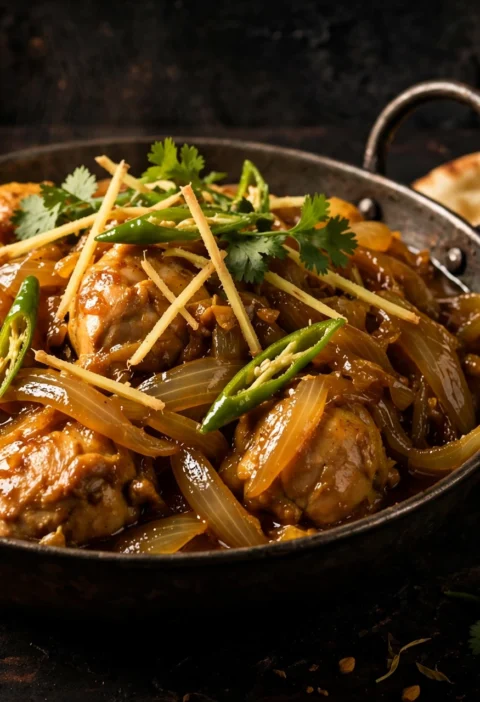
Step 5: Rest it, then carry the karahi to the table. Take the pan off the heat, scatter the remaining ginger matchsticks and the whole green chilies over the top, and let everything rest for 5 minutes while the coating settles and clings. Then serve it the Shinwari way: in the karahi itself, still faintly sizzling, with lemon wedges alongside and naan arriving hot. Eat it communally, with your hands, straight from the shared pan — plating this one up politely, portion by portion, misses the point of it entirely.
Serving Suggestions
Keep the company plain and let the karahi talk. A mound of sliced raw onion and cucumber on the side — yes, onion beside the pan, never in it — a jug of cold water or a glass of salty lassi, and green tea or sweet doodh patti afterwards to settle the richness, exactly as they do it in Peshawar. The bread is not optional: soft, blistered naan is the scoop, the mop and half the meal.
To place this chicken shinwari karahi recipe in its family, taste it against its two closest relatives on this site. Our classic chicken karahi builds its base the familiar way — browned onion, ginger-garlic paste and a full shelf of ground spices — and tastes rounder and deeper for it, though the chicken there shares the stage with its sauce. The chicken charsi karahi is the shinwari’s nearer cousin, also proudly onion-free, but it floods the pan with tomatoes until they become the sauce itself, and ginger appears only as a finishing flourish. Shinwari is the fat-and-pepper argument: fewer tomatoes, ginger in quantity from the middle of the cooking, black pepper as the lead voice. Same famous street, three different opinions.
Storage and Reheating
Shinwari karahi deserves to be eaten the day it is made, but leftovers keep kindly. Cool the karahi quickly and refrigerate everything — fat, coating and all — in an airtight container for up to 3 days. The ghee sets into a firm pale layer on top; treat that layer as stored flavour rather than waste, because it melts straight back into the dish. Reheat in a karahi or wide pan over medium heat with a spoonful of water, stirring until the coating loosens, turns glossy again and the chicken is piping hot, about 5 minutes. The microwave works but dulls the ginger’s sparkle. Freezing holds up for about a month; the tomatoes soften on thawing and the pepper fades a touch, so wake the reheated karahi up with fresh ginger matchsticks and one more pinch of crushed black pepper.
Frequently Asked Questions
Truly no onion and no garlic? Not even a little?
Truly none, and that is not a gap in this chicken shinwari karahi recipe — it is the recipe. The purist position is that onion and garlic bully a good chicken into tasting like every other karahi on the street. Add one small sliced onion and you will gain sweetness and body, and it will still be a fine pan of food; it simply stops being shinwari and becomes a light chicken karahi instead. Garlic is the subtler cheat: a single crushed clove fried in the ghee rounds the edges without announcing itself, and plenty of home cooks quietly do exactly that. Make it the strict way once, though. You may be surprised how little you miss either of them.
Which fat is best — ghee, oil, or dumba fat?
Tradition votes for dumba: rendered tail fat from the fat-tailed sheep gives the tribal-belt karahis their deep, savoury bass note, and if you can get clean lamb tail fat, using it for part of the fat here is a genuine revelation. For everyday cooking, ghee is the best stand-in — rich, steady at high heat, and it perfumes the whole pan. Plain oil is what many shops honestly use for chicken, and it works, but the finished dish tastes leaner and a little less complete; if oil is your choice, stir a tablespoon of ghee through at the end to round it out.
Why does the salt go in so late?
Two practical reasons. Salt scattered over raw chicken draws moisture to the surface, and damp chicken steams in the fat instead of frying — you lose the deep golden colour the first step works so hard for. Waiting also lets you season accurately: by the time the salt goes in, the tomatoes have collapsed and the coating sits at its final concentration, so what you taste is exactly what you get. Salt this dish at the start and it can still taste under-seasoned at the table; salt it late and it tastes precise.
How do I make the mutton shinwari version?
Keep the same short list and the same discipline, but respect the meat’s longer clock. Brown 2 1/2 pounds (about 1.1 kg) of bone-in mutton in the fat — dumba fat if you have it — then add a splash of water, cover and simmer gently for 45 to 55 minutes until nearly tender, or pressure-cook it for about 20 minutes. Only then add the tomatoes and carry on exactly as above, because mutton sitting in tomato from the start toughens, and the tomatoes disintegrate long before the meat yields. Finish with the chilies, ginger, late salt and pepper, and give it the same 5-minute rest before the karahi goes to the table.
Recipe Summary
- Prep time: 15 minutes
- Cook time: 30 minutes
- Total time: 45 minutes
- Servings: 4 to 6
- Cuisine: Pakistani
- Course: Main Course