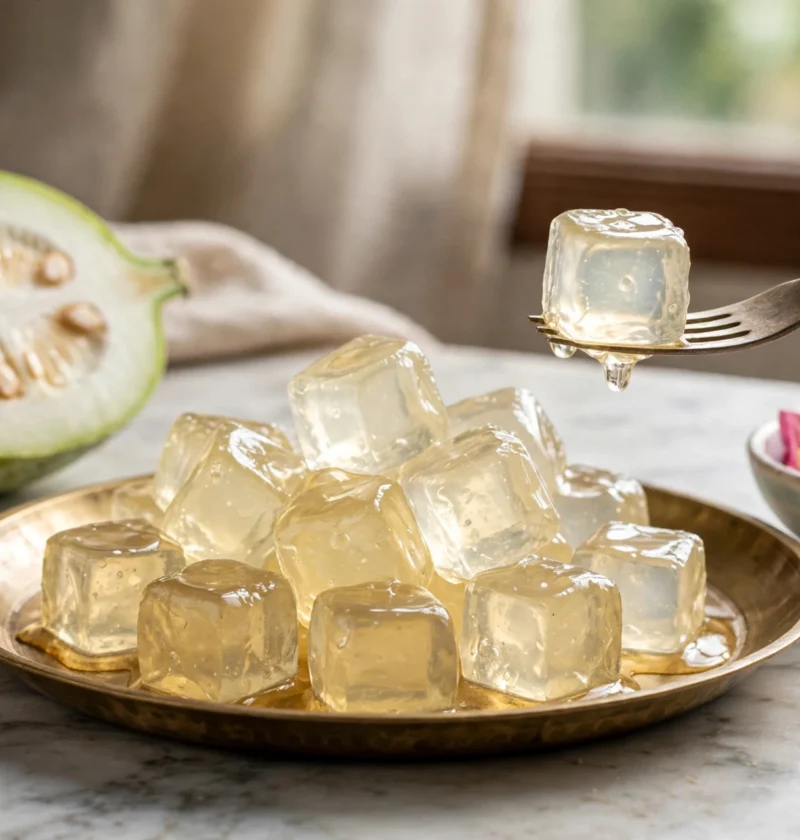
The first time I ate petha, I was eleven years old and half asleep on a train stopped at Agra on a hot afternoon. My father vanished onto the platform and came back with a cardboard box — the kind vendors pressed into every open window — packed in neat rows with pale, glassy chunks that looked more like frosted glass than food. I bit one expecting something crisp, and instead it burst — soft, juicy, impossibly clear, tasting of sugar and rose and something I couldn’t name. That box is the reason this petha recipe exists in my kitchen. Years later I learned the pieces were no magic — just a humble ash gourd, firmed in lime water and coaxed clear in syrup, a trick anyone can learn at home.
What I love most about petha is that it refuses to behave like every other sweet on our table. It is not fried, it is not baked, it is not milk-based. It starts as a watery, mild-mannered gourd that most people walk straight past in the market, and it ends as a candy so translucent you can nearly read a newspaper through a thin slice. Old Agra families will tell you the sweet belongs to their city the way the Taj does, and I am not inclined to argue. The petha recipe I make at home is the classic juicy version — the pieces stay plump and glossy in their syrup — with the option to dry them firmer at the end if that is how your household likes them.
Why This Petha Recipe Works
Petha fails in predictable ways — mushy pieces, cloudy syrup, sweetness that sits only on the surface — and every step in this petha recipe answers one of those failures:
- The lime-water soak firms the gourd before any heat touches it. Ash gourd is mostly water held in a soft sponge, and boiling it raw turns it to baby food. A soak in food-grade lime water (chuna) tightens the flesh so the pieces keep their edges and bite back gently instead of dissolving.
- Pricking every piece lets the syrup travel to the centre. A fork worked over all sides opens dozens of tiny channels, so sweetness goes all the way through instead of glazing the outside and leaving the middle bland.
- Blanching before sweetening keeps the syrup clear. A short boil in plain water first cooks out the raw, green taste and the foam that would cloud your syrup.
- The syrup starts thin, never thick. Thick syrup seals the surface and the pieces stay raw inside; a thin, watery one moves through those pricked channels and thickens later, on its own schedule, as the petha rests.
- An overnight rest finishes what the stove started. Off the heat the pieces look pale and half-clear; by morning, in their syrup, they turn fully glassy — patience is a genuine ingredient in this petha recipe.
Ingredients for This Petha Recipe
The shopping list is short, but the main ingredient deserves a moment. Ash gourd — also sold as white pumpkin, winter melon, or safed kaddu — is a big, pale, waxy-skinned gourd with mild white flesh. Buy the firmest, heaviest one you can find; a soft or yellowing gourd has already started breaking down inside and will not hold its shape. Petha itself is inseparable from the city of Agra, where shops have been candying this gourd for generations and now sell dozens of flavours, from rose and saffron to paan. We are making the original plain one, with a couple of gentle flavour options at the end, and this petha recipe keeps the ingredient list that short on purpose.
For the petha
- 1 large ash gourd / white pumpkin, about 4 1/2 pounds (2 kg) whole, yielding roughly 2 1/4 pounds (1 kg) peeled, seeded pieces
- 1 teaspoon food-grade slaked lime (chuna / calcium hydroxide) — the same edible lime sold for paan, clearly labelled food grade
- 10 cups (2.4 litres) water, for the lime soak
- Plenty of fresh water, for rinsing and blanching
For the syrup and flavour options
- 3 cups (600 g) granulated sugar
- 3 cups (720 ml) water, for the syrup
- 1 tablespoon lemon juice, to keep the syrup from crystallising
- 1 teaspoon rose water, or 1/2 teaspoon ground cardamom, or a generous pinch of saffron strands (optional flavours — pick one, not all three)
- 1 tablespoon slivered pistachios or edible silver leaf (varq), to finish, optional
How to Make This Petha Recipe – Step by Step
Step 1: Peel, seed and cut the gourd into even pieces. Slice the ash gourd into thick rounds, then cut away the hard waxy rind and the soft, spongy seed core completely — any seed fibres left behind turn stringy in the syrup. Cut the firm white flesh into chunky rectangles, roughly 2 inches by 1 1/2 inches (about 5 x 4 cm) and a good 3/4 inch (2 cm) thick. Even sizes matter: thin pieces overcook into rags while thick ones are still catching up. You should have about 2 1/4 pounds (1 kg) of clean pieces.
Step 2: Soak the pieces in lime water, then rinse like you mean it. Stir the food-grade lime into the 10 cups of water in a large non-reactive bowl until it dissolves into a cloudy liquid, then slide in the gourd pieces and weigh them down with a plate so everything stays submerged. Leave them for 5 to 6 hours, or overnight in the fridge. This step gives petha its signature gentle firmness, and it is perfectly safe done properly — the lime is a traditional firming agent, not a flavouring, and none of it should reach your mouth. So rinse seriously: drain the pieces and wash them under running water 4 to 5 times, rubbing each one, until the water runs completely clear and no chalky film remains on your fingers. Well rinsed, the pieces are clean, firm and ready.
Step 3: Prick every piece and blanch until just tender. Prick each piece all over with a fork — fussy, five-minute work, but those holes are the doors the syrup walks through later. Bring a big pot of plain water to a rolling boil, add the pieces, and cook for 8 to 10 minutes, until a piece bends when pressed and a knife slips in with slight resistance. They should be tender but still holding their shape, since they cook further in the syrup. Drain them in a colander and let the steam and surface water escape for a few minutes; waterlogged pieces dilute the syrup.
Step 4: Simmer in thin syrup until the pieces turn translucent. Put the sugar, 3 cups of water and the lemon juice in a wide, heavy pan, set it over medium heat, and stir as it comes up to a boil and the sugar melts clean away. The syrup should look thin and watery — that is correct. Slide in the blanched pieces in a single layer if you can manage it, lower the heat to a gentle simmer, and cook uncovered for 25 to 30 minutes. Turn the pieces once or twice with a slotted spoon. You will watch the change happen slowly: the white flesh turns grey-white, then opalescent at the edges, then clear all the way through, like frosted glass warming up. When a piece lifted out looks translucent from edge to centre, stir in your chosen flavouring — rose water, cardamom or saffron — and take the pan off the heat.
Step 5: Rest the petha in its syrup, then serve it juicy or dried. Leave the pieces in the warm syrup for at least 4 hours, overnight if you can — this rest is when they turn fully glassy and drink the sweetness to the middle. For the classic juicy style, lift the pieces out with a little of their syrup, scatter over the pistachios or press on the silver leaf, and serve. For the firmer, drier style sold in sweet shops, lift the pieces onto a rack, let them drain for an hour, then leave them uncovered at room temperature for 6 to 8 hours, turning once, until the surfaces feel dry and just slightly tacky and the flesh has set a little denser.
Serving Suggestions
Petha is a sweet that rewards being eaten plain and cold. I serve the juicy pieces straight from the fridge in small glass bowls, two or three pieces a person, because the first cold, syrupy bite is the whole point. It is also wonderful chopped over kulfa or plain vanilla ice cream, folded through a fruit chaat, or set out on a mithai tray next to the louder sweets — the pale, quiet-looking pieces are always gone first.
Set it beside its site-mates and the contrasts tell you what petha is. My gajak is a hard, dry sesame brittle that shatters between your teeth; petha is its opposite in every direction — soft, wet, gentle, a candy you press rather than crack. And where my imarti is a fried batter flower that drinks its syrup in minutes, petha is a blanched vegetable that simmers slowly clear, with no frying anywhere in its story. Three syrup sweets, three different roads — and this petha recipe is the slow, clear one.
Storage and Reheating
This petha recipe needs no reheating — petha is eaten cold or at room temperature, never warmed. The juicy style keeps best in its syrup, in a clean glass jar in the fridge, for about 2 weeks — keep the pieces submerged and use a dry spoon each time. The dried style keeps longer: pack the pieces in an airtight box with parchment between layers and they will stay good at cool room temperature for about 10 days, or a month in the fridge. If dried petha turns a little too firm, a 10-minute sit in warm syrup brings back its bounce. I do not freeze petha — the ice crystals break that delicate, glassy texture for good.
Frequently Asked Questions
What exactly is ash gourd, and where do I buy one?
Ash gourd (Benincasa hispida) is a large pale gourd with waxy, ash-dusted skin and mild, watery white flesh — you may know it as winter melon, white pumpkin, wax gourd or safed kaddu. Look in South Asian and Chinese grocery stores, where it is sold whole or in wrapped wedges. Pick one that feels heavy, with hard skin and firm, white flesh. There is no true substitute for this petha recipe; bottle gourd (lauki) is too soft and turns to mush, so it is worth hunting down the real thing.
Is the lime (chuna) safe, and can I use something else?
Yes — food-grade slaked lime has firmed fruits and vegetables for pickling and candy-making for centuries, and it is sold for exactly this purpose. The honest conditions are these: it must be food grade (the paan-shop chuna or pickling lime), and you must rinse the pieces thoroughly, several times, until no chalky trace remains; the lime does its firming work and is then washed away. The traditional substitute is alum (fitkari), about 1/2 teaspoon dissolved the same way, which firms more gently and is also rinsed off. If you cannot find either, skip the soak — just know the finished pieces will be softer and more fragile, though still sweet and pleasant.
Why did my petha stay opaque, or turn out mushy?
Opaque petha is almost always under-rested petha: the pieces may look white after cooking but turn clear as they sit in the syrup, so give them the full overnight rest before judging, and make sure they were pricked well so syrup could reach the centres. Mushy petha has the opposite biography — the lime soak was skipped or cut short, or the pieces were blanched too long. Cut pieces chunkier next time, keep the blanch just-tender, and stir gently with a slotted spoon to keep the edges intact.
Can I honestly make petha with less sugar?
Honestly — only a little. The sugar is not just sweetness; it is the preserving syrup, and it draws water out of the gourd and replaces it — that exchange is what creates the translucent, candied texture. You can trim the sugar by about a quarter and still get recognisable petha, a little softer and less glossy. Go much below that and you are poaching gourd in sweet water — it will taste pleasant for a day, stay stubbornly opaque, and spoil quickly. My advice is to make the real thing, cut the pieces smaller, and let one good piece be enough.
Recipe Summary
- Prep time: 25 minutes, plus 5–6 hours of lime soaking
- Cook time: 40 minutes
- Total time: About 7 hours, mostly resting and soaking
- Servings: About 20 pieces
- Cuisine: Pakistani
- Course: Dessert