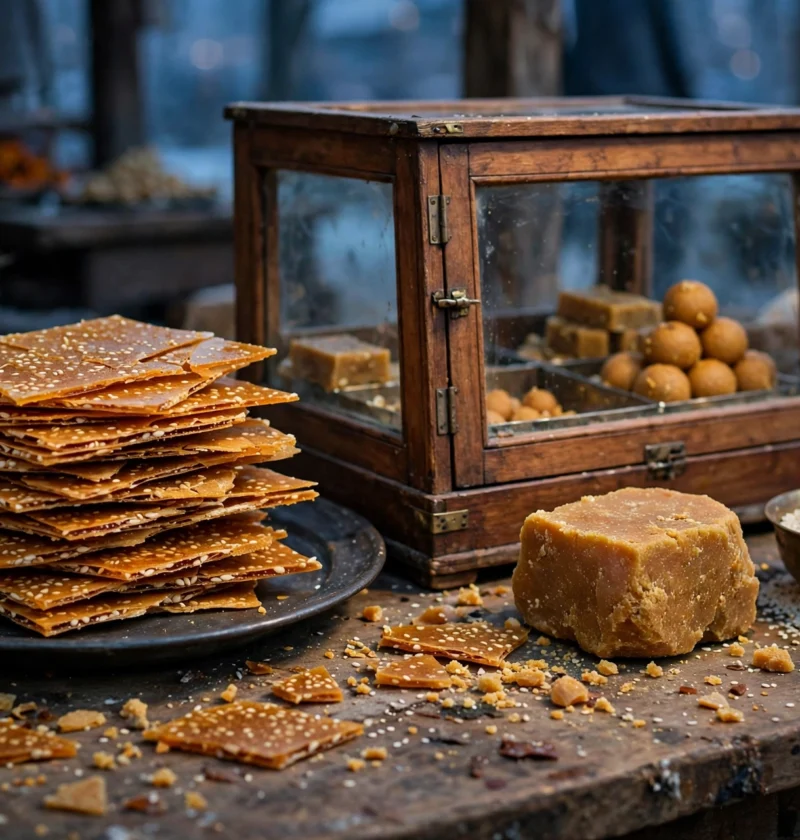
The gajak I remember best was never eaten sitting down. It came from a sweet shop on a bazaar corner where winter arrived before the calendar allowed it — glass-fronted boxes stacked with amber sheets, every sheet veined with sesame, and a shopkeeper who weighed a quarter kilo on a brass balance and wrapped it in newspaper. My father would snap the first shard in the street, hand me the bigger half without looking down, and we would stand in the cold eating brittle that cracked loud enough to turn heads, while sacks of peanuts and rewari waited their turn around us. This gajak recipe is my attempt to rebuild that sheet at home: toasted til, jaggery cooked hard, and a snap you can hear from the next room.
Gajak is winter’s sweet across our part of the world — the brittle of the cold months and the Lohri season, sold at railway stations and bazaar stalls all winter long. Two humble things build it — sesame seeds and jaggery — but it is neither a soft sweet nor a peanut brittle. The syrup is cooked far past the gentle stage that keeps a laddu chewy, all the way to hard and glassy, and the mixture is rolled into sheets so thin the light comes through them. Get the syrup stage right and the rolling fast, and gajak practically makes itself. Get either one wrong and you are left with a sticky chew where a shattering shard should be.
Why This Gajak Recipe Works
Brittle is a small recipe with nowhere to hide, so this gajak recipe is built around the five decisions that decide whether your sheet shatters or sulks:
- The syrup goes all the way to hard-ball. This is the whole dish in one sentence. Jaggery stopped early gives you the soft chew of a laddu; pushed to 255–265°F (124–129°C), the same syrup sets into dry glass that snaps instead of bending.
- The sesame is toasted gently, then kept warm. Sesame crosses from golden to bitter in a blink, so it toasts low and slow and leaves the pan the moment it smells nutty. Held warm in a low oven, it folds into the hot syrup without dragging the temperature down and seizing the batch.
- It is rolled to an eighth of an inch — no thicker. Thinness is gajak’s identity. A fat slab makes your jaw work and your teeth complain; a sheet rolled thin breaks into shards and crunches cleanly instead of clunking.
- The sheet is scored while it is still warm. Thirty seconds with a greased knife, marking diamonds or squares across the sheet, buys you neat edges later. Unscored, the sheet breaks wherever it pleases and half of it ends as crumbs.
- Jaggery does the sweetening, never plain sugar. Gur brings deep amber colour and a caramel depth with a whisper of smoke that white sugar cannot imitate — the flavour that makes gajak taste like winter instead of candy.
Ingredients for This Gajak Recipe
At heart, gajak is one of the subcontinent’s great travelling sweets — sesame set in cooked jaggery, built to survive a coat pocket, a long train ride and a month in a tin. The seed is the body of it: white til, tiny and oil-rich, the winter staple our kitchens lean on when the cold sets in. The jaggery is the soul of it: unrefined cane sugar sold in amber blocks, and for this gajak recipe you want the darkest, softest block on the shelf, the kind that dents under a thumbnail and smells faintly of molasses. Pale, dusty, rock-hard jaggery makes pale, dusty gajak. Everything else here is a whisper — cardamom, a breath of dry ginger, a pinch of soda — because the two main ingredients are already loud enough.
For the gajak
- 2 cups white sesame seeds (about 10 ounces / 280 g), picked over for grit and tiny stones
- 1 1/2 cups chopped or grated jaggery, loosely packed (about 9 ounces / 255 g)
- 1 tablespoon water
- 1 teaspoon ghee
- 1/2 teaspoon ground cardamom
- 1/4 teaspoon ground dry ginger (optional — an old cold-weather habit in our house)
- 1 small pinch baking soda (optional — it lightens the bite)
For rolling and finishing
- 1 to 2 teaspoons ghee, for the parchment, the knife and the rolling pin
- 2 large sheets of parchment paper (or one silicone mat plus one sheet of parchment)
- 1 tablespoon finely slivered pistachio or a pinch of extra sesame, for the top (optional)
How to Make This Gajak Recipe – Step by Step
Step 1: Toast the sesame until nutty, then keep it warm. Tip the sesame into a heavy, completely dry karahi or wide skillet over medium-low heat. Stir without stopping for 3 to 4 minutes. They will look pale and sleepy; then, suddenly, they gloss over, turn the colour of pale honey, and start popping. The instant that happens, tip them onto a tray — never leave them sitting in the hot pan — and slide the tray into a low oven, about 200°F (95°C), so the seeds stay warm while the syrup cooks.
Step 2: Melt the jaggery into a clean syrup. Wipe out the same pan, set it over low heat, and add the chopped jaggery, water and ghee. Stir patiently as the pieces slump, melt and merge into a dark, glossy syrup — rushing it over high heat scorches the edges before the middle melts. If your jaggery was a rough country block, strain the hot syrup through a fine sieve into a clean pan at this point; bazaar gur often carries grit, and grit has no place in a sheet this thin. Return the strained syrup to the lowest heat.
Step 3: Cook the syrup to the hard-ball stage. Bring the syrup to a steady boil and cook for 5 to 7 minutes, stirring now and then. A thermometer should read 255–265°F (124–129°C), but trust the cold-water test the way every halwai does: set a small bowl of cold water by the stove, drip in a little syrup, wait a few seconds, then fish the blob out and press it between your fingers. At hard-ball it holds its shape as a firm, solid ball — and it cracks when you bite it instead of bending or sticking to your teeth. Threads or a soft, squishy ball mean keep cooking; this is the one moment in the whole gajak recipe that decides everything, so stay at the stove.
Step 4: Fold in the sesame and work fast. Take the pan off the heat. Stir in the cardamom, the dry ginger if you are using it, and the pinch of soda — the syrup will foam briefly. Now pour in all the warm sesame at once and stir hard and fast, 20 to 30 seconds, until every seed is coated, gleaming, with no pale pockets left. Scrape it out in one mound onto a greased sheet of parchment and move straight to the rolling pin — from here it cools and stiffens by the second.
Step 5: Roll it thin, score it, and let it snap. Lay the second sheet of parchment over the mound and roll from the centre outward until the gajak is an even 1/8 inch (about 3 mm) thick. Peel off the top sheet. If you are adding pistachio, scatter it now and press it in with one last pass of the pin. Run a greased knife across the warm sheet to score diamonds or squares, cutting almost but not quite through. Leave it 15 to 20 minutes to cool into glass. Snap it along the scored lines, and listen — that crack is the sound this gajak recipe was chasing.
Serving Suggestions
Eat gajak the bazaar way: a shard in one hand and a cup of strong, hot chai in the other, ideally somewhere cold enough to justify both. It is a sweet for snapping and sharing, not plating — the piece you break off for someone else always tastes better. Crumbled over kulfi, folded through warm kheer, or scattered on a bowl of custard, it behaves like a sesame praline against something soft. A few shards in a small tin travel better than almost any mithai I know — it has been the winter gift and the railway sweet for generations.
Two relatives on this site share gajak’s bloodline, and the contrasts explain it fastest. My til laddu uses the very same pair of ingredients — sesame and jaggery — but stops the syrup at soft-ball and is rolled into balls by hand, so it eats soft and chewy where gajak lies flat and shatters. My peanut chikki is the peanut cousin of the family: thicker, chunkier slabs of brittle packed with whole roasted nuts. Gajak is the delicate one — sesame instead of peanut, rolled noticeably thinner, snapping finer — and this gajak recipe is the one I reach for when the evenings turn cold.
Storage and Reheating
This gajak recipe makes a shelf sweet from a world without refrigerators, and stored properly it keeps beautifully: a clean, dry, airtight tin at room temperature will hold its snap for 3 to 4 weeks. Moisture is the only enemy: handle the shards with dry hands, never pack them warm, and keep the tin away from stove steam. Do not refrigerate gajak — the fridge is a humid box, and the cold air dulls the crunch and turns the surface tacky. There is no reheating as such, but if a damp week robs your batch of its snap, spread the shards on a tray in a low oven, about 225°F (110°C), for 5 minutes, then cool them completely untouched. The glass resets, and the crack comes back.
Frequently Asked Questions
Can I make gajak with sugar instead of jaggery?
Honestly, yes — the method survives the swap. Melt granulated sugar with the same spoonful of water, cook it to the hard-ball stage, 255–265°F (124–129°C), and proceed as written. But sugar gajak sets paler and tastes one-note sweet, and loses the deep caramel, faintly smoky flavour that makes jaggery gajak taste like winter. If jaggery is truly unavailable, dark brown sugar is the closest stand-in and gives back some of that molasses depth. What I would not use is honey or any liquid sweetener — they never set into a hard glass, and the sheet stays sticky forever.
Why did my gajak turn out soft and chewy instead of crisp?
It is the syrup, almost always: the jaggery came off the heat a stage too early. Soft-ball syrup, around 235°F (113°C), is perfect for a chewy laddu and hopeless for brittle — the sheet bends, sticks to your teeth, and drinks moisture until it goes tacky. The fix, next time you make this gajak recipe, is patience and the water bowl: cook until a dropped blob firms into a hard ball that cracks when you bite it, not one that squishes. Humid storage can soften a well-made batch at the edges, but five minutes in a low oven, as described in the storage notes, drives moisture off and brings the snap back.
Why does my sesame taste bitter, and how do I stop it happening?
Bitterness means the seeds toasted too far — sesame is unforgiving here, because tiny, oil-rich seeds sit less than a minute from burnt. Toast over medium-low heat, never medium-high, stir constantly, and tip the seeds out of the pan the moment they turn pale gold and smell nutty. Remember they keep cooking in the hot pan off the flame, so the cold tray is part of the technique, not an afterthought. Old sesame is the other culprit — seeds kept a year in a warm cupboard can turn rancid before they ever meet the pan, so smell them raw first; fresh til smells mild and faintly sweet.
How do I roll the sheet thin without it sticking to everything?
Sandwich the hot mixture between two sheets of parchment and grease both sheets lightly with ghee first — with parchment above and below, the rolling pin never meets the sticky mass at all. Work while the mixture is hot, because a cooling sheet stiffens and tears rather than spreading; if it firms up mid-roll, slide the whole sandwich into a warm oven, about 200°F (95°C), for a minute, then roll again. Roll from the centre outward, and peel the top sheet away slowly at a low angle. A bare counter and a bare pin will defeat you every time; the greased parchment is the entire trick.
Recipe Summary
- Prep time: 10 minutes
- Cook time: 20 minutes
- Total time: About 30 minutes (+ 20 minutes cooling)
- Servings: About 24 shards
- Cuisine: Pakistani
- Course: Dessert