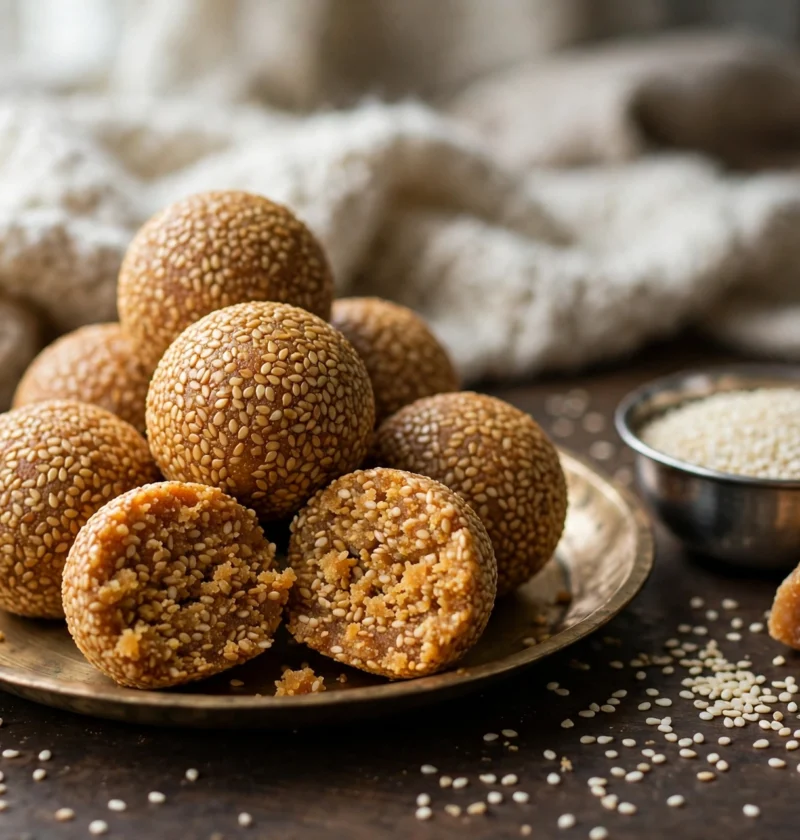
In my grandmother’s house, winter announced itself with a sound: sesame seeds crackling in a dry karahi, popping like tiny firecrackers while she stood over the stove. All through the cold months she kept a dented tin of til ladoos beside the stove — one with her morning chai, one pressed into my palm before school, always with the same ruling: “Til keeps the cold out of your bones.” This til laddu recipe is her winter sweet written down at last — two ingredients, one pan, and a method of watching, listening, and rolling at exactly the right moment.
A til laddu is the plainest-looking sweet on the mithai tray, and the easiest to underestimate. There is no gram flour to roast, no coconut to grate, no milk to reduce, no khoya to crumble — nothing but sesame and jaggery, held together by syrup and stubbornness. Where other ladoos hide behind ghee and flour, this one stands entirely on two techniques: cooking the jaggery to the exact string consistency, and shaping the balls while the mixture is still warm enough to obey you. Everything else in this til laddu recipe is commentary. Get those two moments right and the sweet never fails; miss them and you are choosing between jaw-breakers and a tray of sweet sesame sand.
Why This Til Laddu Recipe Works
Two-ingredient recipes forgive nothing, because there is nowhere for a mistake to hide. This one works because it respects the sesame, respects the jaggery, and never leaves the pan unattended:
- The sesame roasts dry, low and slow. Raw sesame is bland and faintly dusty; roasted sesame is a different ingredient altogether — nutty, warm, almost buttery. Five unhurried minutes wakes up the oils inside every seed, and that roasted depth is the ladoo’s whole flavor. Rush it over high heat and the outsides scorch bitter while the centers stay raw.
- The jaggery syrup is cooked to the string, not guessed at. Syrup is the only glue this til laddu recipe has. Undercooked, it stays soft and the balls slump and crumble; overcooked, it sets like toffee and the ladoos could crack a tooth. The cold-water test in Step 3 takes five seconds — a soft ball that holds its shape means the syrup is ready.
- A third of the sesame is lightly crushed. Whole seeds alone roll into loose, fragile balls. Crushing a portion of the roasted sesame — just broken, never powdered — releases its natural oil and gives the syrup thousands of tiny edges to grip. The ladoos hold together firmly and still crunch like they should.
- The balls are rolled warm, with ghee on the palms. The moment the syrup cools, it firms — and a firm mixture crumbles instead of binding. Rolling while the mixture is warm-but-touchable, with greased palms and a firm squeeze, is the difference between smooth, tight ladoos and a frustrating bowl of rubble.
- They crisp as they cool, so patience finishes the job. A freshly rolled til laddu feels slightly soft. Thirty quiet minutes at room temperature is all it takes — the syrup sets glassy, the seeds lock in, and the bite turns properly crunchy. Judge this sweet cold, never warm.
Ingredients
There is almost nothing to buy here, which is precisely the point. The sesame seed — til — is one of humanity’s oldest oilseeds, cultivated across South Asia for thousands of years and prized in winter cooking for its warmth. The sweetener matters just as much: jaggery — gur — is unrefined cane sugar, and it brings a deep, caramel, almost smoky sweetness that white sugar simply cannot imitate. Buy jaggery that gives slightly when you press it and smells like molasses, and sesame that looks plump and pale.
The two that matter
- 2 cups white sesame seeds (about 10 ounces / 280 g)
- 1 cup tightly packed grated or powdered jaggery (about 7 ounces / 200 g)
Small helpers, big difference
- 1 teaspoon water, only to help the jaggery start melting
- 1/2 teaspoon ground cardamom
- 1 teaspoon ghee, for greasing your palms — it never goes into the mixture
- 1 small pinch of fine sea salt (optional — a whisper of salt makes the jaggery taste deeper)
- 2 tablespoons roasted peanuts, coarsely crushed (optional, for a mixed winter crunch)
- 1/2 teaspoon ground dry ginger (optional, the old-fashioned winter warmer)
How to Make This Til Laddu Recipe – Step by Step
Step 1: Roast the sesame until it talks to you. Set a heavy karahi or a wide, dry skillet over medium-low heat and tip in the sesame seeds — no oil, no ghee, nothing. Stir constantly with a wooden spoon, sweeping the seeds up the sides and back down, for 4 to 6 minutes. First they look pale and matte; then, all at once, they turn glossy and golden, pop and jump in the pan, and smell unmistakably nutty. A seed crushed between your fingernails should snap, not bend. The second they reach that point, tip them onto a cold plate and spread them out. Left sitting in the hot pan, they will keep cooking and cross into bitter.
Step 2: Crush a third of the seeds, lightly. Scoop about a third of the roasted sesame into a spice grinder and pulse it two or three times — you want it broken and rubbly, not powdered and definitely not paste. No grinder? A mortar and pestle, or a rolling pin over a zip bag, does the same honest work. Stir the crushed portion back through the whole seeds along with the cardamom, optional salt, peanuts, and dry ginger. This uneven mixture — whole seeds for crunch, crushed seeds for binding — is the texture a good til laddu is remembered by.
Step 3: Melt the jaggery and cook it to the soft-ball stage. Wipe the karahi clean, set it over the lowest heat you have, and add the grated jaggery with the teaspoon of water. Stir as it slumps into a dark, bubbling syrup. If your jaggery was a gritty country block, pour the melted syrup through a fine sieve into a clean pan to catch the impurities — an old step my grandmother never skipped. Now cook, stirring, for 2 to 3 minutes, then test it the way she did: drop a little into a bowl of cold water. If it dissolves into threads, keep cooking. If it gathers into a soft, pliable ball you can flatten between your fingers, it is ready — this is the moment this til laddu recipe lives or dies on, so do not wander off. On a thermometer it reads about 230°F (110°C), but the water bowl never lies.
Step 4: Bring sesame and syrup together, fast. Take the pan off the heat and pour in the sesame mixture all at once. Stir hard and thoroughly — 30 seconds of real commitment — until every seed gleams with syrup and there are no pale, dry pockets at the bottom. Tip the mixture onto a plate and let it rest 2 to 3 minutes. You are waiting for the window where it no longer burns your fingers but is still soft enough to shape. Too hot and you will hop around the kitchen; too cool and you are holding scented gravel.
Step 5: Roll while warm, rest while they crisp. Smear a little ghee over your palms — or simply wet them with water, re-wetting every few balls — then scoop up a heaped tablespoon of mixture, squeeze it firmly in your fist, and roll it between your palms into a tight ball about the size of a walnut. Work quickly, and recruit anyone standing nearby; this is a two-person job pretending to be a one-person recipe. If the mixture cools and crumbles before you finish, scrape it back into the pan over the lowest flame for 20 to 30 seconds, stir, and carry on — you get one rescue, so make it count. This til laddu recipe makes about 16 ladoos. Leave them in a single layer for 30 minutes to set and crisp before anyone is allowed one.
Serving Suggestions
Til ladoos belong to the cold months, and they serve best the way they were served to me: two on a steel plate beside a glass of hot ginger chai, eaten slowly while the evening comes down. Around Makar Sankranti and Lohri they travel from house to house, exchanged with the traditional tease of “til-gul ghya, goad goad bola” — take sesame and jaggery, and speak sweetly. For a festival table, build a ladoo trio in one gift tin: these crunchy two-ingredient ones, my ghee-rich besan ladoo recipe for the traditionalists, and the soft, pale coconut ladoo recipe for the children. Three ladoos, three completely different personalities, one happy tin.
Storage and Reheating
This is a shelf sweet, built by generations who had no fridge to lean on, and it keeps in a clean, dry, airtight tin at room temperature. Kept away from steam and damp hands, a til laddu recipe batch stays crunchy and good for 3 to 4 weeks — jaggery and sesame’s own oils do the preserving. Never refrigerate them; the cold draws in moisture, dulls the crunch, and sets the balls unpleasantly hard. There is no reheating here, but if a humid week softens your ladoos, spread them on a tray in a 200°F (95°C) oven for 5 minutes, or roll them briefly in a dry, warm pan, and let them cool again — the crunch comes back. Keep the tin away from anything strongly scented, because sesame drinks up neighboring smells.
Frequently Asked Questions
How do I test the jaggery syrup consistency without a thermometer?
Use the cold-water test, which needs nothing but a small bowl of water and is more reliable than most cheap thermometers. Drop a few drops of syrup off the spoon into the water. Early on it will dissolve into wispy threads — not ready. A minute or two later it will sink and gather into a blob you can pick up: if that blob is soft, holds together, and flattens easily when you press it between finger and thumb, the syrup is at the soft-ball stage and perfect for ladoos. If the blob turns stiff and snaps rather than bends, you have overshot into hard-ball territory. The older thread test — a cooled drop pulled between finger and thumb should stretch into one clean thread — works too, but the water bowl is the test I trust for a til laddu recipe.
Why did my ladoos turn out hard enough to break teeth — or crumble into sand?
Both failures live in the syrup, in opposite directions. Rock-hard ladoos mean the jaggery cooked too long, past soft-ball into hard-ball; there is no rescue except crushing the balls into a crunchy topping for kheer or warm milk, where they are delicious. Crumbly ladoos mean the syrup came off the heat too early, or the mixture cooled before you finished rolling. Next time, wait for the proper soft ball, roll faster with help, and remember the one-time rescue: a crumbling mixture warmed for half a minute in the pan usually binds again.
Can I make til ladoos with sugar instead of jaggery?
You can, and the method is identical — melt the sugar with a teaspoon of water, cook it to the same soft-ball stage, and roll the same way. But know what you are giving up: jaggery brings caramel depth, a faint smokiness, and the mineral sweetness that tastes like winter. Plain sugar ladoos are sweeter, paler, and flatter. If jaggery is simply unavailable, dark brown sugar is the closest stand-in. Honey does not work here — it will not set into a firm syrup, and the balls will stay sticky forever.
Should I use white sesame or black sesame? And can I add other things?
White sesame is the classic — milder, sweeter, and the one in this recipe. Black sesame gives a nuttier, slightly more bitter-edged ladoo and looks striking; some families mix the two half and half. Additions are welcome within reason: roasted peanuts, a spoonful of desiccated coconut, or chopped almonds can replace up to a quarter of the sesame without harming the set. Go further than that and the syrup can no longer coat everything, and you are back to the crumble problem. Whatever you add, roast it first — raw additions taste raw forever inside a cooked sweet.
Recipe Summary
- Prep time: 10 minutes
- Cook time: 15 minutes
- Total time: 25 minutes (+ 30 minutes cooling)
- Servings: About 16 ladoos
- Cuisine: Pakistani
- Course: Dessert