There is a mithai shop on Burns Road in Karachi where the pedas are shaped by hand behind the glass, and as a child I was convinced the man doing it was performing a magic trick. A lump of milk dough would roll through his fingers and come out as a perfect disc, pressed with a shallow dent and a single green pistachio, row after row, faster than I could count. My father bought a quarter kilo whenever we went visiting at Eid, and the thin cardboard box, tied with string, ghee already blooming through the paper, never once survived the car ride home unopened. I did not learn this peda recipe from that halwai, who guarded his timings fiercely. I learned it years later in my own kitchen, working backwards from the memory of those car-ride pedas, batch by patient batch.
Peda, I eventually understood, is two recipes wearing one name. The first half is patience: khoya cooked low and slow until it surrenders its moisture and turns dense and glossy. The second half is timing, because the craft of any good peda recipe happens after the pan leaves the flame, in the short warm window when the dough is kneaded, rolled between greased palms and shaped. Too hot, and the sugar melts into syrup and the discs slump. Too cold, and the dough crumbles and cracks at every edge. Land inside that window and this peda recipe hands you exactly what the glass counter sells: soft, close-grained, milky discs that yield under the tooth, then quietly melt away.
Why This Peda Recipe Works
A sweet built on three or four ingredients has nowhere to hide, so small decisions carry all the weight. This peda recipe rests on five of them:
- The khoya cooks entirely on its own first. No sugar enters the pan yet. Stirred over gentle heat, the crumbled khoya loosens, turns glossy, deepens by a shade and leaves the sides of the pan, a faint rim of ghee showing. That unhurried cooking drives off the moisture that would leave the pedas sticky and unset.
- Powdered sugar goes in warm, never cooked. This is the rule that separates tender peda from chewy peda. Sugar added while the khoya is hot melts into syrup that resets hard and taffy-like as it cools, and granulated sugar leaves grit besides. Powdered sugar folded into warm dough dissolves invisibly and sets a smooth, fudge-like grain — in this peda recipe, sugar is a kneading ingredient, not a cooking one.
- The cardamom is ground fresh and added at the end. Cardamom’s perfume is fragile; pan heat cooks most of it away. Ground from whole pods and kneaded in with the sugar, it stays bright and floral, so every bite smells like the mithai shop, the spice showing as tiny green flecks.
- Shaping happens warm, between greased palms. A thin film of ghee on the palms stops sticking and lets each ball roll to a crack-free shine. Warm dough is pliable dough — it flattens evenly and seals its own surface smooth. Let it go cold and it fights you, tearing at the edges however gently you press — warmth is not a detail in this peda recipe, it is the whole technique.
- The thumbprint dent is a quality test, not just a tradition. Press your thumb into a rolled disc and read what happens. A dent held cleanly, without cracking or slumping, tells you the moisture is right. Cracks radiating outward mean dry dough — knead in warm milk a teaspoon at a time. A dent that fills back in means the mass is too wet and wants two more minutes in the pan. The dent also cradles the pistachio — reason enough on its own.
Ingredients
Few sweets carry this much history in this few ingredients. Peda traces back to Mathura in northern India, where it began as a temple offering before travelling the subcontinent to settle in mithai shops everywhere, Karachi included. Its soul is khoya — called mawa in many shops — which is simply milk boiled down until only the rich solids remain. For this peda recipe, fresh khoya from a dairy or the freezer section of a desi grocery gives the deepest flavour; it should smell milky and faintly sweet, never sour. If good khoya is hard to find, the milk-powder shortcut below builds a respectable base in minutes. And buy the best pistachios you can — each peda wears exactly one, and it shows.
Makes about 20 pedas
For the peda dough:
- 1 pound (about 450g) fresh khoya (mawa), crumbled or coarsely grated — roughly 2 1/2 cups, loosely packed
- 3/4 cup powdered sugar (confectioners’ sugar), plus up to 2 tablespoons more to taste
- 1 teaspoon freshly ground green cardamom, from about 8 pods
- 1 teaspoon ghee, for the pan, plus a little extra for greasing your palms
For the milk-powder shortcut base (instead of ready khoya):
- 2 cups full-cream milk powder (not low-fat)
- 3/4 cup whole milk
- 2 tablespoons ghee
For finishing:
- 2 tablespoons pistachios, slivered or finely chopped — one piece per peda
- A few strands of saffron (optional)
How to Make This Peda Recipe – Step by Step
Step 1: Prepare the khoya — or build the shortcut base.
Cold khoya should sit out 20 minutes first; then crumble or grate it finely — small, even pieces melt into the pan without lumps. For the shortcut, whisk the milk powder, whole milk and ghee in your cooking pan until smooth, then stir over medium-low heat for 6 to 8 minutes, until it thickens, gathers into one soft mass and pulls away from the pan. That is your instant khoya — set it aside in a bowl. Do not skip the crumbling with real khoya in this peda recipe; big cold chunks scorch outside while staying raw in the middle.
Step 2: Cook the khoya low and slow until glossy.
Melt the teaspoon of ghee in a wide, heavy pan over medium-low heat and add the crumbled khoya. Stir patiently with a flat spatula for 12 to 15 minutes, pressing out lumps against the base of the pan. First it slumps and loosens. Then it darkens by a shade, takes on a soft sheen, and holds together as one mass that leaves the pan’s sides clean, ghee glistening at the edges. Resist raising the heat — high heat bronzes the outside in speckles while the centre stays raw and wet.
Step 3: Cool to warm, then knead in the sugar and cardamom.
Scrape the cooked khoya onto a wide plate or thali. Leave it 8 to 10 minutes, until you can hold a pinch against the inside of your wrist — warm, but nowhere near hot. Scatter over the powdered sugar and cardamom and knead with the heel of your hand for 2 to 3 minutes, until the dough turns smooth and uniform, peeling cleanly off the plate. Taste, and add the extra sugar a spoonful at a time if your khoya ran unsweetened. If it feels sticky, warm it in the pan 2 minutes more; if dry, knead in warm milk by the teaspoon.
Step 4: Shape the pedas — greased palms, warm dough, one thumbprint each.
Rub a little ghee between your palms. Pinch off walnut-sized portions, about a tablespoon each, and roll them into smooth, crack-free balls. Flatten each gently into a disc roughly 2 inches across and 1/2 inch thick, then press your thumb into the centre to leave the signature dent. Keep the remaining dough covered with a clean cloth as you work; uncovered dough cools, skins over and cracks. Unhurried hands and warm dough are what separate shop-quality discs from homemade-looking ones.
Step 5: Finish with pistachio and let them rest.
While each disc’s surface is still receptive, press a sliver of pistachio into the dent — snug and half-sunk, the way the shops set it. Add a saffron strand, if using. Lay them on parchment, not touching, and rest at room temperature for at least 2 hours, or overnight if you can bear it. Freshly shaped peda is soft dough; rested peda is what this peda recipe is after — firm enough to hold its shape, tender enough to bite through cleanly, the dense milk flavour settled all the way through.
Serving Suggestions
Peda is a room-temperature sweet: take it out well ahead, arrange it on a plate rather than stacked, and eat it with strong doodh patti or unsweetened chai, whose bitterness sets off the milk sugar perfectly. It is the sweet I put out when guests arrive unannounced, because it asks for nothing — no warming, no syrup, no ceremony — and still disappears first.
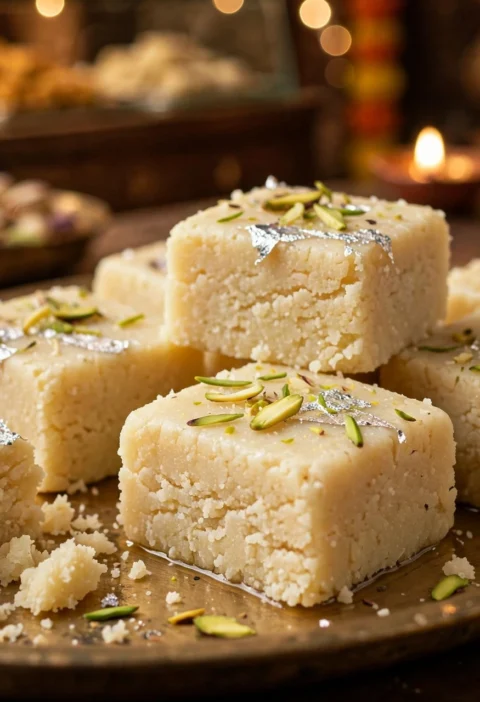
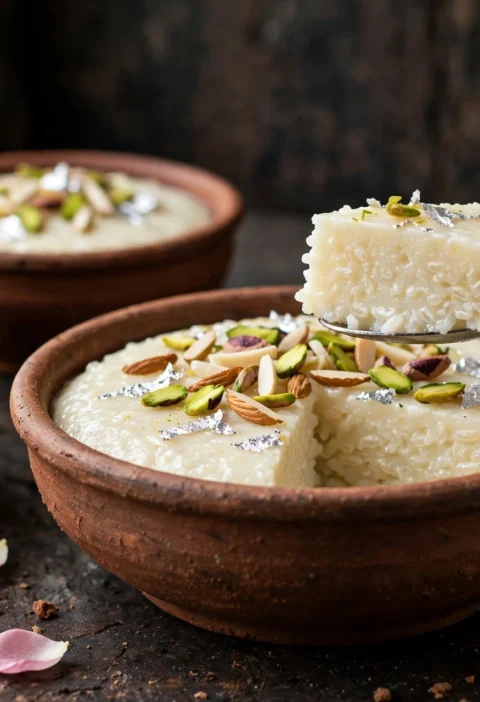
For a proper mithai plate, build it on contrast. Set these smooth, dense discs beside my kalakand and you get milk sweets from opposite ends of the family — kalakand grainy, moist and crumbly, peda close-textured and clean-biting. Add a small bowl of my rasmalai and the plate covers the third texture too: soft discs soaking in chilled, scented milk. Peda is also the traveller of the group — the one sweet that survives a car journey, a lunchbox or a parcel abroad with no syrup to spill and no milk to sour, which is why it has been the default visiting gift for generations.
Storage and Reheating
There is no reheating to speak of in this peda recipe — peda only asks to be stored sensibly and served at room temperature. In an airtight tin on the counter, these pedas keep beautifully for 3 to 4 days — many swear the cardamom improves them by day two. For longer keeping, refrigerate in a single layer with parchment between rows; they keep 10 to 12 days, but bring them out 30 minutes before serving — fridge-cold peda eats firm and muted. Never microwave one back to life; it melts unevenly and sweats grease. To freeze, wrap each piece individually, thaw overnight in the fridge, and let it come fully to room temperature before unwrapping.
Frequently Asked Questions
Why did my peda turn chewy or hard?
Almost always, the sugar met too much heat. If powdered sugar goes into khoya that is still properly hot, it melts into syrup, and that syrup resets into a firm, taffy-like chew as the pedas cool. Overcooking plays the same trick from the other side: khoya driven too dry in the pan leaves the discs dense and hard. The defence is the wrist test in step 3 — if the dough is comfortable there, the sugar dissolves without melting. A hard batch can be partly rescued: crumble it, knead in warm milk a teaspoon at a time, and reshape while warm.
Can I use milk powder instead of khoya for this recipe?
Yes — the shortcut base in the ingredients is built for exactly this, and for many home cooks outside the subcontinent it is the only practical route. Whisk full-cream milk powder with whole milk and ghee and cook, stirring, until it gathers into a soft mass; from there the recipe proceeds identically. Two adjustments matter: use full-cream powder (low-fat versions set rubbery), and hold back a spoonful of the sugar, since milk powders are often faintly sweet. The flavour runs a touch less deep than slow-reduced khoya, but the texture — soft, close, melt-away — comes through honestly.
Why is my peda mixture too sticky to shape?
The pan stage ended too early, or the sugar went in too hot. Undercooked khoya still carries water, so the dough stays tacky however long you knead; melted sugar syrup does the same damage in reverse. If the dough is already mixed, the gentlest rescue is time — chill it 20 minutes and it will firm enough to roll with well-greased palms, though the finish will be a little softer than ideal. A dusting of milk powder on your palms helps too. Next batch, trust the signs in step 2: glossy, holding together, leaving the pan clean.
Can I make kesar (saffron) peda with this recipe?
It is the most traditional variation of all. Soak 15 to 20 saffron strands in 1 tablespoon of warm milk for 15 minutes, until it turns deep marigold, then knead that milk in with the sugar and cardamom in step 3. The dough turns a warm gold, with a honeyed, floral depth plain peda does not have. Use a lighter hand with the cardamom so the saffron leads, and finish with pistachio as usual — green against gold is one of the prettiest sights on a mithai tray.
Recipe Summary
- Prep time: 10 minutes
- Cook time: 15 minutes
- Total time: About 1 hour (+ 2 hours resting)
- Servings: About 20 pedas
- Cuisine: Pakistani
- Course: Dessert