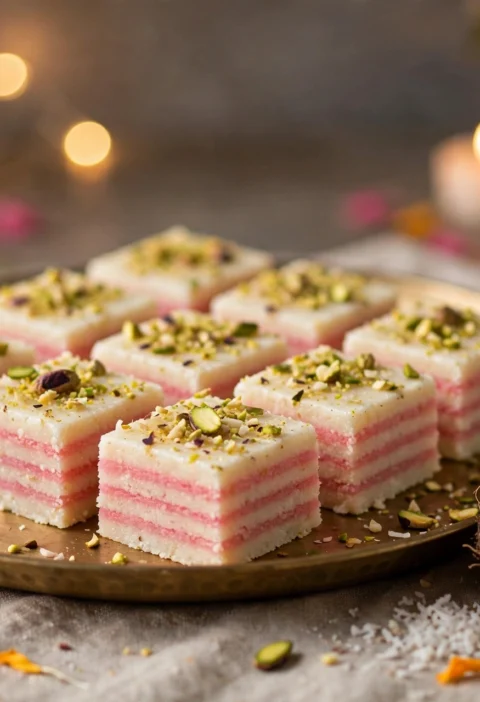
The first time I ever ate kulfa, I had walked straight past the kulfi cart to get to it. This kulfa recipe comes from my nani’s mohalla in Lahore, where an old man everyone called Bare Mian sold exactly one thing from a shop no bigger than a wardrobe: shallow earthen bowls of set milk dessert, stacked in a damp cloth-lined crate, each one capped with a wrinkled golden skin. He never froze anything. He never hurried anything. When you ordered, he would run a knife around the rim of a bowl, tip the whole trembling disc onto a steel plate, slice it like a cake, and slide it across the counter with a spoon. No stick, no cone, no melting race against the sun — just cold, dense, impossibly creamy slices that tasted like milk had been persuaded, over long patient hours, to become something far greater than itself.
Now, before we go any further, let me clear up the confusion that follows this dessert everywhere, because kulfa and kulfi are cousins, not twins. Kulfi is frozen — milk reduced down and set solid in the freezer, eaten off a stick before it melts. Kulfa is only ever chilled. The milk is reduced even further, sweetened, poured into bowls, and left to set in the cold until it firms up into a sliceable, spoon-tender pudding with a caramelised skin on top. Think of it as the elder of the family: quieter, denser, and in no rush whatsoever. If kulfi is a celebration, kulfa is a slow Sunday. The kulfa recipe I make at home is Bare Mian’s, as near as memory — and a good many test batches — can get it.
Why This Kulfa Recipe Works
Kulfa rewards patience and punishes shortcuts, but the rules behind it are simple. This kulfa recipe follows the five habits that matter most:
- The milk reduces further than you think it should. Kulfa only sets because the milk concentrates so heavily — down to roughly a third of where it started — that the milk solids themselves give it body. Stop early and you have sweet soup.
- A wide, heavy pan does the heavy lifting. More surface area means faster evaporation and fewer scorched patches, and a thick base spreads the heat so the milk colours gently instead of catching.
- The skin is stirred back in, again and again. Every film that forms on the surface gets folded back into the pot. Those layers of skin are what give the finished kulfa its rich, almost fudge-like depth.
- Sugar goes in late, never early. Sugar added at the start slows the reduction and can make the milk grain; added near the end, it sweetens an already-thick base and helps the top caramelise beautifully.
- Earthen bowls set it best. Unglazed clay breathes, wicks away a whisper of extra moisture, and lends the faintest earthy note that steel and glass simply cannot copy.
Ingredients
The shopping list for this kulfa recipe is short enough to memorise, because this dessert was perfected in an era of milk, sugar and firewood. Its closest relatives sit in the same family of reduced-milk sweets — kulfi, which takes a similar base and freezes it solid, and rabri, which keeps the reduced milk in soft, luscious layers instead of setting it firm. Kulfa borrows the patience of both and then insists on standing on its own. Full-cream milk is non-negotiable in this kulfa recipe; anything thinner will reduce to a sad shadow of the real thing. Buffalo milk is the traditional choice in the old city and gives the richest result, but good whole cow’s milk works beautifully. Weigh your sugar if you can — kulfa forgives many things, but not a heavy hand with the sweetness, because the reduction concentrates that too.
Serves 6
For the kulfa:
- 8 cups whole milk (full-cream, about 2 quarts)
- 3/4 cup granulated sugar
- 1/2 teaspoon ground cardamom, freshly crushed if possible
- A pinch of fine salt (optional, but it sharpens the sweetness)
- 2 tablespoons milk powder (optional, for extra body — the modern insurance policy)
To finish and serve:
- 2 tablespoons pistachios, finely chopped or slivered
- 1 tablespoon almonds, slivered (optional)
- A few strands of saffron, soaked in 1 tablespoon warm milk (optional)
- Dried rose petals, a small pinch (optional)
- 6 small unglazed earthen bowls (kullhad or katori), or ramekins
How to Make This Kulfa Recipe – Step by Step
Step 1: Reduce the milk slowly and stir the skin back in. Pour the milk into your widest, heaviest pan and bring it to a gentle boil over medium heat, watching it like it owes you money — milk climbs the moment you look away. As soon as it boils, drop the heat to low and let it simmer with lazy, occasional bubbles, somewhere around a bare 200°F on the surface if you use a thermometer. Stir every few minutes, scraping the bottom and sides, and every time a skin forms on top, fold it back in rather than skimming it off. Over 50 to 60 minutes the milk will shrink to about a third of its original volume, turn the colour of pale ivory, and coat the back of a spoon in a thick, slow ribbon.
Step 2: Sweeten and flavour the thickened milk. Only now, with the reduction done, stir in the sugar and the pinch of salt. The sugar will loosen the mixture slightly as it melts — that is expected. Let it simmer 5 more minutes so it tightens back up. If you are using milk powder for insurance, whisk it with a ladleful of the hot milk into a smooth paste first, then stir it through; this is your protection against a soft set. Take the pan off the heat now and fold through the ground cardamom and the saffron milk, if using. Taste it warm: it should be a touch sweeter than you want the final dessert, because chilling mutes sweetness.
Step 3: Pour into bowls and let the skin form. Ladle the hot kulfa into your earthen bowls, filling them nearly to the rim, and leave them undisturbed on the counter for about 15 minutes. Do not stir, do not cover, do not jiggle the tray — this stillness is when the famous top skin forms, a thin golden film that wrinkles gently as it cools and later turns into the most prized bite of the whole bowl. Scatter nothing on top yet; the garnishes would sink into the skin and spoil its looks.
Step 4: Chill until firmly set. Once the bowls are cool enough to handle, move them to the fridge, uncovered for the first hour so the skin stays dry, then loosely covered. This kulfa recipe asks for at least 6 hours in the fridge, and overnight if you can bear the wait — kulfa continues to firm and its flavour deepens as it rests. A properly set kulfa holds a clean edge when you press it lightly with the back of a spoon and trembles only slightly, like a well-made custard that has made up its mind.
Step 5: Unmould or scoop, slice, and serve cold. You have two honourable ways to serve it. For the full old-city ceremony, run a thin knife around the inside of each bowl, place a small plate on top, flip with confidence, and lift the bowl away to reveal the whole disc, golden skin side up; then slice it into wedges like a cake. Or simply serve it in its bowl, scooped straight from the top so every spoonful includes a piece of that caramelised skin. Either way, shower the top with chopped pistachios, almonds and rose petals at the very last moment, and serve it cold — never warmed, never rushed.
Serving Suggestions
Kulfa needs very little company. A small plate, a spoon, and a quiet moment are the classic serving. At weddings and Eid tables in our family it arrives after the heavy food, when everyone claims they cannot eat another bite, and then somehow finishes a whole bowl. A few drops of rose water whisked into whipped cream makes a lovely, untraditional cloud beside it, and a cup of strong, unsweetened green tea afterwards cuts the richness exactly the way the old-timers intended.
If reduced milk is your love language, this kulfa recipe was written for you — you are in the right kitchen. My kulfi takes a similar base all the way into the freezer for that dense, sliceable stick we all chased down the street as children, while my basundi stops at the silky, pourable stage and is served ice-cold in glasses with nuts on top. Kulfa sits proudly between them — firmer than one, softer than the other, and the one my nani always said separated the patient cooks from the rest.
Storage and Reheating
Let us be clear about reheating first: there is none. Kulfa is a cold dessert, always. Warming it would melt the set, ruin the skin and undo an hour of patient reduction, so the bowl goes from fridge to table and nowhere near a stove. If a serving has sat out at room temperature for more than about two hours at a party, be sensible and let it go.
Stored properly, this kulfa recipe keeps beautifully. Keep the bowls covered in the fridge and it will stay good for 3 to 4 days — in fact, day two is often the finest, when the set is at its firmest and the cardamom has settled deep into every bite. Freezing is technically possible for up to a month, but be warned: thawed kulfa weeps a little and loses its silky density, drifting towards its frozen cousin without ever quite becoming it. This is a dessert best made in small batches and eaten within the week — and in my kitchen, a bowl has yet to survive past day three.
Frequently Asked Questions
How is kulfa different from kulfi?
They start as near-identical twins — milk reduced slowly with sugar and cardamom — and part ways at the finish line. Kulfi is poured into moulds and frozen solid, then unmoulded and eaten off a stick or sliced from a frozen block. This kulfa recipe pours it into bowls and only refrigerates it, never frozen, so it sets into a firm but spoon-tender pudding with a caramelised skin on top rather than an icy block. Kulfi is denser and colder; kulfa is creamier and slices like a soft cake. Same family, different temperaments.
Why didn’t my kulfa set?
Almost always, the milk simply wasn’t reduced enough. Kulfa has no gelatin, no eggs and no setting agent — its firmness comes entirely from concentrated milk solids, so if the milk only reduced by half, the set will stay soft and spoonable rather than sliceable. Next time, take it down to about a third of the original volume and look for that thick ribbon on the spoon. The two tablespoons of milk powder in this kulfa recipe are your safety net: whisked in properly, they rescue a slightly under-reduced batch. Also check your fridge is properly cold and give it the full overnight rest before judging it.
Can I make kulfa without earthen bowls?
Yes. Glass ramekins, small ceramic bowls, or even a single shallow glass dish all work — the kulfa will set just the same, and a single dish is actually easier for slicing into wedges at the table. What you lose is only the faint earthy aroma and the slight moisture-wicking that unglazed clay provides, plus, honestly, some of the romance. If you do buy earthen bowls, soak them in water for half an hour before first use so they don’t drink moisture from your dessert instead.
Can I flavour kulfa with something other than cardamom?
Happily. Cardamom is the classic, but saffron steeped in warm milk gives a golden, festive version, and a teaspoon of rose water stirred in off the heat makes it taste like a wedding. Mango pulp folded through the warm reduced milk — about 1/2 cup, added after sweetening — makes a glorious summer kulfa, though it sets a touch softer. Whatever you add to this kulfa recipe, add it at the end; delicate aromatics boiled for an hour with the milk will simply vanish.
Recipe Summary
- Prep time: 10 minutes
- Cook time: About 1 hour
- Total time: Roughly 7 hours 10 minutes (including chilling)
- Servings: 6
- Cuisine: Pakistani
- Course: Dessert