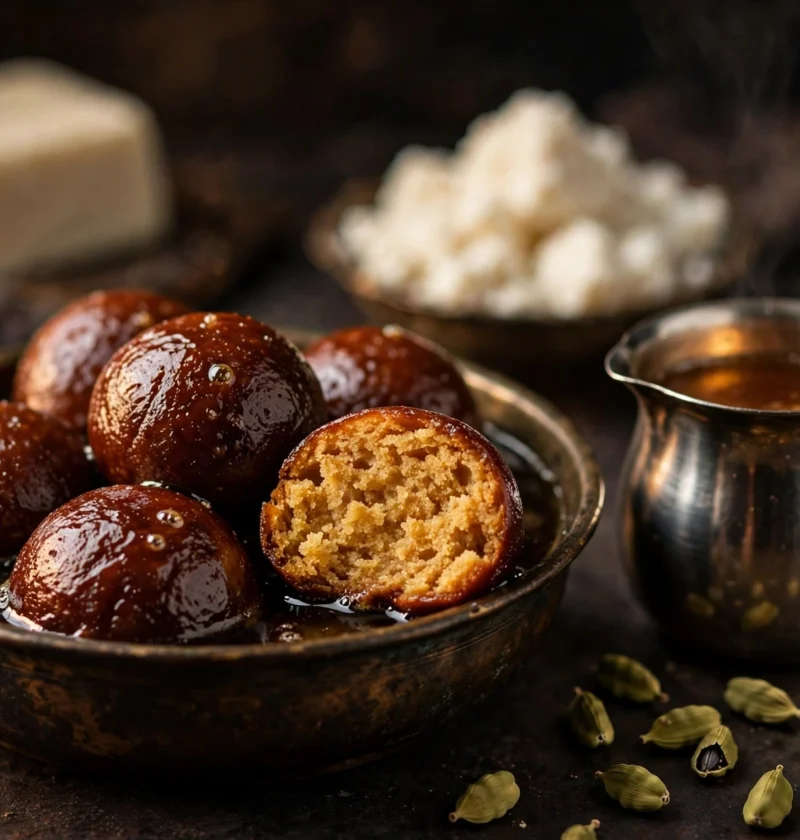
The pantua of my memory did not come in a shiny box. It came from a Kolkata sweet stall near my aunt’s house, wrapped in a twist of newspaper, still warm, syrup already seeping through the paper. I remember the colour first — almost mahogany, far darker than any gulab jamun I had eaten back home — and then the bite: dense, caramel-deep, a crumb that yielded slowly instead of melting away. When I asked the shopkeeper what made it different, he laughed: “Real chhena, and patience in the oil.” This pantua recipe is my attempt to honour both of those instructions.
It is worth saying plainly what a pantua recipe is really describing, because the sweet gets filed under gulab jamun far too often. The two are cousins, not twins. A modern gulab jamun is built on milk powder, fried to a polite golden brown, soft and almost spongy. Pantua is the older Bengali original: fresh chhena — the soft curd cheese you get by curdling milk — kneaded with khoya, the balls fried longer and lower until the outside takes on that deep, burnished colour. That extra time in the oil is not cosmetic: it caramelises the milk sugars toward toffee, and the chhena gives a density and faint tang that milk powder never delivers. Once you have eaten a proper pantua, a gulab jamun starts to feel like the rehearsal.
Why This Pantua Recipe Works
Pantua has only a handful of ingredients, so every one of them is exposed — no spice mix to hide behind, no garnish to rescue a dry centre. After several disappointing batches — cracked balls, hard middles, syrup that refused to enter — I landed on the habits below, and this pantua recipe has not failed me since:
- Fresh chhena, drained but never dry. The curd for pantua should still feel moist and slightly wobbly when you press it. Chhena that has hung too long turns crumbly, and crumbly curd makes a dough that cracks in the oil no matter how long you knead.
- Khoya does the quiet heavy lifting. Grated khoya brings concentrated milk solids and gentle sweetness, so the centre cooks up rich and close-textured instead of bready — and it lets the outside colour deeply without burning.
- The dough is kneaded until it shines. Eight to ten minutes of kneading works the fat through the chhena until the mixture turns smooth, soft and faintly glossy. Under-kneaded dough is the number one cause of cracks, and cracks are where hot oil rushes in.
- Low, slow frying — darker than you think. Pantua fries at a gentler heat than most sweets, and far longer. The balls climb from pale gold to amber to deep mahogany — that slow climb is exactly where the caramel flavour comes from.
- Warm balls meet warm syrup, then a long rest. Dropped into hot syrup, pantua develops a leathery skin; into cold syrup, it barely drinks at all. Keep both warm. Two hours is the minimum soak; overnight is better.
Ingredients
Everything in this pantua recipe revolves around two dairy staples of the Bengali sweet kitchen. The first is chhena, the fresh, unpressed curd you make by splitting hot milk with lemon juice — softer and moister than paneer, and non-negotiable here. The second is khoya, also called mawa: milk reduced slowly until it becomes a dense, fudge-like solid. You can buy both ready-made, but I urge you to make the chhena yourself at least once: fifteen unhurried minutes, and fresh curd kneads into a dough that shop-bought paneer, pressed far too firmly, cannot match. For this pantua recipe, grate a hard block of khoya on the coarse side of a box grater and let it sit out for twenty minutes to soften.
Serves 6 (makes about 15 pantua)
For the chhena (or use 1 1/2 cups fresh store-bought chhena):
- 8 cups (1/2 gallon) whole milk — not ultra-pasteurised if you can avoid it
- 1/4 cup lemon juice, stirred into 1/4 cup water (white vinegar also works)
For the dough:
- 1 1/2 cups fresh chhena, well drained but still moist
- 3/4 cup grated khoya (mawa), at room temperature
- 3 tablespoons all-purpose flour
- 1 tablespoon fine semolina (sooji) — optional, for a slightly firmer skin
- 1/4 teaspoon baking soda
- 1/2 teaspoon ground cardamom
- 1 tablespoon sugar
- A pinch of fine salt
- 1 teaspoon ghee, for greasing your palms
- About 3 cups ghee or neutral oil, for deep-frying
For the cardamom syrup:
- 2 cups sugar
- 2 1/4 cups water
- 5 green cardamom pods, bruised
- 1 teaspoon lemon juice, to stop the syrup crystallising
- 1 teaspoon rose water (optional)
- Crushed pistachios, to finish (optional)
How to Make This Pantua Recipe – Step by Step
Step 1: Make the fresh chhena from scratch. Bring the milk to a rolling boil in a heavy pot over medium heat, stirring now and then so the bottom does not catch. Take the pot off the heat, wait a full minute, then add the lemon mixture gradually — a splash, a gentle stir, another splash — until the milk separates into soft white curds drifting in pale greenish whey. Stop the moment it splits; extra acid toughens chhena and leaves a sour edge. Pour everything through a cheesecloth-lined colander and rinse the curds under cool water. Gather the cloth, twist it loosely, and hang it for about 30 minutes. You want chhena that is moist and yielding, like fresh ricotta — still dripping means ten more minutes; firm and squeaky means too far.
Step 2: Knead the chhena and khoya into a smooth, shining dough. For this pantua recipe, turn the chhena out onto a broad plate and work it with the heel of your hand for 4 to 5 minutes, pushing it away and folding it back, until the grainy curd turns into a soft, smooth mass. Add the grated khoya and knead for another 3 to 4 minutes until the two are completely married. Now sprinkle over the flour, semolina if using, baking soda, cardamom, sugar and salt, and knead for a final 2 minutes. The finished dough should be soft, smooth and slightly glossy, and not stick to your hands. Cover it with a damp cloth and rest it for 15 minutes — the pause lets the flour hydrate and makes shaping far easier.
Step 3: Roll smooth, crack-free balls. Rub a little ghee over your palms. Pinch off walnut-sized pieces of dough — about 1 tablespoon each — and roll each one between your palms with light, steady pressure until perfectly smooth and round, without a single crack or seam. Inspect each ball closely before you set it down; a tiny crack now becomes a split in the oil later. If the dough feels dry and refuses to smooth out, knead in a teaspoon of milk, no more. Keep finished balls under the damp cloth while you work so their surfaces do not dry out.
Step 4: Make the syrup, then fry low and slow to deep mahogany. First the syrup: sugar, water and the bruised cardamom pods go into a wide pan over medium heat. Once the sugar has melted and the surface starts to bubble, stir in the lemon juice and let it simmer for 4 to 5 minutes. You want it lightly sticky — thinner than honey, with no thread between finger and thumb. Park the pan over the lowest possible flame to keep it warm. In a deep, heavy pan, heat the ghee or oil to roughly 300°F (150°C) — a pinch of dough dropped in should sink, pause, then rise slowly with lazy bubbles. Slide in 6 to 7 balls at a time and fry them gently for 8 to 10 minutes, nudging them around constantly so they colour evenly, until they pass through golden and amber to a deep, even mahogany brown. This is the soul of the pantua recipe — do not pull them out early. Dark is not burnt here; dark is the flavour.
Step 5: Soak the hot pantua in warm syrup and rest them properly. Lift the fried balls out with a slotted spoon, let the oil drain for a few seconds, and lower them straight into the warm syrup. If the syrup has cooled while you fried, warm it gently until steam just rises — never boiling. Fry and soak the remaining batches the same way. Leave them submerged for at least 2 hours, turning once halfway — or, if you can bear it, overnight in the fridge, where they swell, soften through, and taste twice as good. Bring them back to room temperature — or warm them very briefly — before serving.
Serving Suggestions
Pantua is traditionally eaten warm — a gentle warm-through in its own syrup, when the centre goes almost custardy, is when it tastes most itself. Serve two per person in small bowls, syrup spooned over, with a whisper of crushed pistachio. On a Bengali sweet platter, set pantua beside its famous cousin from my gulab jamun and let guests taste the difference the chhena makes — it starts a wonderful argument. A few pale, syrup-light rasgulla on the same tray complete the chhena family portrait. A small cup of unsweetened black tea or strong masala chai alongside cuts the sweetness beautifully.
Storage and Reheating
Kept in their syrup in an airtight container, pantua stay good in the fridge for 5 to 6 days, and honestly improve over the first two days — one more reason this pantua recipe is worth making in a full batch. Always store them submerged — one left above the syrup line dries into a sad, leathery thing.
To serve from the fridge, warm them gently — the bowl set over a pan of simmering water for a few minutes, or individual portions microwaved for 20 to 30 seconds, just until the syrup loosens. Never boil them to reheat; hard boiling toughens the crumb and can split the skins. They also freeze well in their syrup for up to a month — thaw overnight in the fridge and warm as above.
Frequently Asked Questions
What is the real difference between pantua and gulab jamun?
Three things: the base, the colour and the crumb. Pantua is made from fresh chhena kneaded with khoya, while most gulab jamun today uses milk powder. Pantua is fried darker — a deep mahogany rather than golden — which builds a caramelised, almost toffee-like flavour. And the crumb of a pantua is denser and richer, where a gulab jamun is soft and spongy. Think of pantua as the original Bengali sweet and gulab jamun as its lighter, quicker descendant.
Why did my pantua come out hard and refuse to soak up syrup?
Almost always, the chhena was too dry or the oil was too hot. Chhena hung for too long loses the moisture the dough needs, and frying at high heat seals a hard crust before the centre cooks, leaving the syrup nowhere to go. Drain the curd for 30 minutes at most, fry at the gentle 300°F (150°C) this pantua recipe calls for, and make sure both the balls and the syrup are warm when they meet. If a batch does come out firm, an overnight soak in gently warmed syrup rescues most of them.
Can I use store-bought paneer or ricotta instead of making chhena?
You can, with one adjustment. Store-bought paneer is pressed much firmer than fresh chhena, so crumble it finely and knead it with a tablespoon or two of warm milk until soft and smooth before adding the khoya. Whole-milk ricotta, drained in cheesecloth for an hour, is a closer match in moisture and works very well. Do not skip the khoya, though — swapping it for milk powder changes the flavour and density enough that you are making a gulab jamun relative, not a true pantua.
Why did my pantua crack or burst while frying?
Cracks in the raw ball are the usual culprit — any seam or fissure expands the moment it meets hot oil. Knead the dough until it is completely smooth and glossy, grease your palms with ghee, and inspect every ball before frying. The other cause is violent oil — smoking-hot ghee makes the outside expand faster than the inside can follow. Keep the heat low and stir gently for the first minute so no side sits still and scorches.
Recipe Summary
- Prep time: 45 minutes (including making the chhena)
- Cook time: 30 minutes
- Total time: About 1 hour 15 minutes, plus at least 2 hours soaking
- Servings: 6
- Cuisine: Pakistani
- Course: Main Course