The first basundi I ever tasted arrived at our door in Karachi in a steel bowl with a plate for a lid, still cold from the fridge, carried over by our Gujarati neighbour’s daughter with strict instructions to return the bowl washed. Her mother made it on slow Sunday afternoons — a wide pan of milk on the lowest flame, a wooden spoon that never seemed to rest, and a house that smelled of saffron by evening. When I finally asked her what made hers so good, she tapped the side of the bowl and said the sentence I have repeated ever since: basundi is something you drink, not something you eat. This basundi recipe is hers as I remember it — silky, barely sweet, and poured ice-cold over a spoonful of slivered nuts.
Basundi is Gujarat and Maharashtra’s answer to a very specific craving: milk, reduced slowly with saffron and cardamom until it thickens just enough to coat a spoon, then chilled hard and served in bowls or glasses like a rich, fragrant drink. It is worth drawing the line clearly, because the milk desserts blur together in people’s minds. This is not rabri — rabri is reduced much further, down to a third, and eaten in thick folded layers with a spoon. And it is not kheer either, because no rice ever goes into the pan; kheer gets its body from rice cooked in the milk, while basundi gets its body from evaporation alone. Basundi stops at about half — pourable, silky, drinkable — and everything in this basundi recipe is built around stopping there.
Why This Basundi Recipe Works
Basundi asks for almost nothing — milk, sugar, saffron, cardamom — and gives back exactly what your patience puts in. Five habits are what separate a silky, pourable bowl from a scorched or watery one:
- It reduces to half, and not a spoonful further. This is the whole identity of the dish. Take the milk down to half its volume and it pours like thick cream; keep going and you have wandered into rabri country — delicious, but a different dessert with a different name. A basundi recipe lives or dies on knowing when to stop.
- The spoon keeps moving, and it scrapes. Milk scorches silently. The bottom of the pan catches, the sides dry into browned rims, and one burnt fleck can perfume the whole batch the wrong way. Stir every couple of minutes, scrape the bottom clean, and scrape the milk solids off the sides back into the pan — those soft creamy flecks are treasure, not mess.
- The skin gets stirred in, never folded. A skin will form on the surface as the milk simmers, and here is the difference from rabri in a single gesture: for basundi you stir that skin straight back in, again and again, so the texture stays uniformly silky. No layers, no strata — just smooth, even richness from top to bottom.
- Sugar goes in late. Sugar added at the start slows the reduction, and it sweetens dishonestly too — as the milk concentrates, early sugar concentrates with it and the result overshoots. Stirred in during the last ten minutes, once the milk has already reduced, the sweetness stays delicate and exactly where you put it.
- It is served properly, unapologetically cold. Chilling is not storage, it is the final step of the recipe. Warm basundi tastes like slightly thick sweet milk; the same bowl after four hours in the fridge turns silky, the saffron blooms, and the cardamom rounds out. Never serve this basundi recipe lukewarm to guests and expect them to understand it.
Ingredients
Basundi is one of the beloved sweets of Gujarati cuisine, and with a list this short there is nowhere for a poor ingredient to hide. The milk must be full-cream — this is a dessert made of milk and nothing else, so the fat is the flavour, the body and the point. Low-fat milk will simmer politely for an hour and give you thin, greyish disappointment. Freshly crushed cardamom beats the pre-ground kind by a mile, and the saffron should be real threads, steeped until the milk blushes. Everything else in this basundi recipe is patience and a heavy pan.
Serves 4
For the basundi:
- 6 cups (1 1/2 liters) full-cream whole milk
- 1/3 cup sugar, plus a spoon or two more to taste
- A generous pinch of saffron threads, steeped in 2 tablespoons warm milk
- 1/2 teaspoon ground cardamom, freshly crushed from about 8 green pods
- 1 teaspoon rose water (optional)
- A tiny pinch of freshly grated nutmeg (optional)
For serving:
- 2 tablespoons almonds, slivered
- 2 tablespoons pistachios, slivered
- 1 tablespoon charoli seeds (chironji), optional but classic
- Dried rose petals, to scatter (optional)
How to Make This Basundi Recipe – Step by Step
Step 1: Start the milk in a wide, heavy pan. Pour the milk into the widest, heaviest pan you own — width means evaporation, and a heavy base is your insurance against scorching. Bring it to a boil over medium heat, standing right there, because milk waits for the exact second you turn away to climb the sides and flood the stove. The moment it rises, drop the heat to a gentle, steady simmer — lazy bubbles at the edges, steam rising, no drama.
Step 2: Settle into the stir-and-scrape rhythm. For the next 45 minutes or so, this is your whole job: every couple of minutes, stir the milk, running the spoon firmly across the bottom and around the sides so nothing settles and catches. As a skin forms on the surface, stir it back in. As milk dries onto the sides of the pan, scrape it down in soft creamy flecks and stir those in too — they dissolve into tiny pockets of richness that make a basundi recipe taste homemade in the best way. Keep the heat patient; a violent boil toughens the milk and throws skins faster than you can stir them down.
Step 3: Reduce to half — and learn the pour test. The milk is ready when it has dropped to roughly half its original volume, turned the palest ivory, and smells faintly caramelised. Test it the way my neighbour did: lift the spoon and let the milk fall. It should pour in a smooth, unbroken ribbon, like single cream — coating the spoon, but flowing freely off it. If it drips thinly like milk, give it ten more minutes. If it plops and sits, you have gone too far (see the first FAQ — it is fixable).
Step 4: Sweeten and perfume, at the end. Now — and only now — stir in the sugar. It will loosen the basundi for a moment as it dissolves; simmer five more minutes and the body comes right back. Pour in the saffron milk and watch the whole pan turn the colour of weak sunlight, then stir in the cardamom and the pinch of nutmeg if using. Taste: the sweetness should be gentle, a background hum rather than the headline. Take the pan off the heat and stir in the rose water if you are using it.
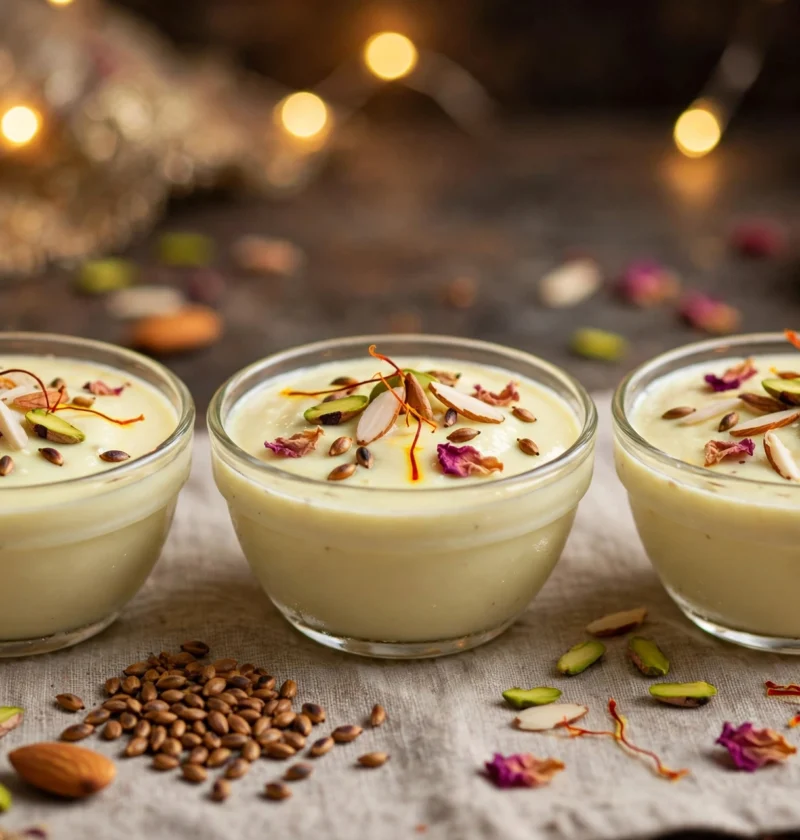
Step 5: Chill it hard, then pour. Let the basundi cool to room temperature, then cover and refrigerate for at least 4 hours — overnight is better still, and the flavour deepens noticeably by the next day. A skin will have formed on top; stir it back in for a uniform silkiness. Pour the chilled basundi into small bowls, glasses or little clay cups, crown each one with slivered almonds, pistachios and charoli seeds, and serve it exactly as it is: cold enough that the bowl sweats.
Serving Suggestions
In Surat, the classic partner is a plate of hot, puffed puris — basundi and puri is a breakfast combination people cross the city for, the warm bread torn and dipped into the cold, saffron-heavy milk. At my table it more often closes a meal: after a heavy biryani or a rich curry, a small glass of ice-cold basundi lands the way a deep breath does. Serve it in the smallest bowls you have — it is richer than it looks, and seconds are always available.
Set this beside its two cousins and the family resemblance — and the differences — become a conversation. My rabri is the eldest: reduced to a third, layered with folded malai, eaten slowly with a spoon. My kheer is the gentle one, a rice pudding where the grain melts into the milk. This basundi recipe is the middle child — no rice, no layers, just milk reduced to the exact point where it can still be drunk, and all the more elegant for it. A dessert spread with all three, in little glasses and bowls, is a short history of what slow heat does to milk.
Storage and Reheating
Basundi keeps happily in the fridge for 3 to 4 days in a sealed container, and I would argue day two is its peak — the saffron and cardamom have fully married into the milk by then. A skin will form on top in the fridge; stir it in before pouring, exactly as you did throughout the cooking. There is no reheating in this recipe at all — basundi is served cold, full stop, and warming it undoes the silky texture the chilling built. If a bowl has sat out and lost its edge, 15 minutes back in the fridge restores it better than anything. Do not freeze it: thawed basundi separates and turns grainy, the milk proteins seizing in a way no whisk can talk them out of. And if yours has thickened a shade too much in the fridge, whisk in a spoonful or two of cold milk to bring back the pour.
Frequently Asked Questions
Help — mine turned out thick like rabri. What happened?
You reduced it too far, which is the easiest mistake in any basundi recipe because the milk keeps thickening as it chills, too. Remember it sets up noticeably in the fridge, so stop the pan while it still pours like single cream. Already too thick? Whisk in a few spoonfuls of warm milk until it loosens back to a ribbon pour — nobody will ever know, and it will still taste like itself.
Why does my basundi taste scorched even though it looks fine?
A thin pan, heat a notch too high, or a few unstirred minutes is all it takes: milk solids catch on the base and their bitterness leaks through the whole batch even if you never see a brown fleck. Use your heaviest pan, keep the simmer gentle, and scrape the bottom with commitment. If you do catch it faintly and early, pour everything into a clean pan without scraping the bottom layer across, and carry on.
Can I shortcut it with condensed milk or evaporated milk?
You can stir condensed milk into hot milk and call it a day, but the result is one-note sweet and tastes of the tin — and condensed milk is already sweetened, so you lose control of the delicate balance that defines the dish. Evaporated milk gets you closer in body but skips the gentle caramelisation of a slow, fresh reduction. And low-fat fresh milk is the worst shortcut of all: no fat, no silk. This basundi recipe is an hour of light work for a reason.
Why is my basundi watery and bland?
Almost always it was under-reduced or under-chilled. If it pours like milk rather than cream, it needed more time at the simmer. And if it went to the table merely cool instead of properly cold, the flavours never woke up — chilling is when the saffron blooms and the texture turns to silk. Give it the full reduction, give it the full chill, and sweeten only at the end, tasting as you go.
Recipe Summary
- Prep time: 5 minutes
- Cook time: About 55 minutes
- Total time: 1 hour at the stove, then 4 hours or more in the fridge
- Servings: 4
- Cuisine: Pakistani
- Course: Dessert