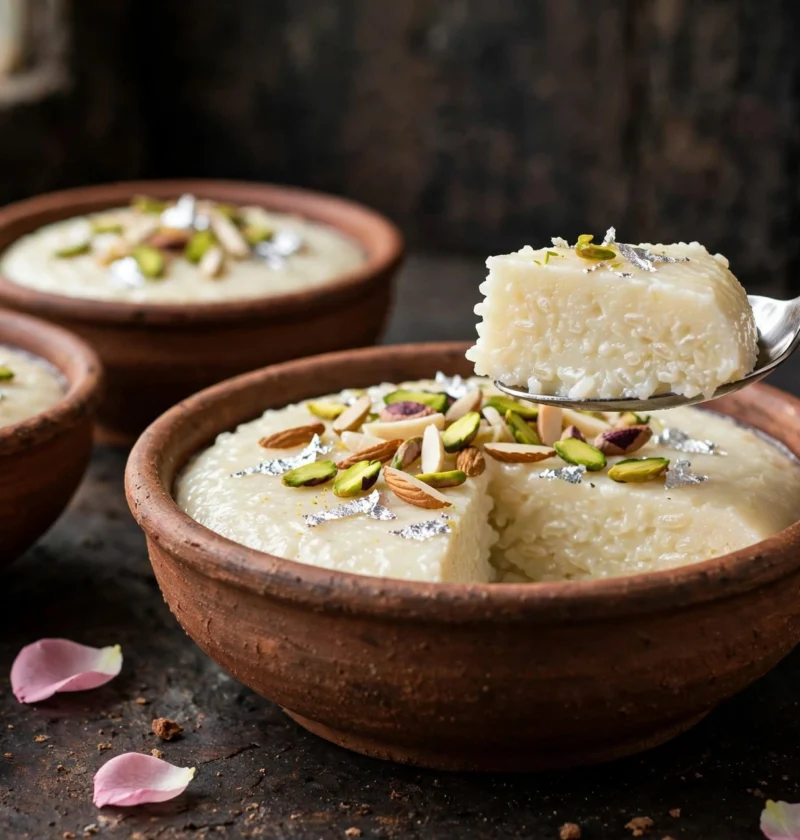
At my nani’s house, firni was never served from a big bowl. It arrived the way it had set — in small, rough clay piyalis, one per person, with a spoon that cut through the pudding with a soft, clean resistance, like slicing through cold silk. She made it the night before Eid, poured it into those little earthen bowls, and lined them up in the fridge like soldiers. By morning the tops had firmed into the faintest skin, the pistachios sat bright against the ivory, and breakfast — because in her house firni absolutely counted as breakfast — was ready. This firni recipe is hers as I remember it, rebuilt spoonful by spoonful until that clay-bowl set came back.
Firni is kheer’s smoother, more composed sister. Where kheer uses whole rice grains that stay visible in the milk, firni is made from ground rice, so the finished pudding sets into a single, seamless custard you can slice with a spoon. My first attempts missed that entirely. I tipped dry rice flour straight into boiling milk and got sweet gravel — dozens of tiny lumps that no amount of whisking could rescue. Another batch never set at all, because I was stingy with the rice and impatient with the stirring. The lessons were simple: the rice goes in as a cold slurry, the pot gets your undivided attention for fifteen minutes, and the fridge does the rest. Follow those rules and this firni recipe sets perfectly, every single time.
Why This Firni Recipe Works
Firni fails as lumps, as a pot that never thickens, or as scorched milk wearing a cardamom disguise. This firni recipe is built around the three techniques that prevent all of it:
- The rice enters the milk as a cold slurry. Ground rice whisked into cold milk first, then streamed slowly into the hot pot, can never clump — each particle is already separated and coated before it meets the heat. Dumping the powder in dry is the single most common firni disaster, and the slurry makes it impossible.
- Freshly ground soaked rice beats store-bought flour. Rice soaked for two hours and ground at home gives firni a silkier body and a faint, fresh rice perfume that bagged flour — milled who knows when — can’t match. Rice flour absolutely works in this firni recipe, but if you have a blender and two hours, the soaked version is noticeably better.
- The stirring never stops once the rice goes in. Ground rice sinks, settles on the base of the pot, and scorches in under a minute of neglect. A wooden spoon in constant motion, scraping the bottom in wide circles, keeps the thickening even and the milk sweet. Fifteen minutes of stirring is the entire price of a perfect set.
- The rose water goes in off the heat. Rose water’s perfume is volatile — boil it for five minutes and you’ve paid for aroma that evaporated. Stirred in after the pot leaves the stove, it blooms through the warm pudding and stays there. Cardamom, which is sturdier, cooks in with the sugar; rose waits for the end.
- It sets in individual clay bowls, not one big dish. Small bowls chill faster and more evenly than a single deep vessel, so the texture is uniform from edge to center. The porous clay also wicks away a whisper of moisture, firming the surface into that classic firni top. And there’s no serving scramble — each guest gets their own bowl.
Ingredients
Serves 6
For the firni:
- 1/4 cup (50g) basmati rice, rinsed and soaked for 2 hours (or 1/3 cup / 40g rice flour)
- 4 cups (1 liter) whole milk, plus 1/2 cup cold milk for the slurry
- 1/2 cup (100g) sugar, adjusted to taste
- 1/2 teaspoon ground green cardamom
- 1 tablespoon rose water
- A few saffron strands (optional)
For the garnish:
- 2 tablespoons pistachios, slivered
- 1 tablespoon almonds, slivered
- Edible silver leaf (varq), optional
- 6 small clay bowls (mitti ki piyali) or ramekins
A note on the ingredients: firni belongs to the great family of rice pudding found across Asia and the Middle East, and its flavor rests almost entirely on good milk and fresh cardamom. Use whole milk without apology — in this firni recipe, the set depends on its richness. If your cardamom powder has been sitting open for a year, replace it; in a dish this simple, stale spice has nowhere to hide. If you’re using the optional saffron, soak the strands in a tablespoon of warm milk for ten minutes and add them with the sugar.
How to Make This Firni Recipe – Step by Step
Step 1: Prepare the rice.
Drain the soaked rice and blend it with 1/2 cup of cold milk until you have a smooth, pourable slurry with no grit when rubbed between your fingers — this can take a full minute of blending, and it’s worth it. If you’re using rice flour instead, whisk it into the cold milk until completely smooth and lump-free. Either way, your slurry should pour like thin cream. Set it within reach of the stove; once the milk is hot, things move steadily.
Step 2: Heat and slightly reduce the milk.
Warm the 4 cups of milk in a heavy-bottomed pot over medium heat until it reaches a gentle boil, stirring now and then so a skin doesn’t form and the base doesn’t catch. Let it simmer for 8 to 10 minutes, reducing just slightly — this concentrates the milk’s flavor and gives the firni a head start on richness. Keep the heat moderate; milk that boils violently is milk that’s about to scorch.
Step 3: Add the slurry and stir without stopping.
Lower the heat to medium-low. Give the slurry a final whisk, then pour it into the hot milk in a slow, thin stream, stirring the pot constantly with your other hand. Now stir — properly stir, scraping the bottom and sides — for 10 to 12 minutes as the mixture thickens. It will go from milky, to coating the spoon, to a slow, glossy custard that leaves a clear trail when you drag the spoon across the base of the pot. That trail is your signal.
Step 4: Sweeten and perfume.
Stir in the sugar and the ground cardamom (and the saffron milk, if using). Cook for 2 to 3 more minutes, stirring, until the sugar has fully dissolved and the firni is thick enough to hold soft peaks on the spoon. Remember it will firm up considerably as it chills, so don’t chase the final set on the stove. Take the pot off the heat and stir in the rose water. Taste — the sweetness should feel a touch bold, because chilling mutes it.
Step 5: Pour, chill, and garnish.
Divide the hot firni among the clay bowls, filling each to just below the rim. Let them cool at room temperature for 20 to 30 minutes, then cover and refrigerate for at least 4 hours, or overnight for the cleanest set. Just before serving, scatter the pistachios and almonds over each bowl and add a small square of silver leaf if you’re using it. Garnishing at the last moment keeps the nuts crisp against the cold, smooth pudding.
Serving Suggestions
Firni is a make-ahead gift to anyone hosting a dawat: it waits in the fridge, perfectly set, while you deal with the biryani chaos. Serve it straight from its clay bowls, very cold, after a heavy meal — a spicy biryani followed by cool, delicately perfumed firni is one of the great closing sequences in desi cooking. At Eid it goes out with the sheer khurma; at my table it usually follows a rich curry night, when nobody has room for cake but everyone somehow finds room for this firni recipe.
If you love milk-based desserts, compare this firni recipe with my kheer — same pantry, same cardamom, but whole grains and a pourable warmth instead of firni’s cool, clean slice. And for the full old-school dessert course, my rabri spooned over the top of a firni bowl is exactly the kind of excess my nani would have approved of.
Storage and Serving
Firni keeps beautifully in the fridge for up to 3 days, covered — which is exactly what makes this firni recipe such a reliable make-ahead dessert. In fact, most people find day-two firni the best of all: the set is at its firmest and the cardamom and rose have settled fully into the pudding. Serve it directly from the fridge, always cold; firni is never reheated, and warming it would undo the set entirely. Garnish each bowl fresh when you serve, even for leftovers, so the nuts stay crisp. I don’t recommend freezing firni — thawed, the texture turns watery and grainy, and the clean slice is lost. If the tops form a thin skin during chilling, that’s traditional and most firni lovers consider it a feature, not a flaw.
Frequently Asked Questions
What’s the difference between firni and kheer?
Both are cardamom-scented milk puddings, but firni is made from ground rice and sets firm enough to slice, served cold in individual bowls. Kheer uses whole rice grains, stays pourable, and is often served warm or at room temperature. Think of this firni recipe as the family’s set custard, and kheer as its porridge.
Why is my firni lumpy?
Almost certainly the rice met the hot milk while dry or under-whisked. The fix is the slurry: blend the soaked rice (or whisk the rice flour) into cold milk until it pours like thin cream, then stream it into the pot slowly while stirring constantly. Lumps that have already formed can sometimes be rescued with an immersion blender before the pudding sets.
My firni didn’t set. What went wrong?
Either the rice proportion was too low, the milk quantity crept up, or the pudding didn’t cook long enough to reach that clear-trail stage on the spoon. Firni should leave the stove looking like a thick, slow custard — it firms as it chills, but it can’t set from a thin base. Next time, cook it a few minutes longer; if a finished batch is soft, serve it in glasses as a drinkable dessert and call it a variation.
Can I make firni without clay bowls?
Yes — ramekins, small glass bowls, or even teacups all set firni perfectly well. The clay is tradition and charm (plus that slight firming of the surface), not a requirement. Whatever you use, pick individual portions rather than one large dish, so each serving chills evenly and carries its own garnish.
Recipe Summary
- Prep time: 10 minutes (plus 2 hours soaking the rice)
- Cook time: 25 minutes
- Total time: 35 minutes (plus at least 4 hours chilling)
- Servings: 6
- Cuisine: Pakistani
- Course: Dessert