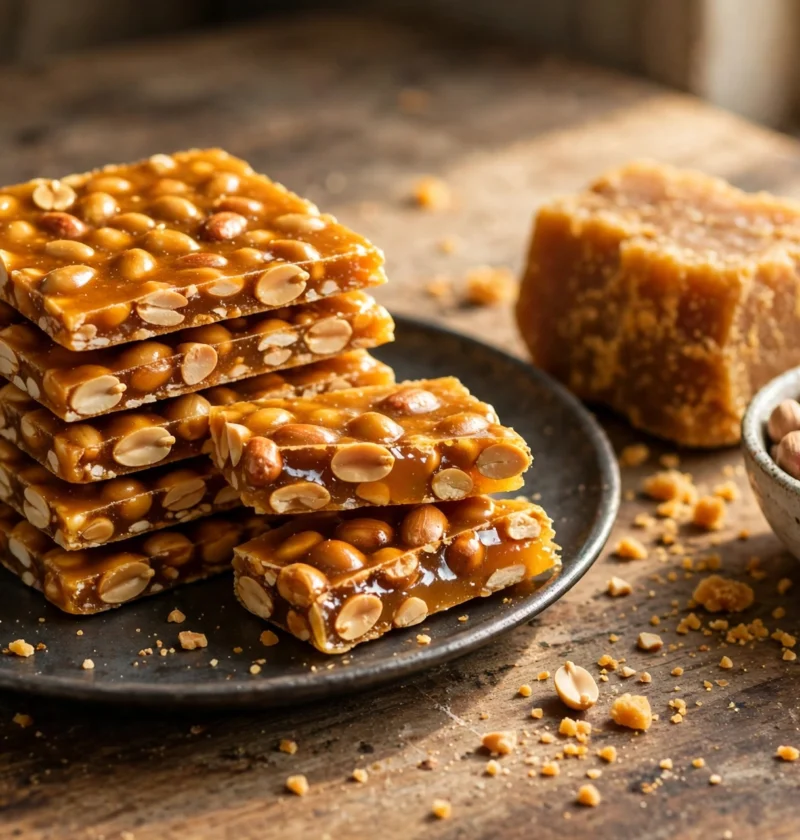
My peanut chikki recipe starts with a sound I have loved since childhood: the crack of a brittle slab being broken at a railway station stall, loud enough to hear over the announcements. On long journeys, my father would buy chikki wrapped in old newspaper — sheet after sheet of it, amber and shining — and my brother and I would argue over who got the piece with the most peanuts. Years later, standing in my own kitchen with a pan of bubbling jaggery, I realised I was not really chasing a sweet. I was chasing that sound.
Chikki belongs to the same jaggery family as our winter laddoos and barfis, but it plays by completely different rules. A laddu is rolled soft and eaten chewy; a barfi is a gentle fudge. Chikki is a brittle — a thin sheet of jaggery glass studded with roasted peanuts, hard enough to snap cleanly between your fingers and keep in a tin for weeks without going sad. Around our side of the world it is called moongphali chikki or gur patti, and it asks for no milk, no khoya and almost no ghee. What it asks for instead is timing: one syrup cooked to exactly the right stage, and the confidence to move fast once it gets there.
Why This Peanut Chikki Recipe Works
Three-ingredient sweets are unforgiving, because the technique is the recipe. This peanut chikki recipe works because every step protects the one thing that makes chikki chikki — the snap:
- The jaggery is cooked to a true hard-crack, not a hopeful guess. Syrup stopped at the soft-ball stage makes a chikki that bends, sticks to your teeth and weeps in the tin within days. Taken all the way to hard-crack, the same syrup sets into glass: shiny, dry to the touch, and loud when you break it.
- The peanuts go in warm, never cold. Cold nuts dropped into hot syrup drag the temperature down in seconds, and the whole mass can seize into a lumpy tangle before it reaches the board. Warm peanuts keep the syrup flowing long enough to coat every piece evenly.
- A pinch of baking soda lightens the bite. It foams invisibly in the hot syrup, leaving microscopic bubbles through the brittle. The sheet still snaps, but it shatters kindly instead of fighting your teeth like a slab of toffee.
- It is rolled thin — a quarter inch, no more. Thickness is destiny with brittle. A thick slab is a jaw workout; a thin sheet breaks into elegant shards, shows off the peanuts suspended in the amber, and stays crisp to the last piece in the tin.
- Everything is staged before the syrup starts. Once jaggery hits hard-crack it will not wait while you hunt for a rolling pin. Board greased, knife out, peanuts warm beside the stove — this recipe succeeds or fails in the two minutes before the pan goes on the heat.
Ingredients for This Peanut Chikki Recipe
At its heart, chikki is the subcontinent’s answer to peanut brittle, a travelling sweet built for railway journeys and winter pockets: nuts set in caramelised sweetener, nothing perishable anywhere near it. The sweetener matters. Jaggery — gur, the unrefined cane sugar sold in amber blocks — brings a deep, almost smoky caramel flavour that white sugar simply cannot imitate, along with that dark honey colour. Buy the darkest, softest block you can find, the kind that yields when you press a thumbnail into it; pale, rock-hard jaggery is usually old and dusty-tasting. Raw peanuts with skins on are traditional and cheapest, and roasting them yourself takes ten minutes. Everything in this peanut chikki recipe is probably already in your kitchen — the real ingredient is attention.
For the chikki
- 2 cups raw peanuts with skins (about 10 ounces / 290 g) — or plain roasted unsalted peanuts if you want to skip Step 1
- 1 1/2 cups grated or finely chopped jaggery (about 9 ounces / 260 g), loosely packed
- 2 tablespoons water
- 1 teaspoon ghee, plus a little extra for greasing the board and rolling pin
- 1/8 teaspoon baking soda
- 1/8 teaspoon fine sea salt
- 1/4 teaspoon ground cardamom (optional, but lovely)
How to Make This Peanut Chikki Recipe – Step by Step
Step 1: Roast the peanuts and rub the skins away. Tip the raw peanuts into a dry, heavy pan or karahi over medium-low heat and roast them, stirring almost constantly, for 8 to 10 minutes. You are listening as much as looking: the skins will loosen and split, the nuts will take on deeper golden spots, and the raw, beany smell will give way to something warm and nutty. Slide them onto a clean kitchen towel, fold the towel over, and rub the bundle briskly between your palms — most of the papery skins will flake right off. Tip the nuts into a colander and shake away the loose skins over the bin. Leave the peanuts in the warm pan, off the heat, so they stay warm while the syrup cooks.
Step 2: Build your rolling station before any syrup exists. This step takes ninety seconds and saves the whole batch. Grease a marble slab, a large baking sheet turned upside down, or a sheet of parchment paper with a thin film of ghee, and grease your rolling pin and a large knife too. Measure the baking soda, salt and cardamom into a tiny bowl beside the stove. Put a small bowl of cold water within reach for testing the syrup. From the moment the jaggery melts, this peanut chikki recipe moves at syrup speed, and syrup speed does not include opening drawers.
Step 3: Cook the jaggery all the way to hard-crack. Put the grated jaggery and the water in a heavy, light-coloured pan over medium heat and let it melt, stirring gently, until it dissolves into a dark, foaming liquid — about 3 to 4 minutes. If your jaggery looked gritty, strain it through a fine sieve into a fresh pan and put it back on the heat. Now stop stirring and let it bubble, watching the foam settle and the bubbles grow slower and larger. Start testing after about 4 minutes: drop a little syrup into the cold water, wait a few seconds, then fish it out. Soft and squashy means keep going. What you want is a drop that hardens instantly into a firm bead that snaps — cleanly, with a tiny click — instead of bending. On a thermometer that is 295–310°F (146–155°C). At the hard-crack moment the syrup also turns visibly glossier and smells like deep caramel rather than raw gur.
Step 4: Fold in the peanuts and roll it thin, fast. Take the pan off the heat. Sprinkle in the baking soda, salt and cardamom — the syrup will puff and foam for a second — then tip in all the warm peanuts at once and stir hard with the spatula until every nut is lacquered. Working quickly, scrape the whole mass onto your greased surface. Lay a greased sheet of parchment over the top and roll firmly from the centre outward into an even sheet about 1/4 inch (6 mm) thick. Peel the parchment away while the sheet is still warm and glossy. You have perhaps two minutes of easy rolling before the edges begin to firm up, so commit and roll with confidence.
Step 5: Score it, cool it completely, then snap. While the sheet is still warm and just pliable, run your greased knife across it to score deep lines — squares of about 2 inches are classic, diamonds if you are feeling like a halwai. Do not try to separate the pieces yet. Leave the slab completely undisturbed for 20 to 30 minutes, until it is stone cold and hard all the way through; warm chikki bends, cold chikki snaps. Then lift the sheet and break it along the scored lines with your hands. That first clean crack — the sound I travelled by train to hear — tells you the syrup went far enough. Any misshapen edge pieces are the cook’s tax. Eat them standing at the counter.
Serving Suggestions
Chikki is a companion sweet rather than a dessert course: a square or two with afternoon chai, a piece tucked into a lunchbox, a shard passed around the car on a long drive. It is the sweet I hand to guests who claim they do not want dessert, because nobody refuses something that looks like amber glass. For a festival tin or a gift box, I like to mix textures from this same family of sweets — my soft, chewy til laddu, rolled warm from sesame and jaggery, and a few slabs of the gentle, milky besan barfi beside the brittle. The contrast is the whole pleasure: two of them yield, one of them snaps. Wrap chikki pieces in small squares of parchment if you are gifting them; stacked bare, the surfaces can kiss and stick.
Storage and Reheating
Storage is where brittle quietly beats every other sweet on this site. Kept in an airtight tin at cool room temperature, this peanut chikki recipe stays crisp and shiny for 3 to 4 weeks — no fridge, no fuss. Layer the pieces between small sheets of parchment so the faces do not stick, and keep the tin away from the stove’s steam. Humidity is the only real enemy: on damp, monsoon-style days the surface can turn faintly tacky as the jaggery drinks moisture from the air. There is no reheating, honestly — chikki is eaten at room temperature, straight from the tin. But if a humid week has softened a batch, spread the pieces on a tray in a low oven at 200°F (95°C) for 5 minutes, cool them completely, and the snap comes back. Do not refrigerate it; the cold, damp fridge air dulls the shine and invites exactly the stickiness you are avoiding.
Frequently Asked Questions
How do I test the jaggery syrup without a thermometer?
Use the cold-water test, the same one halwais have trusted for generations. Keep a small bowl of cold water beside the stove. Drop in half a teaspoon of syrup, wait five seconds, and pick the drop up between your fingers. At the soft-ball stage it flattens like soft toffee — that makes chewy chikki, so keep cooking. At the hard-ball stage it holds a firm ball but still yields when you press it. You are waiting for the stage past that: the drop sets into a hard, glassy bead that snaps with a click when you try to bend it and shatters rather than denting. That snap in the water is the exact snap you will get on the plate, so let the water test do the judging.
Why did my chikki turn out chewy and sticky instead of crisp?
Almost always, the syrup stopped early. Even two minutes short of hard-crack leaves enough water in the jaggery for a bendy, tooth-sticking set, and humid weather can make a borderline batch worse. The good news is that chikki forgives a rescue: scrape the soft slab back into the pan, melt it gently, and cook it again, properly this time, testing in cold water until the drop snaps. It will be a shade darker from the double cooking, and nobody will ever know.
Can I make this peanut chikki recipe with sugar instead of jaggery?
You can, and what you get is classic peanut brittle — paler, sweeter in a simpler way, and perfectly crisp if you cook it to the same hard-crack stage. What you lose is jaggery’s deep, earthy caramel flavour, the thing that makes chikki taste like itself. A fair middle path is half jaggery and half dark brown sugar, which keeps most of the character. If you do go all-sugar, add the water as written and watch the colour, not the clock: pale syrup makes pale brittle, deep amber makes the flavour worth having.
Can I swap the peanuts for other nuts or seeds?
Happily — chikki is a method more than a single recipe. Almonds, cashews and pistachios all work; roast them gently first and keep the total volume at 2 cups. A peanut-and-sesame half-and-half sheet is a winter favourite in my house, and sunflower seeds make a lighter, cheaper slab that still snaps beautifully. Whole nuts give you a chunky, rustic sheet; roughly chopped nuts pack tighter and slice cleaner. Whichever you choose, the rules do not change: nuts warm, syrup at hard-crack, roll it thin.
Recipe Summary
- Prep time: 15 minutes
- Cook time: 15 minutes
- Total time: About 1 hour, including cooling
- Servings: About 16 squares
- Cuisine: Pakistani
- Course: Dessert


