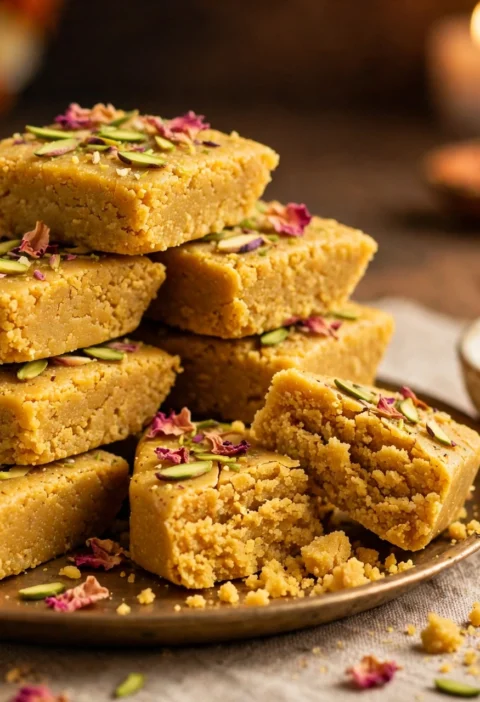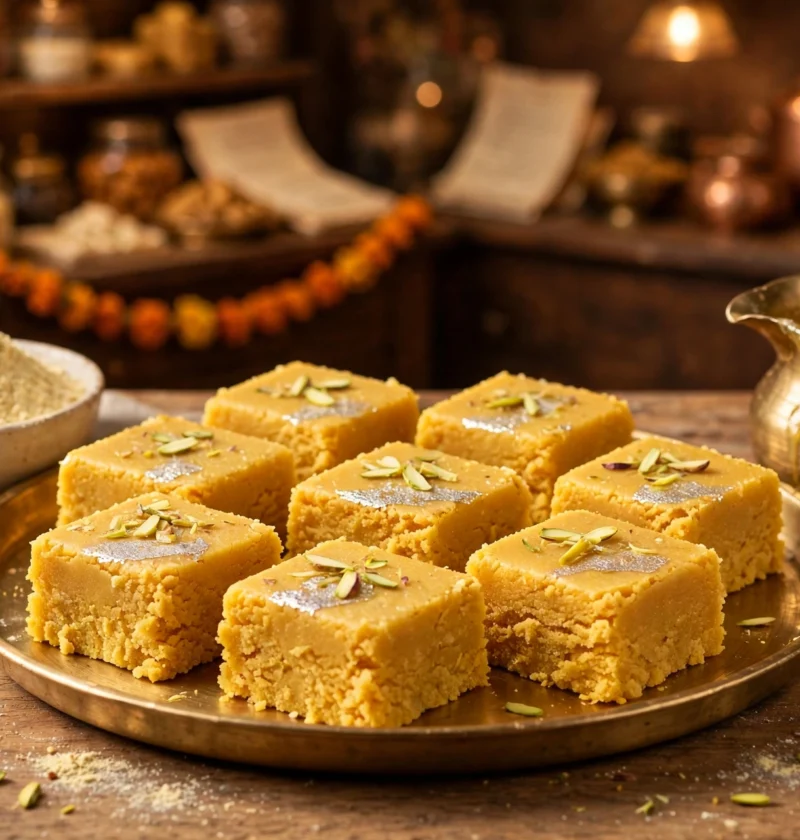
In our house, you could smell a besan barfi recipe before you ever saw it. The moment my mother set besan to roast in ghee, that warm, nutty perfume drifted out of the kitchen and down the hall, and my brothers and I would materialise like cats. She never bought besan barfi from the halwai — she said shop barfi was either sweet cardboard or a ghee puddle, and neither was worth money. Hers set into squares so soft they slumped a little if you held them too long in a warm hand, and they carried the deep, toasted flavour of flour roasted with patience. This besan barfi recipe is hers, written down at last.
Besan barfi is a fudge, but not a milk fudge. No long milk reduction, no khoya doing the heavy lifting — the body of the sweet is gram flour itself, roasted in ghee until it turns the colour of light caramel and loses every trace of its raw, pasty smell. My early attempts taught me the two ways it fails: pull the besan off the heat too soon and the barfi tastes like sweetened raw dough; overcook the sugar syrup and it sets into something you could tile a floor with. Everything in this besan barfi recipe — the slow roast, the one-string syrup, the short rest — exists to land you exactly between those two disasters.
Why This Besan Barfi Recipe Works
Besan barfi has only four real ingredients, which means there is nowhere for a mistake to hide. This besan barfi recipe is built on the five habits that decide whether the squares come out silky or sad:
- The besan is sifted before it touches the pan. Gram flour lumps if you so much as look at it, and a lump that survives into hot ghee roasts on the outside and stays raw in the middle. Thirty seconds through a sieve at the start of this besan barfi recipe saves you from gritty pockets later.
- A spoon of semolina builds the grain. Halwai barfi has a gentle, sandy dana — a fine grain your tongue can feel. One tablespoon of fine semolina roasted along with the besan gives this besan barfi recipe that texture honestly, instead of under-roasted flour faking it.
- The roast is low, slow, and judged by smell. Besan goes from pale to perfect to scorched in a blink. Kept over low heat and stirred without pause, it deepens gradually and the kitchen fills with a toasted, nutty smell. When the raw smell is completely gone, the roast in this besan barfi recipe is done — not one minute before.
- The syrup stops at one string. A drop of syrup cooled between thumb and forefinger should stretch into a single thread. Thinner than that and the barfi sulks and never sets; thicker and it hardens as it cools. That one-string moment is the whole setting secret of a besan barfi recipe.
- The squares are cut warm, not cold. Scoring it while it is still supple — about fifteen minutes in — gives clean edges; wait until it is fully cold and it cracks along its own lines, not yours.
Ingredients for This Besan Barfi Recipe
Everything here hangs on the flour. Gram flour — besan, milled from split brown chickpeas — behaves nothing like wheat flour: it is thirstier, denser, and carries a beany rawness when undercooked that no sugar can cover. Buy it fresh, because old besan picks up a stale, cupboard smell that survives roasting. The sweet it becomes, barfi, is the great tray-set fudge of the subcontinent, cut into squares or diamonds and named for its snow-white milk versions — this golden besan barfi recipe is the rustic cousin.
For the roasted besan base
- 2 cups besan / gram flour (about 8 1/2 ounces / 240 g), sifted
- 3/4 cup ghee (6 ounces / 170 g)
- 1 tablespoon fine semolina (suji) — the grain-maker, do not skip it
- 2 tablespoons milk powder — stirred in at the end for a softer, fudgier set
For the sugar syrup
- 1 cup granulated sugar (7 ounces / 200 g)
- 1/2 cup water (120 ml)
- A small pinch of saffron threads (optional, for colour more than flavour)
To finish
- 1/2 teaspoon ground green cardamom
- 2 tablespoons slivered pistachios
- 1 tablespoon slivered almonds (optional)
- Edible silver leaf (varq), if you are feeling festive
How to Make This Besan Barfi Recipe – Step by Step
Step 1: Prep the tray and sift the flour. Grease an 8-inch square tin or a steel thali with a smear of ghee and set it within arm’s reach of the stove — the end of this recipe moves fast. Sift the besan into a bowl, break up every lump with your fingers, and stir the semolina through. This unglamorous minute stands between you and a smooth besan barfi recipe — lumps discovered in hot ghee cannot be rescued.
Step 2: Roast the besan in ghee, low and slow. Melt the ghee in your heaviest, widest pan over low heat. Tip in the besan mixture and stir it in until every grain is coated — it will look like wet sand, then slacken into a thick, flowing paste as it warms. Now settle in for 12 to 15 minutes of constant stirring, scraping the base and corners in slow figure-eights. The paste will darken in stages: pale gold, then biscuit, then the deep amber of strong tea. Trust your nose over the clock. Raw besan smells like a flour sack; finished besan smells like roasted nuts and warm ghee. The moment that second smell takes over the kitchen, the base of your besan barfi recipe is ready.
Step 3: Make the one-string syrup. While the besan roasts — or just after, if stirring two pans at once is beyond you — combine the sugar, water, and saffron in a small saucepan over medium heat. Stir until the sugar dissolves completely, then bring it to a steady boil and give it three to four minutes. Test it the way my mother taught me: touch a drop between thumb and forefinger, let it cool for a breath, then pull them slowly apart. One single thread that stretches without snapping straight away means you are there. Take the pan off the heat immediately; syrup keeps cooking in its own heat, and in a besan barfi recipe, overshooting this thread is how fudge becomes furniture.
Step 4: Marry the syrup to the besan. With the roasted besan still over the lowest flame, pour the hot syrup in a slow, steady stream, stirring hard and without stopping — it will hiss, swell, and splash if you rush it, so stand back as you pour. Keep stirring for 3 to 4 minutes as the mixture thickens into one glossy mass and starts pulling away from the sides of the pan, leaving a shine of ghee at the edges. Stir in the cardamom and the milk powder in the final half-minute. When a spoon drawn through the middle leaves a trail that closes slowly, your besan barfi recipe has reached setting point.
Step 5: Set, garnish, rest, and cut. Scrape the mixture into your prepared tray at once and level the top with the back of a greased spoon or a flat spatula — work quickly, it firms as you watch. Scatter the pistachios and almonds over the surface and press them in gently so they set into the top. Leave the tray alone at room temperature for 1 to 2 hours. At the fifteen-minute mark, while it is still supple, score deep lines into squares or diamonds with a greased knife. Once fully set, lift the pieces out along your cuts. That first square — warm-smelling, grainy-soft, dissolving on the tongue — is the besan barfi recipe working exactly as it should.
Serving Suggestions
Besan barfi is mithai-hour food: a square or two with strong, unsweetened chai in the late afternoon, or the final sweet note after a heavy dinner, when something small and rich closes the meal best. On a festival tray it holds its golden corner proudly between the white sweets — set it beside my milk barfi, all pale and milky, and my coconut barfi, soft and snowy, and the three together show how one tray format can carry three completely different souls. A small box of it, tied with string, is my favourite thing to carry to a dinner invitation.
One family note, because the confusion is real: this besan barfi recipe is the close cousin of besan ladoo, which this site also carries. Same roasted flour, same ghee, same cardamom — but a ladoo is shaped by hand around powdered sugar and stays tender and crumbly, while barfi is set with cooked syrup and sliced, so it keeps a cleaner, fudgier bite. If you have ever wondered which one your memory is describing, ask whether it was a ball or a square. It is always one or the other.
Storage and Reheating
This besan barfi recipe stores the way mithai has always stored: calmly, at room temperature, in an airtight tin. Kept away from heat and strong smells, the squares stay good for a week, and the flavour of the roasted besan deepens over the first two or three days. In a warm kitchen or a humid spell, move the tin to the fridge, where it will keep for up to three weeks — the texture turns firmer and denser cold, which some people in my family genuinely prefer.
There is no reheating to speak of, and please do not go looking for any: hot barfi sweats ghee and slumps. If your squares have come out of the fridge firm, simply leave them on a plate at room temperature for 20 to 30 minutes and they soften back to that fudge bite on their own. A five-second microwave burst per square is the impatient shortcut and it works, but stop there — ten seconds and you are eating sweet besan soup. It also freezes for up to two months, well wrapped; thaw overnight in the fridge, then rest on the counter before serving.
Frequently Asked Questions
Why did my besan barfi turn hard — or refuse to set at all?
Both failures live in the syrup, in opposite directions. Barfi that sets rock-hard almost always means the syrup cooked past one string toward two, or the besan mixture was stirred too long after the syrup went in and dried out. Barfi that stays a soft spoon-sweet means the syrup never reached one string, or the besan was under-roasted and still holding moisture. The fix for next time is the thumb-and-forefinger test done patiently, and a hard batch can be rescued: crumble it, warm it through with 2 or 3 tablespoons of milk, and reset it — softer than intended, still delicious.
How do I know the besan is roasted enough?
Three signs arrive together. The colour deepens from pale yellow to a warm amber, like strong tea. The paste loosens, flows more freely, and ghee glistens at the edges instead of being swallowed by the flour. And the smell changes completely — raw and beany at first, then nutty and toasted, drifting into rooms beyond the kitchen. If you are unsure, give it one more minute; patience has never ruined a besan barfi recipe, while under-roasting ruins it every time.
Can I cut the ghee or the sugar?
Modestly, yes; drastically, and you are making a different sweet. Ghee can come down to about 1/2 cup if your pan is heavy and your stirring arm is honest, but the roast will be less even and the set a little drier. Sugar can drop to 3/4 cup for a gentler sweetness, though the syrup thread forms faster, so watch it closely. Cut both at once, though, and you have only yourself to blame — this is a celebration fudge, and it asks to be eaten in small, happy squares.
My barfi tastes fine but looks dull and rough on top. What happened?
Almost certainly, the top was levelled too late or with a dry spoon. The surface of a besan barfi recipe begins firming within a minute of leaving the pan, so scrape, spread, and smooth in one confident motion, with a ghee-slicked spoon, and scatter the nuts at once, while the top is still glossy enough to hold them. A slightly rough top, though, is only a looks problem — crumble that batch over warm custard or ice cream and nobody will ask questions.
Recipe Summary
- Prep time: 10 minutes
- Cook time: 25 minutes
- Total time: About 35 minutes, plus 1 to 2 hours setting
- Servings: 12 squares
- Cuisine: Pakistani
- Course: Dessert