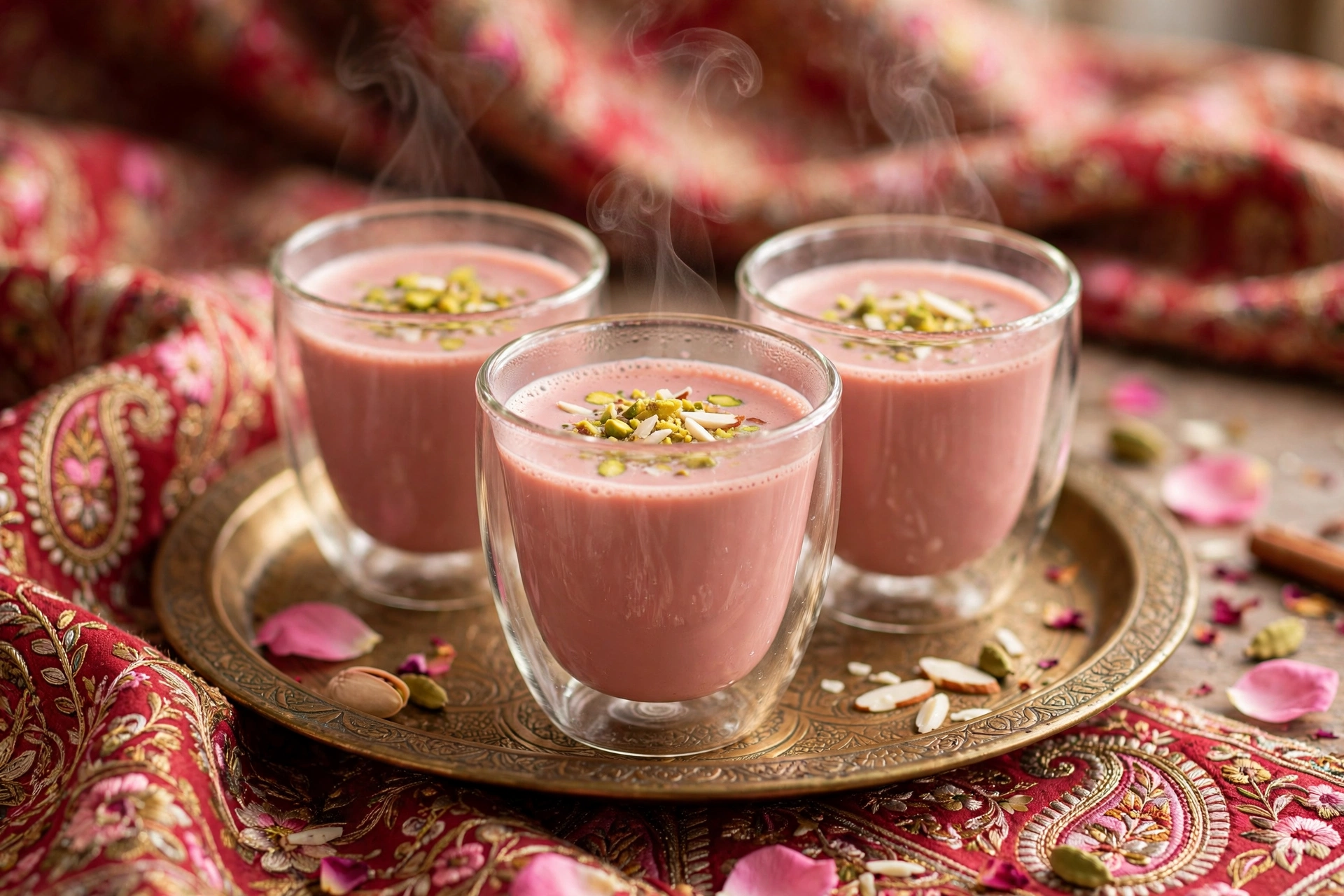
I met this sol kadhi recipe the way most people do — in a state of emergency. My friend Reema’s mother in Karachi, the same Goan-born cook who once fed me a fish curry that nearly took the top of my head off, slid a tall glass of something pale pink across the table without a word. I drank half of it in one go. The fire in my mouth simply… stopped. In its place was this cool, sour, faintly savoury drink, coconut-soft, with the ghost of garlic at the end. She refilled my glass and finally smiled. “That,” she said, “is what the curry is for. The kadhi is the point.”
Our own table is a Punjabi one, and our coolers have always come from the yogurt pot — lassis, chaas, things whisked from dahi. This pink glass was something else entirely: no yogurt, no cooking, no sweetness to speak of. It is a coastal drink, born where kokum trees and coconut palms grow in the same soil, and we adopted it the way you adopt anything that saves your life at dinner — completely, and forever. It is a fire extinguisher and a digestif in one glass, and since that night it has stood next to every fiery fish curry in my house.
Why This Sol Kadhi Recipe Works
With barely a handful of ingredients, sol kadhi gives every small choice nowhere to hide. Here is what makes this sol kadhi recipe the one that tastes like Reema’s mother’s:
- The kokum soaks, it is never boiled. Warm water coaxes the colour and sourness out of the petals gently. Boiling drags out bitterness and turns the beautiful blush muddy.
- The coconut milk is uncooked and added off any heat. Heat is this drink’s enemy — it splits coconut milk into grainy sadness. Everything here happens cold or barely warm, and the glass is served properly chilled.
- Salt is the volume knob. Kokum without enough salt tastes thin and sharp; correctly salted, the sourness rounds out and the coconut tastes richer. Season boldly, then taste again.
- The garlic is a whisper, never a shout. One small clove for four glasses, crushed to a paste so it disappears into the drink. You should wonder what that savoury depth is — not know.
- It rests before it is served. Twenty minutes in the fridge lets the kokum keep tinting, the garlic settle in, and the whole glass turn into one flavour instead of three polite strangers.
Ingredients for This Sol Kadhi Recipe
Two ingredients do nearly all the work here, and both deserve a sentence. The sour soul of the drink is Garcinia indica — kokum — whose dried rind petals are dropped into warm water all along the Konkan coast; look for petals that are deep purple-black, pliable rather than brittle, and faintly smoky-sweet when you open the packet. The body of the drink is coconut milk, and fresh is the gold standard: the first press of grated coconut, thick and fragrant. Buy an extra coconut and make more than you need — nobody in the history of this drink has complained about a second glass.
For the kokum water
- 10 to 12 dried kokum petals (about 1/2 ounce / 15 g)
- 1 1/2 cups (360 ml) warm water — hot from the tap, not boiling
- 1/2 teaspoon fine sea salt, plus more to taste
For the sol kadhi
- 2 cups (480 ml) fresh coconut milk, first press if possible (or canned, see the FAQs)
- 1 small garlic clove, crushed to a smooth paste with a pinch of salt
- 1 small green chili, slit lengthwise (not chopped — you want perfume, not landmines)
- A tiny pinch of sugar, about 1/8 teaspoon (optional, only if your kokum is fiercely sour)
- 2 tablespoons finely chopped fresh cilantro, plus a few leaves to serve
- Ice cubes, for serving
How to Make This Sol Kadhi Recipe – Step by Step
Step 1: Rinse and soak the kokum. Give the kokum petals a quick rinse under running water — they can carry a little dust from drying yards — then drop them into a bowl with the warm water and the salt. Leave them for 30 to 40 minutes, giving the bowl an occasional swirl and pressing the petals once or twice with the back of a spoon. The water will turn from pale amber to a deep rose-pink, like the inside of a shell. That colour is the whole personality of the drink arriving.
Step 2: Squeeze and strain the kokum water. When the soak is done, take the petals in your fist and squeeze them hard over the bowl — the last, darkest juice hides inside the folds. Do this two or three times, dipping and squeezing, until the petals look wrung out and pale at the edges. Then pour the liquid through a fine strainer into a jug. What you have now is kokum water: sour, salty, jewel-pink, and already halfway to dinner’s hero.
Step 3: Whisk in the coconut milk, gently. Pour the coconut milk into the jug and whisk it through the kokum water with a light hand — you are marrying two liquids, not churning butter, and rough whisking can coax coconut milk toward splitting even cold. Watch the colour settle into its famous blush: pale pink, opaque, softer than the kokum water alone. If a few petals escaped the strainer, fish them out now; they are done working.
Step 4: Season it like you mean it. Stir in the garlic paste, drop in the slit green chili, and add the chopped cilantro. Taste. It should be sour first, then salty, then creamy — if it tastes like pink water, it is almost always the salt, so add a pinch at a time until the flavours stand up. Only if your kokum is mouth-puckeringly fierce do you add the pinch of sugar; it is a volume control for sourness, not a sweetener, and nobody should be able to tell it is there.
Step 5: Rest it, chill it, pour it tall. Cover the jug and refrigerate for at least 20 minutes, and up to a few hours — this rest is when the garlic stops tasting raw and the whole glass becomes one flavour. Before serving, fish out the green chili (its job is done), give everything a gentle stir, and pour over ice in tall glasses with a cilantro leaf or two on top. Serve it cold enough that the glass sweats. That first sip after a bite of hot curry is the entire argument for this drink.
Serving Suggestions
This sol kadhi recipe was built for one job: standing next to a Goan fish curry and rice. In Reema’s house it is poured when the curry lands, refilled without asking, and the meal is not considered finished until the jug is empty — many Goan families pour a final small glass over a hand of plain rice as the last course, half drink, half digestif. At my table it appears beside our goan fish curry, and the two have become inseparable: the curry brings fire and ground coconut masala, the kadhi brings the cool pink answer to it.
It also helps to say what this drink is not, because the name confuses people. It is no relation to the kadhi family — the golden, yogurt-and-besan kadhis simmered on our stoves — beyond a shared word; there is no yogurt in this glass and nothing is cooked. Our own yogurt cooler, the thin salted masala chaas, is its closest cousin at our table, and the two together cover every hot meal we make: chaas for the biryani days, sol kadhi for the fish days. Beyond curry night, pour it with anything fried and feisty — fish fry, prawn koliwada, a plate of pakoras on a humid afternoon — anywhere a heavy, spicy bite needs something cold and sour beside it.
Storage and Reheating
This sol kadhi recipe keeps happily in the fridge, covered, for about a day, and it is honestly at its best within the first few hours. The coconut milk will separate as it sits — a thinner pink layer below, a paler creamy one above — and that is natural, not spoilage. A gentle stir or a swirl of the jug brings it back together; taste before serving, because the sourness creeps up a little overnight and you may want a small splash of fresh coconut milk to soften it.
On reheating, the rule is absolute: never. Heat splits coconut milk, cooks the kokum into bitterness, and turns a drink built on freshness into something grainy and tired. There is no warm version of this and no fixing a split glass — prevention is the whole game. Do not freeze it either; thawed coconut milk never finds its silkiness again. If a jug has stood out on a warm table through a long lunch, let it go without regret. A fresh batch is thirty minutes of soaking and two minutes of stirring.
Frequently Asked Questions
Can I use canned coconut milk instead of fresh?
Yes — most of us, most of the time, do exactly that, and this sol kadhi recipe works beautifully with it. Canned coconut milk is thicker and richer than a home first press, so thin it slightly: use 1 3/4 cups (420 ml) canned milk whisked with 1/4 cup (60 ml) water. Shake the can hard before opening, and avoid anything labelled coconut cream, which is too heavy and turns the drink claggy, and low-fat versions, which make it taste like pink skim milk. Fresh still wins on fragrance — that sweet, just-grated smell — but a good canned milk gets you ninety percent of the way.
What can I use instead of kokum?
Tamarind is the usual substitute — soak a walnut-sized ball, squeeze out about 3 tablespoons of juice, and use it in place of the kokum water — but know what changes: the flavour goes darker and earthier, and the colour goes with it, from blush pink to a murky tea-brown. It is a decent savoury cooler; it is not sol kadhi. Fresh kokum, when in season, is wonderful — halve the fruits, scoop the rinds into warm salted water, and the soak takes half the time. Wet kokum sold in brine (agal) is the shortcut Goan shops use: skip the soak entirely and stir the brine straight into the coconut milk, a few spoonfuls at a time, tasting as you go, because brands vary wildly in salt.
Why did my sol kadhi split, or taste flat?
Splitting has two usual causes. The coconut milk met heat somewhere — a still-warm kokum soak is the classic culprit, so let the soak cool to room temperature before the milk goes in. Or the milk itself was old, ultra-heat-treated to within an inch of its life, or whisked violently; gentle handling keeps the emulsion calm. A split glass cannot truly be rescued, though a hard blitz with an ice cube sometimes pulls it back for one serving. Flatness is simpler: it is salt, nearly every time. Kokum’s sourness reads as “thin” until there is enough salt behind it. Add a pinch, wait a minute, taste again.
Does the garlic have to be raw? I have heard of a tempered version.
Both exist, and the choice is a family flag people plant firmly. The raw version in this recipe — garlic crushed with salt and stirred in cold — gives a clean, sharp little hum that stays in the background. The tempered version fries crushed garlic (sometimes with a dried red chili and mustard seeds) in a teaspoon of coconut oil until golden and pours the sizzle over the jug; it tastes rounder, toastier, more like a curry’s cousin — but the hot oil risks splitting the milk, so let it cool for a minute and temper only a small test ladleful first if you are nervous. Reema’s mother is team raw. Her neighbour, I am told, is team tempered. Choose your side; both glasses get finished.
Recipe Summary
- Prep time: 10 minutes, plus 30–40 minutes soaking the kokum
- Cook time: None — this is a no-cook drink
- Total time: About 1 hour, including soaking and chilling
- Servings: 4 tall glasses
- Cuisine: Pakistani
- Course: Beverage