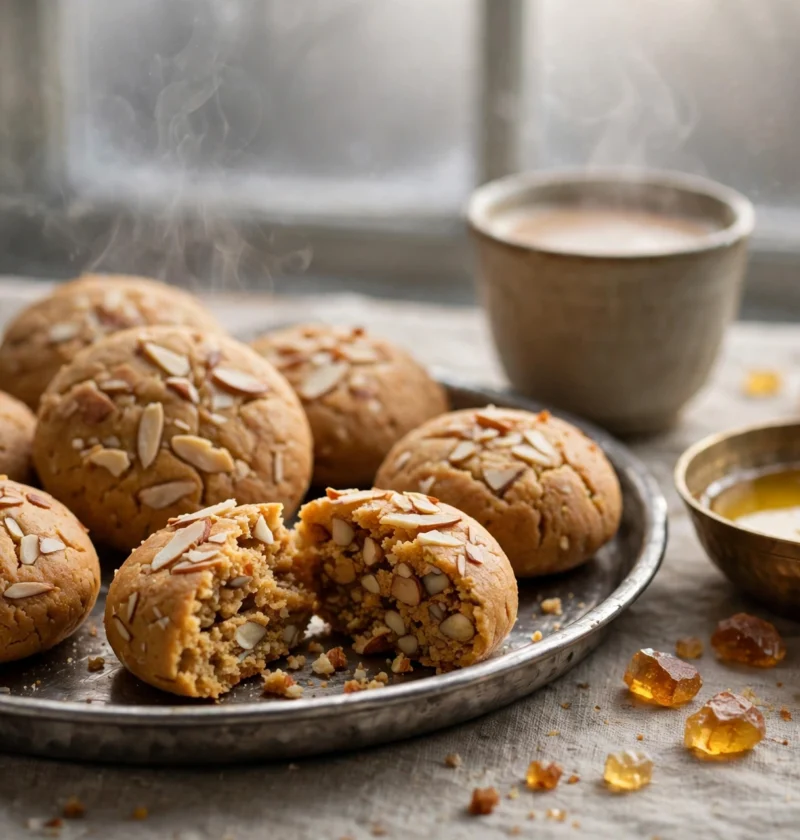
The first true sign of winter in our house was never the fog or the sweaters coming down from the trunk. It was a round steel dabba on the shelf above my grandmother’s stove, filled to the brim with pinnis from one long, patient afternoon. Every morning she lifted the lid, took out one, and set it beside her chai like a small ceremony — her winter medicine, her breakfast and her defence against the cold in one dense, golden ball. This pinni recipe is hers, finally written down after years of watching her hands do what no measuring cup could.
A pinni is not a ladoo that put on a winter coat. Where a besan ladoo is built on gram flour and a til laddu stands on sesame, a pinni is built on whole wheat atta — the same flour as your morning roti — roasted low and slow in ghee until it smells like toasted biscuits. Fried gond crystals shatter between your teeth, makhana and almonds give it body, and cardamom warms the finish. Every Punjabi grandmother I know guards her own version, measured in fistfuls, not scales, but all agree on the heart of it: one pinni with your morning chai, and the cold can do its worst. It asks only for patience — one heavy pan, one wooden spoon, and the willingness to keep stirring.
Why This Pinni Recipe Works
Pinni has a handful of ingredients, so each one has to behave. The method works because it respects the order of things — roast first, sweeten later, shape warm:
- The atta roasts low and slow until honestly golden. Raw wheat flour tastes pasty; flour roasted patiently in ghee turns nutty, deep and almost biscuity. That transformation is the entire flavour of this pinni recipe — no syrup, no milk, nothing to hide behind.
- The gond fries separately, in small batches. Edible gum crystals dropped into hot ghee puff up white and crisp within seconds, like tiny popcorn. Fried apart and crushed coarse, they stay shatteringly crunchy. Tossed in raw, they would sit there as hard little stones.
- The sugar goes in off the heat, into a warm mixture — never a hot one. This one mistake ruins more pinnis than any other. Powdered sugar stirred into scorching atta melts into syrup, and when that syrup cools, the pinnis set rock hard. A warm mixture keeps the sugar as sugar and the texture tender.
- The ghee is generous, because ghee is the glue. There is no syrup binding a pinni — only ghee coating every grain of roasted flour so the mixture presses together as it cools. Skimp on it and you get sweet sand; use enough and each pinni holds its round, proud shape.
- They are shaped warm and rested to set. Warm, the mixture squeezes together willingly. As the ghee cools and firms at room temperature, the pinnis set into proper keeping sweets — no fridge, no syrup thermometer, no drama. An hour or two of resting is all the finishing this pinni recipe needs.
Ingredients
Before you shop, it helps to know what a pinni is: a traditional Punjabi winter sweet of roasted flour, nuts and sweetener, made in big batches when the cold sets in because it keeps for weeks and one piece fills you. The flour roasts in ghee — use the good, grainy, desi kind if you have it; the aroma is half the recipe. The one ingredient that may be new to you is gond: clear amber crystals of edible gum, tapped from acacia trees and sold in desi groceries as “gond” or “edible gum.” Do not confuse it with gond katira, the pale tragacanth of summer drinks — it never fries and does not belong here. Everything else is pantry stock.
The base
- 2 cups whole wheat flour (atta) (about 8 1/2 ounces / 240 g)
- 1 cup ghee (about 8 ounces / 225 g), plus a spoonful more in reserve
- 1 1/2 cups powdered sugar (about 6 ounces / 180 g) — or see the jaggery note in the FAQs
The crunch
- 1/4 cup edible gum crystals (gond) (about 1 ounce / 30 g)
- 1/2 cup almonds, roughly chopped (about 2 1/2 ounces / 70 g)
- 1/3 cup cashews, roughly chopped (about 1 1/2 ounces / 45 g)
- 1/4 cup makhana (fox nuts), lightly crushed (about 1/2 ounce / 15 g)
- 2 tablespoons pistachios, chopped, plus a few slivers for decorating
- 2 tablespoons melon seeds (char magaz)
- 1/3 cup desiccated coconut (about 1 ounce / 30 g)
- 2 tablespoons golden raisins (optional)
The warmth
- 1 teaspoon ground cardamom
- 1/2 teaspoon ground dry ginger (saunth) (optional, but very traditional)
- 1 small pinch of fine sea salt
How to Make This Pinni Recipe – Step by Step
Step 1: Fry the gond and toast the crunch. Heat a third of the ghee in a heavy karahi or deep pan over medium heat. Drop in a small handful of gond crystals — never the whole lot at once — and watch them puff white and crisp within seconds, like miniature popcorn. Scoop them out onto a plate before they colour, and repeat until all the gond is fried. Cool, then crush coarsely with a rolling pin — rubble, not powder. In the same ghee, toast the almonds, cashews, makhana and melon seeds for 2 to 3 minutes until golden, add the coconut for the final 30 seconds, and tip everything onto the plate with the gond.
Step 2: Roast the atta low and slow. Add the remaining ghee, let it melt, and stir in the atta. Keep the heat at medium-low and stir constantly, scraping the bottom and corners, for 25 to 30 minutes. The flour passes through stages — first a pale, wet-sand paste that smells raw, then drier and heavier to stir, and finally a deep golden mixture smelling of toasted biscuits, ghee glistening at the edges. Do not raise the heat to hurry it: high heat scorches the outside of every grain while the inside stays raw, and that bitterness cannot be fixed.
Step 3: Cool it down to warm, and wake up the spices. Take the pan off the heat and stir in the cardamom, dry ginger and salt. Then walk away for 10 to 15 minutes, until the mixture is warm enough to hold a handful comfortably — think bathwater, not tea. This pause protects the batch: it is the difference between pinnis that crumble tenderly and pinnis that could serve as doorstops. If you can press your palm flat against the mixture and count to five without flinching, you are there.
Step 4: Sweeten and bring it all together. Sift the powdered sugar over the warm atta — sifting matters, because its lumps survive as white pockets. Add the crushed gond, the nut mixture and the raisins if using, and mix thoroughly with your hands until no streak of plain flour remains. Squeeze a handful hard: it should clump and hold its shape. If it crumbles instead, melt a tablespoon or two of the reserved ghee, drizzle it over, and mix once more. This fragrant rubble is the finished mixture of this pinni recipe — taste a pinch and adjust the sugar now, while you still can.
Step 5: Shape while warm, then let them rest. Take about two tablespoons at a time, squeeze firmly in your fist to compact it, then roll between your palms into a smooth, round pinni — working while the mixture is still warm. Press a sliver of pistachio or almond into the top of each, the way my grandmother did. If the mixture cools and crumbles before you finish, warm it gently in the pan for a minute and carry on. This pinni recipe makes about 20 pinnis. Leave them on a tray for at least 2 hours (overnight is even better) so the ghee firms into that dense, melting bite.
Serving Suggestions
The classic serving is the one from my childhood: one pinni, one cup of hot chai, on a cold morning while the fog is still deciding whether to lift. For children, a pinni with warm milk is practically a breakfast — Punjabi mothers have relied on it for generations to get small people through a school day in January. Crumbled over warm milk or into a bowl of kheer, a leftover pinni makes an ordinary dessert taste like winter itself.
Pinni also earns its place in the winter gift tin. Packed beside my ghee-rich besan ladoo recipe and the crunchy two-ingredient til laddu recipe, it completes the cold-weather trio — gram flour, sesame, whole wheat — three tins’ worth of personality from one shelf. If your pinnis have sat a few days, ten seconds in the microwave brings back that just-made softness.
Storage and Reheating
Pinni is a keeping sweet from a time before refrigeration, and storage is simple: let the pinnis set fully, then pack them into a clean, dry, airtight tin at room temperature, with parchment between layers if you stack them. They stay good for 3 to 4 weeks, often more — because ghee and roasted flour preserve naturally and there is no milk or khoya in this pinni recipe to turn. Keep the tin away from steam and never refrigerate: cold sets the ghee harshly hard and invites moisture when the tin returns. There is no reheating — a pinni is eaten as it stands, though ten seconds in the microwave softens one beautifully. Freezing works for up to 2 months, though a batch has rarely survived long enough in my house to need it.
Frequently Asked Questions
Should I use powdered sugar or jaggery in this pinni recipe?
Both are traditional; the choice is about the flavour you grew up with. Powdered sugar gives the cleaner, lighter sweetness of my grandmother’s version and keeps the pinnis pale golden and tender. Jaggery — the powdered or finely grated kind, about 1 cup packed (roughly 7 ounces / 200 g) — brings a deep caramel warmth and a moister, softer set, but it loosens the mixture a touch, so shape those pinnis more firmly. Either way, add the sweetener only once the atta has cooled to warm — jaggery melts even faster than sugar.
What exactly is gond, and what do I do if I cannot find it?
Gond is an edible gum tapped from acacia trees, sold as clear amber crystals in desi groceries and online. In Punjabi kitchens it is winter food — traditionally given to new mothers and anyone needing building up in the cold months — and fried in ghee it puffs into the crisp, shattering nuggets that give pinni its crunch. Buy plain gond, not gond katira, a different gum meant for soaking into summer drinks that will not fry at all. If gond is truly unobtainable, leave it out and raise the makhana to 1/2 cup with a few extra almonds: the pinni recipe still works and tastes wonderful — you lose only that one distinctive crunch.
Why did my pinnis turn out hard — or fall apart into crumbs?
Almost every failed batch fails at one of two moments. Rock-hard pinnis mean the sugar went into atta that was still too hot: it melted, turned to syrup, and set like candy as it cooled. That batch cannot be softened back, but crushed over warm milk or kheer it is delicious — nothing is wasted. Crumbly pinnis mean the opposite problem: too little ghee for the flour to drink, or a mixture left to go cold before shaping. Warm a crumbly batch gently in the pan, work in a spoonful or two of melted ghee, and shape again while warm; it forgives you almost every time.
Can I make this pinni recipe with less ghee, or sugar-free?
Honestly: only up to a point. Ghee is not decoration here — it is the binding, the preservative and most of the flavour — but you can come down to about 3/4 cup if you sprinkle 2 to 3 tablespoons of warm milk over the mixture as you combine it. The trade: milk shortens the keeping life to about a week in the fridge, and the pinnis stay softer. My own view is that a smaller pinni made properly beats a lean pinni made apologetically. For sugar-free, powdered erythritol or monk-fruit blends swap in one-for-one by volume, with a faint cooling aftertaste; liquid sweeteners and honey do not work — they bring moisture the mixture cannot absorb. And jaggery, whatever the internet says, is still sugar.
Recipe Summary
- Prep time: 20 minutes
- Cook time: 40 minutes
- Total time: 1 hour (+ 2 hours resting)
- Servings: About 20 pinnis
- Cuisine: Pakistani
- Course: Dessert