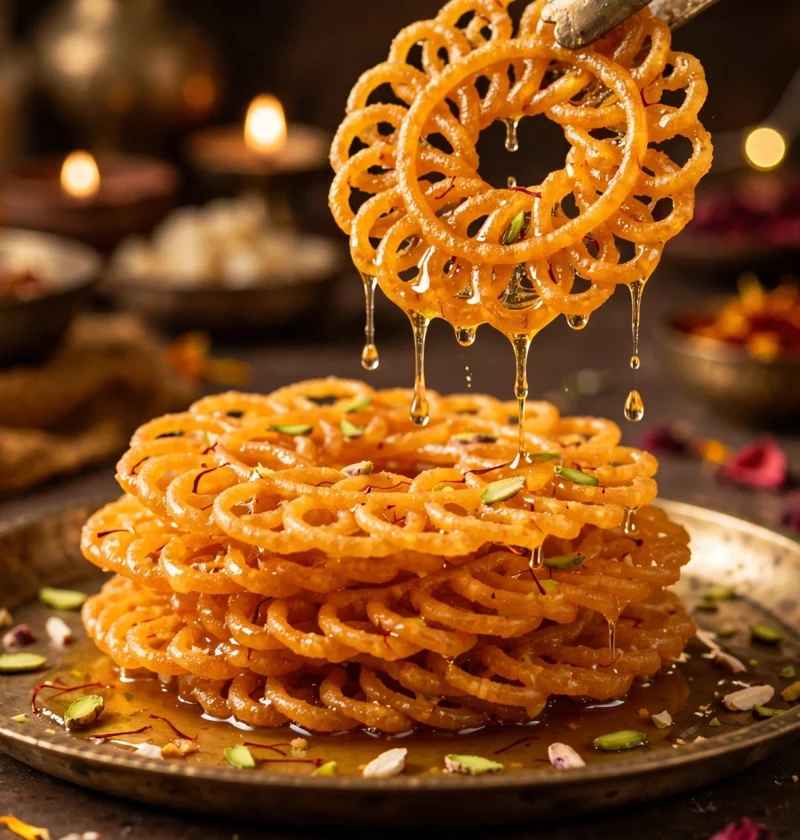
The first time my nani brought imarti home, I refused to believe it wasn’t jalebi. It came from the old halwai near her street, still warm in a paper packet gone translucent with syrup, and the pieces inside looked like little orange flowers caught mid-bloom. I bit one expecting jalebi’s thin shattering crunch and got something different — a crisp, lacy shell around a soft, syrup-soaked middle, fragrant and chewy in the centre. She laughed at my confusion: “Phool wali mithai hai ye” — this is the flower one. It took me years of flat, soggy attempts to understand what made hers different, and this imarti recipe is the version I finally settled on.
So let me clear up the family resemblance, because imarti and jalebi are not the same sweet wearing two outfits. Jalebi is made from fermented all-purpose flour batter, piped into tight little pretzel coils; it fries up thin, glassy and shattering, with a tang from the overnight ferment. Imarti — called amitti in Jaunpur, where many say it was born, and jaangiri further south — is made from ground urad dal instead. The dal batter is piped into open, concentric flower shapes, so the finished sweet is thicker-walled and sturdier: crisp and lacy at the edges, tender and juicy in the middle, with a mild, floral sweetness instead of a tang. Once you know which batter is in the bowl, the two never blur again, and every good imarti recipe is really just a set of habits for treating dal batter properly.
Why This Imarti Recipe Works
Imarti has a halwai-only reputation, but home batches always fail for the same few reasons — dense centres, shapes that dissolve in the oil, or crusts that go limp in the syrup. This imarti recipe is built to take each of those off the table:
- The dal is whipped until a spoonful floats. Urad dal is rich in protein, and when you beat the ground batter hard, that protein stretches into a web that traps tiny air bubbles. That air puffs the piped rings as they fry and leaves a hollow, lacy middle that can drink up syrup. Under-whipped batter has nothing to expand with, so it fries up dense, heavy and leathery — the most common reason homemade imarti disappoints.
- There is no overnight ferment to babysit. Unlike jalebi batter, which needs its long, tangy rest, imarti gets its body from the dal itself, so a short rest while you make the syrup is enough. Leave dal batter sitting around and it turns sour, slack and hard to pipe — the flowers spread instead of holding their petals — which is why this imarti recipe keeps the schedule tight.
- Cornstarch in the batter is quiet insurance. A couple of spoonfuls whisked in sharpens the crust’s crispness and helps it survive the syrup soak without going leathery. It doesn’t change the flavour; it just gives the thin fried lattice more backbone — the same trick halwais work with a pinch of rice flour.
- The flowers fry flat, in shallow oil, at a patient heat. Imarti needs a wide pan with an inch or so of ghee, not a deep pot — the flowers must bloom flat and stay put while they set. Heat matters just as much: too high and the outside bronzes while the middle stays raw and gummy; too low and the batter slumps and drinks grease before it can crisp.
- The syrup is warm and the soak is timed. Warm, one-string syrup flows into every lacy pocket; boiling syrup keeps cooking the shell until it turns soft, and cold syrup just sits on the surface like glue. Two to three minutes, turned once, is the whole discipline.
Ingredients
The beautiful thing about the ingredient list for this imarti recipe is how short it is: one dal, sugar, and aromatics. Everything depends on the dal, so buy it fresh and use the husked kind — split urad dal with the black skins removed, which grinds pale, smooth and fluffy. The sweet has a long history in North Indian mithai shops — read up on imarti and you’ll find it tied to Jaunpur’s old-city halwais. The deep orange colour is traditional but flexible: halwais use food colour, while saffron soaked in warm milk gives a softer golden glow and a better perfume. The cornstarch and baking soda are supporting actors — small amounts, big effect.
Serves 8 (makes about 24 imartis)
For the batter:
- 1 cup split husked urad dal (dhuli urad), picked over and rinsed
- 2 tablespoons cornstarch (or fine rice flour)
- 1/4 teaspoon baking soda
- 1 pinch of salt
- 4 to 5 drops orange food colour, or a generous pinch of saffron strands soaked in 1 tablespoon warm milk (optional)
- Ice-cold water, as needed for grinding (about 1/3 cup)
For the syrup:
- 2 cups granulated sugar
- 1 cup water
- 5 green cardamom pods, lightly crushed
- 10 to 12 saffron strands
- 1 teaspoon lemon juice
- 1 teaspoon rose water (optional)
For frying and finishing:
- Ghee or neutral oil, for frying (about 3 cups)
- 1 tablespoon pistachios, finely slivered, for garnish
How to Make This Imarti Recipe – Step by Step
Step 1: Soak the dal and grind it completely smooth. Rinse the dal in several changes of water until the water runs clear, then soak it in plenty of fresh water for 4 to 5 hours, or overnight in the fridge. Drain it thoroughly, shaking the colander well — surface water sneaking into the batter is the first step toward limp imartis. Grind the drained dal in a blender or wet grinder in two batches, adding ice-cold water only a spoonful at a time, until the batter is pale, thick and utterly smooth. Rub a little between your fingers — any grit means keep grinding, because gritty batter won’t whip properly and fries up coarse and heavy.
Step 2: Whip the batter until it passes the float test. Tip the ground batter into a wide bowl and whisk it in one direction — by hand for 6 to 8 minutes, or with a hand mixer for about 3 — until it lightens in colour, grows in volume and feels moussey. Now check it the way halwais do: drop a pea-sized blob into a bowl of plain water. A properly whipped batter floats right at the surface; a heavy one sinks, which just means it needs two more minutes of beating. Once yours floats, fold in the cornstarch, salt, colouring and baking soda, gently, so you don’t knock the air back out. Let the batter rest for 15 to 20 minutes while you make the syrup.
Step 3: Make the syrup and keep it warm. Combine the sugar and water in a wide saucepan over medium heat, stirring until the sugar dissolves. Add the crushed cardamom and saffron, then let the syrup come to a gentle boil and cook for 4 to 5 minutes, until it reaches one-string consistency — a cooled drop stretched between your thumb and finger should pull into a single thread. Stir in the lemon juice, which keeps the syrup from crystallising as it sits, and the rose water if you’re using it. Take the pan off the boil and keep the syrup warm over the lowest heat; you want it at bathwater warmth when the imartis arrive, never simmering.
Step 4: Pipe the flowers and fry them flat and patient. Pour ghee or oil into a wide, flat-bottomed pan to a depth of about 1 to 1 1/2 inches and heat it to medium-low, around 325°F — a test blob of batter should rise slowly, sizzling gently, not rocket up and brown. Fill a piping bag fitted with a small round nozzle (or a zip-top bag with one corner snipped) with batter, hold it low over the oil, and pipe each flower in one confident motion: a small circle in the centre, six to eight loops around it like petals, then one circle over the petal bases to lock the shape together. Fry in batches for 2 to 3 minutes per side, turning once with a skewer, until the imartis are crisp, puffed and a deep golden orange.
Step 5: Soak in warm syrup, drain, and finish. Lift each batch out with a slotted spoon, let the oil drain off for a few seconds, and slide the imartis straight into the warm syrup while they’re still hot — hot sweet into warm syrup is what pulls the syrup deep into the lacy middle. Soak for 2 to 3 minutes, turning once, then lift them onto a rack to drain. Scatter the slivered pistachios over the top while the surface is still glossy. Serve warm if you can; that’s this imarti recipe at its best, crisp edges giving way to a juicy, cardamom-scented centre.
Serving Suggestions
The classic partner for imarti is rabri — thick, chilled, barely sweetened reduced milk spooned over the warm flowers, so you get hot and cold, crisp and creamy in the same bite. In many old-city breakfasts the pairing is even simpler: imarti with a bowl of cool, unsweetened yogurt, the tang cutting cleanly through the syrup. For a festive mithai platter, I like to set the results of this imarti recipe beside the tight saffron coils from my jalebi recipe and the lacy rabri-topped discs of my ghevar recipe — three orange-gold sweets in a row, each a completely different texture, and guests always end up debating which is which. A small cup of strong, unsweetened chai on the side is never a mistake.
Storage and Reheating
Soaked imartis keep well at room temperature in an airtight container for up to 2 days; the crust softens, passing from crisp to pleasantly chewy, which plenty of people prefer. Don’t refrigerate them — the cold makes the syrup crystallise into a grainy coat and toughens the shell. If you want to work ahead with this imarti recipe, fry a batch and store them unsoaked in an airtight tin for 3 to 4 days; they keep their crunch well.
To bring stored imartis back to life, warm them in a 300°F oven for 4 to 5 minutes until the edges crisp again, then give them a 30-second dip in warm syrup to restore the juicy centre. Avoid the microwave entirely — it steams the lattice from inside and undoes all your careful frying in seconds. Freezing is the one thing I don’t recommend — thawed imarti weeps syrup and loses its structure.
Frequently Asked Questions
Why did my imartis turn out soft instead of crisp?
Three suspects: the batter wasn’t whipped enough to pass the float test, so the flowers had no airy lattice to crisp; too much water crept into the grind, making the batter slack; or the syrup was too hot or the soak too long, which steams the crust from outside. Check them in that order; the float test fixes most cases.
Does the batter need to ferment overnight like jalebi batter?
No, and it shouldn’t. Urad dal gives imarti its body and structure, so a 15 to 20 minute rest after whipping is plenty. If dal batter sits out for many hours it starts to sour and loosen, and the flowers spread into blobs instead of holding their petals. That tangy fermented note belongs to jalebi; imarti is meant to taste mild, milky and floral from the syrup.
What exactly is the difference between imarti and jalebi?
The batter, the shape and the bite are all different. Jalebi uses fermented all-purpose flour batter piped into tight coils — thin, glassy, shattering, with a light tang. Imarti uses ground urad dal batter piped into open flower shapes, so it’s thicker, with a crisp lacy shell around a soft, syrup-soaked centre and no tang at all. Think of jalebi as the delicate one and imarti as its sturdier, juicier cousin.
Can I make this imarti recipe without a piping bag?
Yes — a heavy zip-top freezer bag with one corner snipped off (about 1/4 inch) works perfectly well, and a squeeze bottle with a wide tip is even easier to control. The traditional tool is a small cloth cone, but the bag is better for home cooks, with easy refills and no mess. Whatever you use, keep the tip close to the oil’s surface; piping from a height stretches the batter into strings and ruins the flower.
Recipe Summary
- Prep time: 30 minutes, plus 4 to 5 hours soaking
- Cook time: 40 minutes
- Total time: About 5 hours 30 minutes, soaking included
- Servings: 8
- Cuisine: Pakistani
- Course: Dessert