The first sweet I ever ruined was a pan of rava, and I ruined it by trying too hard. I was about twelve, left in charge of the roasting while my mother ran to the bazaar, and I stood over that karahi determined to get the semolina a deep, impressive gold — the way besan goes for ladoos, the way onions go for biryani. When my grandmother came in, she took one look, one sniff, and shook her head with the sorrow of a woman watching a small tragedy. “Beta,” she said, “suji ko rang nahi dete, khushbu dete hain” — semolina is given fragrance, not colour. The batch went to the neighbour’s chickens, and I started again under her eye, learning to stop while the grains were still pale. That lesson is the whole heart of this rava ladoo recipe, and I have never darkened a pan of suji since.
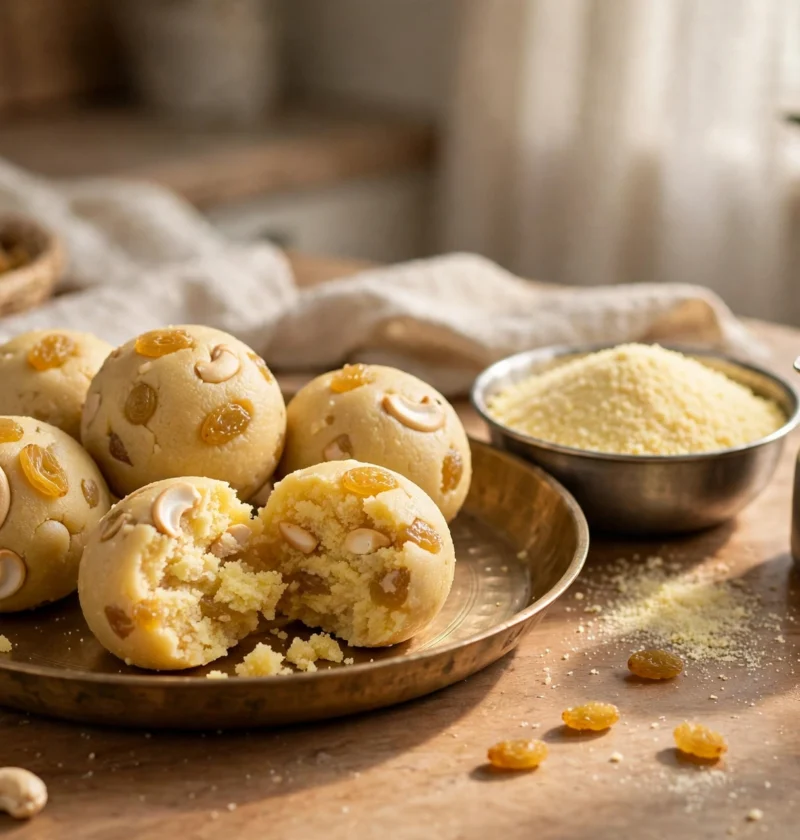
A rava ladoo is the humblest member of the ladoo family, and I mean that as praise. It asks for nothing you do not already own: the same fine semolina that makes suji ka halwa, ghee, sugar, a splash of milk, and whatever raisins and cashews are rolling around in the pantry. There is no syrup bubbling away at a dangerous thread stage, no khoya to hunt down at a specialty shop. Where a besan ladoo is all deep, nutty roast and a coconut ladoo is basically sweetened coconut, this rava ladoo recipe is milky, crumbly and gentle — the sweet my family made for Shab-e-Barat trays, for a new baby’s first visitors, and for the ordinary Tuesday guest who deserved better than a plain biscuit with chai. It is beginner mithai, but it is not lesser mithai, and the people who grew up on it will cross a room for one.
Why This Rava Ladoo Recipe Works
Five ingredients and one pan leave very little room to hide, so this rava ladoo recipe stands on a handful of small disciplines. Get these right and the ladoos come out tender and crumbly every single time:
- The roast stays pale — always. Fine semolina needs only eight to ten minutes in ghee to turn fragrant and lose its raw, floury taste. The moment it takes on real colour, it is heading toward bitter, and a bitter ladoo cannot be rescued by sugar. Pull it while it is still the colour of pale sand and smelling like warm toast.
- Powdered sugar, never syrup and never granulated. Granulated sugar stays gritty in a no-cook mixture, and syrup is a gamble — half a thread too far and the ladoos set like cricket balls. Powdered sugar folds in smoothly off the heat, keeps the crumb delicate, and forgives beginners completely.
- The milk is a sprinkle, not a soak. Warm milk goes in one spoonful at a time, only until the mixture clumps when you squeeze a fistful. That small amount binds the grains without making them damp or heavy, and it is exactly why these ladoos melt instead of chew.
- The nuts and raisins are fried first, in ghee. Two minutes in hot ghee puffs the raisins into little juicy balloons and turns the cashews golden and crisp. Folded through at the end, they stay distinct — small surprises of chew and crunch in a crumbly, soft ball.
- They are rolled warm and set as they cool. Warm mixture shapes willingly because the ghee is still liquid and the milk still tacky. As the ladoos rest, the ghee firms up and quietly locks each ball together — no fridge, no pressing, no drama.
Ingredients for This Rava Ladoo Recipe
Start with the right grain. Semolina — rava, suji, call it what your mother called it — is milled from durum wheat, and it comes in fine and coarse grinds that behave like different ingredients. For ladoos you want the fine one, the floury sort used for halwa; the coarse, sandy grind belongs to upma and will never bind as smoothly. The laddu family is vast and every region guards its favourite, but nearly all of them share this recipe’s backbone: something roasted in ghee, something sweet, and warm hands to roll it. Buy fresh rava if you can — semolina sits in shop bins for months and picks up a stale smell that no amount of roasting quite covers. A quick sniff of the packet at home tells you everything: it should smell like almost nothing, faintly wheaty and clean.
Makes about 16 ladoo
For the ladoos:
- 2 cups fine rava (semolina) (about 11 3/4 ounces / 330 g)
- 1/2 cup ghee (about 4 ounces / 115 g), plus 1 teaspoon for frying the nuts
- 1 cup powdered sugar (about 4 1/4 ounces / 120 g), sifted if lumpy
- 1/2 teaspoon ground cardamom (from about 8 green pods)
- 5 to 6 tablespoons warm whole milk, added a spoonful at a time
- A tiny pinch of salt — it makes the sweetness taste fuller
For the studding:
- 3 tablespoons golden raisins
- 3 tablespoons cashews, chopped into rough pieces
- A few pistachio slivers, for the tops (optional)
How to Make This Rava Ladoo Recipe – Step by Step
Step 1: Fry the raisins and cashews until the raisins puff. Warm the teaspoon of ghee in a wide, heavy-bottomed karahi or pan over medium heat. Drop in the cashews first and stir for about a minute, until they pale-gold at the edges, then add the raisins. Within seconds the raisins will swell into round little balloons — that is your signal. Tip everything onto a plate at once; left in the hot pan, the raisins scorch and turn bitter while you are reaching for the semolina.
Step 2: Roast the rava low, slow and pale. In the same pan, melt the half cup of ghee over the lowest heat and pour in the semolina. Now settle in: stir constantly, sweeping the bottom and corners, for 8 to 10 minutes. The rava will loosen, turn flowing and sandy, and begin to smell like warm biscuits — while staying stubbornly pale, the colour of beach sand at noon. That fragrance with no real colour is the finish line. Take the pan off the heat the moment you smell it; the hot ghee keeps cooking the grains even off the flame.
Step 3: Sweeten it off the heat. Let the roasted rava cool for 2 to 3 minutes — hot enough to stay loose, cool enough that the sugar will not melt into it. Stir in the powdered sugar, cardamom and pinch of salt until no white streaks remain. Taste a pinch now. It should be sweet and milky-smelling, like the crumb of a good cake, and this is your one chance to nudge the sugar up a spoonful if your family likes it sweeter.
Step 4: Sprinkle in the warm milk until it just clumps. Drizzle the warm milk over the mixture one tablespoon at a time, tossing with a spoon or your fingers after each addition. Stop the moment a squeezed fistful holds together in a firm clump that does not crumble at the edges — for most batches that is 5 tablespoons, rarely 6. Fold in the fried cashews and raisins with all their ghee. Rest the mixture for 5 minutes; the semolina quietly drinks in the milk and firms up as it stands.
Step 5: Roll warm, press a pistachio on top, and let them set. Rub a film of ghee over your palms, scoop up about 2 tablespoons of mixture, and squeeze it in your fist first — the squeeze is what compacts it — then roll it under both palms until it comes together as a neat, round ball — think of a golf ball and you have the size. If a ball cracks, the mixture has cooled or dried a touch; sprinkle in half a tablespoon more warm milk and carry on. Set the finished ladoos on a plate, press a pistachio sliver onto each, and leave them for at least 30 minutes. They firm up as the ghee sets, and this rava ladoo recipe is ready for the chai tray.
Serving Suggestions
Rava ladoos belong to the chai hour. Serve them at room temperature — never fridge-cold, which mutes the ghee — on a small plate beside unsweetened doodh patti or a strong cup of tea, because the sweet, crumbly ball and the bitter-hot chai were clearly invented for each other. On a festival or Shab-e-Barat tray, I arrange them in a low pyramid with the pistachio tops showing, surrounded by the saltier, nuttier things, because their pale colour and gentle flavour calm a tray down beautifully.
For a proper ladoo spread, this rava ladoo recipe has two natural partners already on the site: my snowy, three-ingredient coconut ladoo for freshness, and the deep-roasted, ghee-heavy besan ladoo for the opposite end of the spectrum. Pale and crumbly, white and soft, golden and dense — put all three on one tray and you have covered every ladoo lover you are ever likely to feed, with three pans’ worth of work spread across one afternoon.
Storage and Reheating
Be honest with this sweet: because warm milk binds it, a rava ladoo does not keep like a syrup-soaked mithai does, and pretending otherwise only leads to a sad, sour tin. In an airtight container in a cool kitchen, the ladoos stay fresh and tender for 3 to 4 days. In the fridge, in a sealed box, they keep well for up to 2 weeks — the ghee firms them hard when cold, so take them out 30 minutes before serving and let them come back to room temperature, when the crumb turns crumbly and milky again. There is no real reheating: at most, a fridge-cold ladoo can take 5 to 10 seconds in the microwave to lose its chill, but anything more melts the ghee out and spoils the texture. I do not freeze them either; thawed semolina turns a little pasty. Small batches, often, are the grandmother-approved policy for this particular sweet.
Frequently Asked Questions
Why won’t my ladoos bind? They keep crumbling apart.
Almost always, the mixture is a spoonful of milk short, or it cooled too far before rolling. The fix is gentle: sprinkle in warm milk half a tablespoon at a time until a squeezed fistful holds, and if the whole batch has gone cold, warm it for a few seconds over the lowest flame so the ghee loosens again, then roll at once. Too little ghee causes the same trouble in the next batch — measure it generously, because in this rava ladoo recipe the ghee is not just flavour, it is half the glue.
Why did my ladoos turn out hard?
Two usual culprits. The rava was roasted too dark and too dry — over-roasted semolina drinks up every drop of milk and still sets firm — or the batch drifted toward the syrup method, where an overcooked one-string syrup sets like toffee as it cools. With the milk-bound version here, hardness nearly always means the roast went past pale or the milk stayed under 4 tablespoons. A hard batch is not wasted, though: crumble the ladoos over warm milk or stir them into kheer, where they melt back into something lovely.
I only have coarse rava. Can I still make these?
Yes, with one small rescue. Coarse semolina makes a grainier ladoo that struggles to bind, so give it 8 to 10 short pulses in a dry blender or spice grinder first — you are not making flour, just knocking the big grains down toward fine. Then roast and proceed exactly as written, and expect to use the full 6 tablespoons of milk, because coarser grains drink more. The finished texture will always be a shade more rustic than the fine-rava original, which many families, mine included, quietly prefer.
What about the sugar-syrup version I see everywhere?
It is a real and respectable variant: the roasted rava is mixed into a one-string sugar syrup instead of milk and powdered sugar, and those ladoos keep longer at room temperature — a week or more — with a glossier, firmer bite. The trade-offs are honesty-worthy. Syrup ladoos live or die on thread consistency, set noticeably harder, and lack the milky softness that defines this version. I make the syrup kind when the mithai has to travel to another city; for eating at home within the week, the milk-bound rava ladoo recipe above wins on texture every time.
Recipe Summary
- Prep time: 5 minutes
- Cook time: 12 to 15 minutes
- Total time: About 25 minutes, plus 30 minutes to set
- Servings: About 16 ladoos
- Cuisine: Pakistani
- Course: Dessert