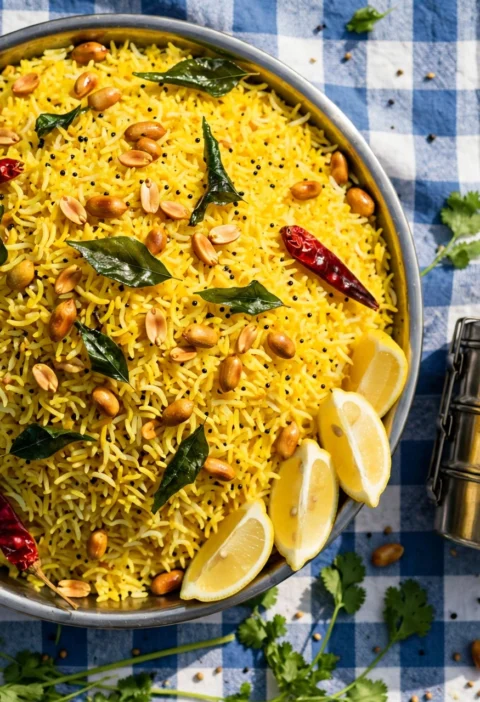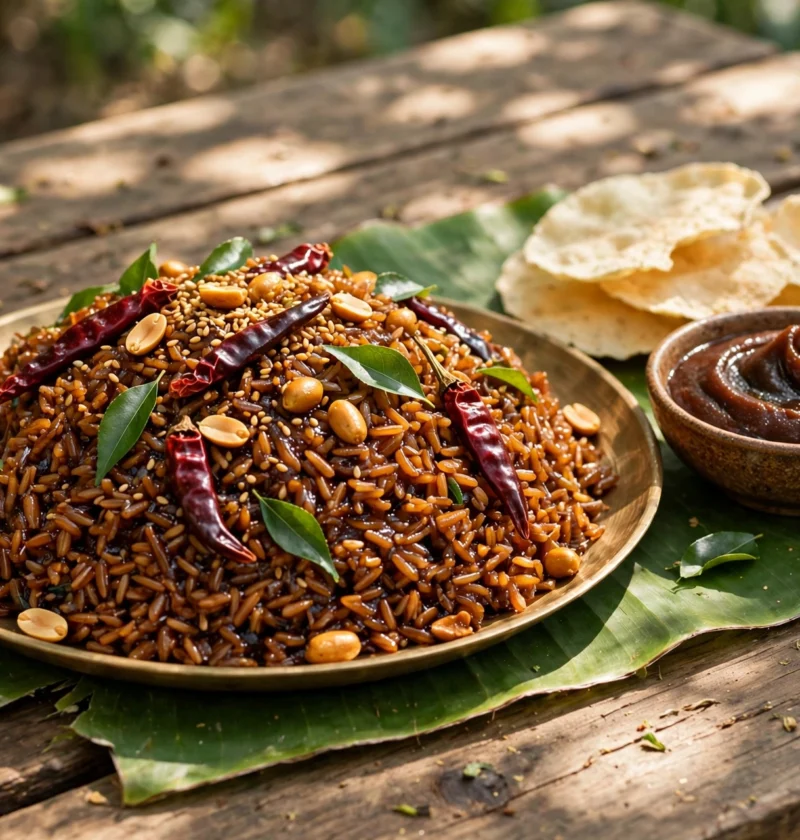
The parcel was not even meant for me. Years ago, on a long train journey, the family sharing our compartment opened a steel tiffin past the four-hour mark, and the smell that came out of it — sour, nutty, warm with sesame — quietly rearranged the whole carriage. The mother saw me looking and, in that way of mothers everywhere, handed me a portion on the tiffin’s own lid without asking. I wanted it. The rice was dark amber and glossy, every grain separate, crunchy with peanuts, and tangier than anything I had eaten at a dining table. That rice, I later learned, had been packed at dawn and had travelled better than any of us. This tamarind rice recipe is my recreation of that tiffin, and it has become the food I make whenever a meal has to leave the house and behave itself.
Let me be upfront about where it comes from, because tamarind rice is not originally ours. It is a South Indian classic — pulihora in Andhra and Telangana homes, puliyodharai in Tamil Nadu — made for temple offerings, festival mornings and, famously, for the road. The tamarind is not a squeeze of sourness added at the end; it is cooked down into a concentrated paste, folded through cooled rice, and the result keeps happily for hours without a fridge. Our tables adopted it the way we adopt anything that travels well and feeds a crowd — picnics, school lunch boxes, long drives — and this tamarind rice recipe keeps the method faithful: dark, tangy, crunchy, in no hurry whatsoever.
Why This Tamarind Rice Recipe Works
Tamarind rice looks like a simple toss-together, and it nearly is — but five quiet disciplines are what separate the tiffin I still dream about from a bowl of sour, soggy rice:
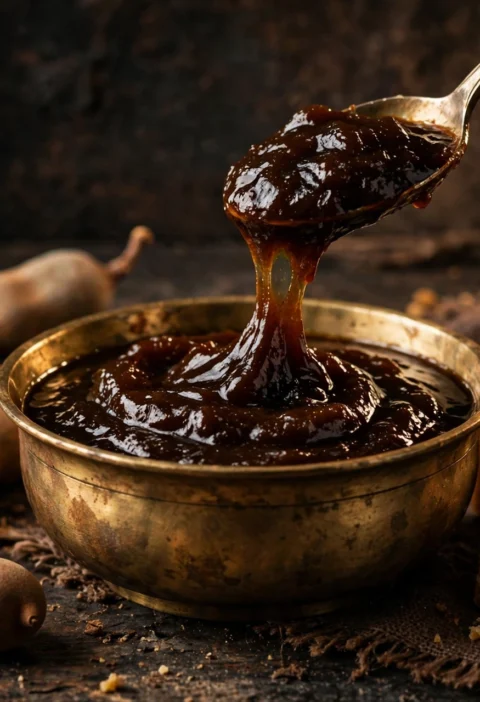
- The tamarind is cooked down, not just soaked and poured. Raw tamarind water tastes thin, sharp and faintly metallic. Simmered in the tempering until it thickens into a dark, glossy paste, it turns mellow and concentrated, coating the grains instead of wetting them.
- The rice goes in cold and firm. Cooled, day-old-style rice has grains that have set and separated, so they drink up the paste and stay whole. Hot, fresh rice breaks at a touch and turns to porridge under the spoon.
- The crunch is built into the tempering. Chana dal, urad dal and peanuts are fried in the oil itself, so they stay properly crunchy. That contrast — soft grain, hard peanut, the little pop of a dal — is half the pleasure.
- A pinch of jaggery does quiet, essential work. It never makes the rice sweet. It rounds off tamarind’s sharpest edge so the sourness tastes full and fruity instead of harsh.
- Time finishes the dish. Freshly mixed, the rice is good. An hour later, as the paste settles into every grain, it is better; the next day it is better still. Few dishes travel this well.
Ingredients for This Tamarind Rice Recipe
The heart of the dish is the paste the rice is folded through: across the south this rice is pulihora, and temple kitchens cook the tamarind mixture in quantity and keep it ready, because it improves with keeping. The other quiet star is sesame — toasted seeds folded through at the end and, more importantly, sesame oil in the tempering, which gives the dish its warm, nutty depth. A word on the tamarind itself: I use the seedless block, soaked and squeezed by hand, because its flavour is the roundest; the FAQs below give honest equivalents for paste and concentrate. Everything else — mustard seed, dals, dried chilies, curry leaves — is tempering stock, and the peanuts must be raw, since they fry in the oil rather than arriving roasted.
For the rice
- 2 cups basmati or long-grain rice (about 14 ounces / 400 g) — cooked, this makes roughly 6 cups
- 1 teaspoon fine salt, for the cooking water
- 1 teaspoon sesame oil, to loosen the cooked grains
For the tamarind base
- 1 packed ball of seedless tamarind (about 2 ounces / 60 g), or the paste/concentrate equivalents in the FAQs
- 1 cup (240 ml) warm water, for soaking
- 1 teaspoon jaggery or dark brown sugar
- 3/4 teaspoon fine salt, or to taste
For the tempering
- 3 tablespoons sesame oil (gingelly oil)
- 1 teaspoon black mustard seeds
- 2 tablespoons chana dal, rinsed and drained
- 1 tablespoon urad dal, rinsed and drained
- 1/3 cup raw peanuts (about 2 ounces / 55 g)
- 4 dried red chilies, broken in half, seeds shaken out if you like it gentler
- 2 fresh green chilies, slit lengthwise
- 12 to 15 fresh curry leaves
- 1/2 teaspoon ground turmeric
- 1/4 teaspoon asafoetida (hing), optional but traditional
- 1 tablespoon white sesame seeds, toasted in a dry pan until they pop
How to Make This Tamarind Rice Recipe – Step by Step
Step 1: Cook the rice, then cool it like you mean it. Cook the rice with the salt until just tender — a grain should squash between your fingers without a chalky core — then spread it in a wide tray or your largest shallow bowl. Drizzle the sesame oil over it and lift the grains apart gently with a fork. Leave it until completely cool, at least 30 minutes; warm rice is the enemy here, and day-old fridge rice is its best friend.
Step 2: Soak the tamarind and squeeze out every drop of pulp. Break the tamarind into the warm water for 15 to 20 minutes, then get your hand in and squeeze and knead the pulp until the water is thick, dark and opaque. Strain through a sieve, pressing the fibres hard, and go back with a few tablespoons more warm water for a second squeeze — that second extract carries surprising flavour, and skipping it is how tamarind rice ends up shy.
Step 3: Build the tempering and fry the crunch into the oil. Warm the sesame oil in a wide, heavy pan over a medium flame until it shimmers and smells nutty. Scatter in the mustard seeds, wait for their crackling to peak, then rain in the chana dal and urad dal, stirring as they deepen a shade past gold — about a minute. Add the peanuts and fry, stirring often, until crisp and roasted-smelling, another 2 to 3 minutes. Follow with the dried red chilies, green chilies and curry leaves — stand back for the spatter — plus the asafoetida if using it. Everything must be properly fried now, because nothing crisps later; pale, underdone dal stays stubbornly hard in the finished rice.
Step 4: Cook the tamarind down into a dark, glossy paste. Lower the heat, pour in the tamarind extract, and add the turmeric, salt and jaggery. Simmer gently, stirring now and then, for 8 to 10 minutes, until noticeably thicker, a deep mahogany, with oil shining at the pan’s edges. It should taste boldly, almost too sour on its own — it still has six cups of rice to season. Cooled, this paste keeps in a jar in the fridge for a fortnight.
Step 5: Fold the paste through the rice, rest it, and let it ripen. Scrape the hot paste and all its tempering over the cooled rice, scatter in the toasted sesame seeds, and fold with a wide spoon or clean hands, lifting from underneath so the grains stay whole. The rice should turn an even amber, dals and peanuts throughout. Cover and rest at least 30 minutes — an hour is better, and you now understand why this tamarind rice recipe was born for journeys: the waiting is not a delay, it is the final stage of the cooking.
Serving Suggestions
Serve this tamarind rice recipe warm or at room temperature — never piping hot, which dulls the tang — with crisp papads or appalams, a spoonful of yogurt or raita, and, in many houses, a halved boiled egg or a small heap of spicy potato fry. It is the picnic hero: packed in the morning, opened at noon under a tree, it will be better than when it left the kitchen.
Set it beside its rice relatives and its identity is unmistakable. My lemon rice is its bright, sunny cousin — turmeric-yellow, lemon-led, never cooked with a paste at all; if lemon rice is a morning flavour, tamarind rice is a late-afternoon one, darker and deeper. My ghee rice stands at the opposite pole — white-golden, gentle, led by ghee under a fried-onion crown, a quiet rice built to carry rich curries. Tamarind rice needs no curry at all. The tang is the main event, the peanuts and sesame are the supporting act, and everything else on the plate is just company.
Storage and Reheating
This tamarind rice recipe is famous for keeping, and the fame is earned — tamarind and turmeric are natural preservers, which is why it became the travel and temple food of the south. But here is the honest, modern version: packed in a clean, dry container, it sits happily at room temperature for the length of a journey or picnic — hours, a good half-day, not days on the counter. Beyond that, refrigerate it for up to 3 days, and know the flavour genuinely deepens overnight; many cooks make it a day ahead on purpose. Reheat gently — a covered pan over low heat with a teaspoon of water, or short microwave bursts, fluffing once — or let a portion return to room temperature and eat it as travellers do, which may be the finest way of all. I do not freeze it; the peanuts lose their nerve and the grains turn woolly.
Frequently Asked Questions
Tamarind block, paste or concentrate — which should I use, and how much?
The block gives the roundest flavour and is what this tamarind rice recipe is written for: about 2 ounces (60 g) of seedless block to 1 cup of warm water. Jarred paste is the convenient middle path — about 3 tablespoons stirred into 3/4 cup of warm water; taste, because brands vary. Concentrate is the fierce one: start with 1 tablespoon in a cup of warm water, since it is roughly three times as strong. Whichever you use, keep the teaspoon of jaggery. It is not there to sweeten; it takes the raw, spiky edge off the sourness so the rice tastes fruity and deep instead of sharp — and if your tamarind turns out ferociously sour, a second pinch is the correct rescue, never more salt.
Why must the rice be cooled — can I use it fresh and hot?
You can, and the rice will punish you for it. Fresh, hot grains are fragile and steamy; folded through a wet paste they swell, split and clump, and no gentle handling brings back the separate grains. Cooled rice has firmed up and dried at the surface, so each grain takes a coating of paste like a jacket instead of drinking it like a sponge. If you must cook fresh, spread it in a wide tray for 30 minutes until cool and dry to the touch. Day-old fridge rice, loosened with your fingers, remains the undefeated champion here.
My rice came out too sour — or far too bland. Can it be fixed?
Both, and neither fix is difficult. Too sour: fold through a cup or two of extra plain cooked rice, which dilutes without disguising; stir in another pinch of jaggery and a drizzle of warm sesame oil; and serve with yogurt or raita. Never add water — that makes sour porridge. Too bland: the cause is almost always an under-reduced paste or a shy second squeeze of the tamarind. Simmer a quick repair paste — 2 tablespoons of jarred paste (or 2 teaspoons of concentrate) in a few spoons of water with salt and jaggery until glossy — fry fresh mustard seeds and curry leaves in sesame oil, pour it over, and fold again. Blandness here is a seasoning problem, not a character flaw.
Does the sesame oil really matter, or can I use what I have?
It matters more than any other single swap you could make. Cold-pressed sesame oil — gingelly oil — has a warm, nutty, almost roasted flavour that is half the signature of temple-style tamarind rice; the dish tastes noticeably flatter without it. A neutral oil produces a perfectly decent tangy rice, but a plainer one, and peanut oil is the closest understudy if sesame is truly unavailable. Ghee is the swap I would argue against: delicious elsewhere, it firms as the rice cools and coats the grains in a waxy richness that fights both the tang and the room-temperature keeping. If you use sesame oil for nothing else all year, use it for this.
Recipe Summary
- Prep time: 15 minutes (plus 20 minutes soaking the tamarind and cooling the rice)
- Cook time: 30 minutes
- Total time: About 1 hour 15 minutes, plus resting — and it only gets better
- Servings: 4
- Cuisine: Pakistani
- Course: Main Course