The first time I ate a bedmi, I was standing up, steel plate in one hand, burning my fingers through the puri in the other. It was a January morning, fog sitting low, and the halwai’s karahi was going like a drum — puris sliding in flat, coming out golden balloons. Somebody passed me a bowl of thin orange aloo, somebody else a green chili, and there I stood with the morning crowd, tearing and dunking, saying nothing — nobody talks through their first bedmi. Years later I have finally landed on a bedmi puri recipe that gives me that counter back: crisp shell, coarse spiced dal inside, aloo thin enough to run.
Let me be honest: this is not originally ours. Bedmi belongs to Delhi and Uttar Pradesh — Old Delhi’s gallis, Agra, Mathura — where halwais have tucked urad dal into puris for longer than anyone dates. Our own halwai counters taught us the halwa puri Sunday; bedmi reached me through travel and friends, and stayed because it is a complete breakfast: dal inside the bread, curry alongside. This version keeps faith with the original — whole wheat, a coarse filling, hing in the tempering — because some recipes you adopt rather than improve. You just learn them properly.
Why This Bedmi Puri Recipe Works
Bedmi fails in three predictable ways — split shells, a bland middle, a soggy plate — and every habit in this bedmi puri recipe exists to head one of them off:
- The dal is ground coarse and roasted dry. A smooth, wet paste turns to steam in the oil and blows the puri open. Ground like damp sand and roasted until crumbly, the filling stays sealed, with a gentle bite that tells you it is dal, not dough.
- The filling is spiced like it has to carry the whole bite. Hing, ginger, fennel and green chili do the talking; the shell is plain wheat and the curry mild-mannered. Season the dal until it tastes a touch too bold off the spoon; wrapped and fried, it lands exactly right.
- The dough is stiff, and it rests. Bedmi dough is firmer than roti dough. Rested half an hour, it rolls thin without springing back or tearing, keeping the filling in and the shell crisp, not chewy.
- Sealed like a kachori, rolled like a puri. The filling is pinched shut as a little parcel first, with clean, dry edges, then rolled gently from the centre — the shaping that keeps a bedmi from unzipping in the oil.
- The aloo is runny on purpose. Dubki means dunked: the curry should be thin enough to pour, soaking into a torn puri instead of sitting on top of it. A thick, dry aloo beside a crisp bedmi is two good things refusing to meet.
Ingredients for This Bedmi Puri Recipe
A bedmi is a puri that was given a job: the plain puffed bread of the northern breakfast table, carrying its own filling. That filling is urad dal — the split, husked kind, dhuli urad, pale and ivory; the whole black bean belongs in a different pot. Two masala notes are not negotiable in this bedmi puri recipe: hing, the halwai signature — alarming in the jar, savoury in hot oil, and kind to digestion, because dal for breakfast is a serious commitment — and coarse-crushed fennel, the quiet sweetness underneath. The amounts below make twelve puris, breakfast for four who eat like they mean it.
For the dal filling
- 3/4 cup split husked urad dal (dhuli urad) (about 5 1/2 ounces / 160 g)
- 2 teaspoons neutral oil or ghee
- 1 teaspoon cumin seeds
- 1 teaspoon fennel seeds, coarsely crushed
- 1/4 teaspoon asafoetida (hing)
- 1 tablespoon finely grated fresh ginger
- 2 fresh green chilies, very finely chopped
- 1/2 teaspoon red chili powder
- 1 teaspoon ground coriander
- 1/2 teaspoon amchur (dry mango powder)
- 3/4 teaspoon fine sea salt
For the dough
- 2 cups whole wheat atta flour (about 9 1/2 ounces / 270 g)
- 2 tablespoons fine semolina (sooji)
- 1/2 teaspoon fine sea salt
- 2 tablespoons neutral oil
- About 2/3 cup (160 ml) warm water, added gradually
- Neutral oil, for deep-frying (about 2 cups / 475 ml)
For the dubki aloo
- 1 pound (450 g) potatoes (about 4 medium), peeled and cut into chunks
- 2 tablespoons neutral oil or ghee
- 1 teaspoon cumin seeds
- 1/4 teaspoon asafoetida (hing)
- 2 medium tomatoes, puréed (about 1 1/2 cups / 300 g)
- 1 tablespoon finely grated fresh ginger
- 1 1/4 teaspoons fine sea salt, or to taste
- 1/2 teaspoon ground turmeric
- 1 teaspoon Kashmiri red chili powder
- 2 teaspoons ground coriander
- 3 1/2 to 4 cups (830–950 ml) water
- 1 teaspoon garam masala
- 1/2 teaspoon amchur (dry mango powder)
- 1 teaspoon kasuri methi (dried fenugreek leaves), crushed
- Chopped fresh cilantro and slit green chilies, to serve
How to Make This Bedmi Puri Recipe – Step by Step
Step 1: Soak the urad and grind the filling coarse. Rinse the dal, cover with plenty of cold water, and leave 4 to 5 hours — overnight in the fridge is fine too. Drain properly: shake the colander, walk away, shake it again. Grind in short pulses, no added water — a teaspoon at most — to damp gravel, not batter (more on texture in the FAQs below). Heat the 2 teaspoons of oil, crackle the cumin and fennel, add the hing, ginger and green chilies, then the dal. Roast, stirring, 3 to 4 minutes, until nutty-smelling, dry and falling off the spoon in crumbs. Off the heat, stir in the chili powder, coriander, amchur and salt, and cool completely.
Step 2: Knead a stiff dough and let it rest. Rub the oil into the atta, semolina and salt until the flour looks like coarse crumbs and holds a shape when squeezed — this little moyan is what fries up crisp instead of leathery. Add the warm water in a slow drizzle, mixing as you go, to a stiff dough, firmer than chapati dough; you may not need every drop. Knead 5 to 6 minutes, until smooth and tight, cover with a damp cloth, and rest 30 minutes. Rested, it rolls thin without a fight; unrested, it snaps back like it is offended.
Step 3: Roll, stuff, seal, then roll again. Divide the dough into 12 balls and keep them under the damp cloth. Roll one into a 3-inch (7–8 cm) disc, cup it in your palm, and set a generous 1 1/2 teaspoons of filling in the centre. Pinch the edges shut over the top, kachori-style, keeping the rim clean and dry — filling or oil on the rim means a seal that will not hold. Flatten gently, dust lightly, and roll out to about 4 1/2 to 5 inches (11–13 cm) from the centre outward. Roll all twelve, lay them on a floured tray, and keep covered so the surfaces do not crack.
Step 4: Fry until they puff and crisp. Heat the oil in a karahi to 375°F (190°C) — a scrap of dough should bob straight back up in a jacket of bubbles. Slide a stuffed disc in, wait a few seconds, then press gently with the back of a slotted spoon; it should swell into a balloon. Flip once and fry until deep golden with darker speckles where the dal sits close to the surface, 1 1/2 to 2 minutes in total. Drain on a rack, not paper, so the underside stays crisp, and fry in small batches, letting the oil recover between them — crowded, cooling oil makes greasy puris.
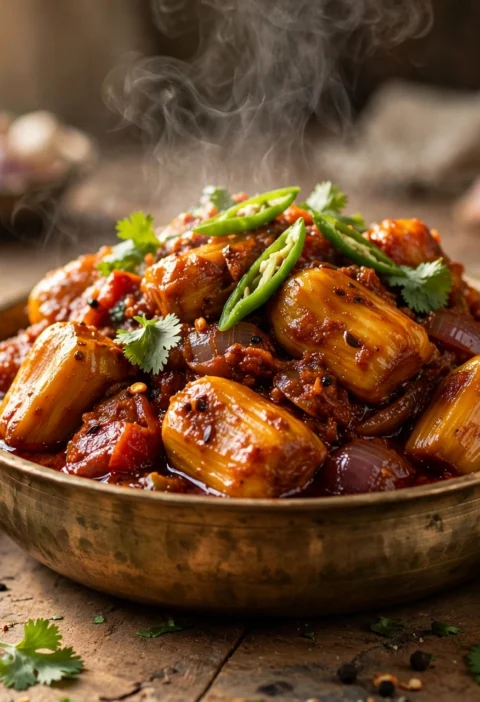
Step 5: Simmer the dubki aloo and bring the plate together. Heat the oil or ghee, crackle the cumin, add the hing and ginger, then the tomatoes with the salt, turmeric, chili powder and coriander. Cook the masala 6 to 7 minutes, until it thickens and the fat glints at the edges. Add the potatoes and the water — yes, all of it; this curry is supposed to look too thin. Simmer 12 to 15 minutes, until tender and a few edges have slumped in, thickening it slightly. Finish with garam masala, amchur and kasuri methi; it should taste bright and brothy, nearly drinkable. (The aloo simmers while the dough rests, so it waits on the puris.) Serve two or three hot bedmis per plate, ladle the aloo generously over and alongside, and get it to the table before the crisp gives up.
Serving Suggestions
Eat this bedmi puri recipe the way the counter taught me: tear, scoop, soak — a bite of curry-soaked crisp, then a spoonful of aloo chased straight from the bowl. On the side: a green chili pickle, julienned ginger sat ten minutes in lemon juice and salt, a kulhad of strong chai.
Two relatives on this site explain it fastest. My halwa puri is the Lahori Sunday star, where the puri is plain and unstuffed — a balloon meant to be torn and dragged through sweet suji halwa and cholay. The bedmi hides its savoury dal inside the bread and brings its own thin curry, so the plate is savoury from first bite to last. My kachori is the closest stuffed cousin — but flakier and richer, maida-based with a heavier hand of moyan, and it lives as a snack or chaat, with chutneys. Bedmi’s whole-wheat shell is sturdier and plainer, built for breakfast; with the aloo beside it, the plate is the whole meal, not a snack.
Storage and Reheating
Honesty first: this bedmi puri recipe is at its best within minutes of the karahi, and no storage trick fully returns that first crisp. Leftover puris keep 1 day airtight at room temperature, or 3 days in the fridge, and refresh well in a 375°F (190°C) oven or air fryer for 3 to 4 minutes; the microwave makes them soft, then leathery, so skip it. The roasted filling is the most obliging part — 3 days in the fridge, a month in the freezer, ready for fresh dough. The aloo keeps 3 days refrigerated and reheats without complaint; it thickens as the potatoes drink, so loosen with water back to pourable.
Frequently Asked Questions
Why do my puris split open or leak their filling in the oil?
Almost always moisture, or a dirty seal. A filling that went in wet — dal under-drained or under-roasted — makes steam in hot oil, and steam finds the weakest seam. The other culprit is the rim: dal crumbs or oil where you pinch means the edges never truly join, and the oil unzips them. Keep the rim clean, pinch firmly, roll gently, and let the oil reach its full 375°F (190°C) first; in cool oil a puri soaks instead of sealing, and soaking pulls seams apart.
How coarse should the dal be ground — and why never a smooth paste?
Aim for damp sand: a pinch rubbed between your fingers should feel like distinct little grains, couscous-like, in a mixture that holds only when squeezed. A smooth paste cooks gummy inside the shell, with no bite to tell dal from dough, and holds far more water — the steam-and-split problem all over again. Grind in short pulses and resist adding water; if the machine sulks, one teaspoon is the limit. Stopping early feels wrong the first time. It is the whole secret.
Can I make the filling or the puris ahead — and do they freeze?
The filling, happily: roasted and cooled, it waits 3 days in the fridge or a month in the freezer. The dough is best kneaded the same morning; a night in the fridge makes it slack and grey at the edges. Shaped puris should be fried within about 30 minutes; the dal dampens the shell from inside, and a damp shell will not puff. To get ahead, fry fully, cool, and freeze flat; re-crisped from frozen in a hot oven, they come back better than anyone expects.
Whole wheat atta or maida — which dough is right for this bedmi puri recipe?
Atta, and it is not close. Whole wheat is the halwai standard because bedmi is breakfast, not pastry: atta gives a sturdier, nuttier shell that holds a spiced filling and stands up to a runny curry. Maida makes a flakier, paler, richer crust — pleasant, but that road leads to kachori, and if you want a kachori you should make one. For a lighter shell, a three-to-one atta-to-maida blend is a fair middle path; keep the semolina either way, as cheap insurance for crispness.
Recipe Summary
- Prep time: 30 minutes (plus 4 to 5 hours soaking the dal)
- Cook time: 40 minutes
- Total time: About 1 hour 10 minutes, plus soaking
- Servings: 4 (12 puris)
- Cuisine: Pakistani
- Course: Main Course