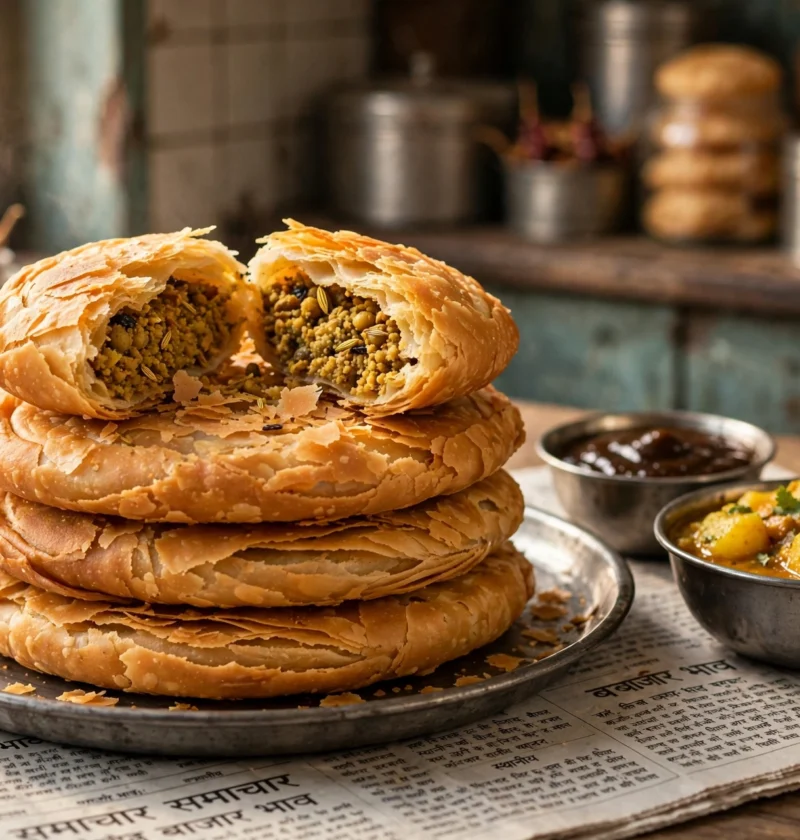
Every Sunday of my childhood had the same opening scene: my grandfather returning from the halwai shop with a newspaper parcel that smelled of fennel and hot ghee, and inside it, still warm, a dozen kachoris — round, golden, their crusts so flaky that the paper was freckled with shards before he reached the door. They were nashta royalty, eaten with runny aloo tarkari and a chutney sharp enough to make your eyes water pleasantly. This kachori recipe is my attempt, after many interrogations of many halwais, to bring that parcel home: a ghee-rich pastry wrapped around a dry, roasted moong daal filling, fried at a patience-testing crawl until the layers set crisp.
The failures came in the classic three. My first batch went into cheerfully bubbling oil and came out blistered and hard as river stones — the outside had seized and browned long before the inside cooked, because kachori oil must begin barely warm, a rule no one had told me. My second batch burst at their seams in the pan, daal freckling the oil, because I had filled them like golgappas and pinched the seals shut with dry fingers. And my third batch, crisp at breakfast, had gone soft and leathery by the next morning, betrayed by a filling I had roasted only until it looked done instead of until it was dry. The rules of this kachori recipe are those three Sundays: generous moyan, a filling roasted truly dry, and a fry that starts at a whisper and rises like a slow dawn.
Why This Kachori Recipe Works
A kachori is pastry before it is anything else, and pastry obeys physics, not wishes. This kachori recipe is organized around the three things that decide it — fat, dryness, and temperature:
- The moyan decides the flake. Ghee rubbed into the flour until the mixture holds together when you squeeze a fistful — that fat coats the flour grains and keeps them from knitting into a tough sheet, so the fried crust separates into shattering layers instead of one hard shell.
- The filling is roasted dry, then cooled. Moong daal cooked in its own soaking water until just tender, then roasted with spices until every trace of steam is gone. Any moisture left inside turns to steam in the fryer and softens the crust from within — dryness is the crispness insurance of every kachori recipe.
- The dough rests before it rolls. A short pastry kneaded and used at once fights the pin, springs back, and tears at the seal. Thirty quiet minutes under a cloth relax it into obedience, and that relaxation is what lets you roll a kachori recipe’s pastry thin without ripping it.
- The fry starts lukewarm and climbs slowly. Kachoris lowered into just-warm oil cook from the inside out; the surface sets gradually, the layers puff apart, and nothing blisters. Hot oil is for samosas. A kachori recipe treats heat the way halwais do — low, slow, and unhurried.
- The discs are rolled thicker than you expect. Kachori pastry is not wonton-thin; a slightly stout disc fries into distinct, flaky strata, while a paper-thin one fries into a single cracker. Thickness, in a kachori recipe, is what tenderness is made of.
Ingredients
Makes 12 kachoris
For the pastry:
- 2 cups all-purpose flour (maida)
- 1/2 teaspoon salt
- 1/2 teaspoon ajwain (carom seeds)
- 1/4 cup ghee, melted — this is the moyan, do not skimp
- Cold water, about 1/3 to 1/2 cup, added a spoonful at a time
For the moong daal filling:
- 1/2 cup moong daal (split yellow mung beans), soaked 3 hours and drained
- 1 tablespoon ghee or oil
- 1 teaspoon cumin seeds
- 1 teaspoon fennel seeds (saunf), lightly crushed
- A pinch of hing (asafoetida)
- 1 teaspoon fresh ginger, grated
- 2 green chilies, minced fine
- 1 teaspoon ground coriander
- 1/2 teaspoon turmeric powder
- 1 teaspoon red chili powder
- 1/2 teaspoon garam masala
- 1 teaspoon amchur (dry mango powder)
- 3/4 teaspoon salt, or to taste
- 2 tablespoons fresh coriander leaves, chopped
For frying and serving:
- Oil or ghee, for deep-frying — enough for the kachoris to float
- Runny aloo ki tarkari and imli chutney, to serve
- Strong doodh patti chai, as tradition requires
The parcel itself has a long and traveled history: the kachori is one of the subcontinent’s oldest fried snacks, a spiced filling sealed in pastry and carried from Marwari kitchens across half of Asia, changing its filling with every region it settled in. Its heart here is the humble mung bean — moong daal — soaked, roasted, and ground coarse, the filling that keeps for days and perfumes the whole house with fennel while it cooks. A kachori recipe is really those two inheritances folded together: the patient pastry, the keeping filling.
How to Make This Kachori Recipe – Step by Step
Step 1: Make the moyan dough and rest it.
Stir the flour, salt, and ajwain together in a wide bowl, pour in the melted ghee, and rub it in with your fingertips until the flour looks like coarse breadcrumbs and a squeezed fistful holds its shape — that squeeze test is the halwai’s measure, and a kachori recipe stands or falls by it. Add cold water a spoonful at a time and gather the flour into a firm, smooth dough; knead only 2 to 3 minutes, just until it comes together. Short pastry punished with long kneading turns tough, so stop early. Cover with a damp cloth and rest 30 minutes.
Step 2: Cook the daal filling until it is truly dry.
Heat the ghee in a wide pan, add the cumin and fennel seeds and let them crackle, then the hing, ginger, and green chilies for half a minute. Tip in the drained daal with 1/4 cup of water, cover, and cook on low for 8 to 10 minutes until the grains are just tender and the water is gone. Now the important part: roast it, uncovered and stirring, for 5 to 6 minutes more, until the daal looks matte, smells toasty, and a spoon dragged through it leaves a dry trail. Stir in all the ground spices, salt, and coriander, roast one minute more, and spread the filling on a plate to cool completely. Pulse it twice in a grinder — coarse, never a paste. A cool, dry, crumbly filling is the second foundation of this kachori recipe.
Step 3: Fill and seal with a wet fingertip.
Divide the rested dough into 12 balls. Roll each into a disc about 3 1/2 inches across, keeping the center a touch thicker than the edges. Cup the disc in your palm, place a heaped tablespoon of filling in the middle — fill generously but leave a clear border — then gather the edges up in pleats. Here is the seal that saves you: run a wet fingertip around the rim before pinching, press the pleats together firmly, twist off the excess dough, and press the knot flat into the parcel. A dry pinch looks sealed and is not; a kachori recipe forgives many things, but not a lazy seal.
Step 4: Fry low and slow, the halwai way.
Heat the oil in a karahi or deep pan over low heat until it is just warm — about 250°F (120°C), when a pinch of flour sizzles lazily instead of leaping. Slide in as many kachoris as float without crowding. They will sit quietly, then slowly blister and rise as the heat climbs gently over 12 to 15 minutes; turn them now and then for an even gold. Only in the last few minutes should the oil approach 325°F (165°C), finishing them a deep, even amber. This slow dawn of a fry is the entire visible secret of a kachori recipe — the layers need time to separate before the crust sets.
Step 5: Drain upright, rest, and serve the nashta way.
Lift the kachoris out with a slotted spoon and drain them standing on their edges in a colander or on a rack, so oil runs off instead of pooling in the dimple — a small halwai habit that keeps the bottoms crisp. Rest them 10 minutes; the crust firms as it cools and the layers finish setting. Then press a thumb into the top of each one to crack it open, spoon in the runny aloo tarkari, drizzle the imli chutney, and serve with chai while the shards are still audibly crisp. That first cracking sound at the table is a kachori recipe keeping the promise the newspaper parcel made.
Serving Suggestions
A kachori recipe is the anchor of a Sunday nashta: a thali with the cracked kachoris, a bowl of thin, tangy aloo ki tarkari, imli chutney, a few whole green chilies and slices of onion, and glass after glass of doodh patti. It is also the tea-time guest of honor, served plain with chutney when tarkari is too much ceremony, and it travels — to picnics, on trains, into office tiffins — better than almost any other fried snack I know, which is exactly what it was invented to do.
To place it among the fried parcels on this site: my samosa is the famous triangular one, filled with spiced potato and fried hot and fast for a shattering, blistered crust. And the kachori’s partner at the nashta table is my halwa puri — the same breakfast, the other thali, where the puri puffs in seconds in roaring oil. The kachori recipe is the patient member of the family: round instead of triangular, daal instead of potato, and a slow fry that trades the samosa’s drama for layers you can count.
Storage and Reheating
Properly made, kachoris are the rare fried snack that keeps: in an airtight tin at room temperature they stay honestly crisp for 3 to 4 days, because there is no moisture inside them to wander into the crust. Keep them away from the refrigerator, whose damp air is their one enemy. If a batch does soften — a humid day, a tin opened too often — 6 to 8 minutes in a low oven at 300°F (150°C) dries the layers back to a crackle. The dry filling alone keeps a week in the fridge, and uncooked, sealed kachoris freeze for a month; fry them from frozen at the same low start, adding a few minutes. A kachori recipe, in other words, is a small investment that pays out all week.
Frequently Asked Questions
Why did my kachoris blister and turn hard?
The oil was too hot at the start. In fiercely hot oil the surface seals and browns instantly, steam blisters push through it, and the inside stays raw while the outside turns to stone. Begin with the oil barely warm — a test pinch of flour should drift and sizzle slowly — and let the temperature climb as the kachoris cook. Patience at the fryer is not a garnish on this kachori recipe; it is the recipe.
Why did the filling burst out during frying?
Either the parcel was overfilled, leaving no clean border to seal, or the pleats were pinched shut dry and the seam opened as the pastry expanded. Leave a finger’s width of bare pastry around the filling, wet the rim before pinching, and press the knot of dough flat so no air pocket hides in it. A sealed seam plus room to breathe is the whole cure in a kachori recipe.
Why did my kachoris go soft by the next day?
Moisture survived somewhere: the filling was roasted until it looked dry rather than until it was, the fry was too fast, or the kachoris were stored warm and steamed themselves in a closed tin. Roast until the pan trail stays dry, fry the full slow fifteen minutes, and let the batch cool completely before the lid goes on. A kachori recipe made that way is still crackling on day three.
Can I bake or air-fry kachoris instead?
You can, with honest expectations. Brush them all over with ghee or oil and bake at 375°F (190°C) for 25 to 30 minutes, turning once, or air-fry at 350°F (175°C) for 14 to 16 minutes. The crust will be crisp and pleasant, though drier and without the deep, layered flake that only immersion in slowly rising oil gives. For a weekday batch, the trade is fair; for Sunday, a kachori recipe asks for the karahi.
Recipe Summary
- Prep time: 30 minutes (plus 3 hours soaking the daal and 30 minutes resting the dough)
- Cook time: About 35 minutes, frying in slow batches
- Total time: Around 2 hours of work spread across the soaking
- Servings: 12 kachoris, serving 4 to 6 people
- Cuisine: Pakistani
- Course: Snack / Nashta (Breakfast)