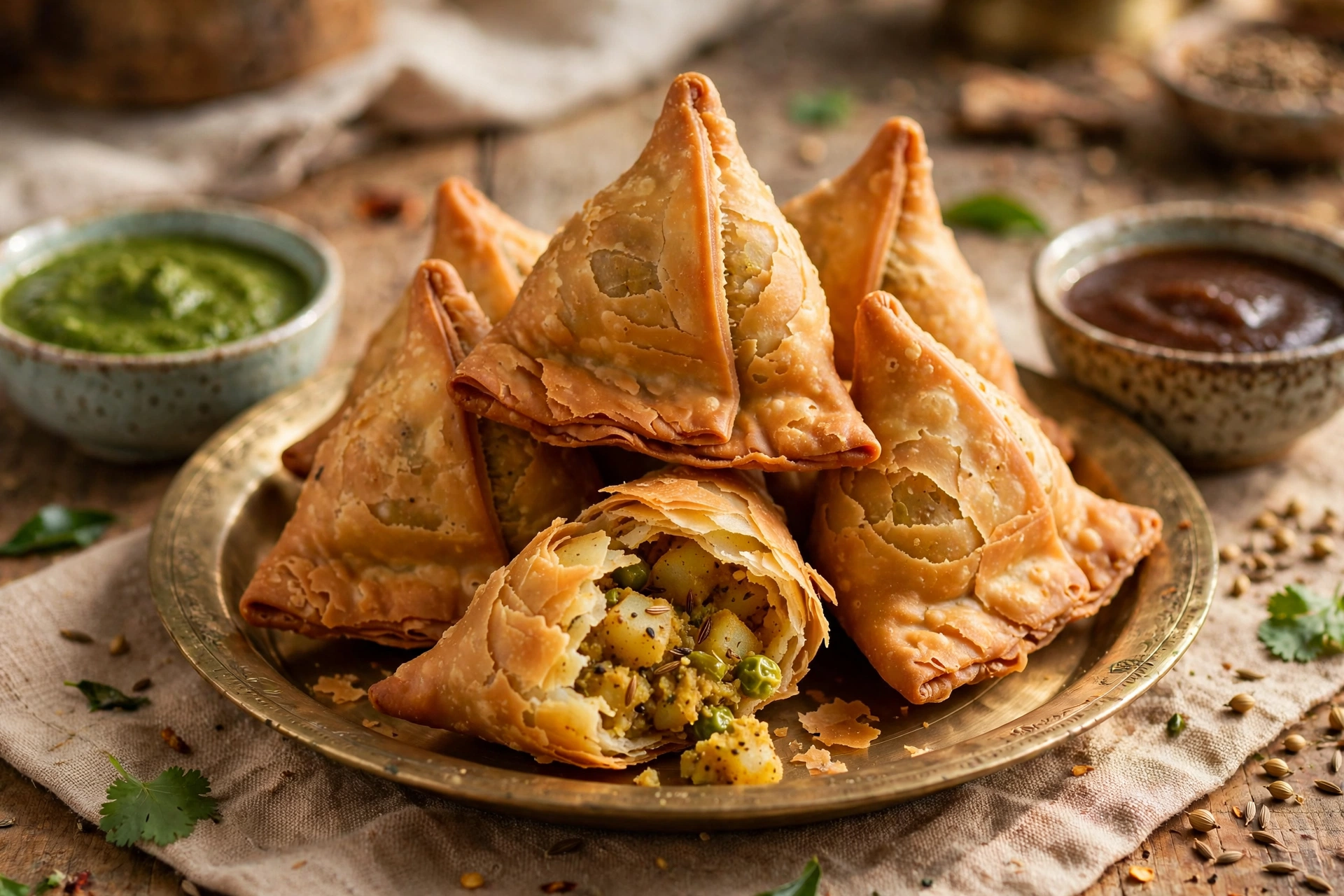
This homemade samosa recipe finally cracks the halwai code: a shatteringly crisp, flaky crust wrapped around a boldly spiced aloo filling, fried low and slow until golden.
There is a halwai near our old house in Lahore whose samosas I have been trying to copy for fifteen years, and for fourteen of those years I failed completely. My samosas looked right — golden triangles, promising — but the crust was always wrong.
Either it was soft and bready like a baked pastry, or it had those ugly blisters all over, or it went soggy within an hour. Meanwhile his samosas sat in a glass case all day and stayed shatteringly crisp, the crust flaking into layers when you bit in.
I finally asked him what his secret was, expecting some exotic ingredient. He laughed and said, “Moyan, beta. Aur thanda paani.” The fat in the dough, and cold water. That was it.
It turned out the entire science of samosa crispiness lives in the dough, not the filling. The filling is forgiving — spiced potatoes are hard to ruin. But the crust demands respect: the right amount of ghee rubbed into the flour (moyan), ice-cold water, a firm knead, a proper rest, and frying at exactly the right temperature. This samosa recipe is built on that halwai’s two-sentence lesson plus everything I learned in my fourteen years of failure. My samosas now stay crispy for hours, and the crust flakes in layers. The halwai would approve.
Why This Samosa Recipe Works
Every samosa failure I’ve ever had — and I’ve had them all — traces back to one of these five things — and this samosa recipe is engineered to fix all of them:
- Proper moyan (fat rubbed into flour). This is the halwai’s whole secret, and the foundation this samosa recipe is built on. Rubbing ghee or oil into the flour until it resembles breadcrumbs coats the flour particles in fat, which limits gluten formation. Less gluten means a short, flaky, crisp crust instead of a chewy, bready one. The test: squeeze a handful of the rubbed mixture — it should hold together in a clump. If it crumbles apart, add more moyan.
- Cold water, firm dough. Warm water activates gluten; cold water keeps the dough tight and crisp. And the dough should be firm — much stiffer than roti dough. A soft dough absorbs oil and fries up greasy. It feels wrong when you’re kneading it (your arms will complain), but trust the firmness — it’s what makes this samosa recipe fry up crisp instead of greasy.
- The 30-minute rest. Resting relaxes the dough just enough to roll without cracking, while keeping it firm enough to fry crisp. Skip the rest and the dough fights you, tears, and fries unevenly. Cover it with a damp cloth so it doesn’t dry out.
- Low-temperature frying. This is where most home cooks go wrong — they fry samosas the way they fry pakoras, in ripping hot oil. Samosas need low, patient heat (around 150–160°C / 300–320°F) for 12–15 minutes. The slow fry cooks the thick crust all the way through and drives out moisture, which is what keeps this samosa recipe crispy for hours. Hot oil browns the outside while the inside stays raw and goes soggy.
- Dry filling. A wet filling steams the crust from inside and makes it soggy. The potatoes must be completely cool and dry before filling — spread them on a tray for 15 minutes after cooking. No watery peas, no wet masalas. If your filling looks moist, it’s not ready — a dry filling is the non-negotiable rule of a great samosa recipe.
Ingredients
This samosa recipe makes 12–14 samosas.
For the crust:
- 2 cups all-purpose flour (maida)
- 1 teaspoon ajwain (carom seeds) — the signature samosa flavor in the crust
- 1 teaspoon salt
- 1/4 cup ghee, melted (or neutral oil) — this is the moyan
- About 1/2 cup ice-cold water (add gradually)
For the aloo filling:
- 4 medium potatoes (about 600g), boiled, peeled, and roughly crumbled (not mashed smooth — you want texture)
- 1/2 cup green peas (matar), boiled or thawed
- 2 tablespoons oil
- 1 teaspoon cumin seeds (zeera)
- 1 teaspoon coriander seeds, crushed
- 1 teaspoon fennel seeds (saunf) — optional but very halwai
- 2 green chilies, finely chopped
- 1 tablespoon ginger, finely minced
- 1 teaspoon red chili powder
- 1 teaspoon cumin powder
- 1 teaspoon coriander powder
- 1/2 teaspoon turmeric powder
- 1 teaspoon amchur (dried mango powder) — the tangy backbone
- 1 teaspoon chaat masala
- 1 teaspoon salt (adjust to taste)
- 1/4 cup fresh coriander leaves, chopped
For frying and serving:
- Oil for deep frying (enough to submerge — about 4–5 cups)
- Imli (tamarind) chutney and green chutney, for serving
On the filling: this samosa recipe is the classic Punjabi aloo samosa, which is why it sits in Vegetarian Recipes. But the crust technique is identical for keema samosas — just swap the potato filling for 500g of cooked, well-seasoned keema (my slow-cooked beef mince, chopped fine and cooked dry, makes an outrageous keema samosa). Whatever the filling, keep it dry.
How to Make This Samosa Recipe – Step by Step
Step 1: Rub in the moyan.
In a large bowl, mix the flour, ajwain, and salt. Pour in the melted ghee and rub it into the flour with your fingertips for 3–4 minutes, until the mixture looks like coarse breadcrumbs. Do the clump test: squeeze a handful — it should hold together. If it falls apart, work in another tablespoon of ghee. This step is the crispiness at the heart of this samosa recipe. Don’t rush it.
Step 2: Knead a firm dough.
Add the ice-cold water a few tablespoons at a time, kneading as you go, until a stiff, firm dough comes together. It should be noticeably harder than roti dough — your knuckles should feel the workout. Knead for 5 minutes until smooth — this samosa recipe needs a dough that’s stiff and satiny, not soft. Cover with a damp cloth and rest for 30 minutes.
Step 3: Make the filling.
While the dough rests, heat the oil in a pan. Add the cumin seeds, crushed coriander seeds, and fennel seeds; let them crackle for 30 seconds. Add the green chilies and ginger, fry a minute, then add all the ground spices. Toss in the crumbled potatoes and peas, and stir-fry for 4–5 minutes until everything is coated and fragrant. Stir in the amchur, chaat masala, salt, and fresh coriander. Taste — it should be bold, tangy, and slightly salty (the crust is plain, so the filling carries the flavor). Spread on a tray and cool completely.
Step 4: Shape the samosas.
Divide the dough into 6–7 balls. Roll one ball into an oval about 8 inches long and 6 inches wide, keeping it fairly thick (not paper-thin like roti). Cut in half crosswise to make two semi-circles. Take one semi-circle, form a cone by bringing the straight edge together and sealing with a dab of water — press firmly, this seam must hold. Hold the cone in your hand, fill generously with the cooled filling (about 2 tablespoons), then seal the top edge with water, pressing out any air. The classic shape has a slightly plump belly. Repeat with the rest.
Step 5: The low, slow fry.
Heat the oil to 150–160°C (300–320°F) — it should look barely shimmering, not smoking. Test with a tiny piece of dough: it should sink, then rise slowly with gentle bubbles. Fry 3–4 samosas at a time for 12–15 minutes, turning occasionally, until deep golden-brown and crisp all over. Don’t rush, don’t raise the heat — patience is what makes this samosa recipe work. Drain on a wire rack (not paper towels — trapped steam softens the bottom).
Step 6: Serve like the halwai.
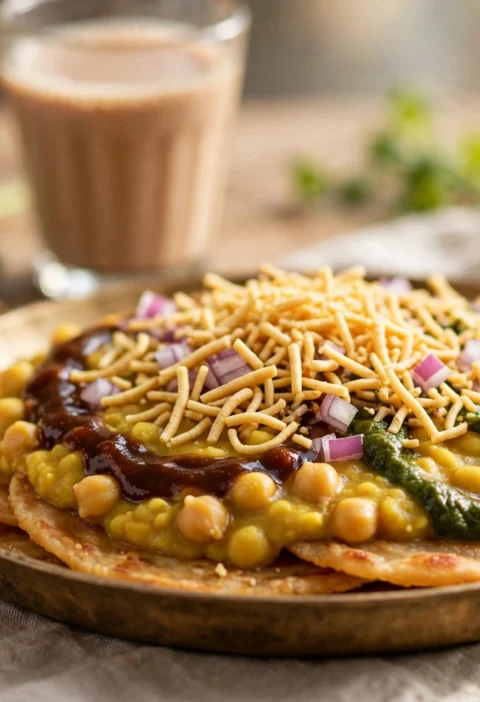
Serve hot with imli chutney and green chutney. The proper way: break the samosa open, spoon chutneys inside, and eat it in three bites while it’s still crackling. If you’re feeling Lahori, crush a samosa into a bowl, top with chole, onions, yogurt, and chutneys — samosa chaat, the king of street snacks.
Serving Suggestions
Samosas and chutneys are the whole story — imli chutney’s sweet tang against the crisp, savory crust is one of Pakistani cuisine’s perfect bites. For a rainy-day spread that will make everyone happy, serve this samosa recipe alongside my crispy mix pakoray and a pot of doodh patti chai — the barish trio, the holy trinity of monsoon snacking.
For parties, double this samosa recipe and keep them warm in a low oven (120°C/250°F) for up to an hour — they stay crisp. And the samosa chaat trick (crushed samosa + chole + yogurt + chutneys + onions) turns six leftover samosas into a dinner that people will request by name.
Storage and Reheating
Fried samosas keep at room temperature for a day (covered loosely — sealing them traps steam and softens the crust) and in the fridge for 3–4 days. Reheat in a hot oven or air fryer at 200°C (400°F) for 8–10 minutes and they come back remarkably crisp — never microwave them unless you enjoy sadness. Shaped samosas from this samosa recipe freeze brilliantly: freeze on a tray, then bag for up to 2 months, and fry straight from frozen at the same low temperature, adding 3–4 minutes. The filling alone keeps 4 days in the fridge and also freezes well.
Samosa Recipe FAQs
Why do my samosas have blisters on the crust?
Blisters mean the oil was too hot. High heat makes the surface puff and bubble before the crust sets. Keep the oil at 150–160°C and be patient — low, slow heat is the core rule of this samosa recipe.
Why did my samosas open up while frying?
The seal wasn’t strong enough, or there was air trapped inside expanding in the hot oil. Seal edges with water and press firmly, squeeze out air pockets when closing, and let shaped samosas rest 10 minutes before frying so the seal sets.
Can I bake samosas instead of frying?
You can, but manage expectations — baked samosas are a different, drier thing, closer to a pastry. Brush generously with oil and bake at 200°C (400°F) for 25–30 minutes, turning once. They’re decent, but they won’t have the shattering crisp of fried — and that crisp is the whole point of this samosa recipe. The air fryer (180°C/350°F, 12–15 minutes, sprayed with oil) lands somewhere in between.
Why is my crust soft instead of crispy?
One of three things: not enough moyan (do the clump test), dough too soft (it must be firm), or oil too hot (fast fry = raw inside = soggy). The recipe’s ratios fix all three — follow them exactly the first time, then adjust to taste — this samosa recipe’s ratios are the result of fourteen years of getting it wrong.
Recipe Summary
- Prep time: 45 minutes (+ 30 minutes resting)
- Cook time: 30–40 minutes (frying in batches)
- Total time: About 2 hours
- Servings: 12–14 samosas
- Cuisine: Pakistani
- Course: Snack / Appetizer