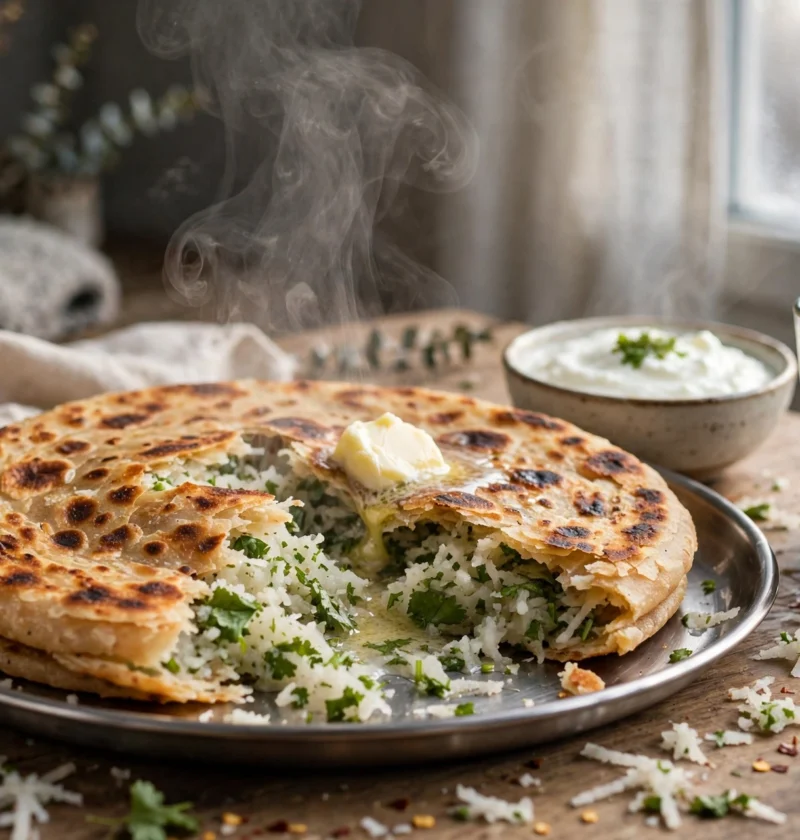
Mooli comes home from the winter bazaar in bundles, long white radishes with their green tops still on, and in my grandmother’s house that bundle meant exactly one thing: parathas by the weekend. She would sit with the grater in a wide steel paraat, wrists moving in a rhythm older than I am, while the whole kitchen filled with that sharp, peppery smell that is halfway between a radish and a promise. This mooli paratha recipe is hers as I finally learned it — grated radish seasoned with ajwain and green chili, sealed inside soft dough, and fried until the crust turns crisp and freckled, with white butter melting into the tear you make for the first bite.
My own first attempts were a small flood. I grated the radish, salted it proudly, and stuffed it straight in — twenty minutes later the rolling board was swimming, the dough tore with every stroke, and half the filling escaped into the tawa. The next batch stayed together but bit back: I had grated too coarsely, so the radish stayed raw and harsh at the center, all sting and no sweetness. And the third batch fried up flat and sulky, refusing to puff, because the filling was still quietly damp and the steam that should have ballooned the paratha leaked out instead. The rules of this mooli paratha recipe are those three breakfasts: grate fine, salt it, and squeeze until your hands complain — a mooli paratha is won or lost before the dough is even rolled.
Why This Mooli Paratha Recipe Works
Radish is mostly water wearing a peppery disguise, and that water is the enemy of every stuffed bread. This mooli paratha recipe is built around removing it and keeping everything else:
- The squeeze is the whole recipe. Salt pulls the peppery juice out of the gratings, and then you wring them — in your fists, then in a cloth — until they feel almost dry and fluffy. Every drop you remove is a tear that never happens in this mooli paratha recipe.
- The grate is fine, never coarse. Fine shreds melt into a single seasoned layer as the paratha fries, cooking through in minutes. Coarse chunks stay raw at the center and pierce the dough from inside as you roll.
- The filling is seasoned like a dish, not a garnish. Ajwain for the warmth radish loves, green chili for heat, ginger, coriander leaves, and a pinch of amchur for tang — the squeezed radish is mild once its juice is gone, and it needs this company.
- The dough is rolled thick first, then thin. A small, thick disc cups the filling without straining; once it is pleated and sealed, gentle rolling walks the filling outward. Rolling a thin disc first and stuffing it is how seams split.
- A dry filling puffs; a wet one leaks. On a hot tawa, the little moisture left in a well-squeezed filling turns to steam inside the sealed paratha and balloons it. Damp filling makes more steam than the seams can hold, and a mooli paratha recipe lives in that difference.
Ingredients
Makes 6 parathas
For the mooli filling:
- 1 pound white mooli (daikon radish) — about 2 medium radishes, peeled
- 1 teaspoon salt, for drawing out the juice
- 1 teaspoon ajwain (carom seeds), crushed lightly between your palms
- 1 tablespoon fresh ginger, grated
- 2 green chilies, chopped very fine
- 1/4 cup fresh coriander leaves, chopped
- 1/2 teaspoon garam masala
- 1/2 teaspoon red chili powder
- 1 teaspoon amchur (dry mango powder), for a gentle tang
For the dough:
- 2 cups atta (whole wheat flour), plus extra for dusting
- 3/4 teaspoon salt
- 1 tablespoon oil or melted ghee, rubbed into the flour
- Warm water, about 3/4 cup, added a little at a time
For frying and serving:
- Ghee, roughly 1 teaspoon per paratha
- White butter, plain yogurt, and a spoonful of pickle, to serve
- Hot chai, because winter insists
The star of the filling deserves its introduction: daikon — mooli — is the long white radish of Asian winter fields, peppery when raw and surprisingly sweet for the few minutes it spends inside a frying paratha. The bread it fills is the beloved paratha, the tawa-fried flatbread that turns a weekday breakfast into a small ceremony. A mooli paratha recipe is the two of them meeting on a cold morning: the sharpest vegetable of the season, tamed by salt and a strong pair of hands.
How to Make This Mooli Paratha Recipe – Step by Step
Step 1: Grate, salt, and squeeze the mooli.
Grate the peeled radishes on the fine side of the grater — the shreds should be soft and thin, never matchsticks. Toss them with the teaspoon of salt in a bowl and leave for 20 minutes; the shreds will slump and pool in their own peppery juice. Now squeeze: take up handfuls and press them hard over the sink, then gather everything into a clean cloth, twist, and wring until barely a drop falls. The squeezed mooli should look pale, fluffy, and almost dry. Do not rush this step; it is the foundation the whole mooli paratha recipe stands on.
Step 2: Season the filling and knead the dough.
Tip the squeezed radish into a dry bowl and fork through the ajwain, green chilies, ginger, coriander, chili powder, garam masala, and amchur until it looks evenly flecked. In a second bowl, rub the oil into the flour and salt, then add warm water gradually and knead for 6 to 7 minutes into a soft, smooth dough — softer than roti dough, never sticky. Rest it under a damp cloth for 30 minutes and divide it into 6 balls. Seasoned filling, rested dough: a mooli paratha recipe asks for both to be ready before a single paratha is shaped.
Step 3: Stuff and seal each paratha.
Dust a dough ball and roll it into a thick disc about 4 inches across, thinner at the edges than the middle. Cup it in your palm and mound 2 generous tablespoons of filling in the center. Gather the edges up in pleats, pinch them together firmly at the top, twist off the excess, and press the seal flat with your thumb. Set the parcel seam-side down and rest it a minute while you fill the rest — a rested seal holds its nerve when the rolling starts, and a mooli paratha recipe rewards the small patience.
Step 4: Roll gently, from the center outward.
Flour the board, set the parcel seam-side down, and press it gently into a thick patty with your fingers. Roll with short, light strokes that begin at the center and move out, turning the paratha a quarter turn after each pass, until it is 7 to 8 inches across and evenly thin. If a shred pokes through, pinch the spot closed and dust it — a small patch is no tragedy. Heavy rolling squeezes filling to the edges and bursts them, so lightness, here, is not delicacy; it is the technique of this mooli paratha recipe.
Step 5: Fry until crisp, freckled, and puffed.
Heat a tawa or heavy skillet over medium heat until a flicked drop of water dances. Lay the paratha on the dry surface for about a minute, until the underside firms and pale spots show; flip and give the second side its minute. Now drizzle a teaspoon of ghee around the rim and a little over the face, turn it once more, and lean the spatula on it softly — a well-sealed paratha swells into a round balloon as the steam gathers inside. Keep turning it every half minute or so until both faces are crisped a deep gold, about 3 to 4 minutes in total. Serve your mooli paratha recipe straight off the tawa, one by one, the way winter breakfast demands.
Serving Suggestions
A mooli paratha recipe is cold-morning food, and it keeps cold-morning company: a melting knob of white butter on top, a bowl of plain yogurt beaten smooth, a spoonful of mango or mixed pickle for the bite, and a glass of doodh patti so strong it needs no introduction. In the fields of Punjab it travels wrapped in cloth with a whole green chili and a lump of jaggery; at my table it simply never survives long enough to travel.
To place it among the stuffed breads on this site: my aloo paratha seals a spiced potato mash inside the dough — soft, mellow, forgiving. My methi paratha takes the other road entirely, kneading fenugreek leaves through the dough itself so nothing is hidden inside. The mooli paratha recipe is the third temperament: a filling that must be wrestled dry before it behaves, and a finished paratha that eats crisper and sharper than either of its cousins — the squeeze, it turns out, is also where the crunch is born.
Storage and Reheating
Cooked mooli parathas keep 2 days in the refrigerator, wrapped in cloth inside an airtight container, and come back well on a hot, dry tawa for a minute a side; a fresh touch of ghee at the end revives the edges. They freeze respectably for up to a month, stacked with parchment between them, and reheat from frozen over medium-low heat. The squeezed, seasoned filling itself keeps a day in the fridge, which makes the morning assembly quick. What does not work is rolling the parathas hours ahead — even well-squeezed filling slowly relaxes into the dough. Shape, roll, and fry to order; a mooli paratha recipe is at its best in the minutes after the tawa, not after the wait.
Frequently Asked Questions
Why does my mooli paratha tear while I roll it?
Juice, almost every time — either the gratings were not wrung dry enough, or the paratha sat filled for too long before rolling and the salt kept pulling water out. Squeeze until your hands ache, then once more in a cloth, and roll each paratha soon after sealing it. Keeping the filling cool and the rolling strokes light closes the last of the gaps in a mooli paratha recipe.
Can I use the juice I squeezed out of the radish?
Yes — do not throw that peppery gold away. My grandmother stirred it into the dough water for the next batch of rotis, and it also disappears happily into a daal or a raita where its sharpness reads as seasoning. Just never put it back into the filling; the entire point of this mooli paratha recipe is that the juice and the paratha part ways.
Why does my filling taste harsh and raw?
The grate was too coarse, or the paratha was rushed off the tawa. Thick radish shreds cannot cook through in the few minutes inside a frying paratha, and their raw pepper concentrates instead of mellowing. Grate fine, season generously, and give the paratha its full time with the ghee press — properly cooked mooli turns sweet and gentle, and a mooli paratha recipe should taste of that sweetness, not of a sting.
Can I knead the mooli into the dough instead of stuffing it?
You can, and many hurried households do — the squeezed gratings knead straight into the atta and the parathas roll like ordinary dough. The result is pleasant and easier, but it eats softer, with the radish spread thin instead of gathered in one seasoned layer. The stuffed version in this mooli paratha recipe takes ten minutes longer and tastes like a different, better dish; the kneaded one is for Tuesday.
Recipe Summary
- Prep time: 25 minutes (plus 20 minutes for the salt-and-squeeze, and half an hour while the dough rests)
- Cook time: About 25 minutes on the tawa, one paratha at a time
- Total time: Roughly 1 hour 40 minutes, start to first bite
- Servings: 6 parathas, serving 3 people
- Cuisine: Pakistani (Punjabi)
- Course: Breakfast