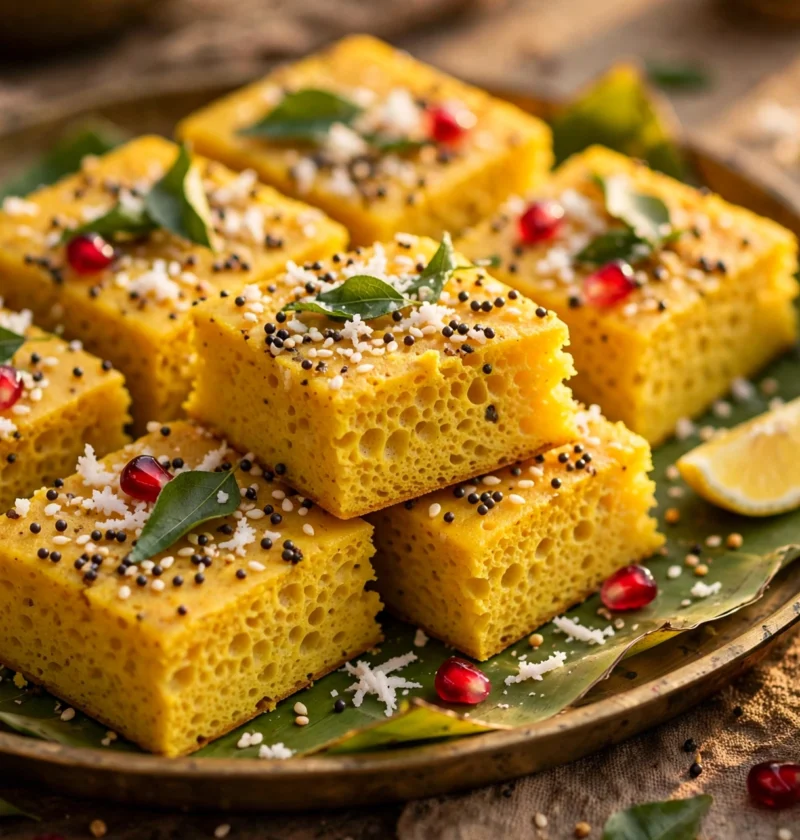
The khaman against which I judge every other khaman reached me in a dented steel dabba, halfway through an overnight train ride to Surat. The woman sharing our compartment — a schoolteacher travelling home with two dabbas and strong opinions — opened it somewhere past midnight and offered the top layer around like it was prasad. The squares inside were the colour of marigolds, impossibly tall, and so light that my first piece collapsed gently between my fingers before it ever reached my mouth. She watched me eat it, nodded once, and said her mother had made it that same morning, in the time it took the household to get ready for the day. This khaman recipe is my attempt, years and many flat failures later, to earn that nod.
Khaman is Gujarat’s beloved instant steamed cake, made from a batter of besan — finely ground chickpea flour — seasoned with ginger, green chilli, a little sugar and lemon, then beaten until it holds air, woken with fruit salt at the final moment, and rushed into a steamer. A crackling tempering of mustard seeds, sesame and curry leaves goes over the top, usually with a spoonful of sweetened tempering water that soaks down and keeps every square moist for hours. Newcomers constantly confuse it with dhokla, and Gujarati grandmothers constantly correct them: dhokla batter is rice and urad dal, ground and left to ferment overnight until it turns pleasantly sour, and the finished dhokla is tangy, firm and sliceable. Khaman asks for no soaking and no fermenting at all — it is besan only, mixed and steamed within the hour, and the result is noticeably softer, spongier and more delicate, a cake that yields like a cushion rather than a bread.
Why This Khaman Recipe Works
Every disappointment khaman can hand you — dense, rubbery, sunken in the middle — traces back to air: how much you build, and how carefully you protect it. This khaman recipe is really five small habits arranged around that single idea:
- The batter gets whipped in one direction only. Beating besan and water steadily, always turning the whisk the same way, for a full five minutes folds in far more air than a lazy stir, and that trapped air is the scaffolding the sponge is built on.
- Fruit salt goes in last, and the steamer is already waiting. The fizz begins the second fruit salt meets the acidic batter, and it fades fast. A steamer at a rolling boil before you add it means the batter is cooking within half a minute, while its bubbles are still young and expanding.
- A measured spoon of sugar does three jobs. Beyond the gentle sweetness Gujarati snacks are known for, sugar feeds the rise, deepens the golden colour, and rounds off the raw edge that plain besan can have even after steaming.
- The tempering carries its own sweetened water. Instead of oil alone, warm water whisked with a little sugar is splashed over the cut squares first, so the cake drinks and stays tender; the seeds and curry leaves follow in hot oil for aroma and crunch.
- The slab rests before anyone cuts it. Ten undisturbed minutes out of the steamer lets the crumb firm up just enough to slice into clean, tall squares instead of tearing into damp shreds.
Ingredients
Nearly everything here is a pantry staple, but the besan deserves one moment of attention: for this khaman recipe, the flour should be the fine, pale, laddu-grade grind sold in Indian stores, not the coarse, darker meal sometimes labelled gram flour elsewhere — coarse particles weigh the batter down and the sponge never opens. Fruit salt, sold under the brand name Eno in most of the world, is the traditional leavener for khaman across Gujarati cuisine; the plain, unflavoured sachet is the one to buy, since the citrus varieties can perfume the batter strangely.
Serves 6
For the batter:
- 2 cups fine besan (chickpea flour), sifted
- 1 cup warm water, plus 2 to 3 tablespoons more as needed
- 2 tablespoons sugar
- 1 teaspoon fine salt
- 1/4 teaspoon turmeric powder
- 1 tablespoon ginger and green chilli paste
- 1 tablespoon lemon juice
- 2 tablespoons neutral oil, plus more for greasing the tin
- 1 teaspoon fruit salt (plain Eno)
For the tempering:
- 2 tablespoons neutral oil
- 1 teaspoon mustard seeds
- 1 teaspoon white sesame seeds
- 1 pinch asafoetida (hing)
- 10 to 12 fresh curry leaves
- 3 green chillies, slit lengthwise
- 1/3 cup water
- 1 teaspoon sugar
- 2 tablespoons grated fresh coconut
- 2 tablespoons finely chopped fresh coriander leaves
How to Make This Khaman Recipe – Step by Step
Step 1: Whip the batter until it turns pale and ribbon-like. Tip the sifted besan into a wide bowl — wide matters, because you need room to beat properly — and pour in the warm water a little at a time, whisking out lumps as you go. Add the sugar, salt, turmeric, ginger-chilli paste, lemon juice and oil, then settle in and whisk in one direction for five full minutes. The batter should lighten in colour, thicken slightly, and drip from the whisk in a lazy ribbon that briefly keeps its line before dissolving back into the bowl. Stir in a spoon or two more water if it feels like cake dough; it should pour like thick cream. Cover and leave it for ten minutes while the flour hydrates.
Step 2: Bring the steamer to a boil and grease the tin. Set a large steamer, or a deep pot with a trivet and a tight lid, over high heat with a few inches of water, and let it reach a confident, rolling boil before the batter is touched again. Brush a 7- or 8-inch square tin generously with oil, right into the corners. Both of these preparations happen before the leavening is added, and that ordering is the entire secret of a tall khaman: once the fruit salt goes in, there is no pausing to hunt for a tin.
Step 3: Wake the batter with fruit salt and pour at once. Sprinkle the fruit salt evenly over the surface of the rested batter, drizzle a teaspoon of water across it so it begins to foam, and fold it through with six or seven swift strokes of the whisk — no more, or you will beat the gas back out. The batter will swell and turn noticeably paler and fluffier. Scrape it straight into the greased tin, level the top with the back of a spoon, and carry the tin directly to the waiting steamer.
Step 4: Steam, then let the slab rest where it is. Set the tin on the trivet, clap the lid on, and steam over medium-high heat for 18 to 20 minutes without lifting the lid to peek — escaping steam in the first ten minutes can dent the rise permanently. The khaman is done when a skewer pushed into the centre emerges clean and the surface springs back under a fingertip. Switch off the heat, crack the lid slightly, and leave the tin inside for five minutes so the temperature falls gently; then lift it out and rest it on the counter for five minutes more.
Step 5: Drench, temper, and finish with coconut. Run a knife around the tin, turn the slab onto a plate, and cut it into generous squares. Stir the teaspoon of sugar into the 1/3 cup of water and spoon this sweetened water slowly over all the cut faces. Heat the oil in a small pan, add the mustard seeds, and when they pop, follow with the sesame seeds, asafoetida, curry leaves and slit green chillies; give them twenty seconds until the sesame blonds. Spoon the sizzling tempering over every square, shower with grated coconut and coriander, and serve while the top still crackles faintly.
Serving Suggestions
At home I serve khaman the way the farsan shops do — still faintly warm, on a steel plate with a bowl of sharp green chutney, a lemon wedge, and a small mound of fine sev for anyone who wants crunch against the softness. It belongs to that great Gujarati snack hour between lunch and dinner, alongside a cup of masala chai strong enough to stand up to it. On a fuller spread it sits happily beside its fermented cousin from my dhokla recipe — taste the two side by side and the family resemblance and the difference are both obvious in one bite — and the spiral rolls of my patra recipe complete a tray that covers tangy, sweet, soft and crisp all at once.
This khaman recipe also travels better than almost any steamed snack I know, which is presumably how it ended up in that train dabba. Packed in an airtight box once fully cool, the squares stay moist for a full day of travel, and a leftover piece, crumbled over a bowl of yogurt with a pinch of roasted cumin, makes a breakfast I have never once been sorry about.
Storage and Reheating
Leftover khaman keeps in the refrigerator, in a sealed container, for two to three days. The tempering water it drank at the start is what protects it here — properly drenched squares stay tender far longer than dry ones. Let refrigerated pieces come back to room temperature before serving and they will already be most of the way to good.
To reheat, steam is the only method that truly restores this khaman recipe: five minutes back over boiling water returns the crumb to something close to fresh. A microwave works in a pinch — cover the plate with a damp cloth and use short bursts — but it toughens the edges if you overdo it. Freezing is not recommended; the delicate sponge weeps on thawing and turns dense and wet.
Frequently Asked Questions
Why did my khaman come out dense and flat instead of spongy?
Three culprits account for nearly every flat khaman: the batter was not whipped long enough to hold air, the fruit salt sat in the batter while the steamer heated, or the lid was lifted mid-steam and the rise collapsed. Whisk the full five minutes, have the water boiling before the leavener goes in, and keep the lid shut for the whole steaming time.
Can I make khaman without fruit salt?
Yes — in this khaman recipe you can swap the teaspoon of fruit salt for 1/2 teaspoon of baking soda plus an extra squeeze of lemon juice, added in exactly the same last-second way. The rise will be a fraction less lofty and the crumb a touch coarser, but the result is still properly soft. What will not work is leaving the leavener out entirely and hoping the whisking alone carries it; steamed besan without gas is a brick.
What exactly is the difference between khaman and dhokla?
Dhokla begins with rice and urad dal that are ground and fermented overnight, which gives it a gentle sourness and a firmer, more bread-like bite. Khaman skips fermentation completely: it is made from besan alone, leavened at the last moment, and steamed immediately, so it tastes milder, looks more vividly yellow, and feels noticeably softer and spongier. In Gujarat, khaman is the one sold by weight at farsan shops as an everyday snack.
Why does my khaman sometimes have reddish-brown patches?
That discolouration is turmeric reacting with too much alkaline leavener in spots where the soda was not folded through evenly. Measure the fruit salt rather than eyeballing it, sprinkle it across the whole surface instead of dumping it in one place, and fold it in with those few swift strokes so it disperses. The patches are harmless, but even mixing makes them disappear.
Recipe Summary
- Prep time: 15 minutes, plus 10 minutes resting the batter
- Cook time: 20 minutes steaming
- Total time: About 45 minutes, start to finish — no fermentation needed
- Servings: 6
- Cuisine: Pakistani
- Course: Main Course