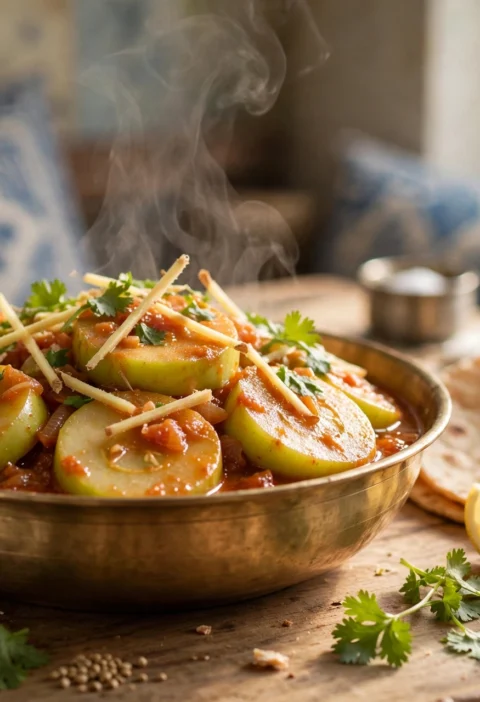
I learned to make patra standing in a neighbour’s kitchen doorway in Surat, drafted into service the moment I made the mistake of looking curious. The lady of the house had a stack of colocasia leaves the size of dinner plates spread across her counter, and she handed me a rolling pin with instructions to flatten veins while she mixed the paste. “Roll them thin,” she said, “or the leaf will fight you all the way to the steamer.” By the time the rolls came out — tight, dark green, smelling of tamarind and sesame — I understood that this patra recipe is less about cooking and more about persuasion: you coax a stubborn leaf into behaving, and it rewards you with one of the great snacks of western India.
Patra means simply “leaf,” and the dish is exactly that: large colocasia leaves (called arbi ke patte in Hindi) spread with a thick, sweet-sour-spiced chickpea flour paste, stacked, rolled into logs, steamed, then sliced into spirals and showered with a crackling tempering. Cross into Maharashtra and the same rolls answer to the name alu vadi, made with a slightly fierier paste and often shallow-fried. Fresh colocasia leaves carry a natural itch — tiny crystals in the leaf that can scratch the throat — which is why every traditional patra recipe builds tamarind or another souring agent right into the paste and cooks the leaves thoroughly. Handle that one detail with respect and the leaf turns silky, earthy and completely tame — the quiet promise every good patra recipe keeps.
Why This Patra Recipe Works
Patra fails in three famous ways: the rolls unroll, the slices taste itchy, or the paste weeps out during steaming. Each failure has a cause, and this patra recipe is built around removing all three before they start:
- The souring agent is in the paste, not an afterthought. Tamarind pulp, amchur and lemon juice do more than flavour the besan — their acidity is what neutralises the leaf’s itchy crystals as the rolls steam. A bland or under-soured paste is the single most common reason homemade patra leaves a scratch in the throat.
- The thick central vein is shaved flat first. A colocasia leaf has a spine like a small tree branch. Roll it untrimmed and the leaf cracks along the fold or springs the roll open in the steamer. Shaving the vein down to the leaf’s own thickness takes thirty seconds and the leaf suddenly rolls as obediently as a tortilla.
- The paste is thick enough to hold a spoon upright. Runny paste soaks through the leaf and leaks into the steaming water, taking your flavour with it. Mixed to the consistency of soft peanut butter, it stays where you spread it, glues the layers together and sets into that beautiful marbled spiral when sliced.
- The roll is tight, and it rests before slicing. Loose rolls steam into floppy tubes that shred under the knife. Rolled firmly with the sides folded in — like a burrito — and given ten minutes to cool and firm up, the log slices into clean coins with every layer intact.
- The tempering lands at the very end, in two stages if you like. Steamed patra on its own is soft and mild; the sesame-mustard tempering is its personality. Toss the slices in the hot, crackling oil just before serving and they stay glossy and fragrant, and a brief pan-fry in the same oil gives crisped edges for anyone who prefers them that way.
Ingredients
The leaf is the whole dish, so choose it like it matters: you want large, unbroken colocasia leaves with flexible stems and no yellowing at the edges. In the US, Indian grocery stores stock them fresh in summer and frozen year-round, and the frozen ones — thawed and patted dry — work honestly well. The paste belongs to the great sweet-sour tradition of Gujarati cuisine, balancing jaggery against tamarind and green chilli heat, and it doubles as the glue, the seasoning and the itch-remover all at once. Everything else is pantry basics.
Serves 6
For the leaves:
- 12 large colocasia (arbi) leaves, about 10 to 12 inches long
For the besan paste:
- 2 cups besan (chickpea flour), sifted
- 3 tablespoons tamarind pulp
- 2 tablespoons amchur (dry mango powder)
- 3 tablespoons grated jaggery (or packed brown sugar)
- 1 tablespoon ginger-green chilli paste
- 1 teaspoon turmeric powder
- 1 teaspoon red chilli powder
- 1 teaspoon ground coriander
- 1/2 teaspoon ground cumin
- 1 tablespoon sesame seeds
- 1 teaspoon salt, or to taste
- 1 tablespoon lemon juice
- About 3/4 cup water, added gradually
For the tempering:
- 2 tablespoons oil
- 1 teaspoon mustard seeds
- 2 tablespoons sesame seeds
- 1/4 teaspoon hing (asafoetida)
- 10 to 12 fresh curry leaves
- 2 green chillies, slit lengthwise
- 2 tablespoons grated fresh coconut, to garnish
- 2 tablespoons chopped fresh coriander, to garnish
How to Make This Patra Recipe – Step by Step
Step 1: Wash the leaves and shave their spines flat. Rinse each leaf gently under running water and pat completely dry with a clean cloth — torn or wet leaves make rolling miserable, so handle them like paper. Lay a leaf face down and, with a small sharp knife held almost flat, shave the raised central vein down until it is level with the leaf surface, working from stem to tip; trim away any thick side veins the same way. Do the rolling-pin trick I was taught as backup: a few firm passes over the vein softens whatever the knife missed. Set the prepared leaves aside, largest ones first.
Step 2: Whisk the paste to peanut-butter thickness. In a wide bowl, whisk the sifted besan with the tamarind pulp, amchur, jaggery, ginger-green chilli paste, all the ground spices, sesame seeds, salt and lemon juice. Add the water a few spoonfuls at a time, whisking hard between additions, until you have a thick, smooth, spreadable paste that holds soft peaks — closer to hummus than to batter. Taste it now, on the end of a spoon: it should be boldly sweet, sour and salty all at once, more intense than feels polite, because the steamed leaf will mellow everything. Paste that tastes perfect at this stage will taste bland later.
Step 3: Spread, stack and roll each log tightly. Lay your largest leaf face down, glossy side underneath, and spread a thin, even layer of paste over the entire surface, right to the edges. Place a second leaf on top pointing the opposite direction, spread it with paste, and repeat until you have a stack of three or four leaves. Fold the left and right edges inward by about an inch, then, starting from the stem end, roll the stack up firmly and evenly, pressing gently as you go so no air pockets hide inside. Spread a dab of paste on the final flap to seal it. Set the roll seam-side down and repeat with the remaining leaves — this patra recipe makes about three rolls from twelve leaves.
Step 4: Steam until firm, then let the rolls rest. Arrange the rolls seam-side down in a greased steamer basket, leaving a little space between them, and steam over steadily boiling water for 25 to 30 minutes. They are done when the surface looks dark and set and a knife slipped into the centre comes out clean, with no wet paste clinging to it. Lift the basket out and let the rolls rest for a full 10 minutes — this pause is not optional ceremony, it is what firms the paste so the slices hold their spirals. Once rested, cut each roll crosswise into slices about 1/2 inch thick with a gentle sawing motion.
Step 5: Temper, toss and serve warm. Warm the oil in a wide skillet over medium heat, then drop in the mustard seeds; once they begin to pop and crackle, follow with the sesame seeds, hing, curry leaves and slit green chillies, and let everything sizzle for about 20 seconds until the sesame turns pale gold and the pan smells nutty. Tip in the patra slices in a single layer and toss gently to coat them in the tempering — or leave them undisturbed for a minute per side if you want crisped, golden edges. Slide everything onto a serving plate, scatter over the coconut and coriander, and serve warm with lemon wedges. This is the patra recipe at its best: tender spiral, crackling top, sweet-sour all the way through.
Serving Suggestions
Patra is farsan — snack food — and it shines brightest in company. Build a Gujarati snack spread with my silky khandvi rolls and a plate of spongy dhokla, add a bowl of green chutney and a pot of masala chai, and you have the tea-time tray every Gujarati household measures itself by. The three share a besan heart but deliver completely different textures — patra dense and tangy, khandvi melting, dhokla airy — which is exactly why they belong on the same table. Patra also slips comfortably into a full thali beside dal, rice and a dry sabzi, where its chew and sourness reset the palate between bites.
Storage and Reheating
The steamed, untempered rolls are the meal-prepper’s friend: wrapped tightly, they keep in the fridge for up to 4 days, ready to slice and temper whenever you want them. Always temper fresh, though — a day-old tempering loses its crackle, and the sesame goes from fragrant to flat. Fully tempered leftovers also keep for 2 days in the fridge and are genuinely good at room temperature, which is why patra travels so well in lunchboxes.
For longer storage, this patra recipe freezes gracefully: keep the steamed rolls whole for up to 2 months, thaw overnight in the fridge, slice while still slightly firm, temper and toss as usual. To reheat already-tempered slices, give them a few minutes in a hot, dry pan until the edges wake up and crisp again — the microwave works but softens them, so treat it as a last resort. A final squeeze of lemon over reheated patra restores the bright note that storage dulls.
Frequently Asked Questions
Why does patra make my throat itch, and how do I stop it?
The itch comes from calcium oxalate crystals in raw colocasia leaves, and two things defeat it: acid and thorough cooking. The tamarind and amchur in the paste begin breaking the crystals down, and a full 25 to 30 minutes of steaming finishes the job. If a batch still tingles, the leaves were under-soured or under-steamed — add a squeeze of lemon over the slices and steam any future rolls a few minutes longer.
I cannot find colocasia leaves in the US. What can I use instead?
Check the freezer section of an Indian grocery first — frozen patra leaves are widely stocked and work beautifully. Failing that, large collard greens are the best fresh substitute: blanch them briefly, shave their stems flat and use them exactly as written, though the flavour will be milder and earthier. Very large Swiss chard leaves also roll well. Small spinach leaves are too fragile to hold a roll, so save those for something else.
My rolls unrolled in the steamer. What went wrong?
Almost always one of three things: the central vein was left thick, so the leaf sprang back against the roll; the roll itself was loose, with air pockets that expanded in the steam; or the seal flap got no paste on it. Shave the veins flat, fold the sides in before rolling, roll firmly from the stem end, and always rest the finished roll seam-side down for a minute before it goes into the steamer.
Can I make this patra recipe ahead for a party?
Yes — it is one of the best make-ahead snacks I know. Steam the rolls up to two days in advance and refrigerate them whole, then slice, temper and toss an hour before guests arrive; the slices hold their gloss and crunch happily at room temperature. For a crowd, double the paste rather than the leaves per roll, because four leaves per roll is the most that steams evenly.
Recipe Summary
- Prep time: 30 minutes
- Cook time: 35 minutes
- Total time: 1 hour 5 minutes
- Servings: 6
- Cuisine: Pakistani
- Course: Main Course