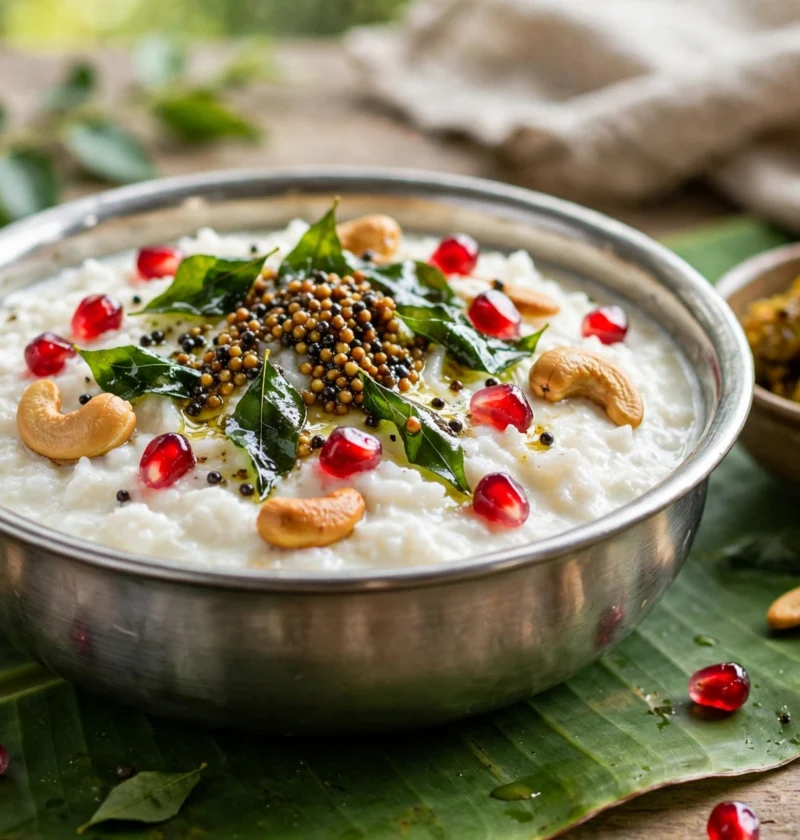
I did not grow up eating curd rice, and my first real bowl of it came from a stranger on an overnight train. The lady across from me opened a steel dabba lined with banana leaf, and inside was soft, white, faintly glistening rice she had packed that morning. It was a hot, dusty journey — but one spoonful of that cool, tangy rice and I understood why she had carried it across two states. Before she got off at her station, I had asked her twice how she made it. This curd rice recipe is my attempt to recreate that dabba, and no curd rice recipe I have eaten since has beaten the memory of that one.
Curd rice — thayir sadam in Tamil — is South India’s great soother. It is the dish served at the end of a fiery meal to calm things down, the prasadam offered in temples, the lunch packed for train journeys because it tastes better a few hours after it is made. A real curd rice recipe does not want separate, fluffy grains. It wants the rice cooked soft — almost to the edge of porridge — lightly mashed while warm, cooled, and then folded through whisked yogurt until it is one creamy, spoonable whole. That is the personality of the dish: cool, gentle, quietly tangy, with a crackling tempering poured over the top like a signature.
Why This Curd Rice Recipe Works
Curd rice sounds too simple to get wrong — rice plus yogurt, what could go sideways? Plenty. This curd rice recipe works because of five small disciplines:
- The rice is cooked soft on purpose. Extra water and a mash while the rice is warm break down enough starch to make the curd rice recipe naturally creamy. Firm grains stay chalky in yogurt and never merge.
- The rice cools before the yogurt goes in. Yogurt stirred into steaming rice thins out and turns sour fast. Lukewarm rice keeps the yogurt thick, mild, and alive — this is non-negotiable in any curd rice recipe worth making twice.
- A splash of milk buys you hours. This is the picnic trick: a few spoonfuls of milk mixed into the rice slow the yogurt’s souring, so the dish stays sweetly tangy instead of sharp, even in a warm lunchbox.
- The yogurt is whisked smooth and salted first. Whisking the curd with its salt first means every spoonful is seasoned and the texture is silk, not lumps. Grainy yogurt makes a grainy dish.
- The tempering lands last and lands hot. Mustard seeds, dals, cashews, and curry leaves crackled in ghee and poured over the finished curd rice recipe give you warm crunch against cool cream in every bite. Mixed through too early, the dals soften and vanish.
Ingredients for This Curd Rice Recipe
Two ingredients decide everything here, and both are humble. The first is the rice itself: curd rice is traditionally made with a short or medium-grain rice that softens willingly, and I will be honest — this is one dish where long basmati grains are not ideal, because they resist the mash. The second is good yogurt: plain, whole-milk, set the day before if you can, because watery, over-sour curd will bully the whole bowl. Everything else in a curd rice recipe — the tempering spices, the pomegranate, the cashews — gives that soft, tangy base its crunch and perfume.
For the rice
- 1 cup short or medium-grain white rice (about 6 1/2 ounces / 185 g) — sona masoori style is ideal; basmati works in a pinch
- 3 cups water, for cooking the rice soft
- 1/2 teaspoon fine sea salt
- 1/4 cup whole milk (60 ml), warmed — the anti-souring trick, do not skip it
For the yogurt mixture
- 2 cups plain whole-milk yogurt (about 500 g), fresh and only mildly tangy
- 1/2 teaspoon fine sea salt, or to taste
- 1 teaspoon grated fresh ginger (optional, but lovely)
For the tempering and finish
- 2 teaspoons ghee or sesame oil
- 1 teaspoon black mustard seeds
- 1 teaspoon urad dal
- 1 teaspoon chana dal (optional, for extra crunch)
- 2 tablespoons raw cashews or peanuts, halved
- 2 dried red chilies, broken
- 1 green chili, finely chopped
- 10 to 12 fresh curry leaves
- 1 pinch asafoetida (hing)
- 1/4 cup pomegranate arils
- 2 tablespoons chopped fresh cilantro
- 2 tablespoons finely grated carrot (optional, for colour)
Judge your yogurt honestly. If it already tastes sharp enough to make you blink, this curd rice recipe will amplify that by the hour. Mild, fresh curd is the foundation — everything else is decoration.
How to Make This Curd Rice Recipe – Step by Step
Step 1: Cook the rice softer than feels right. Rinse the rice until the water runs mostly clear, then cook it with the 3 cups of water and the salt — in a pot, rice cooker, or pressure cooker. You want the rice soft, the grains swollen and starting to break at the edges. The moment it is done, while it is still steaming, mash it lightly with the back of a sturdy spoon — ten or twelve presses, no more. You want creaminess, not baby food: the rice should look like a soft mass that still has some grain to it. This gentle mash is the foundation of the whole curd rice recipe.
Step 2: Cool the rice down, properly. Spread the mashed rice in a wide bowl or tray so steam escapes, and let it come down to just lukewarm — warm to a fingertip, never hot. This takes 20 to 25 minutes, and it is where the dish is saved or ruined. While the rice is still slightly warm, stir through the warm milk and let it absorb. The milk loosens the rice, keeps it soft as it sits, and quietly does its anti-souring work. If the rice has clumped as it cooled, break it up with your fingers or a fork.
Step 3: Whisk the yogurt and fold it through. In a separate bowl, whisk the yogurt with the salt and grated ginger until it is smooth and pourable — whisk until it shines. Pour it over the cooled rice and fold everything together with a light hand, lifting from the bottom, until the rice and yogurt become one soft, creamy mixture. It should look like a loose, spoonable porridge that holds soft peaks. Too thick? A spoonful more milk or yogurt loosens it. Too loose? It will firm slightly as it rests. Taste now and adjust the salt — after this point, the curd rice recipe only gets its crunch and its garnish.
Step 4: Crackle the tempering and pour it over. Heat the ghee or sesame oil in your smallest pan over medium heat and drop in the mustard seeds; give them about 20 seconds to pop and dance. Next go the cashews with both dals — urad and chana — stirred until everything turns a deep gold, 1 to 2 minutes at most, because dals scorch while you are reaching for the next ingredient. Finish with the dried red chilies, green chili and asafoetida, then the curry leaves, which splutter for a few seconds. Take the pan straight off the heat and pour the sizzling tempering over the curd rice. Do not stir it in yet — let it sit on top, fragrant and glistening.
Step 5: Finish with the jewels and let it rest. Scatter the pomegranate arils, cilantro, and grated carrot (if using) over the top, then fold everything through once or twice — enough to distribute the tempering, not enough to crush the pomegranate. Cover the bowl and rest the curd rice for 15 to 20 minutes at room temperature so the flavours settle into one another. Serve it the way it is loved: at room temperature or very lightly chilled, in a wide bowl, with the tempering still visible on top. That first spoonful — cool, creamy rice, a pop of pomegranate, one crunchy cashew — is why this dish gets packed into dabbas.
Serving Suggestions
Curd rice is a team player with strong opinions about its partners. It wants a sharp, fiery pickle beside it — mango or lime pickle are the classics — something crisp like a papad or a handful of fried sun-dried chilies, and a sliced banana on the side, as South Indian families do. It is also the correct ending to any heavy meal: after biryani or a rich karahi, a small bowl of this curd rice recipe does what no dessert can — it settles everyone. For picnics and lunchboxes it is unbeatable: the flavour improves over two or three hours as the tempering perfumes the rice.
One honest comparison, because this site has a family of tempered rices and they are not interchangeable. My coconut rice keeps its grains separate and fluffy, tossed through the tempering so each grain stays its own person. My lemon rice is the bright, sharp one — same separate-grain discipline, lifted with lemon. This curd rice recipe breaks both those rules on purpose: soft rice, lightly mashed, surrendered completely to yogurt. Fluffy rices are about texture; curd rice is about comfort. Know which mood you are in, and choose accordingly.
Storage and Reheating
Let us be honest about storage, because a curd rice recipe lives on a clock. The yogurt keeps culturing in the fridge, which means the dish grows tangier by the hour. Eaten within 4 to 6 hours, it is at its gentle best. Refrigerated in a sealed container, it keeps until the next day — call it 24 hours — and many people happily eat it the following afternoon. Beyond that, the sourness wins and the rice dries at the edges. Freezing does not work; yogurt splits and the texture never recovers.
And reheating? There is none, and there should not be. Hot curd rice is a contradiction — heat thins the yogurt, sharpens the sourness, and kills the soothing point. If your leftovers have gone a little stiff and sharp in the fridge, refresh them instead: fold through 2 or 3 spoonfuls of fresh yogurt and a splash of milk, let the bowl sit out for 20 minutes to lose its chill, and pour over a small fresh tempering of mustard seeds and curry leaves crackled in a teaspoon of ghee. It will taste like you made this curd rice recipe an hour ago.
Frequently Asked Questions
How do I stop my curd rice from turning sour?
Four habits, all in this curd rice recipe, work together. Start with fresh, mildly tangy yogurt — never curd that is already sharp. Cool the rice to lukewarm before the yogurt goes in, because heat accelerates souring. Stir the warm milk through the rice; its mildness slows the yogurt’s tang for hours, which is why picnic curd rice is always made this way. And if you are making it ahead, hold back a third of the yogurt and fold it in before serving, and keep the bowl cool.
Can I make curd rice with leftover rice?
Yes, and leftover rice is what most home cooks use. The trick is to wake it up first: sprinkle the cold rice with a few spoonfuls of warm water or milk, warm it gently until just lukewarm, and mash it lightly with the back of a spoon so it softens and turns creamy rather than staying in separate grains. From there the recipe runs as written. Leftover basmati stays a little more distinct, but still makes a good bowl.
Which rice works best for a curd rice recipe?
Short or medium-grain white rice — the sona masoori type sold in Indian stores — is the classic choice because it cooks soft and mashes willingly, giving you that creamy texture. Long-grain basmati resists the mash and stays aristocratically separate, which fights the idea of the dish. Brown rice is too firm and nutty here. If basmati is all you have, cook it with extra water until it is softer than you would serve it, and mash a little more firmly.
Can I pack this curd rice recipe for lunch or a picnic?
It is one of the great packed lunches of the world. The milk in the rice keeps the sourness gentle for 4 to 5 hours, the tempering perfumes everything as it sits, and it needs no reheating. Pack it in a sealed container, keep it out of direct sun (a cool bag is ideal), add the pomegranate just before packing so it stays bright, and carry the pickle separately. Eat it at room temperature, straight from the dabba, the way it has been eaten on trains for a hundred years.
Recipe Summary
- Prep time: 10 minutes (plus 25 minutes cooling)
- Cook time: 20 minutes
- Total time: About 55 minutes
- Servings: 4
- Cuisine: Pakistani
- Course: Main Course


