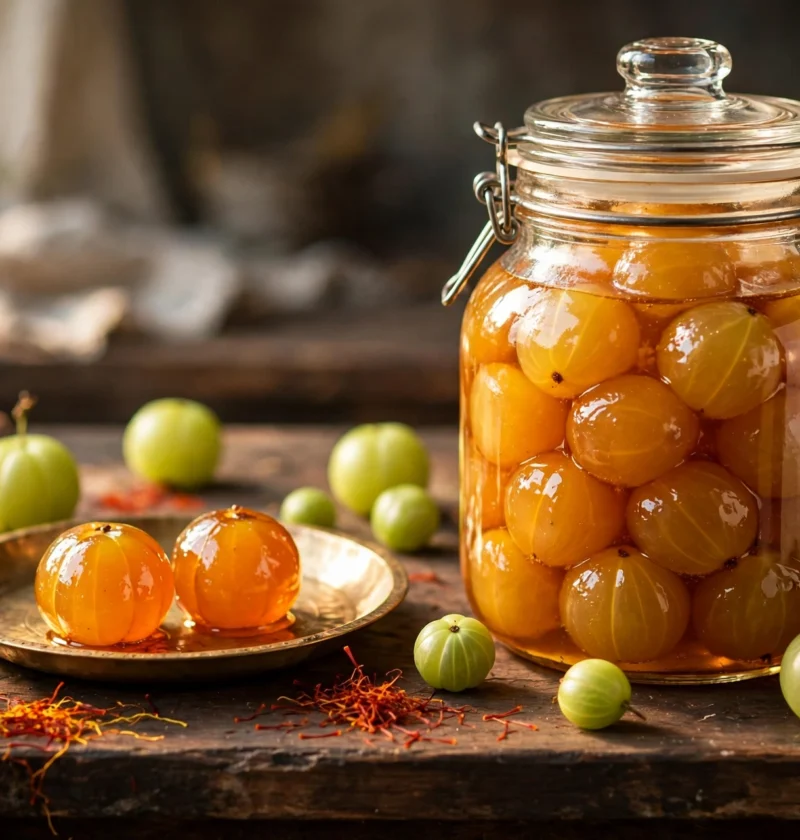
In my grandmother’s kitchen there was a shelf I was not allowed to touch, and on it sat a glass jar big enough to need both her hands. Inside, floating in syrup the colour of late-afternoon light, were whole amlas — Indian gooseberries turned amber, round and glossy as marbles. Once a day, usually after lunch, she would climb onto her little wooden stool, open that jar with a dignity usually reserved for the good crockery, and fish out exactly one piece with a dry spoon. It landed on my palm like a coin from a treasure chest. Half medicine, half mithai, entirely non-negotiable. This amla murabba recipe is the one I coaxed out of her years later, standing in that same kitchen with a notebook she found deeply unnecessary.
If you have only ever eaten amla raw, you will know it as an assault — sour first, then bitter, then a dry astringency that grabs the back of your tongue and will not let go. Murabba is the long, patient argument against all of that. The fruit is pricked, blanched, drowned in cardamom-saffron syrup and then left alone for days, and somewhere in that resting it gives up: the flesh turns jammy and translucent at the edges, the colour deepens to amber, and what was harsh becomes mellow, honeyed and quietly spiced. You do not spread murabba or slice it. You eat one whole fruit at a time, slowly, the way my grandmother intended — and an amla murabba recipe like this one, honestly followed, gives you a jar that lasts the whole winter.
Why This Amla Murabba Recipe Works
A jar of murabba looks effortless, but the failures are always the same three: bitter fruit, burst skins, and syrup that never reaches the middle. The method below is built around the five habits that prevent every one of them:
- Prick deep, and prick everywhere. A fork or a sturdy toothpick, fifteen to twenty holes in every fruit, pushed right down to the stone. Those holes are the only roads into amla’s dense flesh; shallow pricking gives you sweet skin wrapped around a sour heart.
- Blanching does the taming, not the sugar. Raw amla’s bite lives in the fruit itself, and syrup cannot sweeten what it cannot first soften. A proper blanch cooks out the harsh, mouth-drying astringency before the fruit ever meets a grain of sugar.
- One-string syrup, and not a thread thicker. Syrup cooked too far turns to candy on the surface and seals the fruit shut. At one-string consistency it stays fluid enough to creep inward, day after day, until the whole berry is saturated — and that slow saturation is the soul of this amla murabba recipe.
- The simmer should barely murmur. A rolling boil knocks the softened fruit about until the skins split and the jar fills with collapse and crumbs. Lazy, occasional bubbles keep every piece whole, round and jewel-like.
- Days in the jar are an ingredient. Tasted straight off the stove, murabba is a promise, not a result. Two to three days of resting is when the syrup finally reaches the centre and the last of the sharpness rounds itself off.
Ingredients for This Amla Murabba Recipe
Everything in this amla murabba recipe is short-list simple, which puts the spotlight exactly where it belongs: on the fruit. Amla is the berry of Phyllanthus emblica, a small, hardy tree whose pale green fruit has been cooked, pickled and preserved across South Asia for centuries; in season — roughly the cooler months — it arrives in the markets in firm, glossy heaps, and that firmness is precisely what you want. The preserve itself, murabba, came to our kitchens through centuries of fruit-preserving across the region: whole fruit, held in spiced syrup, eaten a piece at a time and traditionally treasured through the winter. Choose amlas that feel like little stones in the hand, unblemished and pale green; a soft or yellowing fruit will fall apart in the syrup, and murabba made from it never quite sets into jewels.
For the amla
- 2 1/4 pounds (1 kg) fresh amla (Indian gooseberries) — about 28 to 32 fruits, firm and unblemished
- 10 cups (2.4 litres) water, for blanching
For the syrup
- 3 cups (600 g) granulated sugar
- 2 cups (480 ml) water
- 10 green cardamom pods, lightly crushed
- A generous pinch of saffron strands (about 20), soaked in 2 tablespoons warm water
- 1 tablespoon lemon juice
- 1 teaspoon rose water (optional)
How to Make This Amla Murabba Recipe – Step by Step
Step 1: Choose firm fruit and prick it like you mean it. Wash the amlas and dry them thoroughly on a clean cloth. Then sit down and prick: a fork, a thick toothpick or the tip of a skewer, fifteen to twenty deep holes per fruit, worked evenly over the whole surface and pushed down until you feel the stone. It is slow, sit-down work — twenty minutes for a kilo — and I have stopped apologising for it. Every hole is a doorway. Skimp here and the syrup will circle the fruit for days without ever truly getting in.
Step 2: Blanch until just tender, and let the harshness leave. Bring the blanching water to a rolling boil — 212°F (100°C) — and lower the pricked fruit in gently. Cook for 8 to 10 minutes: the colour will dull from bright green to olive, and the fruit is ready when it feels just softened, a knife tip slips in with slight resistance, and the natural seams between the segments begin to show. Lift the fruit out with a slotted spoon and drain it well. That cloudy blanching water carries away much of amla’s raw, tongue-gripping astringency — throw it away without sentiment.
Step 3: Build the syrup to one string — no thicker. Combine the sugar, water and lemon juice in a wide, heavy pot and set it over medium heat, stirring until the sugar has dissolved completely and the syrup comes up to a boil. Skim off any grey scum that rises. Add the crushed cardamom pods and cook for 4 to 5 minutes, until the syrup reaches one-string consistency: dip in a spoon, touch a cooled drop between thumb and forefinger, and pull your fingers apart — a single thread should stretch and hold. Stir in the saffron with its soaking water and the rose water, if using, and the syrup will turn the colour of weak tea and smell like a sweet shop.
Step 4: Simmer the fruit gently until it turns amber. Lower the blanched amlas into the hot syrup one by one. Hold the heat at the barest simmer — a bubble rising here and there, never a boil — and cook for 15 to 20 minutes. The fruit will wrinkle slightly at first, which alarms everyone who makes this for the first time; it is only the flesh making room. As the syrup creeps in, the pieces plump back up, turn glossy, and deepen from olive to a clear, warm gold. Take the pot off the heat and let everything cool together in the syrup.
Step 5: Jar it, rest it, and let the days finish the job. Ladle the fruit and syrup into a clean, completely dry glass jar while still warm, making sure every piece sits submerged under the syrup. Cool fully, seal the lid, and leave the jar in a cool corner of the kitchen for 2 to 3 days. My grandmother would set hers in a patch of morning sun for an afternoon and swear it helped; what certainly helps is leaving it alone. Open it on the third day and the fruit will be deep amber, jammy right through, the sharpness gone. That resting is not a delay in this amla murabba recipe — it is the final stage of the cooking.
Serving Suggestions
Murabba is eaten the way it was given to me: one piece, after a meal, unhurried, with the syrup licked off your fingers. In winter my grandmother served it with a glass of warm milk in the morning and called that breakfast enough. At my table it appears after dinner with chai, or chopped over warm custard when I want to show off, or simply standing on the table in its jar through a long family lunch, where it empties itself mysteriously between courses.
It sits in an interesting family of preserves on this site. My petha takes a humble gourd and candies it until it turns to glass — a sweet you make and eat fresh within days, in slices, while it is still juicy and bright. Murabba is the opposite temperament: a whole fruit built to live in its jar for weeks, leaving it one piece at a time. And for the classic pairing, set a piece of murabba beside a weekend halwa puri breakfast — crisp puris, sooji halwa, spiced channay — with the amber amla as the cool, syrupy finish. Old-city breakfast tables have kept a space for exactly that combination for as long as anyone in my family can remember.
Storage and Reheating
There is no reheating in murabba’s life: it is eaten straight from the jar at room temperature, which is rather the point of a preserve. Sealed in a clean, dry, sterilised glass jar with every piece kept under the syrup, a jar of murabba stays good for two to three months in a cool pantry cupboard; refrigerated, it keeps closer to six months. Two rules protect the whole jar: always use a bone-dry spoon, because a single wet spoonful can start the syrup fermenting, and always push stray pieces back under the surface. If the syrup ever turns cloudy or smells sharp and winey, the jar has turned — let it go. If it merely crystallises in cold weather, stand the jar in a bowl of warm water until the crystals melt back in.
Frequently Asked Questions
Why is my murabba still bitter or sharp?
Almost always it comes down to one of two things: the blanch was too short, or the jar was opened too soon. Amla’s astringency is stubborn and leaves in stages — first into the blanching water, then slowly during the days of resting, as syrup replaces the fruit’s own juices. Taste a piece on day three before judging; many jars that seem harsh on day one are mellow by day four. If a full week passes and it is still sharp, warm the fruit and syrup together gently, stir in 2 to 3 tablespoons of extra sugar, simmer for five minutes, and rest it all again.
My amla split open — or shrivelled. What went wrong?
Splitting comes from violence: fruit blanched until it was nearly falling apart, or syrup boiled hard enough to knock the softened pieces against each other. Keep every stage gentle and the fruit stays whole. Shrivelled, wrinkled fruit that never plumped back up points the other way — the syrup was cooked too thick at the start, so it dragged water out of the fruit faster than the fruit could drink sugar in, or the pricking was too shallow to let anything travel. One-string syrup and deep pricks are the whole defence.
Can I use frozen amla instead of fresh?
Yes — and this amla murabba recipe works honestly, without apology, on frozen fruit. Frozen amla thaws softer than fresh, which shortens your work: it pricks easily and needs a minute or two less in the blanching water. Thaw the fruit completely, drain off the liquid it sheds, and pat it dry before pricking. The finished pieces will be a touch less perfectly round than ones made from hard, fresh berries, but the flavour and the amber jamminess arrive in full. Outside the winter season, frozen is not a compromise — it is the only jar you get to make.
Can I use less sugar, or make it with jaggery?
Less sugar is possible but it costs you twice: the syrup is the preservative, so a lighter syrup means a shorter-lived jar, and the fruit keeps more of its bite. Trimming the sugar by a quarter is as far as I would go, and that jar should live in the fridge and be eaten within a month. Jaggery is the older, earthier road and plenty of households take it — use the same weight, melt and strain it to clear the grit, and expect a darker, more caramel-deep murabba whose syrup never turns as clear. It is not the lesser version, only a different one: less jewel, more village.
Recipe Summary
- Prep time: 30 minutes
- Cook time: 45 minutes
- Total time: About 1 hour 15 minutes, plus 2 to 3 days maturing in the jar
- Servings: About 28 pieces
- Cuisine: Pakistani
- Course: Dessert