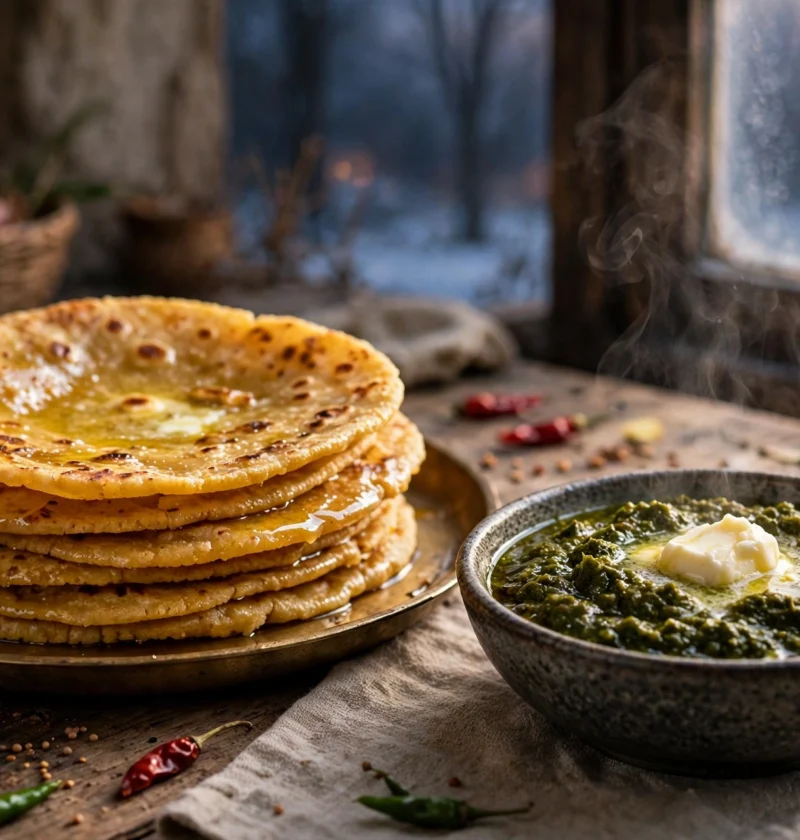
The first hard frost of the year always changed what came off our tawa. The wheat rotis disappeared, and in their place came makki di rotis — thick, golden discs of cornmeal that my grandmother patted out between her palms without ever glancing down, the way other people shell peas. The sarson ka saag had been simmering since afternoon in its corner of the stove, and a lump of white butter sat in a steel bowl, waiting its turn. This makki di roti recipe is hers as I remember it and as I have tested it in my own kitchen since: a hot-water dough, hand patting, ghee on the tawa, and no shortcuts taken with a rolling pin.
I should say plainly that this bread is not some everyday invention of my own family. It is a Punjabi winter classic, a harvest bread we were simply lucky to be raised inside. Makki — maize — comes in with the cold-season crop, and all across Punjab, on both sides of the border, makki di roti beside sarson ka saag is the taste of December and January: mustard fields standing in yellow flower, greens gathered by the armful, corn ground golden and coarse. It is cold-weather food through and through, and it only makes sense when the saag is young and peppery and a dense, buttery bread is exactly what a body wants at the end of a short day. I do make it in other months, out of plain homesickness, but it never tastes quite as true.
Why This Makki Di Roti Recipe Works
Cornmeal has no gluten to forgive your mistakes, so this makki di roti recipe leans on heat, water, and patience instead:
- Hot water does the job that gluten does in wheat. Cornmeal has no stretchy network to hold a dough together, so the water goes on boiling: it swells the grains and partly gelatinizes the starch, and that sticky gel is the glue that lets a corn dough be kneaded, patted, and lifted without subsiding into crumbs.
- The dough rests warm, never cold. Cornmeal drinks water slowly and keeps drinking it. Thirty warm minutes under a damp cloth let every grain hydrate fully, and a fully hydrated dough pats out smooth; a rushed or chilled one cracks around the rim no matter how careful your hands are.
- Hands replace the rolling pin. A pin shears this fragile dough and rolls it thinner than corn can survive. Flattening the ball between your palms, or pressing it out inside a sheet of plastic, keeps the roti evenly thick, rustic-edged, and in one piece.
- The rotis stay small and properly thick. A makki roti is not a wheat sheet. At roughly six inches across and a quarter-inch thick, it cooks through in the middle, holds together when you lift it off the tawa, and gives you the dense, tender-crumbly bite the bread is loved for.
- Ghee cooks it, white butter finishes it. A spoonful of ghee on the tawa fries the surfaces into crisp golden spots, and a knob of unsalted white butter melting over the hot roti at the table is not a garnish — in our house it is half the dish.
Ingredients for This Makki Di Roti Recipe
The whole tradition is summed up by its two famous names: makki di roti, Punjab’s maize flatbread, baked on a tava through centuries of winters, exists to be eaten with sarson ka saag, the slow-cooked mustard greens of the very same season. Get the flour right and the rest is easy: you want stone-ground yellow cornmeal, sold as makki ka atta, in a fine-to-medium grind. The FAQs below explain why corn flour and masa harina are not the same thing. A whisper of ajwain in the dough was my grandmother’s signature, and a makki di roti recipe does not need much more than that — corn, salt, hot water, ghee, butter.
For the dough
- 2 cups fine-to-medium yellow cornmeal (makki ka atta) (about 10 1/2 ounces / 300 g), plus a little extra for dusting
- 1 teaspoon fine salt
- 1/2 teaspoon ajwain (carom seeds), lightly crushed between your palms (optional, but traditional in our house)
- 1 1/2 cups (360 ml) water, brought to a rolling boil — you may not use it all
- 1 teaspoon ghee or neutral oil, worked in at the end of kneading
For cooking and serving
- Ghee, for the tawa — roughly 1 teaspoon per roti
- White butter (unsalted makhan), a generous knob for each serving
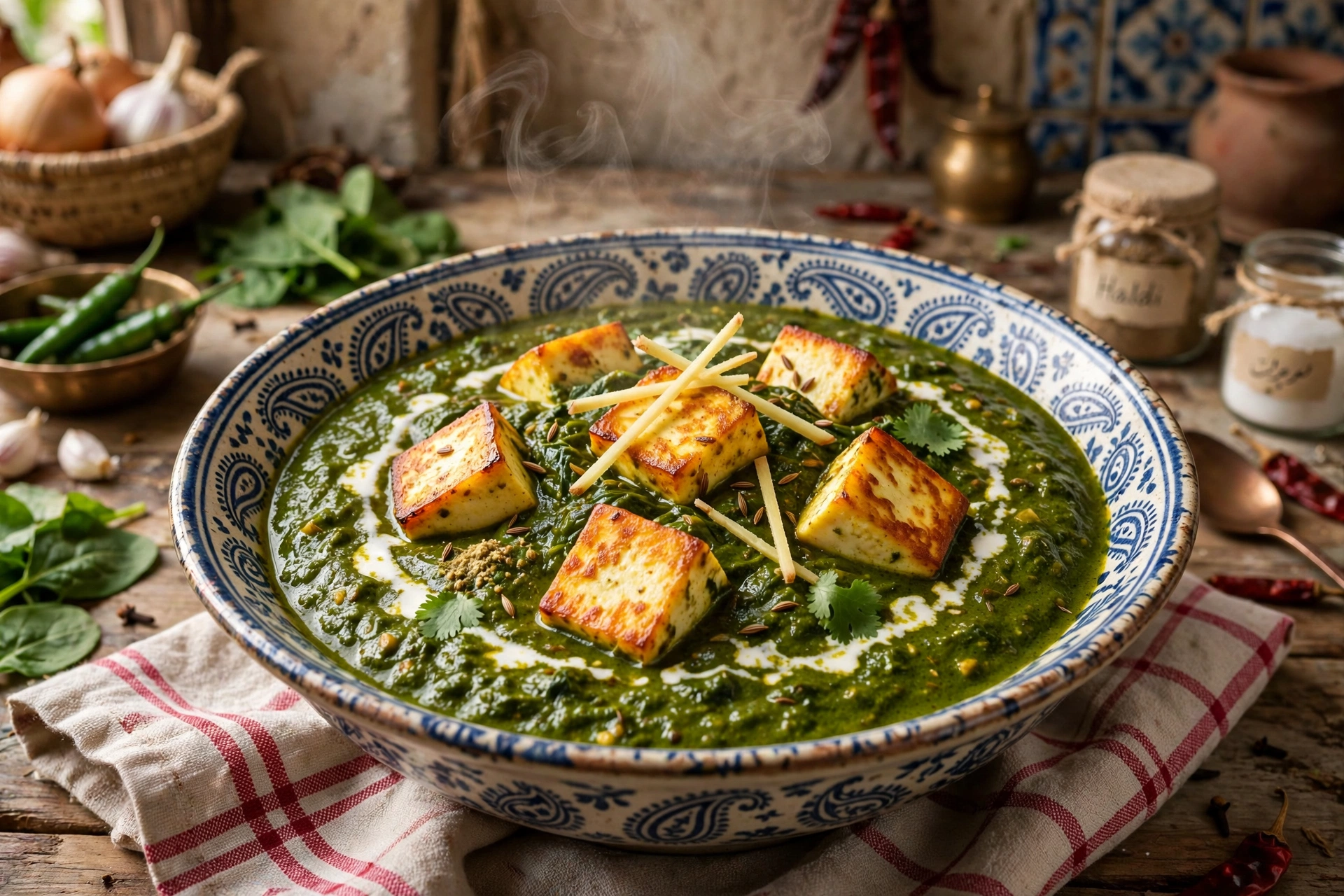
- Sarson ka saag, piping hot, for serving — this is not negotiable
- A small piece of jaggery (gur) on the side, if your family serves it that way
How to Make This Makki Di Roti Recipe – Step by Step
Step 1: Knead the cornmeal with hot water. Tip the cornmeal, salt, and ajwain into a wide, heatproof bowl. Pour over about 1 1/4 cups (300 ml) of the just-boiled water and stir with a sturdy spoon; it will look like wet, golden sand. Cover and leave it for 5 minutes to steam, then, as soon as it is cool enough to touch, knead with damp hands for 4 to 5 minutes, working in splashes of the remaining hot water until the dough is smooth, soft, and pliable — like play dough, not like bread dough. This is the gluten-free logic of the bread: the boiling water pre-cooks the starch, and pre-cooked starch is what binds a flour that has no binder of its own.
Step 2: Rest the dough warm. Rub the teaspoon of ghee over the surface, cover the bowl with a damp cloth, and set it somewhere warm — beside the stove, never in a cold corner — for 30 minutes. Cornmeal dough that chills turns stiff and sulky and will crack on you later. When the rest is done, knead briefly once more and divide the dough into 6 equal balls, keeping them under the cloth as you work.
Step 3: Pat each roti out by hand. Take one ball and flatten it between your palms, turning and pressing, turning and pressing, until you have a disc about 6 inches (15 cm) across and 1/4 inch (6 mm) thick. If palms alone frustrate you, press the ball between two sheets of plastic or parchment and peel the roti free — the village trick, and no shame in it. The cracked-edge fix is simple: keep a bowl of warm water at your elbow, dip your fingers, and pinch and smooth the rim as you go. A rim that keeps splitting is telling you the dough is dry; knead a spoonful of hot water back into the remaining balls.
Step 4: Cook on the tawa with ghee. Heat a cast-iron tawa over medium heat until good and hot — around 375°F (190°C), when a flick of water dances and vanishes. Slide the roti on and let it set for a minute. Flip it, spoon ghee around and over it, and cook 2 to 3 minutes per side, pressing gently with a cloth pad or spatula, until both faces wear deep golden-brown spots and the edges feel crisp. If you like, hold the roti with tongs over the open flame for just a few seconds at the end for a freckle of char — corn scorches fast, so count seconds, not minutes.
Step 5: Serve the moment it leaves the tawa. A makki roti waits for nobody. Carry it straight to the plate, drop the knob of white butter on top while it is still steaming so it slumps and runs, and ladle the saag beside it. Make each roti to order if you can; a stack made in advance and kept waiting is a stack quietly going firm, and this bread deserves better.
Serving Suggestions
The plate is not a suggestion, it is a formula: one hot roti from this makki di roti recipe, a deep bowl of sarson ka saag, and white butter melting over both until the greens shine. Tear the roti with your fingers — it will break into soft, rough-edged pieces — and use each piece to carry up saag and butter together. A tall glass of salty lassi or chaas alongside, and the piece of jaggery at the end, is the full winter ceremony as my grandmother ran it. Eat it sitting down, with your fingers, and do not rush it — this is a plate that was built to slow a winter evening down.
If it is the bread’s company you are thinking about, keep the family straight. My missi roti is the everyday cousin: a wheat-and-besan dough rolled thin, spiced through, made on any weeknight of the year. Makki is something else entirely — pure cornmeal, hand-patted thick, tied to one season and one partner dish. You do not make it because it is Tuesday. You make it because the mustard greens came in and the cold came down, and for a few weeks of the year no other bread will do.
Storage and Reheating
Honesty first: the rotis from this makki di roti recipe are at their best for about twenty minutes. Cornmeal rotis firm up fast as they cool — within the hour they are noticeably denser, and by evening they are a different, chewier bread. Leftovers keep, wrapped in cloth and then foil, for up to 2 days in the fridge; bring them back on a dry tawa with a sprinkle of water and a smear of ghee, or wrapped in a damp towel for a short burst in the microwave. Cooked rotis freeze between sheets of parchment for up to a month, though the crumbly tenderness suffers a little. The raw dough can wait, covered, for a few hours in a warm spot; overnight in the fridge it turns crack-prone, so let it come fully back to room temperature and knead in splashes of hot water before you pat.
Frequently Asked Questions
Why do the edges of my makki di roti crack, and how do I stop it?
Cracked rims are cornmeal dough asking for water or warmth. The usual causes are a dough mixed with merely warm water instead of boiling, too little water overall, or a rest taken in a cold place. Knead with water at a rolling boil, keep the dough covered and warm, and smooth the rim with wet fingers as you pat — small rustic cracks are normal and even charming, but deep splits mean the dough needs another spoonful of hot water kneaded in.
Cornmeal, corn flour, masa harina — which flour is actually correct?
Stone-ground cornmeal — makki ka atta — in a fine-to-medium grind is the correct flour, and the others are not substitutes. Corn flour, in the American sense, is cornstarch: it makes a paste, not a dough. Masa harina is nixtamalized corn treated with lime, made for tortillas; it binds easily but tastes of tortillas, not of Punjab. Very coarse polenta-style grinds can work at a pinch, but the dough will be gritty unless you give it extra hot water and a longer rest.
Can I add a little wheat flour to make the dough easier to handle?
The traditional answer is no: a true makki di roti is corn alone, and my grandmother would tell you that wheat turns it into a different bread wearing a yellow disguise. The practical answer is that two tablespoons of atta folded into each cup of cornmeal quietly rescue a beginner’s dough, and plenty of good home cooks do exactly that. My honest advice is to learn the bread the pure way first, with boiling water and warm resting — then, if a particular bag of cornmeal fights you, use the crutch without guilt.
Can I use a rolling pin instead of patting by hand?
You can try, between sheets of plastic and with almost no pressure, but I will talk you out of it. A pin rolls corn dough thinner than it can survive and shears the edges as it goes, so you get a wheat roti’s shape with a cracked rim and a torn middle. Hand-patting keeps the thickness even and the edges whole, and it takes a week of evenings, not a lifetime, to learn. The bread was designed for palms; give it palms.
Recipe Summary
- Prep time: 15 minutes (plus 30 minutes resting)
- Cook time: 25 minutes
- Total time: About 1 hour 10 minutes
- Servings: 6 rotis
- Cuisine: Pakistani
- Course: Main Course