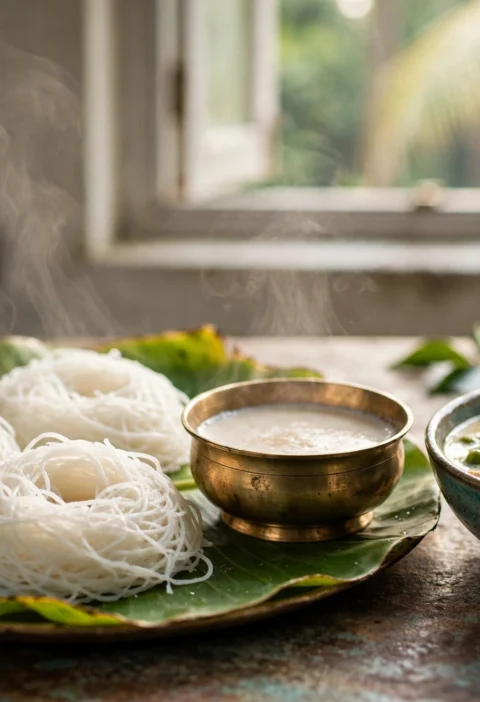
At the sadya — the great banana-leaf feast of Onam — the servers moved down the row of guests with buckets and ladles, and one old server, a neighbour of my grandfather’s, treated every leaf like a map memorised by heart. Pickles at the corner, thoran above the rice line, and the erissery — always the erissery — placed with ceremony in the prized spot near the top of the leaf, where the honoured curries sit. As a child I assumed he was simply tidy; years of cooking taught me he was ranking the dishes, and that the golden, coconut-crowned pumpkin was the one he trusted most. This erissery recipe is the one I have settled on after many Onams of watching, asking, and eating seconds.
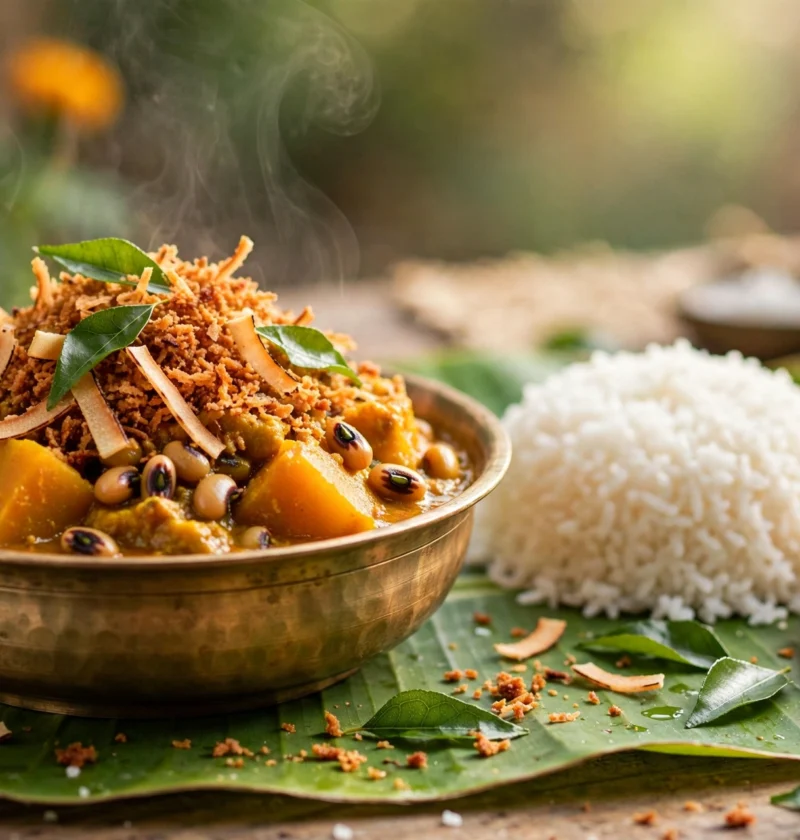
Erissery is Kerala’s love letter to the pumpkin: sweet orange flesh and black-eyed peas folded into a gravy of ground coconut and cumin, finished with coconut fried golden in coconut oil. The trick nobody writes down — you only learn it standing beside the cook — is that half the pumpkin never survives as pieces at all. It gets mashed straight into the pot, so the gravy thickens with pumpkin itself, while the remaining chunks stay tender: every spoonful is both sauce and vegetable. It is not avial — there is no curd here, and no crowd of mixed vegetables; the pumpkin performs solo. And it is not theeyal either: the coconut in an erissery recipe is ground fresh and stays pale and milky-sweet, and the only roasted flavour in the bowl is the crisp fried coconut scattered on top at the end.
Why This Erissery Recipe Works
Erissery is a gentle dish, and gentle dishes punish carelessness, because there is nowhere for a mistake to hide. Five habits keep this erissery recipe in the narrow, golden zone where it belongs:
- Half the pumpkin is mashed, half stays in chunks. This is the architecture of the dish. The mashed half melts into the gravy and thickens it with the pumpkin’s own sweetness — no flour, no starch, no shortcuts — while the surviving chunks give your spoon something to hunt for. Skip the mash and you get pumpkin soup.
- The black-eyed peas cook on their own first. Peas and pumpkin keep different clocks. Boiled together from raw, either the peas stay chalky or the pumpkin collapses while it waits for them. Cooked separately, each arrives already perfect, and the peas hold their shape.
- The coconut paste is ground fresh and kept pale. Coconut, cumin and a green chilli, ground with just enough water to make a thick, smooth paste — no roasting pan, no browning, no darkening. That fresh, milky sweetness is the flavour foundation of any honest erissery recipe, and it is exactly what the fried crown will play against.
- The paste never meets a rolling boil. Once the coconut goes in, the pot stays at the barest simmer for two or three minutes. A hard boil dulls the coconut’s freshness and can split the gravy grainy; gentle heat keeps it glossy, sweet and whole.
- The fried coconut crown goes on at the very end. Mustard seeds, chillies, curry leaves and a handful of grated coconut fried to deep gold in coconut oil, spooned over the surface at the last moment. It is the dish’s only crunch and its only roasted note — fry it early and it steams itself soft under the lid.
Ingredients
Erissery belongs to the family of coconut curries that define Kerala cuisine — but it is the pumpkin that people ask about afterwards. The pumpkin — mathanga in Malayalam — should be the ripe, deep-orange kind, heavy for its size; a pale, watery pumpkin gives a pale, watery curry, and no quantity of coconut will rescue it. Black-eyed peas are the classic partner, though some homes use red cowpeas instead. The coconut, though, is non-negotiable: fresh or frozen grated only, because desiccated coconut in the paste never grinds down to the same milky smoothness — an erissery recipe cannot survive it.
Serves 4
For the erissery:
- 3 cups ripe pumpkin, peeled and cut into 3/4-inch cubes (about 1 1/4 pounds)
- 3/4 cup dried black-eyed peas, soaked overnight in plenty of water
- 1/2 teaspoon ground turmeric
- 2 green chillies, split open along their length
- 1 teaspoon fine salt, adjusted to your taste
- About 1 1/2 cups water for simmering, with extra on standby
For the coconut paste:
- 1 cup freshly grated coconut (frozen works too — just thaw it first)
- 1 teaspoon cumin seeds
- 1 green chilli
- 1 small garlic clove (optional, but traditional in many homes)
- 1/4 to 1/3 cup water, for grinding
For the fried coconut tempering:
- 1 tablespoon coconut oil
- 1 teaspoon black mustard seeds
- 2 whole dried red chillies, snapped into pieces
- A generous sprig of curry leaves, roughly 10 leaves
- 1/3 cup grated coconut, set aside for the frying
How to Make This Erissery Recipe – Step by Step
Step 1: Cook the black-eyed peas until just tender. Drain the soaked peas and put them in a pot with fresh water to cover by two inches. Bring to a boil, skim off any foam, then settle them at a gentle simmer for 25 to 30 minutes, until a pea crushes softly between your tongue and the roof of your mouth with no chalky centre — a pressure cooker does the same job in about 10 minutes. Drain them, but save a cup of the cooking water; it will loosen the gravy later far better than plain water. Set both aside.
Step 2: Simmer the pumpkin until it surrenders. Put the pumpkin cubes in a wide, heavy pot with the turmeric, the slit green chillies, the salt and the 1 1/2 cups of water. Bring to a boil, cover, and simmer for 10 to 12 minutes, until the pumpkin is completely tender — a cube should give way to the back of a spoon without argument. The pot should not be soupy, though; if much water stands around the cubes, lift the lid for the last few minutes and let some steam away.
Step 3: Mash half the pumpkin into the gravy. Now the trick the sadya cooks never write down. With the back of your ladle, or a potato masher used gently, crush roughly half the pumpkin cubes against the side and bottom of the pot, stirring it through until the pot turns into a thick, golden, spoon-coating gravy with whole chunks floating in it. Leave the other half alone — those are the chunks your spoon will hunt for. If the gravy looks thicker than a pouring custard, loosen it with a splash of the reserved pea water.
Step 4: Stir in the peas and the coconut paste, briefly. While the pumpkin simmers, grind the coconut, cumin seeds, green chilli and garlic with 1/4 cup of water to a smooth, thick paste, scraping the blender down once. Fold the cooked peas into the pumpkin pot, then stir the paste through. Bring everything back to the barest simmer — a few lazy bubbles at the edges — and hold it there for 2 to 3 minutes only, stirring now and then. Taste for salt and take the pot off the heat; from here on, this erissery recipe lives or dies by its crown.
Step 5: Fry the coconut golden and crown the curry. Heat the coconut oil in a small pan over medium heat. Add the mustard seeds and let them crackle and pop, then the broken red chillies and curry leaves — stand back, they splutter — and immediately the 1/3 cup of grated coconut. Stir constantly for 2 to 3 minutes, until the coconut turns a deep gold, the colour of toasted almonds, and smells nutty. It crosses from perfect to burnt in a blink, so the second it gets there, tip the whole tempering — oil and all — over the erissery and lid the pot for two minutes, so the aroma settles into the curry rather than escaping into the kitchen. Serve with the crown still sitting proudly on top.
Serving Suggestions
Serve erissery the way the old server placed it: with ceremony, near the top of things. At a sadya it rests on the banana leaf above the rice; at an ordinary family table, ladle it over steamed rice — the short-grained Kerala kind if you can get it — and let the gravy do the rest. Its sweetness makes it the natural peacekeeper on any plate that also holds something fiery or sour: a spoonful of erissery between mouthfuls of a hot, sharp curry resets the mouth. This erissery recipe also travels happily to a potluck — just carry the crown separately and scatter it over at the destination.
If you are building a small sadya from this site, erissery has two natural companions. My avial brings the mixed vegetables and the gentle tang of curd that erissery deliberately leaves out, and the two coconut gravies — one pale and chunky, one golden and smooth — show one ingredient in two moods. Then, for the full argument about what coconut can become, make my theeyal: there the coconut is roasted to the edge of burnt and ground nearly black, which is everything erissery refuses to do. Three dishes, one coconut, three personalities — that is Kerala cooking in a single sentence.
Storage and Reheating
Erissery keeps kindly. Cool the leftovers, cover and refrigerate for up to 3 days; the gravy will thicken in the cold as the mashed pumpkin sets, and it loosens as it warms. Reheat it slowly on a low flame, loosening it with a splash of water, and stop the moment it steams — do not let it boil hard, for exactly the reason the coconut paste never boiled on the first day. The one casualty of storage is the crown: fried coconut softens overnight, so if you are reheating for guests, fry a fresh spoonful of grated coconut in a teaspoon of coconut oil and scatter it over; thirty seconds of work and the dish is dressed again. Erissery also freezes respectably for up to a month — thaw it in the fridge and reheat the same way. My family insists this erissery recipe is better on the second day, when the peas have had a night to drink in the gravy.
Frequently Asked Questions
Can I make this erissery recipe with canned black-eyed peas?
Yes, gladly — it is the one shortcut the dish fully forgives. Drain and rinse about 1 1/2 cups of canned peas and skip both the soaking and most of Step 1; add them in Step 4 and simmer long enough to heat them through, because canned peas are already soft and will break up if you bully them. Loosen the gravy with plain water and an extra pinch of salt, since you lose the starchy cooking water.
Why has the gravy in my erissery recipe come out thin and watery?
Almost always one of two causes: a watery, under-ripe pumpkin, or an enthusiastic hand with the cooking water. Remember that the mash is the thickener — if the gravy looks loose, mash a few more chunks and simmer the pot uncovered for five minutes, and it will pull itself together. It also firms as it stands, so judge it after a short rest.
Can I use yam or raw banana in this erissery recipe instead of pumpkin?
You can, and Kerala does — elephant yam erissery, often made with red cowpeas, is a classic variation in its own right. Yam is firmer and earthier, so give it a longer simmer and skip the mashing; it thickens the pot by standing in it, not melting. Raw banana behaves somewhere between the two. Either way, keep the coconut paste and the fried crown exactly as written — they are what make it erissery.
Why did my coconut gravy turn grainy?
It boiled too hard — coconut gravy is a gentle creature, and a rolling boil after the paste goes in will split it every time. An under-ground paste is the other culprit: blend until no shred resists between your fingers. A grainy pot can be partially rescued by whisking it hard with a splash of hot water off the heat, but prevention is the cure — low heat, a brief simmer, and the gravy stays silky.
Recipe Summary
- Prep time: 15 minutes (plus overnight soaking of the peas)
- Cook time: 45 minutes
- Total time: About 1 hour, plus soaking
- Servings: 4
- Cuisine: Pakistani
- Course: Main Course