My grandmother never owned a timer, a thermometer, or a measuring cup for her theeyal — she owned a blackened iron pan and a nose she trusted more than all three. I would watch her stir grated coconut, coriander and dried chillies in slow circles as the shreds turned gold, then amber, then the colour of old teak, the house smelling of toast and smoke — and still she would not lift the pan. “One more minute,” she would say, at exactly the point where I was sure it was ruined — and then, in a single breath, she would tip it onto a steel plate to stop the cooking, a blink before burnt. This theeyal recipe is my attempt to write down that judgement: how dark is dark enough, and how close to the edge you have to go.
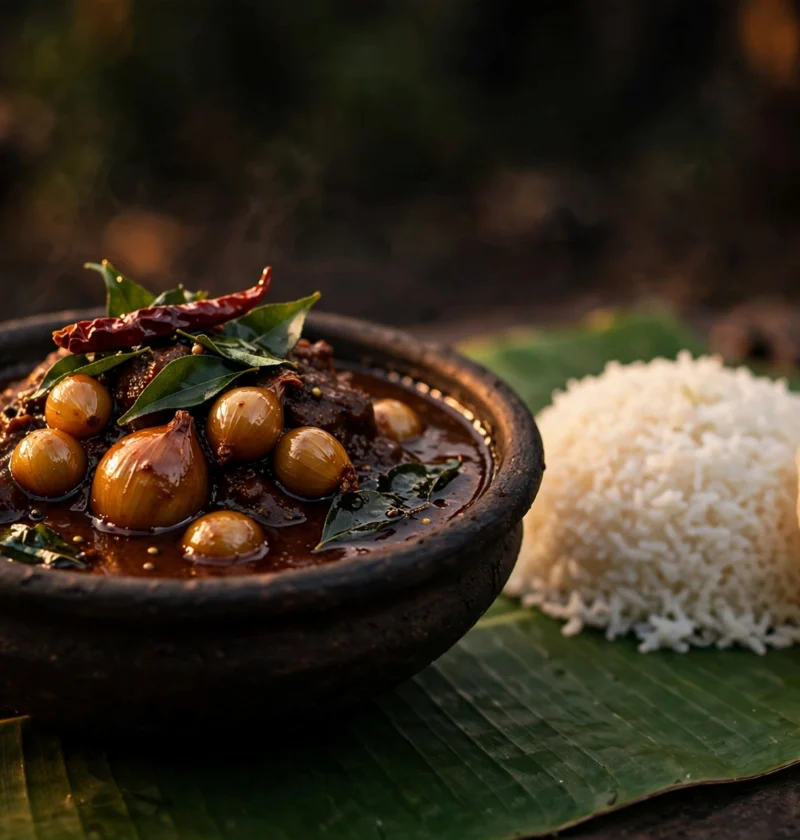
Theeyal takes its name from fire — from the Malayalam thee, flame — and it earns it. Fresh coconut, coriander, chillies and peppercorns are roasted together until nearly scorched, ground to a silk-smooth paste, and simmered with tamarind into a gravy so dark it is almost black, its surface polished with coconut oil. Versions are made with bitter gourd, drumsticks, okra or brinjal, but the one I was raised on is led by shallots — ulli theeyal — whose sweetness turns jammy against the bitter roast. If you know avial, Kerala’s other coconut dish, hold it in mind as this one’s opposite: avial’s coconut goes in raw and pale and is never allowed to boil, while a theeyal recipe sends the same coconut into a pan and does not bring it out until it stands at the edge of burnt. Between those two poles — raw and roasted, ivory and mahogany — sits the whole of Kerala’s coconut cooking.
Why This Theeyal Recipe Works
Theeyal is only three ideas — roast, grind, simmer — yet it fails in one famous way: it comes out merely brown and ordinary, or pushed too far and properly bitter. Five habits hold it in the narrow, glorious band between:
- The roast goes to deep mahogany, not golden. A politely toasted coconut makes a politely flavoured curry. The colour is the flavour here: the shreds must reach a dark reddish-brown, smelling of toasted nuts and woodsmoke, before the pan leaves the heat.
- The roasted coconut is ground completely smooth. Where avial’s paste stays deliberately coarse, this one is blended until it pours like satin. A gritty paste gives a gritty gravy; theeyal should coat the spoon in one glossy, unbroken layer.
- Tamarind is not seasoning — it is a structural beam. A dark roast flirts with bitterness, and sourness holds it in check. Enough tamarind and the gravy tastes deep and rounded; too little and the roast turns harsh.
- The shallots cook inside the gravy until they surrender. They simmer in the gravy until soft all the way through and sweet. A shallot still crunchy in the middle has not finished becoming part of the dish.
- The finished curry is rested before it is served. Fifteen covered minutes off the heat lets the roast settle, the oil rise into its polished sheen, and the first aggressive smokiness soften.
Ingredients
Theeyal is one of the defining curries of Kerala cuisine, a fixture of the sadya leaf and of ordinary Sunday lunches alike, and every household guards its own position on how dark is too dark. The list is short and honest — coconut, shallots, tamarind, spices — because all the transformation happens in the roasting pan. Fresh grated coconut is the one ingredient a theeyal recipe will not negotiate on: it carries enough natural oil to toast into that deep, glossy paste, which is why frozen grated coconut, thawed, is an acceptable stand-in and desiccated a reluctant one. Pearl shallots — the small pink kind sold as sambar onions — are traditional; ordinary shallots, halved, behave exactly as well.
Serves 4
For the roasted coconut paste:
- 2 cups grated fresh coconut (frozen grated coconut, thawed, works well)
- 2 tablespoons coriander seeds
- 6 to 8 dried red chillies, stems removed
- 1/2 teaspoon black peppercorns
- 1/4 teaspoon fenugreek seeds
- 1 sprig fresh curry leaves (about 10 leaves)
- 1 teaspoon coconut oil, for the roasting pan
For the curry:
- 1 1/2 cups shallots (about 12 ounces), peeled and left whole if small, halved if large
- 1 1/2 cups warm water, with a lime-sized ball of tamarind (roughly 1 1/2 tablespoons, packed) soaked in it — or 1 1/2 tablespoons tamarind paste stirred into the water instead
- 1 tablespoon coconut oil
- 1/2 teaspoon ground turmeric
- 1 teaspoon jaggery, grated (optional, only if your tamarind is fierce)
- 1 teaspoon salt, or to taste
- 1/2 to 1 cup hot water, to adjust the gravy
For the tempering:
- 1 tablespoon coconut oil
- 1 teaspoon mustard seeds
- 2 dried red chillies, broken in half
- 1 sprig fresh curry leaves (about 10 leaves)
- 1 small pinch asafoetida
How to Make This Theeyal Recipe – Step by Step
Step 1: Soak the tamarind and undress the shallots. Set the tamarind soaking in its warm water for at least 15 minutes, until you can crush it between your fingers; squeeze it well, strain the dark liquid and throw the fibre away. Meanwhile peel the shallots — warm water loosens the skins — trimming only the root end so each stays whole or halved and holds together in the gravy. Small work, but this theeyal recipe gives you nothing to hide behind later if the shallots go in ragged.
Step 2: Roast the coconut and spices down to mahogany. Warm the teaspoon of coconut oil in a wide, heavy pan over medium-low heat. Add the grated coconut and stir — and keep stirring — for 8 to 10 minutes as it dries, pales, then turns steadily golden. Add the coriander seeds, dried chillies, peppercorns, fenugreek and curry leaves, and go on for 4 to 5 minutes more, never leaving the pan. You are looking for a deep mahogany brown, several shades past comfortable, smelling of toasted hazelnuts and faint smoke. The moment the colour arrives, tip everything onto a cold steel plate in a thin layer; left in the hot pan, the roast keeps travelling and crosses into burnt.
Step 3: Grind the roast to silk. Once the roast has cooled enough to stop steaming, blend it with 1/4 cup of water added a splash at a time, until it runs completely smooth — scrape the sides down and give it a full minute longer than feels necessary. The paste should look like dark chocolate ganache and feel silky between your fingers; any graininess now will still be there in the gravy.
Step 4: Build the curry — shallots first, then tamarind, then the paste. Heat the tablespoon of coconut oil in a deep pot over medium heat and tip in the shallots with a pinch of the salt. Stir for 4 to 5 minutes until their edges catch some colour and they begin to soften. Add the turmeric and strained tamarind water, bring to a boil, then simmer about 8 minutes, until the shallots yield to a spoon and tamarind’s raw smell has cooked away. Stir in the ground paste, the remaining salt and enough hot water for a gravy that pours slowly off the spoon, then simmer gently for 8 to 10 minutes more, stirring now and then. It is ready when the gravy has thickened, darkened another shade, and beads of coconut oil shine on the surface; stir in the jaggery now if the balance leans too sour.
Step 5: Temper in coconut oil, rest, and let the sheen rise. In a small pan, heat the tempering oil until a curry leaf would sizzle on contact. Crackle the mustard seeds in it until they pop, then add the broken red chillies, curry leaves and asafoetida, in that order, and give the leaves five spluttering seconds. Pour the whole tempering over the curry, stir once, then cover the pot and walk away for 15 minutes. That rest is part of this theeyal recipe, not a pause in it: the flavours marry, the roast mellows, and the oil rises into the polished finish the dish is judged by.
Serving Suggestions
This theeyal recipe is built for steamed rice — plain, white, short-grained rice of the kind Kerala prefers — poured over in a thick, dark ribbon rather than ladled thin. The gravy is intense and a little goes a long way, so the plate around it stays simple: a crisp papad, a mild vegetable thoran, perhaps a bowl of thin curd to cool the tongue between mouthfuls. It is one of the strongest flavours on a sadya leaf, so the leaf serves it in a modest spoonful — at a family table I put the pot in the middle and let people take the second helping they always want.
To understand theeyal fully, eat it in the same week as its opposite. My avial uses the same coconut and stops at the far extreme — ground raw and pale, folded through curd, never boiled at all — and tasting the two side by side teaches you what heat does to one ingredient. The third member of the family here is my sambar, lentil-bodied instead of coconut-based, with its own tamarind tang. Dark and smoky, pale and fresh, golden and pourable: three pots, one coastline, not a boring spoonful among them.
Storage and Reheating
A theeyal recipe is one of the great keepers of the Kerala kitchen — it holds in the fridge, covered, for a full 4 days, and grandmothers — mine included — insisted the second day’s pot was better, the roast settled deeper into the shallots overnight. Reheat it gently over low heat with a splash of water, just to a simmer; the oil that set on top in the cold melts back into its sheen as it warms. It freezes well for up to a month — thaw in the fridge, reheat the same way, and a fresh curry leaf or two wakes it up. The shallots soften a little more with each reheating, so the texture drifts sweeter and softer, never worse.
Frequently Asked Questions
My theeyal tastes bitter. Did I burn the coconut?
Probably, a little — bitterness is the toll for crossing the line, and the line is genuinely narrow. The roast should smell toasty and smoky, never acrid; if shreds turned black rather than mahogany, that flavour cannot be cooked out. A mildly over-roasted pot can be rebalanced: a little more tamarind water, a teaspoon of jaggery, five more minutes of simmering. Next time, roast lower and remember the plate trick — coconut keeps darkening in a hot pan even off the stove.
Can I make this theeyal recipe with vegetables instead of shallots?
Yes — the roasted paste is the constant, the vegetable the variable. Bitter gourd theeyal is the most famous variation, its bitterness answering the roast’s; drumsticks, okra, brinjal and yam all have regional versions. Keep the method identical and adjust the simmer: fry okra separately first so it does not turn slimy, and give drumsticks a few minutes longer in the tamarind water. Shallots remain my teaching version: their sweetness shows the sour-smoky balance most clearly.
Why did my gravy come out thin and grainy instead of thick and glossy?
Two separate faults, two fixes. Grainy means the roasted coconut was under-ground — blend longer, with just enough water to keep the blades moving, until it feels like ganache between your fingers. Thin means too much water at once, or a cut-short final simmer; this theeyal recipe gives the gravy its full 8 to 10 minutes at a gentle bubble, when it thickens and the coconut’s oil emulsifies in.
Can I use desiccated coconut for this theeyal recipe?
You can, in the way you can do many things once. Desiccated coconut has less oil, so it colours faster and the paste never quite reaches the same glossy depth — roast it on the lowest heat and watch it like a hawk, because it goes from mahogany to burnt in seconds. Frozen grated coconut, thawed and squeezed dry, is a far better substitute, the one city cooks across Kerala actually use. Either way the judgement stays the same: colour and smell, not the clock.
Recipe Summary
- Prep time: 20 minutes (peeling shallots and soaking tamarind)
- Cook time: 40 minutes
- Total time: About 1 hour
- Servings: 4
- Cuisine: Pakistani
- Course: Main Course