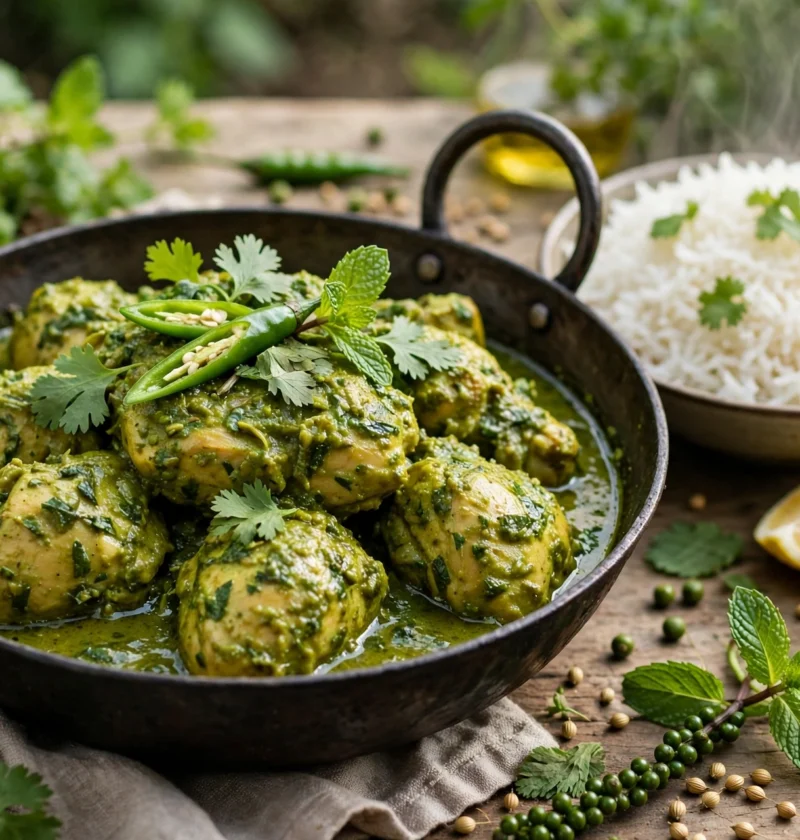
Most chicken curries in my house announce themselves from the spice shelf — cumin, coriander seed, red chili, the warm brown chorus. This hara masala chicken recipe sings from somewhere else entirely: the herb drawer of the fridge. A whole garden of fresh coriander, a measured hand of mint, green chilies, ginger, and garlic, ground into a paste the color of spring leaves, and chicken simmered in it with yogurt until the gravy is a deep, living green. The first time I ate it at a friend’s home in Lahore, I kept turning my spoon in the light just to look at it. It tastes the way it looks — bright, grassy, fresh — and on a table full of brown curries, it is the dish everyone reaches for first.
It took me three attempts to keep that color alive in my own kitchen, and each failure taught me something unglamorous. My first pot came out the color of swamp water because I boiled the herb paste hard for twenty minutes like any other masala — chlorophyll does not survive a long, violent boil, and the green simply dies. My second attempt stayed green but tasted bitter and medicinal, because I had thrown in a giant fistful of mint, stems and all, and mint is a bully: give it the lead role and it shoves the coriander off the stage. My third pot split its yogurt into grainy curds because I stirred cold yogurt into a fiercely bubbling gravy. So the rules of this hara masala chicken recipe are written from those pots: coriander leads and mint supports, the paste is ground thick with barely any water, and once the herbs go in, the heat stays gentle and the yogurt goes in off the boil.
Why This Hara Masala Chicken Recipe Works
A green curry is a race against its own color — this hara masala chicken recipe is arranged so the herbs win it:
- Coriander leads, mint follows at a distance. Two packed cups of coriander to a modest half cup of mint leaves is the ratio that keeps the gravy tasting like a garden instead of toothpaste. Only mint leaves, never the stems — the stems are where the bitterness and the medicinal edge live, and that balance is what every hara masala chicken recipe depends on.
- The paste is ground thick, with almost no water. Every extra spoon of water in the blender dilutes the herbs and gives the gravy more liquid to cook off — and every extra minute of cooking off is another minute the green fades. A paste like wet sand, helped along with a squeeze of lemon, keeps both the flavor concentrated and the color fast in this hara masala chicken recipe.
- The chicken is sealed before the paste arrives. The chicken goes into hot oil with whole spices and onion first and cooks until it firms and changes color. Paste added to raw chicken in a cold pot stews everything together into dullness; a sealed surface lets the green gravy stay a gravy — coating the chicken instead of soaking into a soup.
- The paste cooks on medium heat, never a hard boil. Eight to ten gentle minutes is enough to cook the rawness out of the herbs without killing their color. The pot should murmur, not riot. This single discipline is the difference between a hara masala chicken recipe that photographs green and one that apologizes.
- Yogurt goes in whisked, warm, and off the fierce heat. Yogurt stirred in a slow stream into a pot taken briefly off the boil emulsifies into the green instead of splitting into curds or graying it. It rounds the herbs’ sharpness with a gentle tang and gives the gravy its body — the finish a hara masala chicken recipe needs.
Ingredients
Serves 4 to 6
For the hara masala paste:
- 2 packed cups fresh coriander leaves and tender stems (2 large bunches)
- 1/2 cup fresh mint leaves only, stems discarded
- 4 to 6 green chilies, stems removed (adjust to your heat)
- 1 inch piece of ginger, peeled
- 5 garlic cloves, peeled
- 1 tablespoon lemon juice
- 1 to 2 tablespoons water, only if the blender refuses to move
For the chicken:
- 2 pounds bone-in chicken pieces, skin removed (or boneless thighs)
- 1/3 cup oil or ghee
- 1 large onion, sliced fine
- 1 bay leaf
- 4 green cardamom pods, lightly cracked
- 4 whole cloves
- 1 teaspoon cumin seeds
- 1/4 teaspoon turmeric powder (a pinch only — more will dull the green)
- 1 teaspoon salt, or to taste
- 1 cup plain whole-milk yogurt, whisked smooth and at room temperature
- 1/2 teaspoon garam masala, to finish
- Extra coriander leaves and lemon wedges, to serve
The whole dish leans on coriander, one of the oldest herbs in the kitchen, whose leaves and seeds taste so different they might as well be two spices — here it is the leaf, fresh and citrusy, doing the work. Its partner mint brings the cool top note, the same family of herbs that runs through raitas and chutneys across the subcontinent. A hara masala chicken recipe is really just the green chutney of the snack table, promoted to a main course and given chicken to carry.
How to Make This Hara Masala Chicken Recipe – Step by Step
Step 1: Grind the green paste thick and bright.
Put the coriander, mint leaves, green chilies, ginger, garlic, and lemon juice in a blender and grind to a paste as smooth as you can get it, stopping to push the herbs down rather than reaching for water. Add a tablespoon of water only if the blades spin empty. The paste should be thick, deep green, and smell like a garden after rain. Set it aside — every minute it waits is fine; it is the cooking, not the standing, that fades it in any hara masala chicken recipe.
Step 2: Seal the chicken with the onion and whole spices.
Heat the oil in a heavy pot over medium-high heat and add the bay leaf, cardamoms, cloves, and cumin seeds. When they sizzle and perfume the oil, add the sliced onion and fry for 6 to 7 minutes until it softens and turns a pale gold — do not chase deep browning here, dark onion will muddy the green later. Add the chicken pieces and cook, turning them, for 6 to 8 minutes until every piece has firmed up and lost its raw pink look. Stir in the turmeric and salt.
Step 3: Add the herb paste and cook it gently.
Tip in all of the green paste and stir it through the chicken. Drop the heat to medium and cook for 8 to 10 minutes, stirring often, keeping the pot at a murmur rather than a boil. The paste will deepen a shade, lose its raw grassy smell, and the oil will begin to glisten at the edges. If it threatens to catch, splash in 2 tablespoons of water — no more. This is the heart of the hara masala chicken recipe, and patience at medium heat is what keeps it green.
Step 4: Whisk in the yogurt off the boil.
Lift the pot off the heat for a moment and let the bubbling settle. Stir the whisked yogurt in a slow stream, mixing constantly, then return the pot to low heat. Simmer very gently for 5 to 6 minutes, stirring now and then, until the gravy thickens slightly and coats the chicken in a smooth green sauce. It must not boil hard at this stage — a lazy bubble at the edge is all you want, and that restraint is written into every good hara masala chicken recipe.
Step 5: Rest, finish, and serve it green.
Stir in the garam masala, cover the pot, and take it off the heat. Rest it for 10 minutes so the chicken finishes in the residual warmth and the gravy settles into its final color — a deep, honest green. Shower it with fresh coriander, set lemon wedges alongside, and bring it to the table in the pot if you can. This hara masala chicken recipe waits for no one, because every minute on a hot stove costs it a little of its looks.
Serving Suggestions
A hara masala chicken recipe wants a quiet stage: plain steamed basmati or a simple zeera rice — white rice against that green gravy is half the pleasure of serving it. Soft rotis or naan for scooping, a bowl of plain raita, and a salad of sliced onion and cucumber with lemon is the full table as far as I am concerned. Because the dish is vivid and herb-forward, keep the rest of the menu quiet and let it be the color on the table.
Its nearest neighbors on this site show what it is not. My chicken methi is also a green chicken, but it belongs to fenugreek — a deeper, slightly bitter, more wintry green with a flavor all its own. My chicken white karahi goes entirely without herbs, building its pale gravy from yogurt, cream, and black pepper. The hara masala chicken recipe sits apart from both: fresh coriander and mint, ground raw and cooked gently, in a gravy that is meant to taste like the garden it came from.
Storage and Reheating
Hara masala chicken keeps in the refrigerator for up to 3 days, and I will be honest with you the way I wish someone had been with me: the flavor deepens beautifully overnight, but the color softens from vivid green to a gentler olive, and no reheating trick fully brings back the first day’s brightness. Reheat it covered over the lowest heat with a splash of water, bringing it only to the edge of a simmer. It freezes acceptably for up to a month; thaw overnight and warm it slowly. A handful of fresh coriander stirred through at serving — and a fresh squeeze of lemon — wakes a reheated hara masala chicken recipe up more than any other rescue I have tried.
Frequently Asked Questions
Why did my hara masala gravy turn brown or dull?
Almost always, the paste boiled too hard or too long. Chlorophyll, the pigment that makes herbs green, breaks down under sustained high heat, and a rolling 20-minute boil will take any green gravy to olive and then to brown. Cook the paste at a murmur for 8 to 10 minutes, add the yogurt off the boil, and serve without holding the pot on the stove — those three habits protect the color of any hara masala chicken recipe.
Can I use boneless chicken instead of bone-in?
Yes — boneless thigh pieces are the best substitute because they stay juicy; cut them large and reduce the simmer after the yogurt by a few minutes. Breast works if you are careful not to overcook it, though it dries faster. Bone-in chicken gives the gravy more body, which is why it is the traditional choice, but the green paste carries a hara masala chicken recipe either way.
My gravy tastes bitter. What went wrong?
Mint is the usual suspect — too much of it, or stems ground into the paste. Mint leaves are potent and their stems are bitter; a half cup of leaves to two cups of coriander is the balance to hold. Bitterness can also come from coriander that included thick, woody lower stems. A pinch of sugar and an extra squeeze of lemon will soften a mildly bitter pot, but the real fix is in the picking and measuring next time you make a hara masala chicken recipe.
Can I add spinach or cream to this recipe?
Both are common home variations. A handful of spinach ground with the herbs deepens the color and stretches the paste, though it softens the coriander’s brightness a little. A few tablespoons of cream stirred in at the end, off the heat, make the gravy richer and paler — closer to a restaurant finish. Neither is traditional in the version I grew up with, and the plain hara masala chicken recipe needs neither, but both are respectable once you know the base dish.
Recipe Summary
- Prep time: 20 minutes
- Cook time: About 30 minutes
- Total time: Around 50 minutes
- Servings: 4 to 6 people
- Cuisine: Pakistani
- Course: Main Course