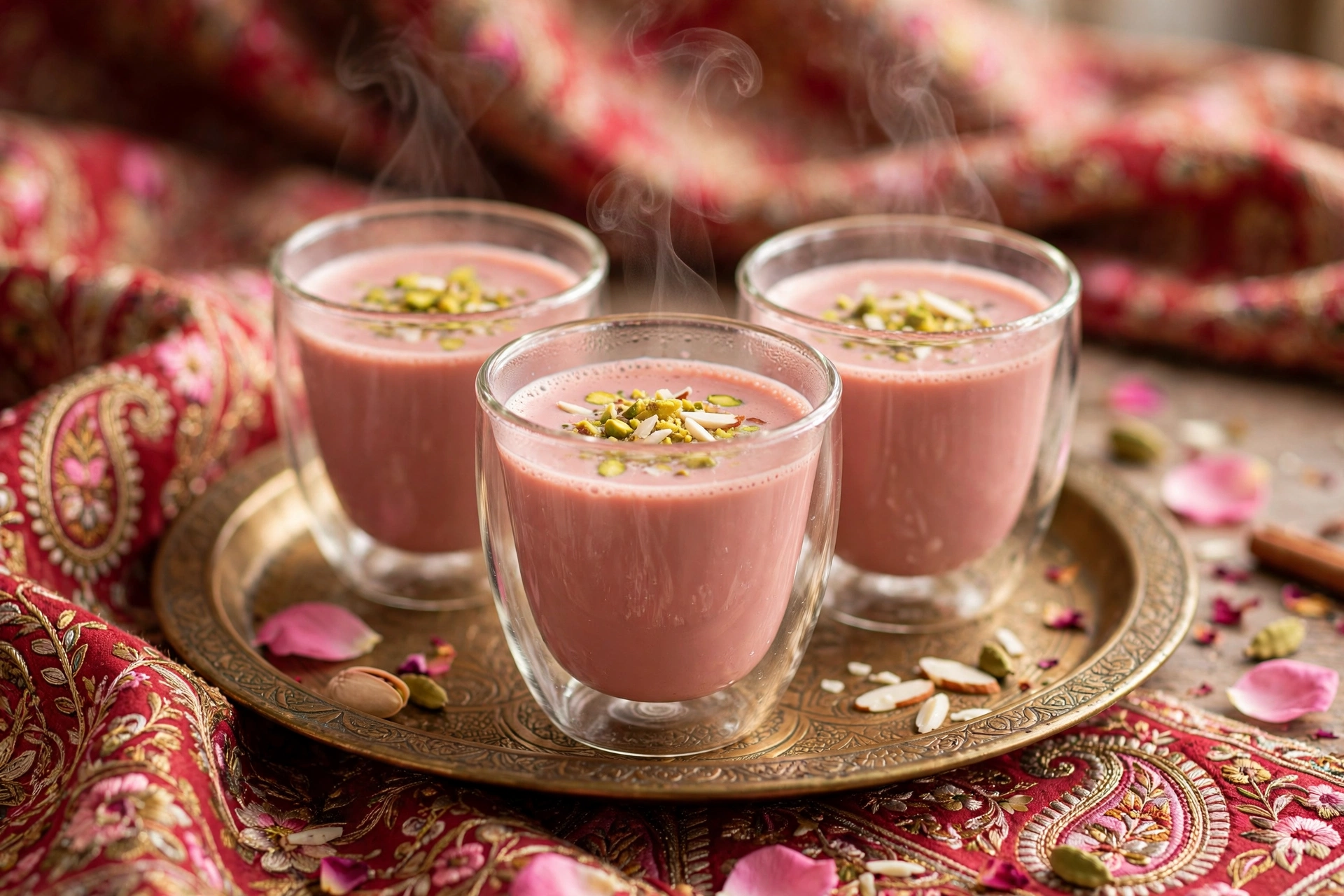
In our house, two seasons announced themselves the same way: a steel jug of thandai appeared in the refrigerator door. It came for Ramadan evenings, when it was the first cold thing to pass our lips after maghrib, and it came back in the first cruel week of May, when the afternoons turned white with heat and my mother would pour a small glass for anyone who walked in from outside, as if issuing first aid. Almonds, fennel, poppy seeds, and pepper, ground to a paste and stirred into cold milk — the drink was always pale, always icy, and always gone too soon. This thandai recipe is that jug, rebuilt from her method and my mistakes.
The mistakes deserve their paragraph, because thandai forgives nothing done in a hurry. My first solo batch was gritty enough to chew: I had ground dry almonds, dry, in a small grinder, and made a fragrant sand that no amount of stirring could persuade into milk. The second batch tasted like cough syrup wearing a costume — I had added the rose water with enthusiasm instead of by drops, and it shouted over every spice in the glass. And the third was simply flat, made from a thandai spice mix I had ground a month earlier and stored hopefully; the fennel had faded to a rumor of itself. The rules in this thandai recipe are the corrections: soak everything, grind the paste wet, dose the rose like medicine, and let the spices be ground the same day they meet the milk.
Why This Thandai Recipe Works
Thandai is a drink with no cooking to hide behind, so everything depends on the paste and the temperature. This thandai recipe is built to get both right:
- The nuts and seeds are soaked before they are ground. Almonds, poppy seeds, and fennel seeds left in water for 6 hours soften all through, so the grinder can take them to a true paste instead of a gritty powder. Dry-ground nuts will stay sandy no matter how long you blend them — the soak is not a suggestion in this thandai recipe, it is the difference between silk and sand.
- The almonds are peeled. Soaked almond skins slip off with a pinch, and they should: the skins carry a faint bitterness and a brown fleck that dulls both the flavor and the drink’s pale color. Peeled nuts grind paler, sweeter, and smoother. Ten unhurried minutes at this step is what separates a homemade glass from a halwai’s.
- Pepper warms; it never leads. The black pepper in thandai is a shadow, not a headline — a warmth at the back of the throat that makes the cold drink taste colder by contrast. Measured in peppercorns rather than spoonfuls, it stays in its place behind the cardamom and fennel. Overdo it and the glass turns medicinal, a failure every thandai recipe should warn about in writing.
- The sweetness is set after chilling. Cold dulls the taste of sugar, so a drink sweetened warm at the counter will taste shy and flat when it is finally served icy — and one sweetened generously warm lands cloying. This thandai recipe stirs the sugar in early but does its final tasting with the drink properly cold, and adjusts then.
- It is strained, and served at the edge of freezing. The classic glass is smooth — the paste’s body without its particles — so the milk is poured through a fine sieve or muslin and served colder than feels reasonable in the jug. Warm thandai is a contradiction; icy thandai is the entire point.
Ingredients
Serves 4
For the paste:
- 1/4 cup almonds, soaked overnight and peeled
- 2 tablespoons poppy seeds (khus khus), soaked
- 2 tablespoons melon seeds (magaz), or 8 cashews, soaked
- 1 tablespoon fennel seeds, soaked with the nuts
- 8-10 black peppercorns
- 4 green cardamom pods, seeds only
- 1 teaspoon dried rose petals (optional)
For the milk:
- 4 cups whole milk, well chilled, divided
- 1/3 cup sugar, or to taste
- A pinch of saffron strands
- 1/2 teaspoon rose water, added by drops (optional)
- Crushed ice, to serve
- Slivered almonds and pistachios, and a few rose petals, to garnish
The drink itself, thandai, takes its name from the Hindi word for cold, and it was built as edible air-conditioning: a chilled, spiced milk served at festivals — most famously Holi, and on Ramadan and Eid tables across the region — wherever a crowd needs cooling down in ceremony. Its green-hearted spice is fennel, the sweet, anise-scented seed chewed after meals all over the subcontinent for digestion and fresh breath. In the paste, fennel does double duty — aroma and that unmistakable cooling sweetness — which is why an honest thandai recipe grinds it fresh rather than reaching for a stale jar.
How to Make This Thandai Recipe – Step by Step
Step 1: Soak the nuts, seeds, and fennel.
Put the almonds, poppy seeds, melon seeds, and fennel seeds in a bowl, cover generously with water, and leave for at least 6 hours or overnight. The almonds will plump and their skins will loosen. Drain everything, then pinch each almond between finger and thumb so it slips out of its skin — oddly satisfying work, and the quiet first step of this thandai recipe.
Step 2: Grind the paste until it is truly silk.
Put the soaked, peeled nuts and seeds in a grinder with the peppercorns, cardamom seeds, and rose petals if using, plus 1/2 cup of the milk. Grind in bursts, scraping the sides down, until the paste rubs between your fingers with no graininess at all — this can take 3 to 4 minutes, and it is worth every one. If the paste feels sandy, add another spoonful of milk and grind again. Grit is decided here, entirely, in the grinder; no later step in a thandai recipe can undo it.
Step 3: Bloom the saffron and stir the drink together.
Warm 1/4 cup of the milk — barely warm, not hot — and steep the saffron strands in it for 10 minutes until it turns deep gold. Stir the ground paste, the saffron milk, and the sugar into the remaining chilled milk in a jug, whisking until the sugar dissolves and the drink is evenly pale and fragrant. This is the moment the thandai recipe becomes a drink rather than ingredients.
Step 4: Strain it, chill it hard, and set the sweetness cold.
Pour the mixture through a fine sieve or a layer of muslin into a clean jug, pressing the solids with the back of a spoon to extract every bit of the paste. Cover and refrigerate for at least 2 hours, until the drink is properly, thoroughly cold. Then taste it — this is the only honest moment to judge — and stir in more sugar if it needs it and the rose water, a few drops at a time, if you are using it. A thandai recipe is seasoned at refrigerator temperature or not at all.
Step 5: Serve it icy, with the garnish on top.
Stir the jug well — the good paste settles — and pour the thandai over a little crushed ice in tall glasses. Scatter slivered almonds and pistachios and a rose petal or two over each glass and serve immediately, while the chill is still sharp. At iftar or on an Eid morning, serve this thandai recipe in small glasses rather than large ones: it is rich, and a modest glass poured cold is the traditional luxury.
Serving Suggestions
This thandai recipe belongs to the cold end of the table: at iftar it follows the dates, at Eid it stands among the morning sweets, and on a summer afternoon it needs no occasion at all beyond a hot door and a guest walking through it. The garnish is not decoration in the casual sense — the slivered nuts and petals tell the drinker what is in the glass before the first sip, and a glass without them always looks slightly unfinished.
Its closest relative on the site works the opposite season: my badam milk is almond milk too, but hot, almond-only, and built for winter nights — the two drinks together are the same idea wearing summer and winter clothes. And on the Eid table, a jug of this sits naturally beside my sheer khurma, the warm vermicelli pudding of the morning: one glass cold and spiced, one bowl warm and rich, and between them the whole argument of the festival table. A jug made from this thandai recipe also keeps a fast-breaking crowd patient while the main food is still in the kitchen.
Storage and Reheating
There is no reheating a drink whose name means cold, and storage is a matter of days, not weeks. Kept in a sealed jug in the refrigerator, this thandai recipe holds well for up to 2 days; the paste will settle and the flavors will marry, so stir or shake the jug thoroughly before every pour. Add the rose water fresh on the second day if the aroma has faded, a few drops at a time. Do not freeze it — milk that has frozen and thawed turns grainy, and grain is the one flaw thandai cannot survive. For a crowd, the paste alone can be made a day ahead and refrigerated, then stirred into fresh cold milk a few hours before serving.
Frequently Asked Questions
Why is my thandai gritty?
Grit is born at the grinder, almost always from nuts and seeds that were soaked too briefly — or not at all — and ground dry. Soak for the full 6 hours, peel the almonds, and grind the paste with milk in the jar, in patient bursts, until it rubs perfectly smooth between your fingers. Straining removes the last of it, but it cannot rescue a paste that was sandy from the start. Texture is the whole reputation of a thandai recipe, so give the grinder its minutes.
Can I leave out the poppy seeds?
Yes. Poppy seeds (khus khus) are traditional, but they are restricted or simply unavailable in some places, and the drink survives their absence gracefully. Replace them with an extra tablespoon of melon seeds or a few more cashews so the paste keeps its body, and everything else in this thandai recipe stays exactly the same. The fennel and cardamom carry the signature flavor; the seeds, whichever you use, are there for silk.
Can I make thandai without dairy?
You can — the paste does most of the work in this drink, so a good unsweetened almond milk or oat milk carries it well. The result will be a shade less rich than the whole-milk original, so grind the paste with the alternative milk and consider a couple of extra cashews for body. Sweeten and chill exactly as directed; the cold-tasting rule applies to every version of this thandai recipe.
My thandai tastes like cough syrup. What happened?
The rose did it — rose water and kewra are measured in drops in this drink, and poured generously they drown the spices and turn the glass medicinal. There is no removing it once it is in, but you can dilute the batch with more cold milk and re-balance the sugar to soften the effect. Next time, add the rose at the very end, cold, a few drops at a time, tasting between additions; a thandai recipe should hint at rose the way a room hints at a garden outside the window.
Recipe Summary
- Prep time: 20 minutes (plus 6 hours of soaking)
- Cook time: 5 minutes
- Total time: About 8 hours, soaking and chilling included
- Servings: 4
- Cuisine: Pakistani
- Course: Beverage