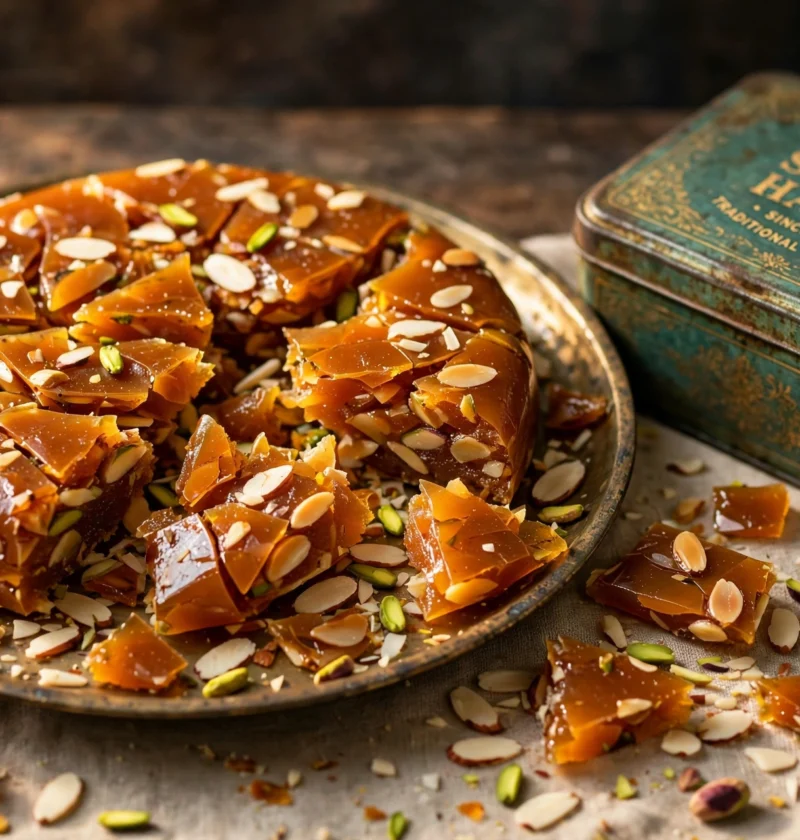
Anyone in our family who travels to Multan knows the duty without being told: a round tin of sohan halwa comes home with you, packed in the top of the bag like treasure. As a child I thought it was a kind of edible glass — amber, glossy, freckled with almonds — and the ceremony of it thrilled me as much as the taste: my grandfather would set a piece on the marble counter and crack it with the back of a heavy spoon, and we children divided the shards like conspirators. Most halwas are soft, warm, spooned things. This one snaps. Getting that snap at home took me years of questions asked of patient halwais and more failed batches than I like to count, and this sohan halwa recipe is everything those failures taught me, written in order.
My first batch never set at all — I pulled it off the heat at what looked like a promising thickness, poured it proudly, and by morning it bent like toffee and stuck to the teeth like it too. My second set beautifully and ate like sand, because the sugar had crystallized into grain and I had not yet learned that a spoonful of lemon juice stands guard against exactly that. My third was nearly right and then scorched in the final five minutes, when I answered the phone and left the heat where it had been at the start. The rules of this sohan halwa recipe are those three discs remembered: cook all the way to the thread stage and prove it with the snap test, put the lemon in early, and drop the heat and stir without pause at the end.
Why This Sohan Halwa Recipe Works
Sohan is less a pudding than a confection — sugar, wheat milk, and ghee persuaded into glass. This sohan halwa recipe respects the confectioner’s logic:
- The wheat milk is the soul of it. Sprouted wheat, ground and strained into a milky liquid called angauri, brings a natural starch and a deep, malty sweetness that plain milk cannot imitate. It is what gives a sohan halwa recipe its glassy body and its unmistakable flavor — everything else is support.
- The syrup is cooked to the thread stage, then proved. Two-thread consistency is the address where sohan lives; stop earlier and it bends, push much further and it turns bitter and brick-like. The snap test — a drop cooled on a plate must crack, not fold — is the only honest proof, and a sohan halwa recipe that skips it is guessing.
- Lemon juice keeps the grain away. A little acid in the syrup discourages sugar crystals from forming as it concentrates, which is the difference between a glossy snap and a gritty one. The Multan shops use citric acid; lemon does the same quiet work in a home sohan halwa recipe.
- Ghee goes in gradually, heat falls at the end. Spooned in as the mass absorbs it, ghee keeps the halwa from sticking and gives it that fried richness. The last ten minutes happen over the lowest flame with constant stirring, because a sohan halwa recipe is most likely to scorch exactly when it is almost done.
- The pour allows no hesitation. Once the mass pulls cleanly from the pan it sets fast, so the tray is greased and waiting, the nuts are ready, and leveling happens in seconds. Score it while warm and the pieces break along your lines later instead of shattering at random.
Ingredients
Makes one 9-inch disc, about 1 1/2 pounds; serves 10 to 12 in small pieces
For the wheat milk (angauri):
- 1 cup whole wheat berries (gehun), picked over and rinsed
- 4 cups water, for blending and straining
- Honest shortcut, if sprouting is impossible: 1/2 cup whole wheat flour (atta) whisked smooth into 4 cups water with 2 tablespoons cornflour — a good halwa, a shade less glassy
For the halwa:
- 2 cups sugar
- 1/2 cup ghee, plus extra for greasing the tray
- 1 tablespoon lemon juice
- 1/2 teaspoon cardamom powder
- 1/2 teaspoon kewra water (optional)
- A small pinch of salt
For the nuts:
- 1/3 cup almonds, slivered or halved
- 1/4 cup pistachios, slivered
- 2 tablespoons melon seeds (optional)
The sweet has centuries behind it: sohan halwa is a dense, solid confection of Mughal-era kitchens, unusual among halwas precisely because it sets hard instead of staying soft and spoonable. Its fame, though, belongs to the shrine-dotted old city of Multan, whose halwai families refined it into the amber disc now carried as a gift across the whole country. A sohan halwa recipe made at home is a small act of respect toward those shops — slower than buying a tin, and quietly satisfying in a way the tin cannot be.
How to Make This Sohan Halwa Recipe – Step by Step
Step 1: Sprout the wheat and strain the milk.
Soak the wheat berries in plenty of water for 24 hours. Drain, tie them in a damp muslin cloth, and leave them in a dark corner for 24 to 36 hours, rinsing twice, until tiny white tails sprout from the grains. Blend the sprouted wheat with the 4 cups of water until milky, then strain through muslin, squeezing hard to press out every drop. Let the liquid stand for 30 minutes; pour off and use the thick, milky part. This angauri is the making of a sohan halwa recipe — do not rush it, and start it two days before you plan to cook.
Step 2: Start the syrup and add the lemon.
Pour the wheat milk into a large, heavy karahi or a wide, thick-bottomed pot — the heaviest you own, because this mixture scorches where thin pans run hot. Add the sugar and set over medium heat, stirring as it warms until the sugar has fully dissolved. Stir in the lemon juice now, not later; added early, it guards the syrup quietly for the whole cook, and a sohan halwa recipe has no second chance to prevent grain once the crystals have formed.
Step 3: Cook to the thread stage, feeding in the ghee.
Settle in: the next 35 to 45 minutes are stirring, steady and patient, scraping the base and sides. The mixture will thin, then thicken, then begin to darken toward amber. Add the ghee a tablespoon at a time whenever the surface looks dry, letting each spoonful absorb before the next. To test the stage, lift the spoon and let a little syrup fall between two cooled fingertips — it should stretch into two fine threads — and drop a bead onto a cold plate: cooled, it must feel firm and snap when pressed, not bend. That snap is the signature of a sohan halwa recipe, and nothing else on the stove can tell you it has arrived.
Step 4: Finish with nuts, cardamom, and falling heat.
In the last 10 minutes, lower the heat to the minimum and stir without stopping — this is where scorching happens, and where attention pays. The mass should turn glossy, deepen to a clear amber, and pull away from the pan in one slow sheet, leaving the base almost clean. Stir in the cardamom, kewra if using, the salt, and most of the nuts, keeping a handful back for the top. When the whole mass moves as a single shining body, your sohan halwa recipe is cooked; take it off the heat at once.
Step 5: Pour, level, score, and let it become glass.
Tip the mass immediately onto the greased tray or a greased flat thali and level it fast with a ghee-slicked spatula to about 1/4 inch thick — you have seconds, not minutes. Scatter the reserved nuts over the top and press them in lightly. While it is still warm, score deep squares or diamonds with a greased knife. Then leave it completely alone for at least 2 hours. When it has cooled and hardened, break it along the scores with your hands or the back of a spoon, and listen for the crack: that small, clean sound is a sohan halwa recipe keeping its promise.
Serving Suggestions
A sohan halwa recipe yields a rich sweet, so serve it the Multani way: in small shards, never slabs, with strong doodh patti chai or black tea to cut through the ghee and sugar. It belongs on Eid trays and wedding sweet tables, and a few pieces set beside a bowl of plain yogurt make an old-fashioned dessert more people should know. Because it travels and keeps so well, it is the sweet to hand to anyone leaving for another city — which is, of course, exactly how it earned its fame.
To place it among the halwas on this site: my suji ka halwa is the soft, golden breakfast sweet, spooned warm over puris on a Friday morning. My gajar ka halwa is winter’s slow labor, grated carrots cooked down to a rich, fudgy crumble. The sohan halwa recipe is the family’s third temperament entirely — neither spooned nor crumbled, but snapped, carried in tins, and eaten in shards days after it was made.
Storage and Reheating
Sohan keeps the way it was designed to: in an airtight tin in a cool, dry cupboard, it stays glossy and snappable for 4 to 6 weeks, because there is barely any moisture left in it for spoilage to work with. Do not refrigerate it — the cold, damp air of a fridge clouds the shine and can soften the edges. There is no reheating; a sohan halwa recipe is served at room temperature, and if a piece has sat somewhere humid and lost a little crispness, ten minutes in a low oven at 250°F (120°C) will often dry it back to a snap.
Frequently Asked Questions
Why did my sohan halwa stay soft and bendy?
The syrup stage, almost certainly — it came off the heat before reaching a true two-thread consistency, usually because the cook trusted the clock or the color instead of the test. Put it back over low heat and cook on, testing every few minutes: a cooled drop must snap, not fold. A sohan halwa recipe forgives a return to the stove far more readily than it forgives being poured early.
Why is my halwa grainy instead of glossy?
Sugar crystallized somewhere along the way: the lemon was skipped or added too late, or dry sugar crusted on the pan walls and fell back in as seed crystals. Add the acid early, stir the walls down as you cook, and keep the heat even. Once set, graininess cannot be cooked out — but it can be prevented completely the next time, and a grainy batch still tastes fine crumbled over ice cream.
Can I really use the flour shortcut instead of sprouting?
Yes, and I would rather you made it that way than not at all. The atta-and-cornflour version snaps properly and tastes close, though the flavor is a little flatter and the finish a little less glassy than the sprouted-wheat original. Think of the shortcut as the rehearsal: many cooks try a sohan halwa recipe first with flour, learn the syrup stages, and sprout the wheat the second time with confidence.
Why does mine taste faintly burnt even though it never caught?
The final minutes run hotter than they look. A thin pan, a flame left at medium, or a stirring pause while the mass is at its thickest will scorch the sugars on the base and perfume the whole disc. Use your heaviest pot, drop the heat early, stir constantly at the end, and pull the pan off the burner a shade before you think it is done — the residual heat of a sohan halwa recipe carries it the last few degrees on its own.
Recipe Summary
- Prep time: 20 minutes, plus 2 days to sprout the wheat
- Cook time: About 50 minutes
- Total time: 2 days of sprouting, then about 1 hour 10 minutes
- Servings: 10 to 12 people, in small pieces
- Cuisine: Pakistani (Multani)
- Course: Dessert / Mithai