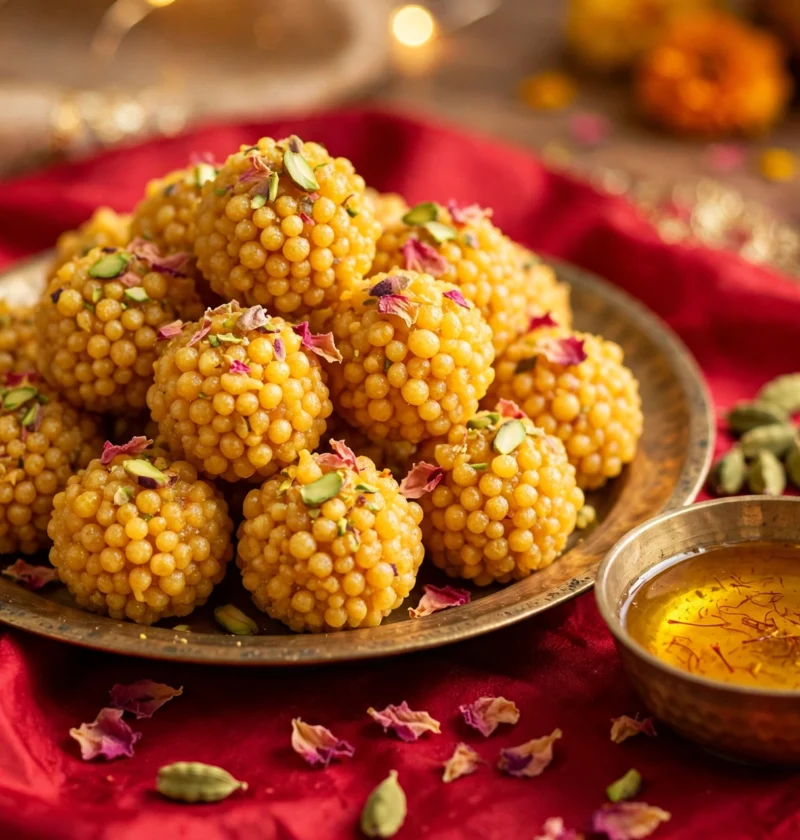
The first time I made boondi laddu at home, it was the night before my cousin’s mehndi, and the house was already in that happy chaos that only a wedding brings. Someone was stringing marigolds in the hallway, someone else was arguing about the music playlist, and my aunt looked at me and said, quite simply, that the laddus were my job. I had eaten boondi laddu all my life at weddings and Eid tables, but I had never actually made a batch myself, and I stood in the kitchen with a bag of gram flour, quietly terrified. By midnight, though, the trays were full of round, golden laddus that smelled of cardamom and ghee, and my aunt took one bite and nodded like a judge awarding full marks. This boondi laddu recipe is the method I have used ever since, tested through more weddings, Eids and Diwalis than I can count.
What I love about this sweet is that it looks far more difficult than it is. The process has only two real parts: frying tiny gram-flour pearls until crisp and golden, then soaking them in warm, fragrant sugar syrup and pressing them into balls while they are still warm. There is no mould, no special equipment beyond a perforated ladle, and no decorating skill required, because the laddus decorate themselves with their bumpy, jewel-like surface. Once you learn the two judgements that matter — the batter consistency and the syrup stage — you will reach for this boondi laddu recipe whenever a celebration is coming, because a plate of homemade laddus beats anything from a sweet shop.
Why This Boondi Laddu Recipe Works
- A thin, smooth batter makes round pearls, not blobs. The batter must flow freely through the ladle holes, which is why this boondi laddu recipe insists on a pouring consistency closer to pancake batter than to pakora batter.
- Hot ghee fries the pearls crisp in seconds. Small droplets cook almost instantly, so this boondi laddu recipe gives you golden, crunchy boondi without any greasiness or raw centres.
- One-string syrup binds without hardening. Syrup cooked to a single thread coats the pearls and sets soft, so this boondi laddu recipe produces laddus that hold their shape yet melt in the mouth.
- Warm shaping is the secret step. Pressing the mixture while it is still warm lets the syrup glue the pearls together, which is why this boondi laddu recipe never crumbles apart on the plate.
- Cardamom and saffron do all the perfuming. A little of each goes a long way, giving this boondi laddu recipe its unmistakable wedding-sweet fragrance without any artificial flavouring.
Ingredients
The list is short, and every item is ordinary pantry stock in a desi kitchen. The one ingredient worth choosing with care is the gram flour. Buy fresh, fine besan, not a bag that has sat open for months, because stale flour makes dull, heavy boondi. The ghee should be good quality too, since its flavour carries through the whole sweet, and this boondi laddu recipe rewards you for not cutting corners on these two basics.
- 2 cups fine gram flour (besan), sifted
- 1 1/2 cups water, plus more as needed
- 1/4 teaspoon baking soda (optional, for lighter pearls)
- 2 cups ghee, for frying
- 1 1/2 cups sugar
- 1 cup water, for the syrup
- 1/2 teaspoon green cardamom powder
- Saffron threads, a generous pinch, bloomed in 2 tablespoons of hot milk
- 1 teaspoon lemon juice
- 2 tablespoons chopped pistachios
- 1 tablespoon dried rose petals (optional, for garnish)
- 1 tablespoon melon seeds (optional)
On the frying fat: ghee is traditional and gives the best flavour, but a neutral vegetable oil works if you prefer it. What matters is clean, fresh fat, because boondi picks up any stale taste immediately. This boondi laddu recipe uses a deep, wide pan so the pearls have room to dance in the fat rather than clumping together.
Method
Step 1: Whisk the batter until smooth and flowing
Sift the gram flour into a large bowl and add the baking soda if you are using it. Pour in the water gradually, whisking all the while, until you have a smooth batter with no lumps at all. The consistency is the whole game here: it should pour off the whisk in a steady ribbon and coat the back of a spoon thinly. If it is too thick, the pearls will be fat and doughy; if it is too thin, they will scatter into crumbs. Rest the batter for 10 minutes, then whisk once more before frying, because this boondi laddu recipe depends on a batter that flows like ribbons.
Step 2: Fry the boondi pearls until golden
Warm the ghee in a deep, wide pan over medium heat until a drop of batter sizzles at once and rises to the surface. Hold a perforated ladle or a boondi jhara about 6 inches above the fat and pour a ladleful of batter through it, tapping gently so droplets fall in a steady rain. The pearls will puff and turn golden in under a minute. Lift them out with a slotted spoon, drain well, and spread them on a tray. Work in small batches, wiping the ladle clean between rounds, and keep the heat steady so every batch fries at the same golden pace.
Step 3: Cook the cardamom-saffron syrup to one string
While the last batch of boondi fries, stir the sugar and 1 cup of water together in a separate pan over medium heat until the crystals melt completely and the liquid turns clear. Squeeze in the lemon juice, which keeps the syrup from crystallising, then simmer for 5 to 7 minutes. Test by pinching a cooled drop between thumb and forefinger: it should stretch into a single fine thread before breaking. Stir in the cardamom powder and the saffron milk, then take the pan off the heat. This one-string stage is the heart of this boondi laddu recipe, and it is worth testing twice rather than guessing.
Step 4: Soak the boondi and mix in the nuts
Tip all the fried boondi into the warm syrup and stir gently so every pearl gets coated. Cover the pan and leave it for 10 to 15 minutes, by which time the pearls will have absorbed most of the syrup and turned soft, sticky and fragrant. Stir in the chopped pistachios and melon seeds, and taste a pearl: it should be sweet right through, not dry in the centre. If the mixture looks dry, sprinkle in a tablespoon of warm water; if it looks wet, rest it a few minutes longer. Patience at this stage is what makes this boondi laddu recipe give soft laddus instead of dry ones.
Step 5: Shape warm laddus and let them set
Grease your palms lightly with ghee and, while the mixture is still warm but comfortable to handle, take a small handful and press it firmly into a round ball, about the size of a golf ball. Work quickly and steadily, re-greasing your hands as needed, and set each laddu on a greased tray. Press a few rose petals or a pistachio sliver onto the top of each one if you like. Leave the laddus to set for 30 minutes at room temperature, during which the syrup firms up and the shape holds. That warm, quick shaping is the final trick of this boondi laddu recipe, and it is deeply satisfying work.
Serving Suggestions for This Boondi Laddu Recipe
On a festival day, this boondi laddu recipe needs nothing more than a beautiful plate and a pot of chai. I pile the laddus in a brass thali, scatter rose petals over them, and set them at the centre of the table for guests to help themselves. They are also the sweet I pack in boxes for neighbours at Eid and Diwali, because they travel well, keep their shape, and taste of celebration the moment the box is opened.
For a wedding spread, serve this boondi laddu recipe alongside other traditional sweets so guests can compare textures and flavours. If your table already enjoys our besan ladoo, set the two out together for a lovely contrast, the melt-in-the-mouth crumble of besan against the syrupy, pearl-studded bite of boondi. And for a finer, more delicate laddu on another occasion, our motichoor ladoo brings the same festive spirit in a softer, finer-grained form.
Storage and Reheating
Boondi laddu is one of the kindest sweets to keep, which is why it is made in bulk for weddings. Store this boondi laddu recipe in an airtight box at room temperature for up to 2 weeks; kept away from heat and sunlight, the laddus stay soft and fragrant. The syrup acts as a natural preservative, so there is no rush to finish them.
For longer keeping, refrigerate the laddus for up to a month in a sealed container, but bring them back to room temperature for 30 minutes before serving, because cold syrup firms up and dulls the fragrance. Freezing is not recommended, since thawed laddus weep syrup and lose their shape. There is no reheating here in the usual sense; if a laddu feels firm after refrigeration, a few seconds in a warm (not hot) oven softens it beautifully, though this boondi laddu recipe is at its best served at room temperature.
Boondi Laddu Recipe FAQs
Is boondi laddu the same as motichoor laddu?
No, and the difference is the size of the pearls. Motichoor laddu is made from very fine, tiny boondi that almost dissolves on the tongue, giving a soft, almost creamy texture. This boondi laddu recipe uses coarser, pea-sized pearls, so each laddu has a distinct bumpy bite and a little more chew. The syrup and flavourings are close cousins, but the mouthfeel is different, and most sweet shops sell the two side by side precisely because customers have strong loyalties to one or the other.
How is boondi laddu different from besan laddu?
The two start from the same flour but take completely different paths. Besan laddu is made by roasting gram flour in ghee until nutty and fragrant, then mixing it with powdered sugar and shaping it into crumbly, melt-in-the-mouth balls, with no syrup at all. This boondi laddu recipe fries the batter into pearls first, then binds them with sugar syrup, so the result is glossy, syrupy and studded with visible pearls rather than smooth and crumbly. Same flour, entirely different sweet.
Is boondi laddu the same as boondi raita?
Not at all, and the confusion comes only from the shared word boondi. Boondi raita is a savoury yogurt dish: small, plain fried boondi pearls soaked in whisked, salted dahi with spices, served cool as a side dish with curries. This boondi laddu recipe is a sweet through and through, with the pearls soaked in cardamom-saffron sugar syrup and shaped into festive balls. One belongs beside a karahi, the other belongs on a sweet tray, and they could hardly be further apart on the table.
Why do my laddus fall apart or turn rock hard?
Falling apart almost always means the syrup was too thin or the shaping happened after the mixture cooled. Syrup that never reached one string cannot glue the pearls, and a cold mixture will not bind no matter how hard you press. Rock-hard laddus mean the opposite problem: syrup cooked past one string into two or three strings, which sets like toffee. Test the syrup carefully, shape while warm, and this boondi laddu recipe will give you laddus that hold their shape and yield softly to a bite.
Recipe Summary
Prep time: about 15 minutes of batter whisking and setup. Frying and syrup: roughly 45 minutes of active work, most of it in small, satisfying batches. Makes about 20 medium laddus. Level: easy to moderate, with the batter consistency and the syrup stage as the two skills worth practising. This boondi laddu recipe takes gram flour, ghee, sugar, cardamom and saffron, and turns them into golden, syrupy, pearl-studded laddus that taste of weddings, festivals and home kitchens at their happiest.
A little background for the curious: laddu is one of the oldest sweets of the Indian subcontinent, offered at temples, weddings and festivals for centuries, with countless regional versions built on flour, sugar and ghee. And boondi itself, the tiny fried gram-flour pearl at the heart of this sweet, is a versatile little thing, appearing in savoury raitas as well as festive laddus. Turning those humble pearls into a syrup-soaked celebration sweet is one of the great tricks of the desi kitchen, and that trick is exactly what you taste in this boondi laddu recipe.