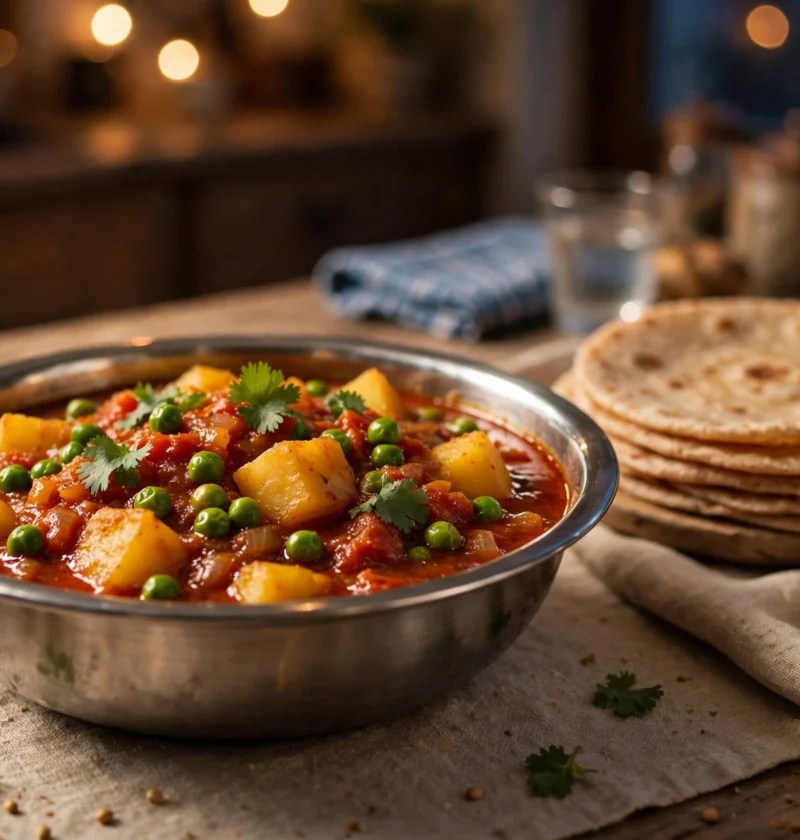
Some dishes announce themselves, and some just quietly feed the family for decades. Aloo matar is the second kind. In our house it was the Tuesday answer — the sabzi my mother could start with her eyes half closed, potatoes from the sack by the door, peas from the freezer, and a tomato-onion masala that perfumed the whole street by six o’clock. Nobody photographed it, nobody praised it loudly, but the pot always emptied. This aloo matar recipe is that pot, written down: tender potatoes with their edges intact, peas that stay green and sweet, and a gravy with enough body to coat a roti properly.
My early attempts missed the mark in the usual ways. I once tipped the peas in with the potatoes and simmered everything together for half an hour; the peas came out the color of old army blankets, wrinkled and sad. Another time I boiled the potatoes hard to hurry them and they surrendered completely, turning my curry into spiced potato soup. And more than once my masala stayed thin and raw-tasting because I rushed the frying stage and never waited for the oil to rise. The method in this aloo matar recipe is the correction of all three: the masala fries until it shines, the potatoes simmer gently instead of boiling, and the peas go in at the very end, where they belong.
Why This Aloo Matar Recipe Works
Aloo matar is a two-ingredient dish hiding inside a gravy, which means the gravy has to do the heavy lifting and the two ingredients have to arrive at tenderness on different clocks. This aloo matar recipe is organized around exactly that:
- The masala is fried until the oil separates. Onions, ginger, garlic, and tomatoes are cooked past the raw stage, past the wet stage, until the mixture darkens, thickens, and beads of oil appear around its edges. That bhuno is the entire flavor foundation of this aloo matar recipe — a masala stopped early gives you a curry that tastes of boiled tomato no matter what you add later.
- The peas go in last, and barely cook. Peas need only a few minutes in the hot gravy to turn tender; give them twenty and their color and sweetness are gone. Added near the end, they stay bright green, keep their gentle pop, and taste like peas instead of filler — the difference between a sabzi and a slog.
- The potatoes hold their edges. Cut into even chunks and simmered gently in the masala rather than boiled in plain water, the potatoes cook through while keeping their shape, their surfaces drinking in the gravy. Even cutting matters: a tray of mixed sizes guarantees some pieces raw and others in pieces.
- Hot water only, and only a little. A splash of hot water loosens the gravy without shocking it or diluting the fried masala into soup. Cold water at this stage drops the temperature and washes the shine right off — a small discipline this aloo matar recipe insists on.
- The finish is fresh, not more cooking. Garam masala, green chilies, and coriander go in at the end, off the hardest heat, so their aroma survives to the table. Five rested minutes under a lid lets the potatoes absorb one last layer of flavor before serving.
Ingredients
Serves 4
For the curry:
- 4 medium potatoes (about 1 1/2 pounds), peeled and cut into 3/4-inch chunks
- 1 1/2 cups green peas, fresh or frozen (thawing not required)
- 1 large onion, finely chopped
- 2 medium tomatoes, finely chopped (or 1 cup crushed tomato)
- 1 tablespoon ginger-garlic paste
- 1/3 cup cooking oil or ghee
- 1 teaspoon cumin seeds
- 1 teaspoon red chili powder (adjust to taste)
- 1/2 teaspoon turmeric powder
- 1 1/2 teaspoons coriander powder
- 1 teaspoon salt, or to taste
- 1/2 to 3/4 cup hot water, as needed
To finish:
- 1/2 teaspoon garam masala
- 2 green chilies, slit
- A handful of fresh coriander leaves, chopped
- A squeeze of lemon juice (optional)
The potato is a traveler that never went home — it left the Andes a few centuries ago and became so thoroughly ours that half the subcontinent’s everyday cooking now leans on it. The pea, by contrast, is an old resident, cultivated for thousands of years, and its sweetness against the potato’s earthiness is the whole quiet argument of this dish. Together they make the vegetarian original; add minced beef and you have aloo keema matar, its meat-eating cousin, and swap the potato for paneer and the dish changes its name again — a distinction this aloo matar recipe keeps firmly in view.
How to Make This Aloo Matar Recipe – Step by Step
Step 1: Fry the onion and build the masala base.
Heat the oil in a karahi or heavy-bottomed pot over medium heat, add the cumin seeds, and let them sizzle for a few seconds. Add the chopped onion and fry, stirring regularly, for 8 to 10 minutes until it turns a deep golden brown at the edges. Stir in the ginger-garlic paste and cook for another minute, until the raw smell leaves the pan. A pale onion cannot carry this aloo matar recipe, so let the color develop honestly.
Step 2: Add the tomatoes and spices, and bhuno until the oil rises.
Add the chopped tomatoes, chili powder, turmeric, coriander powder, and salt. Cook on medium heat for 8 to 10 minutes, stirring and scraping, until the tomatoes melt completely into the onions and the masala thickens, darkens, and shows oil glistening around its edges. This is the moment the whole dish is decided — undercooked tomato is the one flaw no garnish can hide in any aloo matar recipe.
Step 3: Coat the potatoes in the masala and simmer them gently.
Add the potato chunks and stir them through the masala for 2 to 3 minutes, so every piece is coated and the edges begin to fry lightly. Pour in 1/2 cup of hot water, cover the pot, and reduce the heat to low. Simmer for 12 to 15 minutes, stirring once or twice with a gentle hand, until a knife slides into the largest chunk with only slight resistance. Add a little more hot water only if the gravy threatens to catch.
Step 4: Add the peas and finish the cooking.
Stir the peas into the pot, replace the lid, and cook for just 4 to 5 minutes more — long enough for the peas to turn tender and vivid, not a minute beyond. If you are using frozen peas, they need no thawing and no extra time; they will warm through in the steam of this aloo matar recipe exactly as fresh ones do, and keep their color doing it.
Step 5: Rest, garnish, and serve.
Take the pot off the heat. Sprinkle over the garam masala and slit green chilies, cover again, and let the curry rest for 5 minutes — the potatoes drink in a final layer of masala as it sits. Scatter the fresh coriander over the top, add the squeeze of lemon if you like, and carry this aloo matar recipe straight to the table in the pot it cooked in.
Serving Suggestions
Aloo matar belongs to the roti-and-rice rotation of ordinary evenings. Spoon it beside a stack of soft, puffed rotis — my homemade roti is what this gravy was born to be scooped with — or serve it over plain boiled rice with a spoonful of dahi on the side and a few rings of raw onion for crunch. Nothing about the plate needs to be fancy; the curry’s shine does the decorating.
When the same peas-and-masala mood strikes but you want something richer for guests, the natural next step is my matar paneer, where the potato steps aside and soft paneer takes its place in a creamier gravy. Cooking both dishes in the same week teaches you more about how a masala works than a month of reading — this aloo matar recipe is the humble teacher, and matar paneer is the dressed-up exam.
Storage and Reheating
Leftovers of this aloo matar recipe keep well in the fridge, in a covered container, for up to 3 days — and honestly it is one of those sabzis that tastes better the next day, once the potatoes have sat in the masala overnight. Warm it slowly in a covered pot over the lowest heat, loosening the gravy with a splash of hot water and stirring carefully so the softened potatoes do not break. The microwave works too, in short bursts with a stir between each. Freezing is possible for up to a month, though the potatoes soften further on thawing — still perfectly good for a weeknight, if not for guests.
Frequently Asked Questions
Can I use frozen peas in this recipe?
Yes — frozen peas are what most of us actually use, and in some ways they behave better than fresh, because they are frozen at their sweetest. Add them straight from the freezer at the same late stage, with no thawing and no extra cooking time. The one rule of this aloo matar recipe does not change: late peas stay green, early peas go grey.
Why did my peas turn dull and wrinkled?
They cooked too long, almost certainly alongside the potatoes from the start. Peas surrender their color after about ten minutes of simmering and never get it back. If your batch has already gone dull, the dish will still taste fine — just shorten the peas’ time in the pot next round, and this aloo matar recipe will reward you with the bright version.
How do I stop the potatoes from breaking apart?
Three things: cut the chunks evenly and not too small, simmer rather than boil, and stir gently and rarely once they are in. Waxy potatoes hold their shape better than floury ones if you have a choice. And never cook the potatoes separately in water first — they arrive flavorless and fragile, which defeats the purpose of this aloo matar recipe.
Can I make it dry instead of with gravy?
Yes — the khushk, or dry, version is a tiffin classic. Simply leave out the added water after coating the potatoes in masala, cover tightly, and let them cook in the steam of the tomatoes on the lowest heat, shaking the pot instead of stirring. The peas still go in at the end. It will not scoop the same way, but packed with roti this aloo matar recipe travels beautifully.
Recipe Summary
- Prep time: 12 minutes
- Cook time: 40 minutes
- Total time: About 55 minutes
- Servings: 4
- Cuisine: Pakistani
- Course: Main Course