The first doi chicken I ever ate was cooked in a cramped Lahore flat by the mother of my university roommate, a boy from Dhaka who had endured three months of my cooking before his amma arrived to rescue him. She unpacked a steel bowl of yogurt, whole spices knotted into a handkerchief, and a paper bag of raisins, and I remember thinking — with all the certainty of a twenty-year-old — that the raisins had wandered into the wrong recipe. Ninety minutes later I was eating the pale, gentle, sweet-tangy chicken she set in front of me in complete silence, because there was nothing to say that a second helping would not say better. This doi chicken recipe is my attempt, many years and many split gravies later, to finally deserve that dinner.
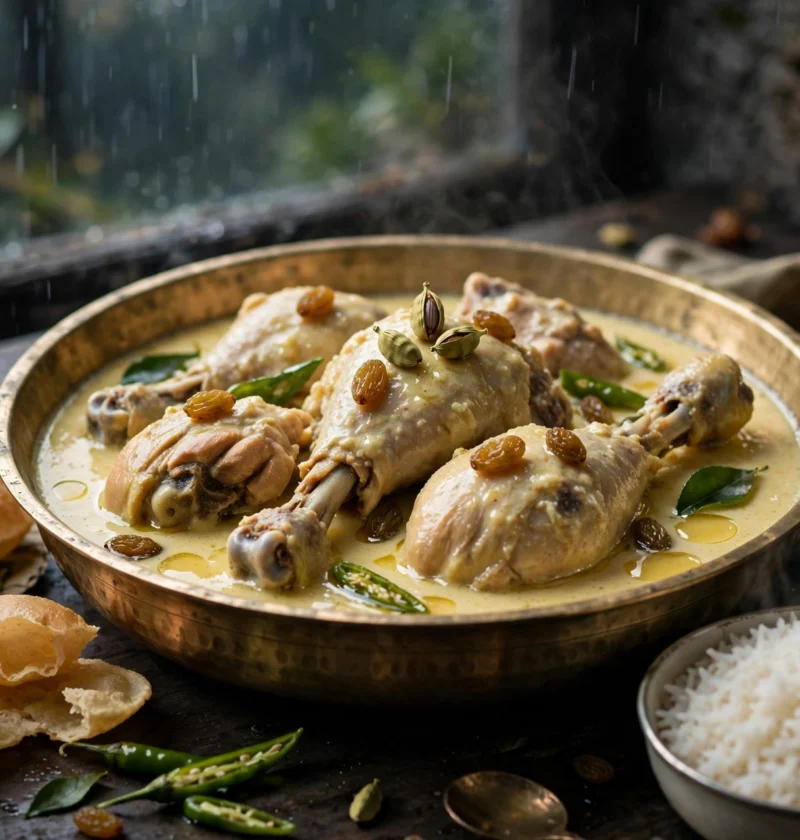
Doi is simply the Bengali word for yogurt, and in this dish the yogurt is not a finishing flourish — it is the cooking medium itself. The chicken goes down into the doi for its marinade, and then it braises in that very same marinade, so the gravy in the bowl at the end is the marinade transformed: pale gold, tangy, faintly sweet, threaded with whole garam masala and dotted with raisins that have swollen soft in the sauce. It helps to separate it from its two pale neighbours. Northern-style dahi chicken sears the bird in a fried-onion masala first and only folds the yogurt in at the end, finishing with dried fenugreek — a good dish, but the chicken never sits in its marinade the way this one does. Rezala gets its body from cashew and poppy-seed paste and its perfume from kewra water; it is restaurant silk, built for weddings. Doi chicken is the home cook of the family: no nut paste, no searing, no cream — just yogurt, patience, and the lowest flame you own.
Why This Doi Chicken Recipe Works
Doi chicken has exactly one dramatic way to fail — the yogurt splitting into grains — and a handful of quiet ones. Everything in this doi chicken recipe is arranged to keep the gravy in one pale, glossy piece:
- The chicken cooks inside its own marinade. Nothing gets drained away and no separate sauce is built across the room. The yogurt the chicken sat in for an hour is the gravy it finishes in, which means the flavour is married all the way through — and there is no raw, sharp yogurt taste underneath, because it has all cooked together.
- The yogurt is whisked to silk and steadied first. A tablespoon of flour and a spoon of sugar whisked into the doi give the proteins something to hold on to when the heat arrives, and the sugar takes the raw edge off the tang in advance. Whisking until it pours like double cream is not fussiness; it is insurance you can taste.
- It never, at any moment, boils. The pot is brought up slowly, kept at the barest simmer, and stirred as it warms. A rolling boil is the one unforgivable thing here — it shatters yogurt gravies in seconds, and no stirring afterwards can persuade the grains back together.
- The onions melt down pale, never browned. They cook in ghee until they are soft, translucent and sweet, and they are pulled back long before they colour. Browned onions would drag this gravy toward the red-brown of an ordinary curry and bury the gentle flavour the dish exists for.
- The raisins and whole spices do the Bengali work. The raisins plump in the warm ghee and burst sweet against the tang when your spoon finds one, while the cardamom, cinnamon and cloves stay whole — perfuming the gravy instead of muddying it. Ground blends would cloud the colour and flatten the very contrast this doi chicken recipe is built on.
Ingredients
Bengali cuisine treats yogurt — doi — as a foundation rather than a garnish: it is whipped into drinks, sweetened and set into clay pots for dessert, and here it becomes an entire gravy. That is why the tub you buy matters more than any spice on this list. It should be full-fat and fresh-tasting, pleasantly sharp rather than mouth-puckeringly old; a yogurt that has turned aggressively sour will bully the whole pot, and no pinch of sugar at the end will talk it down. Everything else is short and homely — chicken, onions, ghee, whole spices, and that small scandal of raisins, which by the time you eat will feel entirely natural.
Serves 4
For the marinade (which becomes the gravy):
- 2 pounds bone-in chicken, skin removed, cut into 8 curry pieces
- 1 1/2 cups plain whole-milk yogurt, at room temperature
- 1 tablespoon all-purpose flour
- 1 tablespoon ginger paste
- 1 teaspoon garlic paste
- 1 teaspoon sugar
- 1 teaspoon salt
For the pot:
- 3 tablespoons ghee (or 2 tablespoons ghee and 1 tablespoon mustard oil)
- 2 medium onions, sliced into thin half-moons (about 2 cups)
- 2 bay leaves
- 4 whole cloves
- 1 cinnamon stick (2 inches long)
- 4 green cardamom pods, bruised lightly
- 1/2 teaspoon ground white pepper (black pepper works, flecks and all)
- 3 tablespoons golden raisins
- 3 to 4 green chillies, slit lengthwise
- 1/2 teaspoon Bengali garam masala, to finish (optional)
- Salt and a pinch more sugar, to balance at the end
- Warm water, a splash at a time, only if the gravy tightens too far
How to Make This Doi Chicken Recipe – Step by Step
Step 1: Whisk the doi to silk and marry the chicken to it. Tip the yogurt into a wide bowl and whisk it hard for a full minute, until it pours in one smooth ribbon with no lumps hiding in it. Whisk in the flour, sugar and salt, then the ginger and garlic pastes. Add the chicken pieces and turn them until every piece is thickly coated, cover the bowl, and leave it in the fridge for at least 1 hour — overnight is better still, if the day allows. Bring the bowl out half an hour before cooking: a room-temperature marinade meets the heat far more calmly than a cold one.
Step 2: Soften the onions to pale sweetness and plump the raisins. Warm the ghee in a heavy pot over medium-low heat and drop in the cardamom, cinnamon, cloves and bay leaves for about 30 seconds, until the oil smells warm and sweet. Add the onions with a pinch of salt and cook slowly for 10 to 12 minutes, stirring often, until they collapse into a soft, translucent tangle — sweet and barely golden at the edges, never browned. In the final minute, stir in the raisins and watch them swell in the ghee like little amber balloons.
Step 3: Bring the chicken and every drop of its marinade into the pot, gently. Slide the chicken in with all of its yogurt — do not shake the pieces dry; the marinade is the gravy now. Stir, and let the pot come up slowly, stirring from the bottom so nothing catches. The moment you see the first lazy bubble, drop the heat to its lowest setting. This is the stretch where this doi chicken recipe is won or lost: off a hard boil from first bubble to last, no exceptions granted to impatience.
Step 4: Braise low, covered, and mostly leave it alone. Cover and cook at the gentlest possible simmer for 25 to 30 minutes, lifting the lid only twice — once for the white pepper, once to check nothing is sticking. If the gravy tightens too far, loosen it with warm water, never cold. It is done when the chicken yields at the bone and the sauce coats the back of a spoon in a pale, glossy film.
Step 5: Balance it, rest it, and finish it off the heat. Taste now, and think in contrasts: tang first, sweetness standing just behind it. Adjust by pinches — a little salt, a touch more sugar, never both at once. Stir in the slit green chillies and the garam masala if you are using it, cover the pot, and take it off the flame for a full 10 minutes. In that rest the chillies perfume the gravy without cooking into it, the raisins settle into their sweetness, and the sauce composes itself. Serve this doi chicken recipe straight from the pot, while the surface is still glossy.
Serving Suggestions
In Dhaka, Farhan’s amma served this with luchi — small, pale, deep-fried breads that puff into balloons — and I have never improved on that pairing: you tear, you scoop, the gravy clings, the raisin bursts. Plain steamed rice is the other honest partner, and a crisp salad of cucumber, onion and green chilli gives you something cold and sharp between bites. What the dish does not want is competition: keep the sides quiet and let the pale gravy be the calmest, most interesting thing on the table.
Line the three white-gravy chickens up side by side and the family tree suddenly makes sense. My dahi chicken is the northern relative — chicken seared in onion masala, yogurt folded in only at the end, dried fenugreek scattered over the top — tangier, browner at the edges, more assertive. My chicken rezala is the dressed-up one, all cashew silk and kewra perfume, a curry that expects a celebration. This doi chicken recipe sits between them and belongs to neither: a home braise, sweet at the edges, cooked entirely inside its own marinade, that tastes unmistakably like somebody’s mother made it — because, the first time I ever had it, somebody’s mother had.
Storage and Reheating
Leftovers settle into themselves beautifully. Cooled and sealed, the pot keeps in the fridge for up to 3 days, and the second day may be the finest — the chicken drinks the tang deeper, and the gravy turns mellower and more unified. Reheat it the way it was cooked: covered, over the lowest flame you have, stirring gently, and off the heat the moment it is hot through. Boiling a reheated yogurt gravy can split it just as surely as boiling a fresh one. Freezing is where I draw the line — thawed yogurt sauces come back thin and grainy, and a dish this gentle deserves to be eaten within its few good days.
Frequently Asked Questions
Why did my gravy split into little grains?
Heat, every single time: the marinade went in fridge-cold, the flame ran too high, or the pot was allowed to reach a true boil. The flour in the marinade is real protection, but it cannot survive a rolling boil. If yours has split, take it off the heat, whisk a spoonful of fresh yogurt with a teaspoon of flour, stir it through, and warm everything gently — a lightly split gravy often smooths back out.
Can I make this doi chicken recipe with boneless chicken?
Yes, and boneless thigh pieces are the ones to choose — they stay juicy through the braise and need only 15 to 18 minutes at the simmer. Boneless breast works if you shorten the time further and pull it the moment it cooks through, but be honest about the trade: with no bones and no nut paste in this dish, the bone-in pieces quietly give the gravy much of its body.
Do the raisins and sugar really belong in a chicken curry?
They are not decoration — they are the Bengali signature, the sweet standing behind the tang so each makes the other taste more like itself. The raisins plump in the ghee and burst against the sauce, and the single teaspoon of sugar disappears into balance rather than sweetness. If you are cautious, start with half the sugar, taste at the resting stage, and add the rest a pinch at a time; you will almost certainly end up adding it.
Can I cook it ahead for guests?
Gladly — it is one of the kindest make-ahead curries I know. Cook it fully the day before, cool it, and refrigerate it in its pot. The next day, warm it covered over the lowest heat with a splash of warm water, stirring now and then, and keep it far from a boil. Hold back the slit green chillies and add them during the final rest before serving, so their fresh perfume lands at the table instead of in the fridge.
Recipe Summary
- Prep time: 15 minutes of hands-on work, plus 1 hour (or overnight) in the marinade
- Cook time: 35 to 40 minutes
- Total time: About 2 hours all in, most of it marinating
- Servings: 4
- Cuisine: Pakistani
- Course: Main Course