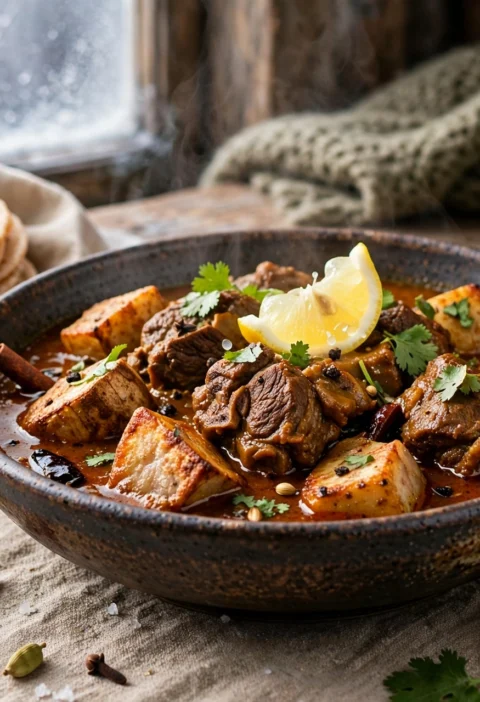
My first kacchi was at a wedding in Old Dhaka, while an ancient baburchi guarded a row of enormous degs like sleeping children. When he cracked the dough seal off one pot with the back of a spoon, the steam that rolled out carried mutton, ghee, saffron and plums in one breath. Nobody talked about the decorations. This kacchi biryani recipe is my long attempt to earn that breath of steam at home — and it hinges on one act of faith: the meat goes into the pot completely raw.
That is what kacchi means — raw, uncooked. The mutton is marinated in spiced yogurt, spread in the pot exactly as it is, and buried under half-cooked basmati, fried potatoes and aloo bukhara. Then the lid is sealed and everything finishes together on dum, in trapped steam. It could not be further from my mutton biryani, where the goat simmers tender inside its masala before any rice comes near it, or from a Sindhi biryani, fiery and tomato-rich, its meat likewise cooked through in its gravy first. Kacchi skips the braise entirely: the marinade does the early work, the steam does the rest, and your job — the hard part — is to not open the pot.
Why This Kacchi Biryani Recipe Works
Cooking raw meat under rice sounds like a gamble, and in careless hands it is one. Dhaka’s wedding cooks have run it for generations, on five load-bearing rules:
- The marinade is given its full time — there is no shortcut version. The mutton never gets a head start in a frying pan, so the marinade does the tenderizing alone. This kacchi biryani recipe gives it six hours at minimum, overnight if you can: yogurt acids loosen the fibers, salt seasons to the bone, and raw papaya paste — the old baburchi’s quiet weapon — dismantles the toughness steam alone cannot fix.
- The meat cooks in its own juices, and nothing is diluted. No water is added to the pot. The mutton steams in its marinade and its own rendered juices, which rise into the rice as pure biryani perfume. A pre-cooked masala has already spent some of that aroma on the kitchen air; this kacchi biryani recipe keeps every bit of it sealed in until serving.
- The rice is parboiled less than usual — barely halfway. Where tender meat waits below, rice boiled to seventy percent finishes in twenty minutes of steam. Here the rice must survive a long dum alongside raw meat, so it leaves the water at fifty percent, still chalky at the core. Those firm hearts are the budget of doneness the long steam will spend, grain by grain.
- The potatoes are fried golden before they go anywhere near the pot. The spuds are the one element that enters pre-cooked: raw potato buried under rice steams up pale and waxy, while a fried one drinks the marinade through its golden crust and arrives burnished and fluffy.
- The seal is the recipe. It is never opened, not even to peek. Every lift of the lid dumps the steam the mutton is counting on and drops the temperature when it can least afford it. The timing keeps the seal shut from the first minute to the table: high heat to build pressure, a long low dum, a rest off the flame, and only then the crack of the dough.
Ingredients
Serves 6
For the raw marinade:
- 2 1/2 lbs (1.1 kg) bone-in mutton (goat), leg and shoulder, cut into 2- to 3-inch pieces
- 2 tablespoons raw papaya paste, skin on (or 1 teaspoon meat tenderizer powder)
- 1 1/2 cups (360g) plain whole-milk yogurt, whisked until completely smooth
- 2 tablespoons ginger-garlic paste
- 1 cup crisp fried onions (birista), lightly crushed, plus more for the layers
- 2 teaspoons red chili powder
- 1 teaspoon turmeric powder
- 2 teaspoons salt
- 1 1/2 teaspoons garam masala
- 1/2 teaspoon ground mace and 1/4 teaspoon grated nutmeg (the Dhaka wedding pair)
- 1 teaspoon sugar
- 1 tablespoon lemon juice
- 1/4 cup mustard oil (or melted ghee, for a gentler perfume)
- 1 teaspoon kewra water
For the rice:
- 3 1/2 cups aged basmati rice (700g), given a rinse and a 30-minute soak
- For the rice water: 2 tablespoons salt, 4 green cardamom pods, 2 bay leaves, 1 cinnamon stick, 1 teaspoon cumin seeds
- 1/3 cup warm milk, with a generous pinch of saffron threads steeped in it
For the layers and the seal:
- 4 medium potatoes (about 1 lb), peeled, halved and fried in oil until deeply golden (a pinch of orange food color in the oil is the wedding touch)
- 10-12 aloo bukhara (dried plums), soaked in warm water for 15 minutes and drained
- 1/2 cup coriander leaves and 1/2 cup mint leaves, roughly torn
- 4-5 fresh green chilies, slit
- 3 tablespoons melted ghee
- 1 teaspoon kewra water and 1 teaspoon rose water
- For the dough seal: 2 cups flour kneaded with about 3/4 cup water to a stiff dough (or foil under a tight, heavy lid)
Two things here deserve an introduction. Kacchi biryani is the signature feast dish of Dhaka, and its identity lives in the aloo bukhara — dried plums that swell in the steam and burst sweet-sour against the rich mutton. Within the wider family of biryani, kacchi is the purist’s argument: no separate curry, no gravy stage, just marination, layering and sealed steam. Dried apricots stand in if plums are scarce — but find the real thing once; they are the accent the dish speaks in.
How to Make This Kacchi Biryani Recipe – Step by Step
Step 1: Marinate the mutton raw, and give it the evening.
Rub the mutton with salt, lemon juice and papaya paste first; rest it 30 minutes while the tenderizer gets to work. Then fold in the yogurt, ginger-garlic paste, crushed birista, all the ground spices, sugar, mustard oil and kewra until every piece wears a thick orange coat. Cover and refrigerate at least 6 hours, overnight if the day allows. Let it lose its fridge chill for 45 minutes before layering — cold meat delays the steam and throws the timing off.
Step 2: Fry the potatoes and parboil the rice to halfway.
Fry the potato halves in hot oil until deeply golden; you are buying color and a sealed surface, not tenderness — they finish in the dum. Lift them out. Meanwhile boil the drained basmati with the rice spices and salt for just 3 to 4 minutes: a pressed grain should bend at the edges but snap chalky-white in the middle. That is fifty percent, earlier than instinct says. Drain at once and spread the rice on a tray so it stops cooking in its own heat.
Step 3: Layer the pot — raw meat first, everything in its order.
Brush the base of your heaviest lidded pot with ghee. Spread the marinated mutton in one even layer with every spoonful of its marinade; that liquid is the only water the pot gets. Tuck the fried potatoes and half the aloo bukhara down among the meat. Blanket everything loosely with the parboiled rice, then scatter the remaining plums, green chilies, herbs and a handful of birista. Finish with stripes of saffron milk, the melted ghee, and the kewra and rose water over the top.
Step 4: Seal it and dum it, without opening, for the full time.
Wind the dough, kneaded into a long snake, around the pot’s rim and settle the lid into it, pressing until the seal holds all the way around — or crimp foil over the top and weight the lid. Set the pot over high heat for 5 minutes, until the lid feels hot and you hear the faintest hiss of building steam. Then drop the flame to its lowest and dum for 1 hour 30 minutes; a tawa under the pot steadies things. Do not lift, tilt, shake or “just check” the pot. Turn the heat off and rest it, still sealed, for 15 minutes more; the mutton finishes in the carry-over steam.
Step 5: Break the seal at the table and serve in folds.
Carry the whole pot to the table — the theatre is part of the dish. Crack the dough seal with a spoon, lift the lid away from your guests so the first cloud of steam escapes upward, and give everyone a second to breathe it in. To serve, slide a wide spoon down the inside wall of the pot and lift portions up from the bottom, so each plate gets mutton from the base, a golden potato, a swollen plum and both white and saffron rice in one fold. Never stir the pot to “mix it evenly”; the layers are the point, and mixing flattens this kacchi biryani recipe into ordinary rice and meat.
Serving Suggestions
In Dhaka, kacchi arrives with borhani — the frothy, spiced yogurt drink built for wedding feasts — cold, tangy and faintly fiery against the rich rice. At home, plain raita and a sharp onion-cucumber salad under lemon juice do the same cooling work. Keep the sides humble; a dish that steamed sealed for two hours has earned the center of the table, and this kacchi biryani recipe asks for nothing louder beside it.
For a proper biryani education, serve the site’s other two mutton pots across the month. My mutton biryani is the Eid classic, its goat simmered tender in masala first and layered second — deeper, darker, more gravy-driven. My Sindhi biryani is the fiery one — tomato tang, green chili heat, meat cooked in its masala before layering. Set either beside a kacchi and the lesson lands: pre-cooked meat gives you control; raw meat, sealed and trusted, gives you a perfume the other two cannot match.
Storage and Reheating
Kacchi keeps beautifully — the rice has already proven it can finish in steam. Cool leftovers quickly, refrigerate sealed for up to 3 days, and warm portions covered, with a spoonful of water flicked over them, until the grains steam again and the mutton is hot to the bone. It also freezes for a good 2 months — let it thaw in the fridge overnight, then reheat it covered, with steam doing the work again. Save a little fresh birista and a squeeze of lemon for serving leftovers, and nobody will guess the pot was opened yesterday.
Frequently Asked Questions
Does the mutton really cook through if it goes in raw?
Yes — completely, and this is the question every kacchi biryani recipe gets asked. Ninety minutes of sealed, steam-saturated heat plus the rest cooks 2- to 3-inch bone-in pieces to tenderness — a slow braise, except the steam cannot escape. What makes it fail is impatience: pieces cut too large, a marinade cut short, a lid lifted mid-dum “to check.” Cut to size, marinate fully, trust the seal.
What can I use if I cannot find raw papaya paste?
Kachri powder is the traditional alternative, and a standard meat tenderizer powder works in the same spirit. With none of the three, extend the marinade to a full 12 hours and buy the youngest mutton you can find — the yogurt alone gets you most of the way there. Never substitute pineapple or kiwi juice; their enzymes are aggressive enough to turn the meat’s surface mushy before the pot is sealed.
Can I make this kacchi biryani recipe with beef or chicken instead?
Beef, yes: use well-marbled bone-in beef, give it the full overnight marinade, and add 15 to 20 minutes to the dum. Chicken kacchi is lovely but plays by different timing — marinate small bone-in pieces just 3 to 4 hours (longer and the yogurt turns the texture woolly), raise the rice to sixty percent, and cut the low dum to about 45 minutes. Treat the chicken version as a cousin rather than a straight swap.
My pot has no dough seal — can I still make it?
Certainly. The dough is tradition and theatre, but its job is simply an airtight seal. Foil crimped tightly over the pot’s mouth, with the lid and something heavy on top, traps steam well enough for home cooking. What you cannot do without is a heavy pot and a low, steady flame — a thin pot scorches the marinade layer during the long dum, and no seal will save the bottom once it catches.
Recipe Summary
- Prep time: 40 minutes (plus 6-12 hours of marinating)
- Cook time: 1 hour 50 minutes (including the sealed rest)
- Total time: About 2 hours 30 minutes, plus the marinade
- Servings: 6
- Cuisine: Pakistani
- Course: Main Course