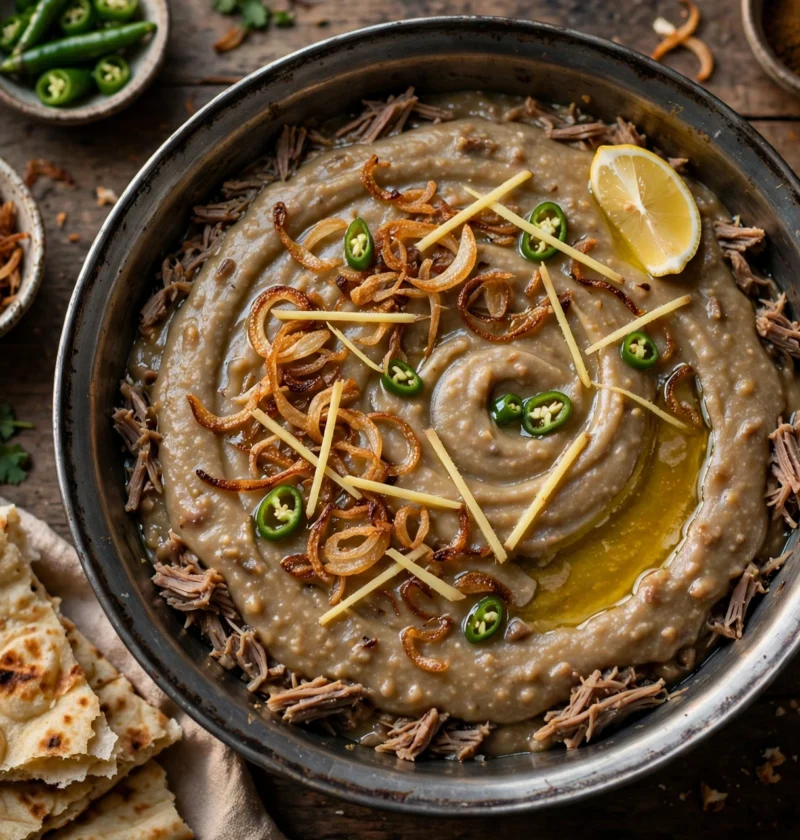
The first time my father let me take a turn at the deg paddle, I lasted maybe four minutes. It was a Muharram night in our mohalla, the big deg sitting over a wood fire at the end of the street, and every household on the lane had sent something down for it — a kilo of wheat here, a bag of lentils there, mutton from the two families who could afford it that year. The men stirred in shifts because nobody’s arms survived a whole hour of it, and my father, handing me the long wooden ghotna with great ceremony, said only: “Don’t let it catch at the bottom.” I was twelve and convinced I was strong. I was not. But I remember the smell rising off that pot — wheat, mutton fat, browned onion — and thinking this was the most important cooking in the world. This mutton haleem recipe is that deg, shrunk to fit a home kitchen, and it still feels important every time I make it.
Mutton is the awkward one of the haleem family, and I say that with love. Cook it carelessly and it stays stringy, sulking in the porridge in long threads that never quite melt in. My first solo attempts were exactly that — grainy and separate, two things refusing to become one dish. What fixed it was learning patience in the right order: the mutton has to completely surrender before it ever meets the grains, falling apart at the touch of a spoon, and the pounding has to happen in stages with rests in between, not in one heroic burst. This mutton haleem recipe is built around those two lessons. It asks for an afternoon. It pays you back for every minute.
Why This Mutton Haleem Recipe Works
Mutton haleem fails in one specific way — meat and grains that never merge. Every choice in this mutton haleem recipe exists to prevent exactly that:
- Bone-in mutton shoulder and neck. These are the working cuts, threaded with fat and connective tissue, and over a long, gentle cook they give up gelatin generously. That gelatin is what makes the finished porridge glossy and spoon-coating rather than thin and soupy. Leg meat works too, but shoulder is the cut my family swears by.
- The grains cook separately, to total collapse, before anything else happens. Wheat and barley are stubborn — they need their own long simmer until they burst and turn to mush. Pre-cooked to surrender, they blend into the meat in under an hour.
- The mutton cooks in its own spiced yakhni until it falls apart. Not tender — falling apart. You should be able to pull it to shreds with the back of a spoon. Only then does it get shredded properly, bones lifted out, and only then does it meet the grains. That order is the whole secret.
- Pounding in stages, with rests. Fifteen minutes with the ghotna, ten minutes of the pot simmering quietly, then back to the paddle. The rests let the starch relax and hydrate, so each round of pounding goes further than the last.
- The finish is sharp against the rich. Mutton fat is generous, so the garnishes have a job to do: shattering birista onions, raw ginger juliennes, green chili heat, a hard squeeze of lemon, and a final spoon of hot ghee poured over at the table. Skip the lemon and the bowl feels heavy by the fifth spoonful. With it, you suddenly want a second helping.
Ingredients
Haleem belongs to a very old family of dishes — the haleem tradition traveled from the Arab world through Persia into the Deccan and up to our cities, picking up local grains and local patience along the way. In our version the backbone grain beside the wheat is barley, the jau our grandmothers insisted on because it melts into a particular creaminess wheat alone can’t give. Most of this list is already sitting in a desi pantry, and most of the work is just soaking and waiting. Everything for this mutton haleem recipe is measured for a home pot that feeds a family with leftovers — which, with haleem, is exactly the point.
Serves 8
Grains and lentils (soak overnight):
- 1 cup whole wheat berries (gandum)
- 1/2 cup pearl barley (jau)
- 1/2 cup split chickpeas (chana daal)
- 1/4 cup red lentils (masoor daal)
- 1/4 cup yellow moong lentils (moong daal)
- 2 tablespoons white urad daal (mash daal) — this is the silk-maker
For the mutton:
- 2 pounds bone-in mutton shoulder or neck, cut into 2-inch pieces (ask the butcher for haleem cut)
- 2 large onions, finely sliced
- 2 tablespoons ginger-garlic paste
- 1 1/2 teaspoons red chili powder
- 1 teaspoon turmeric powder
- 1 tablespoon coriander powder
- 1 teaspoon cumin powder
- 1 1/2 teaspoons garam masala, divided
- 2 teaspoons salt, plus more to finish
- 1/2 cup oil or ghee
- 3 bay leaves
- 4 green cardamoms
- 1 black cardamom
- 1 cinnamon stick (about 2 inches)
- 6 cloves
- 8 cups water for the grains, plus 4 cups for the mutton (hot, as needed)
To finish and serve:
- 2 large onions, sliced thin and fried crisp and golden (birista)
- 1/4 cup ghee, melted and hot, for the final pour-over
- a 2-inch piece of fresh ginger, cut into fine juliennes
- 4 to 5 green chilies, sliced
- 1/2 cup fresh coriander, chopped
- 2 lemons, cut into wedges
- 1 teaspoon chaat masala, for dusting
How to Make This Mutton Haleem Recipe – Step by Step
Step 1: Soak everything the night before. Rinse the wheat, barley, and all four lentils until the water runs mostly clear, then soak them together in a big bowl under plenty of water for 10 to 12 hours. If a few wheat berries float, skim them off. This mutton haleem recipe genuinely begins the night before, and there’s no honest shortcut around the soak; unsoaked barley will still be chewing back at you after three hours of cooking.
Step 2: Cook the grains down to a soft, bursting mush. Drain the soaked grains and put them in your heaviest pot with 8 cups of fresh water and 1 teaspoon of the salt. Bring to a boil, skim the foam, then settle into a gentle simmer for 1 1/2 to 2 hours, stirring now and then so nothing parks on the bottom. The wheat should squash flat between finger and thumb, and the barley should be burst open and creamy. Mash the whole pot roughly with a potato masher and set it aside. It will look like unpromising beige porridge — exactly right.
Step 3: Cook the mutton until it completely gives up. In a second large pot, heat the oil and fry the sliced onions until deep golden, 10 to 12 minutes. Add the ginger-garlic paste and the whole spices; fry a minute until the raw smell is gone. Add the mutton and sear over medium-high heat for 8 to 10 minutes, until the pieces are well browned and the oil begins to separate. Stir in the chili, turmeric, coriander, cumin, half the garam masala, and the remaining salt. Pour in 4 cups of hot water, cover, and simmer on the lowest heat for 1 1/2 hours, until the meat is collapsing off the bones. Lift out the bones and any large whole spices, shred the mutton thoroughly with two forks, and return every shred to its gravy.
Step 4: Marry the two pots and pound in stages. Tip the mashed grains into the mutton pot, stir well, and bring everything back to a bare simmer. Now the ghotna work: pound and stir vigorously for 15 minutes, rest the pot for 10, then go again. Repeat for about 45 minutes to an hour in total, loosening with splashes of hot water whenever it gets too thick to move — you want a slow, lava-like consistency that holds the mark of the spoon. In the last 10 minutes, stir in the remaining garam masala and taste properly: it needs confident salt and a warmth of chili that builds rather than bites.
Step 5: The ghee finish, and straight to the table. Ladle the haleem into a wide serving dish — a degchi if you have one, for the feeling of it. Scatter the birista generously over the top, then the ginger juliennes, green chilies, and coriander. Dust with chaat masala, set lemon wedges around the edge, and at the table pour the hot melted ghee over the top so it pools in the swirls. Serve immediately with naan.
Serving Suggestions
Serve this the way it was served on our street: communally, from the pot, with everyone dressing their own bowl. Some people load the birista, some drown it in lemon, my uncle adds extra green chilies until his forehead shines — all correct. Naan is the traditional partner, though a spoon does most of the work. Set the garnishes out in small bowls and let the table do what it wants; haleem has always been a participatory dish.
If your family argues about haleem the way mine does, cook the relatives too and hold a tasting. The beef haleem is the dark, deep, heavyweight version, the one for people who like their porridge intense — while the chicken haleem is lighter, paler, and quicker, the weeknight-friendly sibling. Mutton sits between them in richness but ahead of both, I’d argue, in character: sweeter fat, more perfume, more of that old deg flavor. Cook all three across a winter and your family will have opinions until spring.
Storage and Reheating
Haleem keeps beautifully — it may be the friendliest leftovers dish in our whole cuisine. Refrigerated in a sealed container it holds for 4 days, and frozen, in portions, for up to 2 months. It will set almost solid in the fridge; don’t panic, that’s the gelatin doing its job. Bring it back on the gentlest flame you have, stirring a little water through as it warms until it loosens into that slow pour again, and keep the spoon moving so the base doesn’t catch. Never boil it hard. And always — always — garnish fresh after reheating: yesterday’s birista on today’s bowl is the one shortcut that actually shows.
Frequently Asked Questions
My mutton haleem came out stringy and the grains never blended in. What happened?
Almost always, the mutton wasn’t cooked long enough before the two pots met. If the meat isn’t collapsing and shredding easily with a fork, the fibers survive the pounding and stay stringy. Next time give the mutton its full 1 1/2 hours — or longer — and shred it completely before combining. Pounding blends shreds and grains; it can’t rescue chunks that were never tender.
Can I make this mutton haleem recipe with boneless mutton?
You can — boneless leg or shoulder works and saves the bone-picking step. But you’ll lose some body, because the bones quietly contribute gelatin and depth during the long simmer. If you go boneless, cut the pieces a little bigger so they don’t dry out, and stir an extra tablespoon of ghee through at the end to make up the richness. The result is very good; the bone-in version is just better.
Can I use a pressure cooker or Instant Pot?
Yes, for the components — it’s how I do it on busy weeks. The soaked grains take about 25 minutes at high pressure, and the mutton about 35 to 40 minutes, both with natural release. But do the combining and pounding in an open pot on the stove. You need to see the texture, adjust the water, and work the ghotna properly, and none of that happens behind a sealed lid.
My mutton smells a bit gamey. How do I calm that down?
Start at the butcher: fresh mutton shouldn’t smell strong at all, so a powerful smell means it sat around. At home, rinse the pieces, rub them with a spoon of flour or a splash of vinegar, rest 15 minutes, and rinse again before cooking. Browning the meat hard in Step 3 and not skimping on the ginger-garlic paste also tames it a great deal. Properly cooked, the gaminess becomes the gentle sweetness mutton lovers are actually chasing.
Recipe Summary
- Prep time: 30 minutes (plus overnight soaking)
- Cook time: 4 hours 30 minutes
- Total time: About 5 hours (plus soaking)
- Servings: 8
- Cuisine: Pakistani
- Course: Main Course