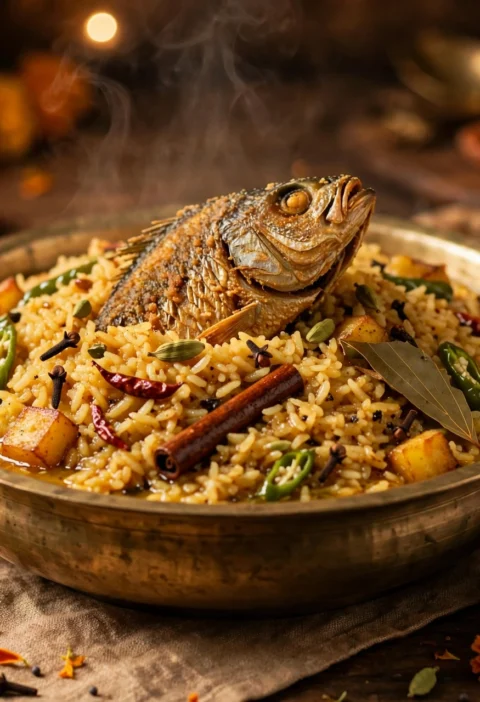
There was a fish my grandmother refused to let anyone else cook. Kajoli came home from the river market in a small bundle of banana leaf, a dozen or so tiny silver fish no longer than my finger, and the kitchen door stayed shut until she emerged with a shallow plate held high like an offering. The gravy — if you can call a spoonful of fire a gravy — was the colour of marigolds and smelled the way a cleared throat feels: mustard, first and last. This kajoli macher jhal recipe is the one she guarded, and it took me three burnt, bitter failures to learn what she had always known — with a fish this small and a paste this fierce, everything depends on gentleness.
Let me say plainly what a jhal is, because it is not a jhol. A jhol is a broth; a jhal is a mood. It is built on freshly ground mustard seed, sharpened with green chillies, and it clings rather than pours — just enough sauce to gloss each fish and leave the rice beneath it stained gold. Kajoli is the perfect fish for it precisely because it is so fragile: soft-fleshed, fine-boned, sweet in a quiet way that a loud paste could easily erase. The trick of this dish is balance — a mustard gravy bold enough to announce itself, cooked briefly enough that the little fish still gets the final word.
Why This Kajoli Macher Jhal Recipe Works
A tiny fish in a mustard gravy leaves almost no room for error, and every disappointing plate I have eaten — including two of my own — broke one of these five rules. This kajoli macher jhal recipe is written around keeping them:
- The mustard is soaked first, then ground with a green chilli and salt. The soak softens the seed’s harsh edge, and short grinding bursts with splashes of water keep the paste sweet-pungent instead of bitter — a paste ground hot and dry is ruined before the pan is even on.
- The fish is fried for seconds, not minutes — or not at all. Kajoli tears if you look at it firmly. Thirty seconds a side in hot mustard oil sets the skin so the pieces survive the gravy; on the freshest fish, many cooks skip the fry and slide them in raw.
- The mustard paste never boils hard. This is the golden rule of every jhal. The paste goes into warm gravy off a rolling boil and simmers at a murmur for two or three minutes at most. Boil it and the mustard turns bitter and splits.
- There is barely any gravy, and that is deliberate. A cup of water, no more. A jhal should coat, cling and shine; flood the pan and you have an assertive soup with the little fish lost inside it.
- Raw mustard oil and slit chillies finish it, off the heat. A teaspoon of oil from the bottle and chillies laid on top restore the fresh, nose-opening perfume that cooking softens.
Ingredients
The fish needs a word first. Kajoli — also sold as kajuli or kajli in some markets — is a small river fish of the Bengali cuisine heartland, caught in Bengal’s great rivers and beels and prized out of all proportion to its size. Its flesh is soft, almost translucent, its bones fine enough to eat, and it spoils faster than nearly any fish I know — buy it the morning you cook it, bright-eyed and smelling of clean river water. The paste comes from the mustard seed — black or dark brown for a true jhal, and fresh: old mustard seed is bitter seed, and no technique rescues it. Everything else is nigella, tomato, chillies and oil — a short list for a very loud plate.
Serves 4
For the fish:
- 1 pound whole kajoli fish (about 12 to 16 tiny fish), cleaned and gutted, heads on or trimmed as you prefer
- 1/2 teaspoon ground turmeric
- 1/2 teaspoon fine salt
- 3 tablespoons mustard oil, for the brief fry
For the mustard paste:
- 2 tablespoons black mustard seeds
- 1 fresh green chilli
- 1/4 teaspoon fine salt
- 3 to 4 tablespoons warm water, for grinding, plus more for soaking
For the jhal gravy:
- 2 tablespoons mustard oil (the fish’s frying oil, strained, is traditional)
- 1/2 teaspoon nigella seeds (kalonji / kalo jeere)
- 1 small tomato, finely chopped (about 1/2 cup)
- 1/2 teaspoon ground turmeric
- About 1 cup hot water
- 1/2 teaspoon sugar, to round the mustard
- Fine salt, about 3/4 teaspoon, or to taste
- 4 fresh green chillies, slit lengthwise
- 1 teaspoon raw mustard oil, for finishing
- Fresh cilantro leaves, to serve (optional)
How to Make This Kajoli Macher Jhal Recipe – Step by Step
Step 1: Soak the mustard seeds, then grind them silky. Cover the mustard seeds with warm water and soak 30 minutes — this is where the bitterness gets talked down. Drain, then grind them with the green chilli, salt and 3 to 4 tablespoons of warm water, in a small blender or on a stone if you have one. Work in short pulses of a few seconds, stopping to splash in a little more water whenever the paste looks dry; friction heat is bitterness in the making. You want a pourable, pale-gold cream that ribbons off the spoon. Let it stand 10 minutes; do not strain it — a jhal keeps its texture.
Step 2: Marinate the kajoli and fry it for a breath. Rinse the fish once, gently — they bruise like plums — drain them a few minutes and pat dry with a soft hand. Toss carefully with the turmeric and salt; rest 10 minutes. Pour the mustard oil into your widest pan, set it over medium-high heat, and wait until the surface shimmers and the raw, peppery bite in its smell has softened — around 350°F. Lay the fish in one at a time and give them just 30 seconds a side — no crust, no colour to speak of, only a skin that has set enough to hold. Lift them out onto a plate in a single layer with a thin spatula. Impeccably fresh fish may skip the fry entirely; give them a minute longer in the gravy instead.
Step 3: Build the thin tomato base. Return all but 2 tablespoons of the strained oil to the pan over medium heat. Scatter in the nigella seeds and listen for their peppery crackle, about 20 seconds. Add the chopped tomato with a pinch of the salt and cook it down for 3 to 4 minutes, pressing it with the spoon until it softens into a loose, brick-red mush and the oil begins to bead at the edges. Stir in the turmeric, then pour in the hot water and let the pan come up to a gentle simmer — this thin, reddish broth is the river the mustard is about to swim in.
Step 4: Swear in the mustard — gently, and off the boil. This is the step the dish hangs on: lower the heat until the broth is barely moving, its surface steaming but still. Whisk the rested mustard paste once, then stir it into the pan along with the sugar and the remaining salt. Let it murmur — never boil — for 2 minutes while the raw sting of the mustard cooks into warmth, the gravy turning a deep, glossy gold, thick enough to veil the back of a spoon. Taste it now — it should be pungent and alive, blooming up through your nose. If it tastes sharp-edged rather than warm, another half teaspoon of sugar rounds it without sweetening it.
Step 5: Slide the fish home, rest the pan, finish raw. At the gravy’s barest simmer, lay the fried kajoli in one by one, spooning sauce over each as it lands. Give them 2 to 3 minutes — 3 to 4 if they went in raw — without stirring; swirl the pan once, gently, the way you would settle a sleeping child. Take the pan off the heat. Lay the slit green chillies across the top, drizzle over the teaspoon of raw mustard oil, scatter the cilantro if you are using it, and cover the pan for 5 minutes. In that sealed rest, the fish drinks the paste in and the perfume gathers.
Serving Suggestions
There is one correct plate for this dish, and it is a mound of plain, hot, steamed rice — nothing perfumed, nothing fried — with the fish laid over it and the mustard gravy spooned across so it runs down into the grains. Eat it with your fingers if you can; kajoli bones are soft enough that most simply vanish, and the ones that do not give you fair warning. A lemon wedge on the side and a raw green chilli for the brave, and the plate wants nothing else. Serve it at lunch, the day it is made — a jhal is midday food, sharp enough to wake the whole afternoon up.
It sits at the fiery end of a family I cook from all year. My pabda jhal is its closest relative — the same mustard logic with a bigger, butter-soft fish with more body, the one I make when kajoli cannot be found. For the same small-fish pleasure in a different key, my tangra macher jhol wraps little catfish in a thin cumin-ginger broth that soothes where this kajoli macher jhal recipe provokes. One fish for comfort, one for fire — a Bengali kitchen keeps both doors open.
Storage and Reheating
This is a cook-it, eat-it dish, at its best within the hour, because a mustard gravy sharpens as it sits and a fish this delicate does not forgive a second day. If life intervenes, the remains will hold a day in the fridge, sealed in a lidded box, and they are still good — the flavour deepens even as the fish softens a shade. I never freeze it; the paste turns woody and the little bodies fall apart on thawing.
To reheat, tip everything into a wide pan, add a spoonful of water at the edge, cover it, and warm it over the lowest flame for 3 to 4 minutes, only until the gravy steams — bring it anywhere near a boil and the mustard will punish you with bitterness. Do not stir; tilt the pan to move the gravy around. A fresh drizzle of raw mustard oil and a slit chilli on top once it is warm will persuade everyone, briefly, that it was made an hour ago.
Frequently Asked Questions
I cannot find kajoli. What fish can I use instead?
Reach for any small, soft-fleshed river fish. Pabda is the classic stand-in and loves a mustard jhal; small tangra, little mola or puti fish, and even modest smelt all work with the same paste and timing. Thin fillets of mild white fish, cut small, are the supermarket answer. Avoid big, oily, strong-tasting fish — the gravy is fierce enough on its own, and the charm here is delicate flesh under loud spice.
Why did my mustard paste turn bitter?
Mustard turns bitter for three usual reasons: the seeds were ground dry or ground so long the paste heated up, the paste was boiled once it hit the pan, or the seeds themselves were old. Soak the seeds first, grind wet in short pulses with salt and a green chilli, and keep the finished gravy at a murmur for two minutes at most. A pinch of sugar and the tomato in the base are your insurance — they cushion the paste’s edge without hiding it.
Should the kajoli be fried first, or can it go into the gravy raw?
Both ways are honestly Bengali, and the choice is about freshness and confidence. A thirty-second fry sets the skin and makes the fish far easier to handle, which is why I recommend it to first-timers. When the fish is glitteringly fresh, though, the raw method is lovelier — the flesh stays silkier and drinks the mustard deeper. Add one extra minute of simmering and move the pan even less than usual.
Can I make this kajoli macher jhal recipe with yellow mustard or store-bought paste?
You can, with expectations adjusted. Yellow mustard seed grinds milder and gentler — the jhal will be softer and rounder. Ready mustard paste or a strong kasundi can stand in — about 3 tablespoons, stirred in at the same off-the-boil moment — but read the label: many carry vinegar and preservatives that bend the flavour. Freshly ground black mustard remains the dish’s beating heart.
Recipe Summary
- Prep time: 15 minutes, plus 30 minutes soaking the mustard seeds
- Cook time: About 15 minutes
- Total time: Roughly 1 hour
- Servings: 4
- Cuisine: Pakistani
- Course: Main Course