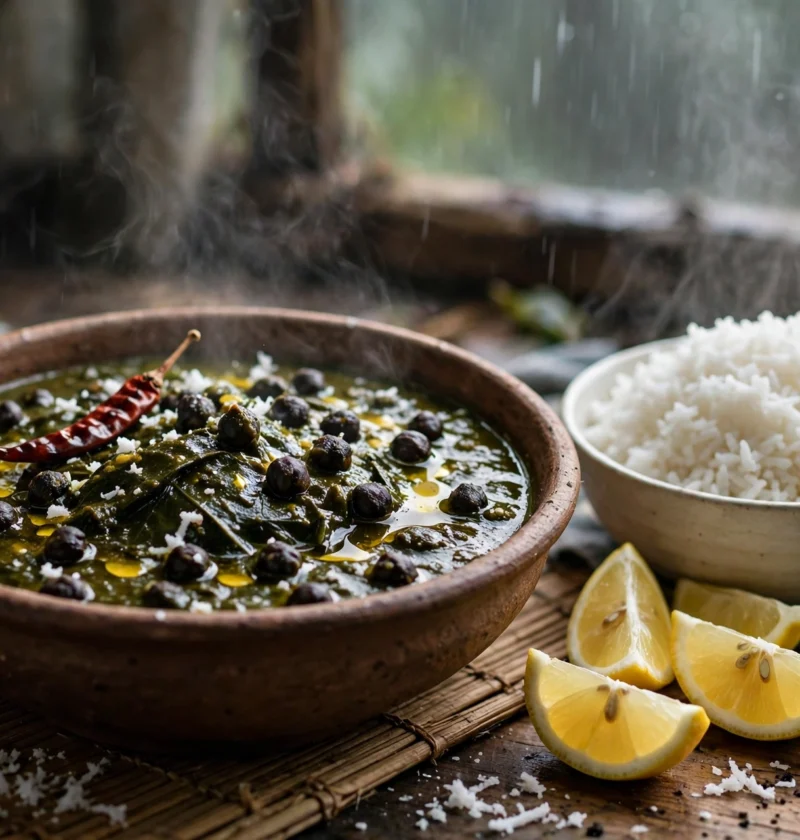
The kochu shak of my childhood arrived with the first heavy monsoon rain, when the taro plants behind my grandmother’s house stood taller than I did and their leaves shed water like green umbrellas. She would send me out with a knife almost too big for my hands and one strict instruction: cut only the young, tender leaves, the ones still curled at the edges. Back in the kitchen the bundle went into her oldest, blackest pot, and there it stayed for the better part of an hour while she repeated the rule every Bengali child hears — kochu is never, ever eaten half-cooked. This kochu shak recipe is hers, the way I finally wrote it down: silky, dark, earthy, with coconut melting through it and black chickpeas hiding in every spoonful.
Shak is the Bengali word for leafy greens, and kochu shak is the monsoon queen of them all — the leaves and tender stems of the taro plant, shredded fine and cooked down until they surrender completely into a soft, almost creamy mass. It is a rustic dish, village food, the kind cooked without onion or garlic in most homes, leaning instead on mustard oil, whole spices and patience. Raw taro leaves carry a sharp itch from naturally occurring crystals, but an unhurried cook and a squeeze of something sour melt that away entirely, leaving only the deep, spinach-dark flavour the leaves are loved for. Serve it in the rains, with plain rice, and it tastes like the season itself.
Why This Kochu Shak Recipe Works
Taro leaves frighten many cooks — the itching throat stories are real — but this kochu shak recipe removes every bit of the risk with five habits my grandmother treated as law:
- Only young, tender leaves go in the pot. Old, fully opened leaves are tougher, more fibrous and noticeably sharper. Choose leaves that are still partly furled, bright green and unblemished, and the finished curry turns out silkier.
- The leaves are shredded fine and the thick veins removed. Tough central ribs never soften properly, so they come out before cooking. Thin ribbons collapse evenly into the curry, while chunky pieces stay stringy no matter how long the pot simmers.
- A long, slow cook does the real work. Forty-five minutes to an hour of steady simmering is non-negotiable — this is what dissolves the itch-causing crystals completely and transforms a basket of raw leaves into a dark, spoonable, almost buttery curry.
- Something sour goes in near the end. A spoonful of lemon juice (or a little tamarind) is the old insurance policy: the acid helps neutralise any remaining sharpness and brightens the earthy leaves so the dish never tastes heavy or flat.
- Coconut and black chickpeas give it body. Plain cooked greens can feel thin. Grated coconut melts into the leaves with a gentle sweetness, and the firm, nutty chickpeas give every mouthful substance — together they turn a humble pot of greens into a complete dish.
Ingredients
Everything begins with the taro plant itself — kochu in Bengali — whose big heart-shaped leaves and pale stems are the whole point of this dish. In the US, look for taro (colocasia) leaves at South Asian and Southeast Asian grocers, sold in bundles or frozen; buy more than you think you need, because the leaves cook down dramatically, a mountain shrinking into a modest pot. The second pillar is fresh coconut, grated fine so it disappears into the greens; frozen grated coconut, thawed, is an honest stand-in. Black chickpeas (kala chana) should be soaked overnight, though canned ones work in a pinch. Beyond that, this kochu shak recipe asks only for mustard oil, a few whole spices, ginger and lemon — a short list for a dish with such a long memory.
Serves 6
For the leaves and chickpeas:
- 1 large bunch fresh taro leaves with tender stems (kochu pata), about 1 1/2 pounds
- 1 1/4 cups canned black chickpeas, rinsed and drained — or 1/2 cup dried, soaked in water overnight
- 1 teaspoon fine salt, divided
- 1 cup water, for the first boil
For the tempering and curry:
- 2 tablespoons mustard oil (or a neutral oil for a gentler result)
- 1 teaspoon panch phoron (or cumin seeds)
- 1 bay leaf
- 2 whole dried red chillies, snapped in two
- 1 tablespoon fresh ginger, grated fine
- 1/2 teaspoon ground turmeric
- 1 teaspoon ground cumin
- 3/4 teaspoon fine salt, or to taste
- 1 teaspoon sugar
- 2 green chillies, slit lengthways
- 1/2 cup finely grated coconut, fresh or thawed from frozen
To finish:
- 1 tablespoon lemon juice (or 1 teaspoon tamarind pulp)
- 1 teaspoon ghee (optional, but lovely)
- 1/4 teaspoon garam masala
How to Make This Kochu Shak Recipe – Step by Step
Step 1: Clean, trim and shred the leaves. Work at the sink and take your time — good prep is half this dish. Wash the leaves and stems thoroughly in several changes of water, because monsoon greens carry grit. Strip away the thick central rib from each leaf with a small knife (a few people find the raw sap mildly irritating on skin, so rub a little oil on your hands first if yours is sensitive, and never taste the leaves raw). Roll a stack of leaves into a tight cigar and slice crosswise into thin ribbons, about 1/4 inch wide. Peel the fibrous outer skin from the tender stems and chop them into 1-inch pieces. Drain the soaked chickpeas.
Step 2: Cook the chickpeas and give the leaves their first boil. Put the drained black chickpeas in a pot with fresh water to cover by two inches and half the salt. Simmer for about 40 minutes, until one chickpea mashes readily when pinched between finger and thumb yet still holds together; drain, saving the cooking liquid. (Canned chickpeas simply get drained and rinsed.) Meanwhile, tip the shredded leaves and chopped stems into a large pot with the cup of water and a pinch of salt, cover, and cook over medium heat for 15 minutes. The leaves will wilt, turn a deep army green and release a surprising amount of liquid — that is exactly right. Drain them lightly and press out a little of the bitter first water with the back of a spoon; this first boil is the beginning of the itch leaving for good.
Step 3: Bloom the tempering and fry the ginger. Wipe out the pot or take a heavy kadai and warm the mustard oil over medium-high heat until a faint wisp rises and the raw, nose-tickling sharpness softens. Add the bay leaf, dried red chillies and panch phoron, and let the seeds crackle and turn fragrant for about 30 seconds. Add the grated ginger and fry for a minute, stirring, until the sharp raw smell cooks off. Sprinkle in the turmeric and ground cumin with a spoonful of water so the powders bloom instead of scorching, and stir for a few seconds into a rust-coloured base.
Step 4: Add the leaves and cook them down, slowly. Slide the boiled leaves and stems into the tempered oil along with any liquid clinging to them. Add the salt and sugar, stir everything through, and lower the heat. Now comes the part that cannot be rushed: cook for 30 to 35 minutes, stirring every five minutes or so and mashing the leaves against the side of the pot with your spoon as they soften. Splash in chickpea cooking liquid whenever the pot looks dry. Slowly the ribbons will break down into a dark, glossy, almost homogeneous mass that pulls away from the sides — soft enough to spread, with no pieces that resist the spoon.
Step 5: Bring in the chickpeas and coconut, then finish with lemon. Fold the cooked black chickpeas, grated coconut and slit green chillies into the leaves. Simmer together for a final 8 to 10 minutes, so the chickpeas take on the curry’s flavour and the coconut melts in rather than sitting on top. Take the pot off the heat and stir through the lemon juice, the ghee if using, and the garam masala — the sour finish is the last guarantee of a completely itch-free dish, and it wakes the whole pot up. Taste for salt and sweetness, rest the shak covered for 10 minutes, and serve warm. In that short rest the curry settles, thickens slightly, and tastes unmistakably of the rains.
Serving Suggestions
This kochu shak recipe belongs over plain steamed rice, eaten the Bengali way — a generous spoonful mashed lightly into the rice with your fingers, a piece of green chilli crushed in for heat, and nothing flavoured or fried to distract from its deep, quiet earthiness. It is traditionally an early course in the meal, the greens arriving before the fish and the richer curries, and a small bowl of thin masoor dal alongside is the only company it really asks for.
For a full niramish spread, build the plate the way my grandmother did. Begin with shukto, the bittersweet medley of vegetables that opens a proper Bengali lunch and sharpens the appetite, then bring out this shak beside kumror chokka — pumpkin gone sweet and honeyed with its own chickpeas and coconut — and you have two monsoon vegetables telling two very different stories: one dark, dense and earthy, the other golden and gentle. Add hot rice, a wedge of lemon for each plate, and a mishti doi at the end, and nobody will believe the whole meal came from leaves and a pumpkin patch.
Storage and Reheating
Covered and refrigerated, leftovers from this kochu shak recipe stay fresh for 3 days, and like most slow-cooked greens they taste rounder on the second day, once the mustard oil and coconut have settled right through the leaves. It also freezes better than most leafy curries — up to a month in a sealed box — though the chickpeas soften a little after thawing.
To reheat, tip the shak into a pan with a spoonful or two of water, cover, and warm it over the lowest flame for 6 to 8 minutes, stirring now and then, until it steams and loosens back to its silky self. A fresh squeeze of lemon and a few drops of raw mustard oil stirred through at the end bring back the just-cooked brightness. The microwave works too, in short bursts with one stir halfway.
Frequently Asked Questions
Why does my throat itch after eating taro leaves?
That prickly, scratchy feeling means the leaves were undercooked — taro leaves contain tiny needle-shaped crystals that only a thorough cook destroys. Simmer the full time given here, and never serve them even slightly firm. The lemon juice finish in this kochu shak recipe helps too. If a finished batch still bites, return it to the pot with a splash of water and another 10 minutes of cooking, plus a little more lemon; it almost always settles.
Where can I buy taro leaves in the US, and what if I cannot find them?
Fresh taro (colocasia) leaves appear in summer at South Asian, Bangladeshi and Southeast Asian grocers, often labelled kochu pata or patra leaves, and frozen leaves are sold year-round in the same shops. There is no perfect substitute, because the flavour is singular, but a patient cook can use mature spinach or chard: shred it, cook it down just as long, and use the same tempering, coconut and chickpeas — the result is a fine green shak, if a different one.
Can I make this kochu shak recipe without chickpeas or coconut?
You can — plenty of village versions are nothing but leaves, tempering and time — but the curry will be thinner and less rounded, so add a small peeled potato, cut tiny, to give it body as it cooks down. The coconut, though, is worth keeping if you possibly can: its faint sweetness is what balances the leaves’ earthiness, and frozen grated coconut does the job well.
Do I need to wear gloves when handling raw taro leaves?
Most people handle them bare-handed without any trouble, but sensitive skin can tingle from the raw sap, so rubbing a little mustard or cooking oil over your hands before you start is the traditional precaution, and washing them well afterwards is enough. What is not optional is this: raw or undercooked taro leaves should never be tasted, not even a nibble to test seasoning — season the dish only after its long, full cook.
Recipe Summary
- Prep time: 30 minutes, plus overnight soaking for the chickpeas
- Cook time: 1 hour
- Total time: About 1 hour 30 minutes, plus resting
- Servings: 6
- Cuisine: Pakistani
- Course: Main Course