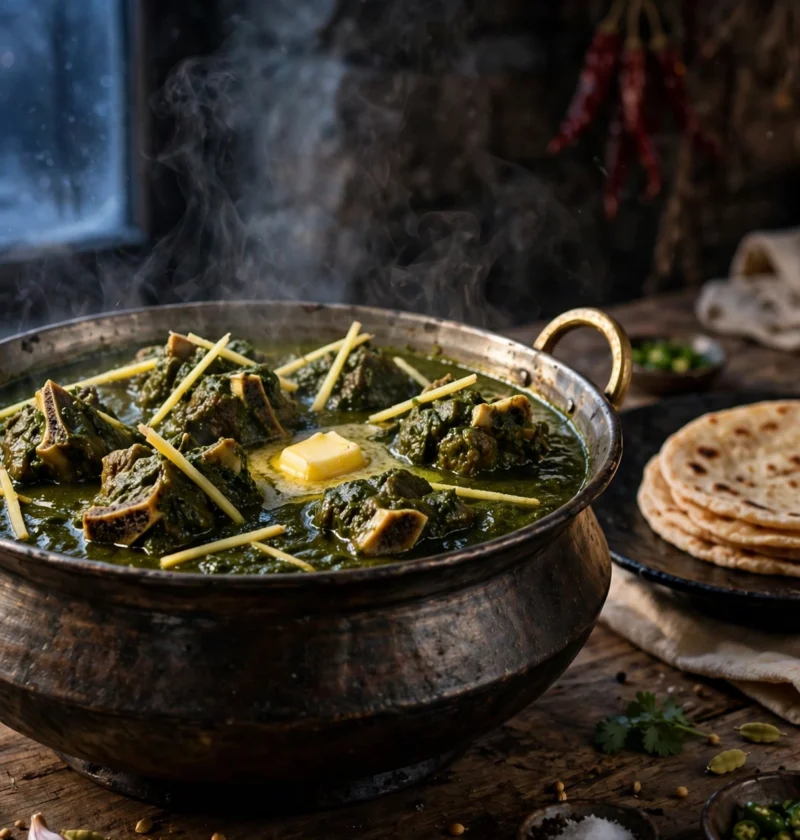
Every winter, when the sabzi cart came down our street piled high with spinach, my mother would buy an unreasonable amount, and half of it was always destined for this palak gosht recipe. The mutton went on the stove right after breakfast — gosht was never rushed in her kitchen — and the spinach sat in a basin of water on the floor, waiting for its cue. Which, in a way, it was. Her rule, repeated every time: “Palak sab se akhir mein.” Spinach goes in last of all.
It took me years to understand why that order matters so much. Mutton needs a long, patient braise to turn tender; spinach needs about ten minutes before it surrenders its color and its temper. Cook them together from the start and you get meat floating in a khaki, faintly bitter stew. Cook them in the right sequence — meat first, fully, spinach at the end, briefly — and the gravy stays a deep forest green and the gosht carries it like it was always meant to. The only real argument in our house was the finish: my father insisted a spoon of cream belonged in it, my mother called that restaurant nonsense. I serve the pot plain now and put the cream on the table, and let everyone fight their own battle.
Why This Palak Gosht Recipe Works
Two ingredients with opposite needs share one pot here, and nearly every failed version traces back to ignoring that. This palak gosht recipe is sequenced around it:
- The meat is completely tender before spinach appears. Not nearly tender — completely. Once the greens go in, the pot gets only a short finish, so there is no rescue time left for chewy gosht.
- The spinach is cooked down alone first. Wilting it in its own pan drives off the raw, grassy edge and lets you squeeze out the flood of water spinach releases, so the gravy stays thick.
- A properly browned onion masala carries the whole dish. There is no tomato-heavy gravy to hide behind; the sweetness comes from onions taken to a deep amber, and that base makes the spinach taste rich instead of worthy.
- Yogurt goes in off the boil, in spoonfuls. Added patiently, a spoonful at a time, it melts into the gravy and rounds everything out. Dumped in cold over high heat, it splits and grains the sauce.
- The lid stays off after the spinach joins. Trapped steam is what drags bright greens down to olive and khaki. Ten uncovered minutes and the color holds at a dark, handsome green.
Ingredients for This Palak Gosht Recipe
Greens cooked this way belong to a wide family here — saag in its many regional forms is the famous cousin — but palak gosht keeps its focus narrow: just spinach, no mustard leaves, no bathua, nothing competing with the meat. Buy spinach with sturdy, dark leaves rather than the pale baby kind sold for salads; mature bunches stand up to the masala and taste like something. For the gosht, take bone-in pieces from the shoulder or leg — the bones flavor the gravy as it braises, and the meat stays juicier than boneless cubes. Ask the butcher for pieces of roughly two inches; uneven sizes mean half the pot is tender and half is still arguing.
For the mutton and its masala
- 2 pounds (900 g) bone-in mutton (goat), cut into roughly 2-inch pieces
- 1/4 cup ghee or neutral oil
- 2 large onions (about 1 pound / 450 g), thinly sliced
- 1 bay leaf, 4 green cardamom pods, 1 black cardamom pod, a 1-inch piece of cinnamon, and 4 whole cloves
- 1 1/2 tablespoons ginger-garlic paste
- 2 medium tomatoes (about 12 ounces / 340 g), finely chopped
- 1/2 cup (120 g) plain whole-milk yogurt, at room temperature, whisked until smooth
- 1 teaspoon red chili powder
- 1/2 teaspoon ground turmeric
- 2 teaspoons ground coriander
- 1 1/2 teaspoons fine sea salt, plus more to taste
- 1 to 1 1/2 cups water, as needed for braising
For the spinach and the finish
- 1 1/2 pounds (680 g) fresh spinach, tough stems trimmed — about 12 packed cups of leaves
- 2 or 3 fresh green chilies, slit
- 1 teaspoon garam masala
- 1 tablespoon butter or ghee
- 2 tablespoons heavy cream (optional — see the family debate above)
- Julienned fresh ginger and lemon wedges, for serving
How to Make This Palak Gosht Recipe – Step by Step
Step 1: Brown the onions and wake the whole spices. Heat the ghee in a heavy pot over medium-high heat. Tip the sliced onions into the hot ghee with a pinch of salt and cook, stirring often, until they reach a deep, even amber — allow a good 12 to 15 minutes for this, and do not rush it toward pale gold. Drop in the bay leaf, both cardamoms, cinnamon, and cloves for the last minute so they perfume the fat. Stir in the ginger-garlic paste and fry until the raw smell leaves, about a minute more. Pale onions now mean a flat gravy later, no matter what you add — this base is the flavor floor of the dish.
Step 2: Sear the mutton, build the masala, and braise it tender. Add the mutton pieces and fry over high heat for 6 to 8 minutes, letting them catch color at the edges instead of steaming in their own juice. Add the tomatoes, chili powder, turmeric, coriander, and remaining salt, and cook — bhunao, as my mother would say — until the tomatoes collapse and oil beads at the sides, about 8 minutes. Lower the heat right down, then work the yogurt in gradually — a spoonful, stir, another spoonful — until it has all melted into the masala, and pour in the water. Now braise low and slow: lid on, the barest simmer, 1 1/2 to 2 hours in a regular pot, until a piece of meat yields easily when pressed with a spoon. (Pressure cooker timings are in the FAQs.) Do not shortcut this stage; there is no fixing it later.
Step 3: Cook the spinach down on its own. While the meat braises, put the washed spinach in a wide, dry pan over medium heat, with nothing else. It will slump within minutes and release a surprising amount of green water; keep cooking, stirring, until fully wilted and the sharp raw smell softens, about 5 minutes total. Tip it into a colander, press out as much liquid as you can with a spoon’s back, and chop it coarsely. Some families blend the spinach to silk; I prefer it chopped, so the gravy has texture and the meat stays the event. Reserve the pressed-out spinach liquor in case the pot needs loosening.
Step 4: Bring meat and spinach together — briefly, lid off. When the mutton is fully tender and its gravy has thickened, fold in the chopped spinach and the slit green chilies. Cook, uncovered, over medium heat for a short 8 to 10 minutes, until the spinach and masala are one dark, glossy gravy that coats the meat. Add the reserved spinach liquor only if the pot looks dry. This short meeting is the whole secret of a palak gosht recipe that stays green: long enough for the flavors to marry, far too short for the color to die.
Step 5: Finish, rest, and settle the cream question yourself. Scatter the garam masala over the top and drop in the butter or ghee, letting it melt into a shine. Taste for salt — spinach drinks seasoning, so it almost always wants a little more. Rest the pot off the heat for 10 minutes; the gravy settles and the meat relaxes. Serve with ginger juliennes over the top and lemon wedges alongside. If you are in my father’s camp, swirl the cream through your own bowl. If you are in my mother’s, you will say nothing and simply not reach for it.
Serving Suggestions
This is a roti dish in our house — plain tawa rotis or chapatis, torn and used to wrap a piece of mutton and its green masala together. If rice is your preference, keep it simple: plain steamed basmati, because a loud pulao will shout over a gravy this deep. A chopped onion-and-cucumber salad with lemon, and plain yogurt on the side, are all it needs.
It helps to know how this palak gosht recipe differs from its green relatives on this site. My palak chicken is the lighter, quicker weeknight version — chicken browns fast and cooks within the gravy itself, since it never needs mutton’s long braise. My palak paneer goes the opposite way: no meat at all, the spinach is the whole dish, and soft paneer cubes fold into a pure green gravy. Palak gosht sits apart from both — the meat is the hero, cooked first and on its own terms, and the spinach arrives as a rich, dark supporting act rather than the main event.
Storage and Reheating
This palak gosht recipe keeps for up to 3 days in the fridge, stored in a container with a tight lid, and the meat tastes even better on day two, once it has sat in the masala overnight. The green, honestly, will be a shade darker after reheating — that is spinach’s nature, and the flavor does not suffer for it. Warm it back up on the stove over the lowest heat, a splash of water stirred in and the lid ajar, until the meat is hot through; hard boiling now would toughen what the long braise softened. It freezes happily for up to 2 months, too — thaw it in the fridge overnight and warm it through the same slow way. If you plan to freeze a batch, leave the cream out entirely and add it, if at all, only when serving.
Frequently Asked Questions
Can I make this palak gosht recipe with beef instead of mutton?
Yes — beef works well, and in many US kitchens it is the easier find. Choose a braising cut with marbling and connective tissue: chuck, cut into the same 2-inch pieces. Lean stewing beef dries out over a long cook, so skip it. Expect beef to need roughly 2 to 2 1/2 hours at a bare simmer, or about 10 minutes longer under pressure than mutton — and test a piece before the spinach goes anywhere near the pot. The gravy tastes a little more robust, a little less sweet; everything else stays the same.
Why did my spinach turn dark and bitter?
Almost always, time. Spinach cooked 30 minutes or more — especially simmered from the start with the meat — loses its brightness, drifts to khaki, and turns flatly bitter as it breaks down. A closed lid speeds the loss. On blanching, honestly: a 1-minute blanch followed by an ice bath does set a vivid green, and if presentation is everything, do it. But it washes away flavor and adds a basin of dishes, and my mother’s wilt-and-squeeze method, with the spinach meeting the meat only at the end, keeps the color a deep green without it. What you cannot do is add the spinach early and hope — there is no version of that story with a happy ending.
Can I use frozen spinach instead of fresh?
You can — in a US winter it is sometimes the better-tasting option. Use about 20 ounces (560 g) of frozen chopped spinach in place of the fresh. Thaw it completely, then squeeze it hard — frozen spinach holds far more water than fresh, and that water would thin your gravy to soup. Because it is already blanched by the manufacturer, skip the pan-wilting step entirely and add it straight into the tender meat at Step 4, but give it the full 10 uncovered minutes so the raw frozen-vegetable taste cooks out. Hold back extra liquid until you see what the pot needs.
Pressure cooker or regular pot — what are the timings?
Both work; the meat just refuses to be hurried either way. A stovetop pressure cooker needs about 20 to 25 minutes at full pressure for mutton, plus a 10-minute natural release; an electric one takes roughly 25 minutes on high, same release. In a regular heavy pot, plan on 1 1/2 to 2 hours at the barest simmer. The non-negotiable part is identical in both: check for true tenderness first, and only then let the spinach in. Spinach cooked under pressure, even briefly, comes out olive and exhausted — it always goes in after the pressure is off.
Recipe Summary
- Prep time: 25 minutes
- Cook time: 1 hour 15 minutes (pressure cooker) to 2 hours 15 minutes (pot), mostly unattended
- Total time: About 1 hour 40 minutes to 2 hours 40 minutes
- Servings: 6
- Cuisine: Pakistani
- Course: Main Course