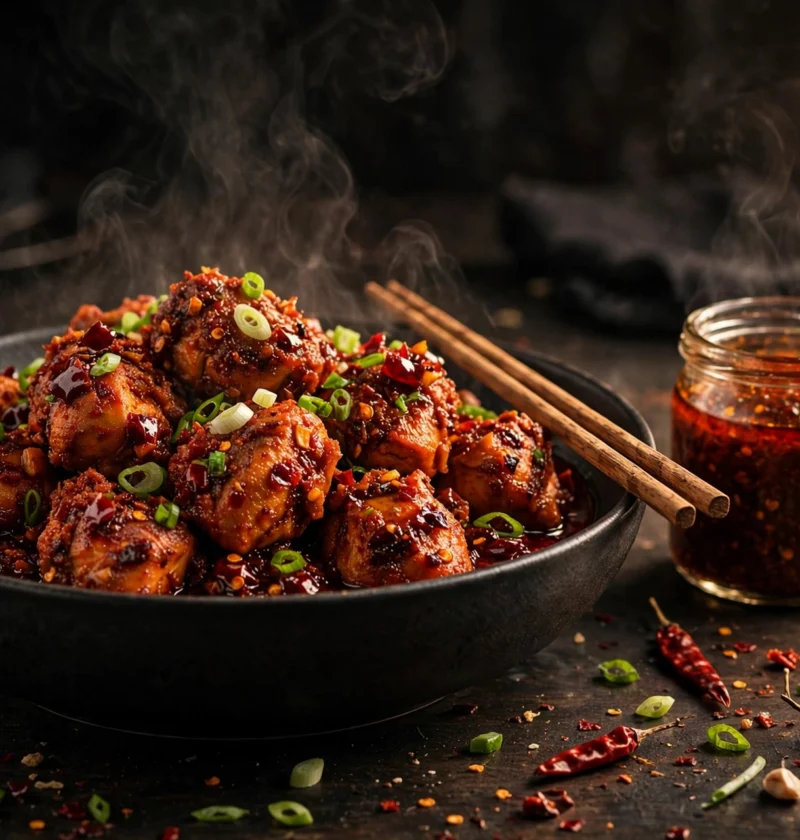
There is a small glass jar that lives in the door of my fridge, wedged between the ketchup and a mustard nobody remembers buying, and it holds a deep red, oily paste that improves nearly everything it touches — eggs, noodles, a plain bowl of rice, leftover roast chicken raided at midnight. That jar is homemade schezwan sauce, and this schezwan chicken recipe is the dish it was born for: crisp-fried chicken chunks glazed in the sauce until they shine brick-red and flecked with chili. I first ate it at a desi-Chinese restaurant where the waiter warned me about the heat twice, like a man issuing a weather alert. He was right to. It was wonderful.
For a long time I tried to shortcut my way there. Bottled sauces tasted flat and sweet, all colour and no character. Worse were the evenings I ground the dried chilies without soaking them, the way impatience suggests, and fried the paste hard — it turned bitter within a minute and took the whole dinner down with it. The lesson arrived slowly: this dish is not really about the chicken at all. The chicken is the vehicle. The sauce is the recipe — soak the chilies, grind them coarse, fry the paste gently until the oil itself turns red — and once a jar of it exists, the chicken part takes fifteen cheerful minutes.
Why This Schezwan Chicken Recipe Works
Everything here serves two things — a sauce with real depth, and a crust that survives it. This schezwan chicken recipe is arranged so the sauce gets the time and the chicken gets the speed:
- The sauce is made first, as a condiment in its own right. Not stirred together in the wok while the chicken waits — built separately, at its own pace, in enough quantity to leave a jar behind. A sauce given its own cooking time tastes layered; a sauce invented mid-stir-fry tastes like an apology.
- The chilies are soaked, then ground coarse. Half an hour in hot water plumps dried chilies so they grind instead of shattering, and the soaking tames the raw, dusty edge that turns to bitterness in hot oil. Coarse, not smooth — you want visible flecks that give the glaze texture and little pockets of heat.
- The paste is fried until the oil reddens and separates. Raw chili-garlic paste tastes harsh and grassy. Fried slowly in its oil, it deepens, sweetens at the edges, and stains the oil a clear ruby. That coloured oil is the sauce’s body — the thing that coats every piece of chicken.
- The crust is mostly cornflour, and the chicken is thigh. Thigh meat stays juicy through a hard fry, and a cornflour-heavy coat fries into a rugged shell with edges that hold their crunch even under an oily glaze. A soft, floury coating would surrender within seconds.
- The final toss is under a minute. The sauce blooms with fresh garlic, the chicken goes through it hot and fast, and the spring onions land at the very end. This is glazing, not simmering — give it five minutes in the pan and you have traded crackle for stew.
Ingredients
The sauce borrows its soul from Sichuan cuisine — that southwestern Chinese tradition built on chilies, garlic and generous amounts of flavoured oil — and its body from chili oil, the jarred red oil spooned over nearly everything in that kitchen. Our desi version is coarser than both parents: less a smooth oil than a spoonable paste, heavy on garlic, with vinegar and a whisper of sugar rounding the heat. One honest note — true Sichuan cooking leans on Sichuan peppercorns for a numbing tingle; I keep them optional here, a pinch if you have them, because the desi-Chinese restaurants that raised this dish mostly left them out. In this schezwan chicken recipe, one batch of sauce makes more than the chicken needs, on purpose. The extra jar is not a leftover. It is the point.
Serves 4
For the schezwan sauce:
- 18 dried whole red chilies (stems removed; shake out some seeds for a gentler heat)
- 3/4 cup hot water, for soaking
- 10 garlic cloves, peeled (about 3 tablespoons, chopped)
- 1/3 cup neutral oil
- 1 tablespoon white vinegar
- 1 tablespoon soy sauce
- 1 teaspoon sugar
- 1/2 teaspoon salt, or to taste
- 1/2 teaspoon Sichuan peppercorns, ground (optional)
For the chicken:
- 1 1/2 pounds skinless, boneless chicken thighs, in roughly 1 1/2-inch chunks
- 1 large egg, beaten
- 1/2 cup cornstarch (cornflour), for the crust
- 2 tablespoons all-purpose flour
- 1 teaspoon soy sauce, to season the chicken
- 1/2 teaspoon fine salt
- 1/2 teaspoon ground black pepper
- Neutral oil, for deep frying (about 2 cups)
- 4 garlic cloves, finely chopped, kept aside for the toss
- 1 teaspoon white vinegar, for the toss
- 4 spring onions, only the greens, sliced
How to Make This Schezwan Chicken Recipe – Step by Step
Step 1: Soak the dried chilies and grind them coarse. Snip the stems off the dried red chilies — shake out some of the seeds as you go if your table prefers warmth to warfare — and cover them with the hot water for 25 to 30 minutes, until they have plumped and darkened. Lift them out, keeping a few spoonfuls of the soaking water, and grind the chilies with the garlic in a small food processor or mortar, pulsing and stopping, until you have a rough, rust-red paste with visible flecks. It should look coarse and a little wild; a baby-food purée is not what we are after. Add a spoonful of soaking water only if the blades refuse to catch.
Step 2: Fry the paste until the oil turns red and separates. Warm the 1/3 cup of oil in a small, heavy pan over medium heat and scrape the paste into it — it will sizzle and spit a little, so stand ready with a spoon. Fry, stirring almost constantly, for 6 to 8 minutes. Watch the transformation: the paste darkens a shade, the raw garlic smell cooks off into something sweet and deep, and the oil rises to the surface in ruby pools around the edges. That separation is your signal. Stir in the vinegar, sugar, salt and soy sauce, give it one more minute, then take it off the heat and let it cool. You should have about 3/4 cup of sauce; this dish uses 1/2 cup, and the rest goes into a clean jar.
Step 3: Coat the chicken in its cornflour crust. Pat the chicken chunks properly dry with paper towels — a damp surface shakes its coating off in the fryer, so this minute matters. Scatter over the fine salt and black pepper, splash in the soy sauce, and leave the pieces for 10 minutes, until the surface turns tacky. Whisk the beaten egg with the cornstarch and flour into a thick batter, about the consistency of heavy cream falling slowly off a spoon, and fold the chicken through until every chunk is wrapped. No long marinating, no fuss; the crust does the talking here.
Step 4: Fry the chicken until it crackles. Heat about 2 cups of oil in a wok or deep pan to 350°F — a pinch of batter dropped in should fizz and climb straight back up. Slide the chicken in piece by piece, in two batches so the pan never crowds and the temperature never sulks. Fry 4 to 5 minutes per batch, turning now and then, until the pieces are a deep, even gold and knock together with a dry, crisp sound. Drain them on a rack set over a tray, where air can reach the undersides, and bring the oil back to heat before the second batch goes in.
Step 5: Bloom the sauce, toss for one minute, and serve. Tip the frying oil away, wipe the wok, and set it over high heat with a teaspoon of fresh oil. Add the finely chopped garlic kept for the toss and stir for 20 seconds, until it smells sweet, then spoon in 1/2 cup of your schezwan sauce and the teaspoon of vinegar. It will bubble and shine within half a minute. Return all the chicken at once, scatter the spring onion greens, and toss hard for 45 to 60 seconds — long enough for every piece to wear the red oil, short enough that the crust still crackles. Serve this schezwan chicken recipe immediately, straight onto a warmed platter.
Serving Suggestions
This schezwan chicken recipe is a plate that wants company of the plain kind: steamed basmati rice to catch the red oil, or a tangle of plain hakka noodles for the full restaurant theatre. I serve it on a warmed platter with extra sauce in a small bowl for the brave, and a quick cucumber salad — sliced cucumber, a pinch of salt, a squeeze of lemon — standing by as the fire brigade. And a spoonful of the leftover sauce whisked into mayonnaise makes a dip that will ruin plain fries for you forever, in the best way.
It sits at the fiery end of a desi-Chinese family that has a few regulars on this table. Its closest cousin is my chilli chicken, where the glaze is thinner, darker with soy, and built around crunchy capsicum and onion petals — same Friday-night energy, a different kind of heat. And whichever of the two you cook, the rice underneath should be the smoky, wok-tossed egg fried rice, whose plain grains are exactly what a sauce this loud wants to shout over.
Storage and Reheating
Leftover chicken holds up better than you might expect: cool it quickly, box it airtight, and refrigerate for up to 2 days, then revive it in a fierce oven at 425°F for 8 to 10 minutes, spread out on a rack, until the crust dries and crispens again — the microwave turns it leathery and is no friend of this dish. The sauce, though, is the real keeper. Spooned into a clean jar with its own oil settled over the top, it keeps happily in the fridge for up to 2 weeks, and a spoonful will wake up noodles, fried rice, eggs or a dull soup on any tired evening. Always take it out with a clean, dry spoon, and let the oil cover what remains.
Frequently Asked Questions
How is this schezwan chicken recipe different from chilli chicken?
The sauce, entirely. Chilli chicken is glazed in a thin, soy-dark sauce tossed with big pieces of capsicum and onion. Schezwan chicken is built around a coarse, oily chili-garlic paste made as a standalone sauce — chunkier, redder, far more garlicky — and the chicken is simply glazed in it, with no vegetable profile competing for attention.
Can I use bottled schezwan sauce instead?
You can, and about 1/2 cup of a good bottled sauce will get dinner on the table. Fry it in a teaspoon of oil with the fresh garlic for half a minute first, to wake it up. But bottled sauces lean sweet and smooth; the homemade paste is why this dish tastes like a restaurant’s best night rather than a jar’s average one.
Why did my sauce turn out bitter?
Almost always the chilies. Dried chilies fried without soaking scorch fast, and scorching reads as bitterness; so does paste cooked over fierce heat instead of a patient medium. Soak for the full half hour, keep the pan moderate, stir constantly — and if a batch still leans bitter, a pinch more sugar and vinegar will pull it back.
How do I make it less hot without losing the flavour?
Reduce the chilies to 10 or 12 and shake out most of their seeds before soaking — the seeds carry much of the fire. Keep the garlic and the full measure of oil; what makes the sauce taste like itself is the garlic and the red oil, not the punishment. An extra teaspoon of ketchup stirred into the sauce rounds the edges kindly, too.
Recipe Summary
- Prep time: 25 minutes, plus 30 minutes of soaking
- Cook time: 25 minutes
- Total time: About 1 hour 20 minutes
- Servings: 4
- Cuisine: Pakistani
- Course: Main Course