Saturday night in our house has a quiet ritual that nobody announces: a steel bowl of rice and daal goes into soak, and by Sunday morning the whole kitchen smells faintly, pleasantly sour, like something good has been happening while we slept. The batter rises overnight on the counter, and the first sound of the day is not an alarm — it is the hiss of batter hitting a hot tawa and my father asking, from two rooms away, whether the first dosa is his. This masala dosa recipe is our Sunday project, the one breakfast nobody is allowed to rush, because a dosa cannot be hurried any more than the batter could.
I will be honest about the learning curve. My first attempts were thick, pale pancakes that steamed instead of crisping, and my first batter never fermented at all — a cold January kitchen, a bowl that sat there sulking. The lessons, when they settled, were simple: the batter must ferment properly, the tawa must be hot but never furious, and the dosa must be left alone to crisp in its own time. Get those three right and you are no longer making a substitute for the restaurant version. You are making the thing itself.
Why This Masala Dosa Recipe Works
A dosa has only four moving parts — batter, tawa, filling, timing — and each one fails in its own predictable way. This masala dosa recipe is arranged around the habits that keep all four honest:
- The batter ferments overnight, and that fermentation is the soul of the dish. Soaked rice and urad daal, ground smooth and left to rise, give you a batter full of tiny bubbles and a gentle sourness no shortcut can fake. Those bubbles become the lacy, crisp edges on the tawa, and the tang is the flavour underneath everything else.
- A spoon of fenugreek goes into the soak. Methi seeds help the batter ferment reliably, deepen the golden colour, and add a faint aroma you cannot name but would miss. It is a small ingredient doing quiet, essential work.
- The tawa’s heat is regulated, not guessed. Too hot and the batter sets before you can spread it, tearing into a ragged sheet; too cool and the dosa steams pale and leathery. A sprinkle of water that sizzles and vanishes signals a ready surface — and cools it a breath between dosas.
- The batter is spread in one confident spiral and never flipped. A ladle of batter, pressed lightly and swept outward from the centre, gives a crepe thin enough to crisp through on a single side. The top cooks in the steam rising off the bottom — flipping a dosa is how you lose the lace.
- The dosa is never pressed down. Resist the urge to squash it flat with the spatula. Oil around the edges and patience do the crisping; pressing squeezes the steam out and glues the surface to the pan.
Ingredients
The masala dosa travelled up from the kitchens of Karnataka and Tamil Nadu to become, arguably, the most beloved breakfast on the subcontinent — a crisp fermented crepe around spiced potatoes, with chutney and sambar standing guard. At the heart of the dosa sits patience: the rice and urad daal are not cooked until they meet the tawa, transformed instead by water, time and wild fermentation. Use ordinary medium-grain rice if idli rice is hard to find — the ferment matters far more than the variety. Everything else is a mustard-seed tempering and a bowl of potatoes.
Serves 4
For the batter:
- 2 cups raw rice (parboiled/idli rice if available, otherwise any medium-grain rice)
- 1/2 cup whole urad daal (skinless)
- 1 teaspoon fenugreek (methi) seeds
- 1/4 cup cooked rice or flattened rice (poha), soaked — helps a soft, bubbly ferment
- 1 teaspoon salt, added after fermenting
- Water, for soaking and grinding
For the potato masala:
- 4 medium potatoes (about 1 1/2 pounds), boiled, peeled and crumbled by hand
- 2 tablespoons neutral oil or ghee
- 1 teaspoon black mustard seeds
- 1 teaspoon chana daal or urad daal (optional, for crunch)
- 10 to 12 fresh curry leaves
- 1 large onion, thinly sliced
- 1 tablespoon finely chopped fresh ginger
- 2 to 3 fresh green chilies, slit
- 1/2 teaspoon ground turmeric
- 1/2 cup green peas, fresh or frozen (optional)
- 3/4 teaspoon salt, or to taste
- 2 tablespoons chopped fresh coriander
- 1 tablespoon lemon juice
For the coconut chutney:
- 1 cup fresh or frozen grated coconut
- 2 tablespoons roasted chana daal or a small handful of peanuts
- 1 to 2 fresh green chilies
- 1/2-inch piece of fresh ginger
- 1/2 teaspoon salt, plus water to grind
- For the tempering: 1 teaspoon oil, 1/2 teaspoon mustard seeds, 6 curry leaves, 1 dried red chili
For the tawa:
- Neutral oil or ghee, a few teaspoons per dosa
- Half an onion, speared on a fork, for rubbing the tawa (optional but traditional)
How to Make This Masala Dosa Recipe – Step by Step
Step 1: Soak, grind, and ferment the batter overnight. Rinse the rice until the water runs mostly clear and soak it for 5 to 6 hours. In a second bowl, soak the urad daal and fenugreek seeds together for the same time. Drain the daal and grind it first, adding cold water a splash at a time, until pale, fluffy and full of air — this airy paste is the engine of the ferment. Grind the rice separately with the soaked poha until smooth but faintly grainy, like fine semolina between your fingers. Stir the two together by hand — hand-warmth genuinely helps — into a batter like thick pouring cream, cover, and leave it in the warmest corner of the kitchen for 8 to 12 hours. By morning it should have risen, domed with tiny bubbles, and smell faintly sour. Only now stir in the salt, gently, without beating the air out.
Step 2: Make the potato masala. Warm the oil in a wide pan over medium heat and add the mustard seeds; when they crackle, add the chana daal if using and let it turn golden. Drop in the curry leaves, ginger and green chilies, then the sliced onion, and cook until soft and sweet, about 6 minutes — do not brown it. Stir in the turmeric and peas, then fold through the hand-crumbled potatoes and salt, pressing and turning until the potatoes are evenly yellow and dry. The filling should be soft and scoopable, never wet. Off the heat, stir in the lemon juice and coriander, and keep it warm.
Step 3: Grind the coconut chutney and temper it. Blend the coconut, roasted chana daal, green chilies, ginger and salt with just enough water to make a spoonable, slightly coarse chutney — resist thinning it into a sauce; it should sit on the plate in a soft mound. Tip it into a serving bowl. In a small pan, heat the teaspoon of oil, pop the mustard seeds, and add the curry leaves and broken red chili; the moment they splutter, pour the tempering, oil and all, over the chutney and stir it through. Set the bowl beside the stove with the sambar, if serving, warming gently.
Step 4: Season the tawa and spread the first dosa. Set a heavy cast-iron tawa over medium heat, then flick a few drops of water across it: they should sizzle, dance and vanish within seconds — that is your temperature. Rub the surface with the cut onion if using, or wipe it with a barely oiled cloth; this seasons the pan and cools it a fraction. Pour a ladleful of batter — about 1/3 cup — into the centre, and with the back of the ladle in one smooth, continuous spiral, press lightly and sweep outward into a thin round about 9 inches wide. Drizzle a teaspoon of oil around the edges and a few drops over the surface. Do not touch it now.
Step 5: Crisp it, fill it, fold it — no flipping, ever. Let the dosa cook undisturbed for 2 to 3 minutes, until the edges lift and turn lacy and the underside is a deep, even gold. Spoon a line of warm potato masala along the centre, give it another 30 seconds, then fold both sides over the filling and slide it onto a warm plate. Serve immediately — a dosa waits for nobody. Between dosas, sprinkle the tawa with water to bring its heat back down, wipe, and repeat. The cook eats last and standing up; it is the best seat in the house anyway.
Serving Suggestions
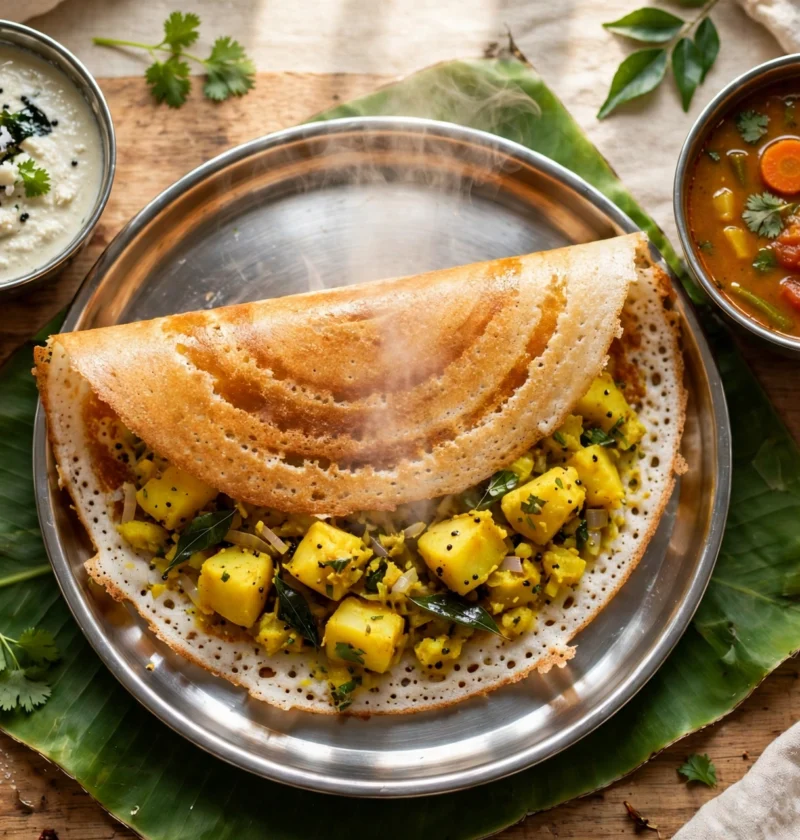
The classic plate for this masala dosa recipe is a small ceremony: the folded dosa laid golden-side up, coconut chutney in a cool white mound on one side, a bowl of hot sambar for dipping torn pieces into. Tear, dip in chutney, dip in sambar, eat — in that order, because the chutney’s coolness lands first and the sambar follows warm behind it. Any potato masala that escapes onto the plate is the cook’s portion, eaten with the last crisp corner.
Masala dosa anchors the great griddled breakfast family at our table. On mornings when the potatoes want a bread instead of a crepe, my aloo paratha takes nearly the same spiced potato heart and wraps it in flaky whole-wheat layers — the Sunday debate in our house is genuinely between these two. And for the egg-eaters who feel breakfast is incomplete without one, the anda paratha brings a spiced egg filling to the same tawa. Crepe or paratha, potato or egg — the tawa barely cools either way.
Storage and Reheating
In this masala dosa recipe it is the batter, not the dosa, that keeps — and it keeps beautifully. Covered in the fridge, fermented batter stays good for 3 to 4 days, and the day-two and day-three dosas are honestly better: the flavour deepens and the crepes colour more evenly. Bring the bowl out 30 minutes before cooking, and thin the batter with a spoonful of water only if it has thickened — it should pour like thick cream. The potato masala refrigerates for up to 3 days and reheats gently in a covered pan with a splash of water. The dosas themselves are a make-and-eat food: a reheated dosa is a sad, leathery thing, so cook only as many as the table will eat, and cook them to order.
Frequently Asked Questions
My batter did not rise at all. What went wrong?
Almost always warmth, or the lack of it. Fermentation needs a genuinely warm spot — in winter, put the bowl inside a switched-off oven with the light on, or wrap it in a towel. Cold grinding water, salt added before fermenting (salt goes in after), and heavily chlorinated tap water can all slow it down. Give a sluggish batter more time before judging it; a slow ferment still arrives.
Why does my dosa stick to the tawa or tear when I spread it?
The tawa is either too hot or not seasoned. If the batter seizes the instant it lands, the surface is furious — sprinkle water over it to cool it a breath, rub with the cut onion, and try again slightly lower. A freshly scrubbed iron tawa needs a few sacrificial dosas to build its seasoning; by the third, the crepes release on their own.
Can I make this masala dosa recipe without fermenting, for a same-day breakfast?
You can make a respectable crepe from freshly ground batter rested a few hours — but it will not be the same dish. Without fermentation there is no tang, fewer bubbles, and thicker, paler dosas that crisp less willingly. If the craving is urgent, make the fresh version honestly and enjoy it; but once you have tasted the overnight batter, you will plan your Sundays around it.
How do restaurants get their dosas so much crisper and more golden?
Three things: a seasoned commercial tawa that never cools, a touch of extra poha in the batter to help the colour along, and a patient hand with the oil around the edges. At home, this masala dosa recipe leans on the honest equivalents — a heavy cast-iron tawa, batter at the right consistency, and refusing to rush the crisping. Most home dosas are pale because they came off a minute too early, not because anything was missing.
Recipe Summary
- Prep time: 30 minutes, plus 5–6 hours soaking and 8–12 hours fermenting
- Cook time: 45 minutes
- Total time: About 1 hour 15 minutes of active time, plus overnight fermenting
- Servings: 4
- Cuisine: Pakistani
- Course: Breakfast