The Besan Halwa That Smelled Like Winter Mornings
The first time I made this besan halwa recipe on my own, I was twenty-two, living in a flat with a temperamental stove, and trying to recreate something my grandmother made without ever measuring a thing. She would stand at her old karahi stirring besan in ghee while the whole house slowly filled with a deep, toasty smell that meant winter had properly arrived. I called her mid-attempt in a panic because my halwa looked pale and smelled faintly of raw flour, and she laughed and said I had barely started. “Beta, abhi to rang aana baqi hai,” she said. The color is yet to come. That one line changed everything, because this besan halwa recipe is not really about a timer at all. It is about patience, and about learning to trust your nose over your clock.
What nobody tells you about besan halwa is how different it is from its famous cousin, suji halwa. Semolina turns golden fast and forgives a rushed hand; besan does not. It needs a slow roast on low heat until it darkens three shades and smells like roasted nuts, and if you rush it, the raw taste of uncooked chickpea flour lingers no matter how much sugar you add. But get that roast right and the reward is something else entirely: a halwa that is dense and fudgy rather than grainy, with a nutty depth that tastes like it took all day when it actually takes about thirty-five minutes. This is the version I make whenever the evenings turn cold, whenever someone in the house is feeling low, and whenever I want the kitchen to smell like my grandmother’s house again.
Why This Besan Halwa Recipe Works
- The slow roast is the whole secret: Besan is roasted on low heat until deep caramel brown, which cooks out the raw taste and builds the nutty flavor that makes this besan halwa recipe taste like it simmered for hours.
- Milk makes it softer than water alone: A splash of warm milk alongside the water gives the halwa a creamy, almost fudge-like body instead of a drier crumb.
- The syrup goes in hot, not cold: Pouring warm sugar syrup into the roasted besan keeps the mixture smooth, because cold liquid hitting hot flour is what causes stubborn clumps.
- Ghee is added in two stages: Half the ghee roasts the flour, and the rest goes in at the end, which is why this besan halwa recipe finishes glossy and rich instead of greasy or heavy.
- It is a one-pan, pantry-only dessert: Besan, ghee, sugar, milk and cardamom are all you need, so this besan halwa recipe rescues many a last-minute craving without a single trip to the store.
Ingredients for This Besan Halwa Recipe
The quantities below serve four generously, or six as a small after-dinner sweet with chai. Measure everything before you light the stove, because once the besan starts roasting, this besan halwa recipe wants your full attention. Use a heavy karahi or thick-bottomed pan; thin pans scorch besan in seconds.
- 1 cup besan (gram flour / chickpea flour), sifted
- 1/2 cup ghee, divided
- 3/4 cup sugar
- 1 cup water
- 1/2 cup whole milk, warmed
- 4 green cardamoms, crushed, seeds removed
- 2 tablespoons chopped almonds
- 2 tablespoons chopped pistachios
- 1 tablespoon golden raisins (optional)
- 1 pinch saffron, soaked in 2 tablespoons warm milk (optional)
How to Make This Besan Halwa Recipe in 5 Steps
The method below has five parts, and the roast is the one that makes or breaks the dish. Stay close to the stove through it, keep the flame low rather than rushing it, and judge by color and smell instead of the timer. Nail the roast and the rest follows easily.
Step 1: Warm the syrup first
Put the sugar, water, crushed cardamom seeds and saffron milk, if using, in a small saucepan and bring to a gentle simmer over medium heat, stirring until the sugar dissolves. Then drop the heat to minimum and keep the syrup warm; it must be hot when it meets the besan, not lukewarm and definitely not cold. Warming the syrup first saves this besan halwa recipe from its most common failure, because hot liquid folds into roasted flour smoothly while cold liquid seizes it into lumps. Set the pan aside on low heat and move on to the roast.
Step 2: Roast the besan low and slow
Melt half the ghee in a heavy karahi over low heat, then add the sifted besan all at once and begin stirring with a silicone spatula or a sturdy spoon. At first nothing much changes, then very gradually the flour loosens, darkens from pale yellow to gold and finally to deep caramel brown, while the kitchen fills with a nutty, almost peanut-like aroma. This takes a good 12 to 15 minutes, and you must keep stirring, because besan scorches in patches if it sits still. You will know the roast is done when the mixture looks like wet sand, smells deeply toasted, and pulls slightly away from the sides of the pan. That color and smell, not the timer, are the real test of this besan halwa recipe.
Step 3: Add the hot syrup in stages
Turn the heat down to its lowest point and pour the warm syrup into the roasted besan in three slow additions, stirring hard after each one. The mixture will bubble and hiss fiercely at first and look loose and alarming, almost like soup. Keep stirring: within two or three minutes it thickens, turns glossy, and comes together into a soft, dense mass that moves as one piece around the pan. Should any lumps form, crush them flat against the karahi wall with your spoon and carry on stirring; they melt away with steady work. This is the moment the besan halwa recipe transforms from toasted flour into dessert, and it happens fast, so stay at the stove.
Step 4: Stir in the milk and remaining ghee
Pour in the warm milk and stir until it disappears completely into the halwa, which will loosen for a moment and then thicken again into something softer and creamier than before. Now add the remaining ghee a tablespoon at a time, stirring until each addition is absorbed and the halwa shines. It is ready when the halwa leaves the sides of the pan cleanly and a thin sheen of ghee appears around the edges — the classic sign this besan halwa recipe has reached the right texture: soft enough to scoop, firm enough to hold its shape.
Step 5: Fold in the nuts and serve warm
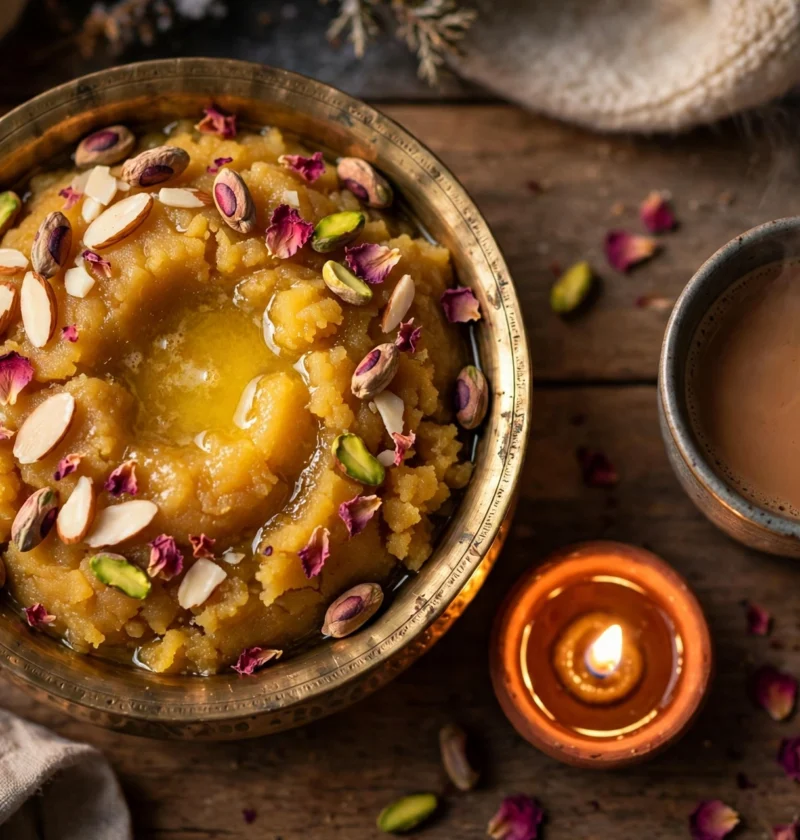
Take the pan off the heat and fold in the chopped almonds, pistachios and raisins, saving a small pinch of each for garnish. Spoon the halwa into a serving bowl or onto individual plates while it is still warm, scatter the reserved nuts over the top, and serve it right away. Besan halwa is at its best warm, when it is soft, glossy and fragrant, and a spoonful straight from the karahi — cook’s privilege — beats the plated version. Making it ahead is no problem; this besan halwa recipe reheats beautifully, as the storage notes below explain.
Serving Suggestions
The simplest way is still my favorite: warm besan halwa in a small bowl with a cup of doodh patti, eaten slowly while still soft enough to leave a shine on the spoon. My grandmother served it exactly like that on cold evenings, sometimes with a few extra pistachios scattered on top and sometimes with nothing at all, because she believed a good halwa needed no decoration. I have kept that habit, and whenever I make this besan halwa recipe for guests, the bowls come back scraped clean.
For a celebration spread, besan halwa sits beautifully next to its halwa cousins so people can taste the difference. I often serve it alongside my Suji Ka Halwa for the classic semolina lovers, and my Atta Halwa for those who prefer the deep wheat flavor of a prasad-style pudding, with the besan version as the nuttiest of the three. A pot of chai, a plate of pooris, and that trio turns an ordinary Sunday breakfast into something people remember.
For a dinner party, a scoop of vanilla ice cream on warm besan halwa sounds unlikely and tastes wonderful, the cold cream melting into the nutty warmth. A drizzle of warm milk softens it further for older guests, and a few dried rose petals make it look as special as it tastes. Serve this besan halwa recipe warm; it firms as it cools, and while still delicious cold, that first warm spoonful is the one people talk about.
Storage and Reheating
Besan halwa keeps well, which is one of the reasons I love making a full batch even for a small household. Keep it in a sealed container in the refrigerator for up to a week, or at room temperature for two days in cooler weather. It firms up considerably when cold, turning almost fudge-like, and some people prefer it that way, sliced cold straight from the fridge like a sweet bar. Either way, this besan halwa recipe keeps its nutty flavor in storage.
To reheat, warm a portion in a heavy pan over low heat with a splash of milk, stirring until it softens back to its glossy texture, about three minutes. The microwave works too: heat it in thirty-second bursts, stirring between each, with a spoon of milk sprinkled over the top. I do not recommend freezing finished halwa, because the ghee separates slightly on thawing and the texture turns grainy. Make it fresh instead, since the whole besan halwa recipe takes barely half an hour.
Frequently Asked Questions
Why does my besan halwa taste raw or bitter?
Almost always, the roast was too short or the heat too high. Besan needs a full 12 to 15 minutes on low heat to lose its raw edge, and a high flame only browns the outside while the inside stays uncooked. If your halwa tastes bitter, the flour was under-roasted, and no extra sugar will fix it. Next time, roast until the color is a true deep caramel and the smell is nutty and rich, because that is the only reliable sign this besan halwa recipe is on track.
Can I make besan halwa with less ghee?
You can reduce the ghee slightly, but I would not cut it by more than a couple of tablespoons. Ghee is what carries the roasted flavor and gives the halwa its glossy finish; too little and the halwa turns dry and crumbly instead of soft and fudgy. If you want a lighter version, use the full amount for the roast, where it matters most, and trim only the finishing ghee. That compromise keeps this besan halwa recipe tasting right while saving a little richness.
Why did my halwa turn lumpy?
Lumps usually come from syrup that was too cold, or from pouring all the liquid in at once. Keep the syrup simmering gently while the besan roasts, and add it in three slow stages with vigorous stirring after each addition. If lumps still show up, mash them flat against the pan wall with your spoon and continue on low heat; most dissolve within a minute or two. A whisk can help, but a wooden spoon and patience smooth this besan halwa recipe just as well.
Is besan halwa gluten-free?
Yes, besan itself is naturally gluten-free, since it is milled from chickpeas rather than wheat. Just check your gram flour packet is certified gluten-free if cooking for someone with celiac disease, since some mills process wheat on shared equipment. The rest of the ingredients in this besan halwa recipe — ghee, sugar, milk, cardamom and nuts — are naturally free of gluten as well, which makes it a reliable dessert for mixed tables.
Recipe Summary
Count on about 5 minutes of measuring, 15 minutes of roasting, and 10 minutes of finishing, so the dish is done in roughly 35 minutes and serves four generously. Each serving comes to near 420 calories, and the dish sits proudly on the winter dessert shelf of Pakistani cooking, between a quick weeknight sweet and a celebration pudding. It earns a permanent place in your rotation once you have made it twice.
If you give this dish a go, I hope the first nutty, ghee-glossed spoonful explains why my grandmother guarded her karahi so fiercely and why I now do the same. For the backstory on the star ingredient, read about gram flour and the wider family of halva sweets on Wikipedia.