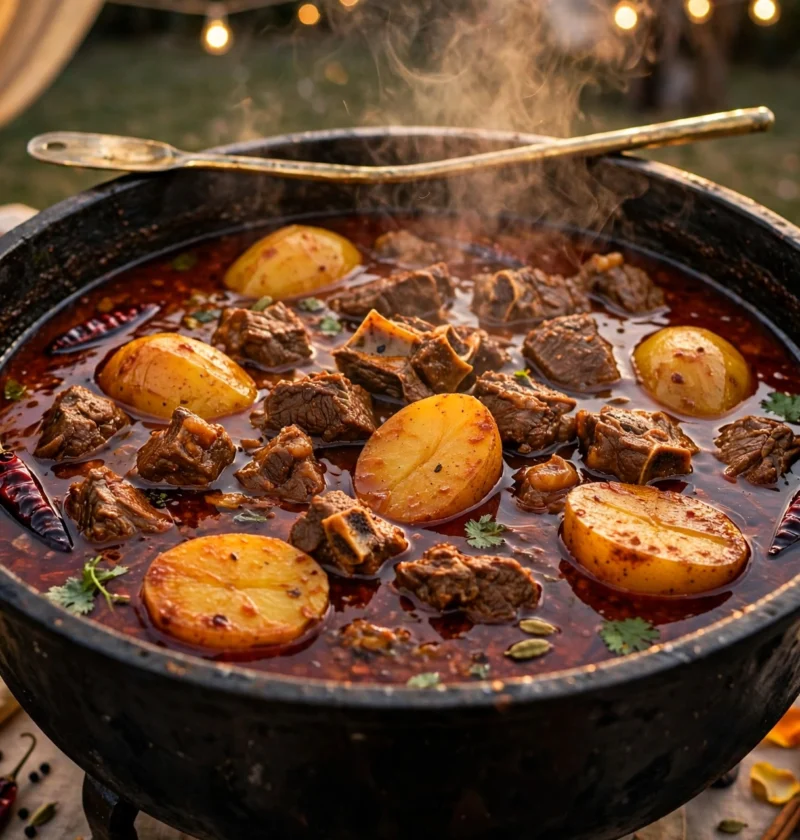
Every shaadi I attended as a boy had the same perfume drifting over the boundary wall before the guests had even sat down: onions frying in a deg the size of a bathtub. When the lid finally came off that cauldron, the shorba inside was a deep, dark red with the oil shining on top like a sunset, and the man serving it worked from the top of the pot with a long spoon, because everyone knew the first ladles — the ones carrying the oil and the color — were the prize. I chased that pot for years in my own kitchen, and this deggi aloo gosht recipe is where I finally caught it: beef and big potato halves in a thin, drinkable, fiery-red shorba whose entire body and color come from a mountain of slow-fried onions and deggi mirch. No tomato. No yogurt. The deg does it with onions, chili, and time.
Let me spare you my failures, because there were three distinct disasters. The first pot came out a pale, apologetic orange because I fried the onions to a polite gold and moved on — in deg cooking, gold is where you start, not where you stop. The second time I cut the potatoes into neat little cubes like a home cook and added them with the meat; they dissolved into the shorba and I served a sort of spicy beef porridge to people who had driven an hour. And once, out of pure habit, my hand reached for tomatoes as it does for every other curry I know, and what landed on the table was a perfectly nice home-style aloo gosht wearing the wrong clothes. The deggi aloo gosht recipe below is those three lessons, formalized: onions fried to deep mahogany, potatoes kept large and added late, and the tomato tin staying firmly in the cupboard where it belongs.
Why This Deggi Aloo Gosht Recipe Works
A deg is not a small pot scaled up — it is a different philosophy of curry, built for a crowd and for shorba you can drink off the spoon. This version shrinks the cauldron to a home pot without surrendering any of its logic:
- No tomato and no yogurt — the onions are the base, all of it. Four large onions, fried dark and slow, dissolve into the cooking liquid and give the shorba its body, its sweetness, and half its color. Tomato would turn it into a home curry and yogurt would pale it; the deg gets its depth from onion mass and patience alone.
- The onions go to deep mahogany, not golden. This is the whole game. Sliced onions fried low and slow for a full 25 to 30 minutes, stirred and scraped, until they are uniformly dark brown and sweet as jam. Pale onions make a pale deg, and no amount of chili powder afterward can fake the color or the roasted depth that properly dark onions lay down at the start.
- Deggi mirch gives color first and fire second. The Kashmiri-style chili blend the caterers swear by is bred for pigment — it dyes the oil and the shorba that wedding-hall red while keeping the heat civilized. I layer it with a smaller amount of ordinary red chili powder for actual warmth: the deggi mirch paints, the regular chili bites.
- The potatoes stay large and go in late. Halved, not cubed — big pieces with a fighting chance. They join the pot only when the meat is nearly tender, simmer just until a knife slides through, and hold their shape while their edges soften into the shorba. A potato in a deg should arrive at the plate as a potato, stained red and saturated, not as a rumor.
- The shorba is thin on purpose. Where a home curry clings, a deggi shorba pours. It is meant to be spooned generously over rice, drunk a little off the side of the plate, and to carry that shining layer of red oil on its surface. If your instinct says thicken it, resist: the thinness is the dish’s signature and the reason the first serving from the top of the pot is fought over.
Ingredients
Serves 6 to 8
For the deg base:
- 1/2 cup oil (deg cooking is generous — this is not the place to be shy)
- 4 large onions, sliced thin (about 5 cups)
- 1 cinnamon stick, about 2 inches
- 6 whole cloves
- 2 bay leaves
- 1 black cardamom pod
- 4 green cardamom pods
- 1 1/2 tablespoons ginger-garlic paste
For the meat, potatoes, and shorba:
- 2 pounds bone-in beef curry pieces (mutton works beautifully too)
- 2 tablespoons deggi mirch (Kashmiri chili powder)
- 1 teaspoon regular red chili powder, for heat
- 1 tablespoon coriander powder
- 1/2 teaspoon turmeric powder
- 2 teaspoons salt, or to taste
- 1 1/2 pounds potatoes (about 4 medium), peeled and halved
- 4 to 5 cups water, for the shorba
- 1 teaspoon garam masala, for the finish
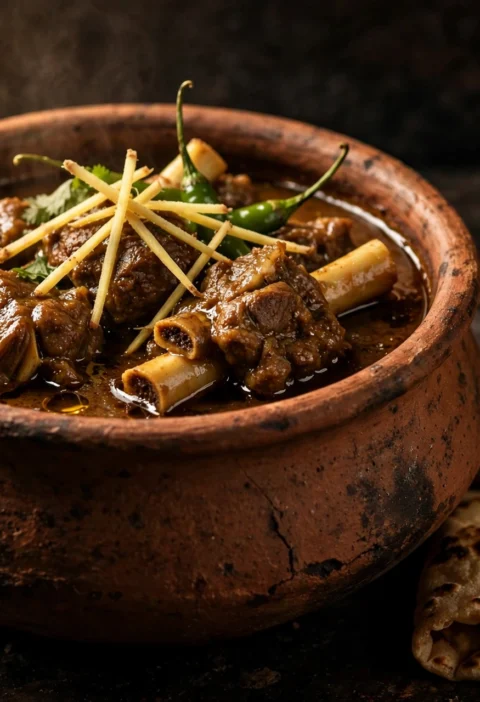
- Fresh coriander leaves, fine ginger julienne, and green chilies, to serve
The dish takes its name from the deg itself, the great round cauldron of the professional caterer, and from Kashmiri chili — the mild, pigment-rich pepper at the heart of deggi mirch. The humble potato is the other pillar: in a deg it is never a filler but a co-star, chosen large, cooked in the shorba it will be served in, and expected to taste of the pot it shared with the meat. A deggi aloo gosht recipe is, at bottom, a lesson in how much flavor two cheap ingredients — onions and potatoes — can be made to give up when nobody is in a hurry.
How to Make This Deggi Aloo Gosht Recipe – Step by Step
Step 1: Fry the onion mountain down to deep mahogany.
Heat the oil in your heaviest, widest pot over medium heat, add the whole spices, and then the sliced onions with a pinch of the salt. Now settle in. Fry for 25 to 30 minutes, stirring every few minutes and scraping the bottom, lowering the heat as they color so they darken evenly instead of scorching at the edges. They will pass gold, then amber, then a proper deep mahogany brown, shrinking to a fraction of their raw volume. If a few strands at the edge go very dark, splash in a tablespoon of water and stir — you want roasted, never burnt. This is the longest step of the deggi aloo gosht recipe and the one that decides everything after it.
Step 2: Add the ginger-garlic and sear the meat.
Stir in the ginger-garlic paste and fry for a minute in the dark onions. Raise the heat to high, add the beef pieces, and bhuno them hard for 8 to 10 minutes, turning and scraping, until the meat has lost its raw sheen and taken on the color of its surroundings. The onions will coat every piece like a dark paste — that coating is the deg’s body in waiting.
Step 3: Bloom the chili and spices until the oil turns red.
Lower the heat to medium and add the deggi mirch, regular chili powder, coriander, turmeric, and the rest of the salt, with a splash of water so the powders do not scorch. Bhuno for 4 to 5 minutes, stirring constantly, until the masala darkens another shade, smells toasty rather than raw, and the oil begins to separate at the edges carrying that deep wedding-pot red. Trust the color here; it is supposed to be dramatic.
Step 4: Build the shorba and simmer the meat tender.
Pour in 4 cups of water (5 if you like a more generous shorba), stir well, and bring to a boil. Cover, drop the heat to a low simmer, and cook for 60 to 75 minutes — about 25 minutes under pressure — until the meat is properly tender and the onions have melted entirely into the liquid. What you should have now is a thin, deep-red, oil-flecked shorba with body underneath its thinness. Taste for salt; a shorba this size drinks more than you expect.
Step 5: Potatoes in late, garam masala last, and a proper rest.
Tuck the potato halves into the shorba, cover, and simmer for 20 to 25 minutes, until a knife slides into a potato without resistance and their edges have just begun to soften. Stir in the garam masala, take the pot off the heat, and rest it covered for 15 minutes — the red oil will rise and gather on the surface, which is the deg announcing it is ready. Serve the deggi aloo gosht recipe from the top of the pot, ladling the shining shorba over each portion, with coriander, ginger julienne, and green chilies over everything.
Serving Suggestions
The shaadi-hall plate is a mound of plain steamed rice drowned cheerfully in shorba, one potato half, two pieces of meat, and nothing else competing — though hot naan for chasing the last of the oil across the plate is entirely respectable. At a family table it wants sliced onions and lemon on the side; the deg itself asks for no garnish beyond its own shine.
Two relatives on this site frame it by contrast. My aloo gosht is the home version most of us grew up on — a thick, tomato-and-yogurt family curry that clings to the spoon and tastes of somebody’s mother; the deggi version shares its two main ingredients and almost nothing else, not its base, not its color logic, not its pourable shorba. And the deg’s natural partner at every wedding is my mutton biryani, the other cauldron on the caterer’s row — serve them side by side and you have recreated the exact moment, halfway through a shaadi, when the whole hall goes quiet at once.
Storage and Reheating
Deggi aloo gosht keeps in the refrigerator for up to 3 days and is honestly better on the second day, when the potatoes have drunk the shorba to their centers and the onion base has settled into its full depth. Reheat it gently in a covered pot over low heat — the potatoes are at their most fragile now, so stir with a flat spoon and rarely. It freezes well for up to 2 months if you accept softer potatoes on the other side; for the best result, freeze the meat and shorba alone and simmer fresh potato halves in it as it reheats. Either way, a reheated deggi aloo gosht recipe returns with its color and its shine intact, ready to pretend the wedding never ended.
Frequently Asked Questions
What exactly is deggi mirch, and what can I use instead?
Deggi mirch is a blend built on Kashmiri chilies — dried red peppers prized for pigment far more than heat — often with red capsicum in the mix. Its job is that glowing red color at a heat level a whole wedding hall can handle. If you cannot find it, Kashmiri chili powder alone is the closest substitute; failing that, use 3 parts sweet paprika to 1 part cayenne, which gets the color right and approximates the warmth. What you cannot substitute is ordinary hot chili powder in the full quantity — you would get the fire and miss the red entirely.
Why is there no tomato in this curry?
Because the deg’s identity depends on it. Tomato brings acidity and a particular orange-red body that belongs to home-style curries; the caterer’s pot builds its body from dissolved fried onions and its color from deggi mirch, producing a darker, rounder, more roasted shorba. Add tomato and you have made a fine aloo gosht — just not a deggi one. This is the single distinction shaadi cooks are most stubborn about, and I have joined their side of the argument.
My deg came out pale. Where did the color go?
Into onions that were not fried long enough, almost every time. The base must reach a uniform deep mahogany before the meat goes in; golden onions cannot be rescued later because the chili blooms in their oil and borrows their darkness. A partial rescue for a finished pale pot: bloom an extra teaspoon of deggi mirch in 2 tablespoons of hot oil and stir it through. But the real fix is the clock at Step 1 — give the onions their full half hour.
Should deggi aloo gosht be made with beef or mutton?
Mutton is the shaadi classic and its fat enriches the shorba in a way beef does not quite match; beef is what most home cooks I know actually use, and it takes the deg treatment beautifully. The method does not change — only the simmering time does, with mutton usually tender a little sooner than beef. What matters far more than the animal is the discipline: dark onions, large late potatoes, and a shorba kept thin enough to drink.
Recipe Summary
- Prep time: 20 minutes
- Cook time: About 1 hour 45 minutes
- Total time: Around 2 hours 5 minutes
- Servings: 6 to 8 people
- Cuisine: Pakistani
- Course: Main Course