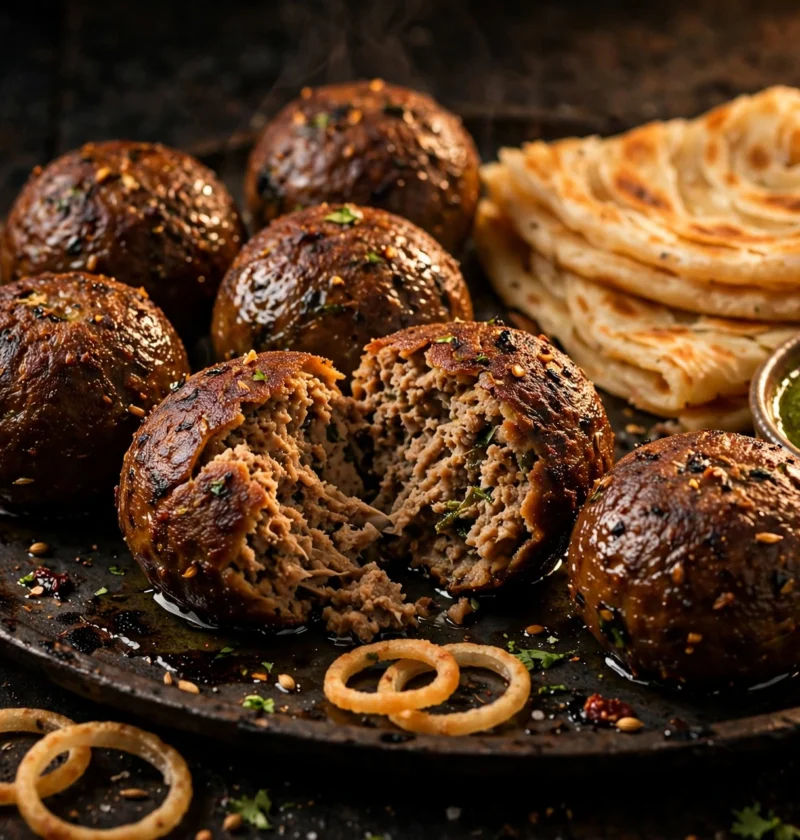
On Burns Road in Karachi there is a shop that sells exactly two things: gola kababs and parathas to wrap them in. No menu, no chairs worth mentioning, and a queue that ignores both facts. The ustad lifts each kabab off his wide iron tawa with two fingers and a kind of tenderness, because a gola kabab handled roughly simply comes apart — it is less a meatball than a rumor of one, a round of beef mince so soft that my grandfather insisted it should melt before you ever had to chew. I ordered four, ate six, and went home determined to reverse-engineer that softness. This gola kabab recipe is the result of a full year of polite failures.
The failures were all firm. Pleasant, well-spiced, entirely respectable — and firm, like koftas that had wandered into the wrong recipe. The breakthrough came from an elderly butcher near my home who asked, with genuine suspicion, whether I was “putting the kachri in or just hoping.” Kachri — raw green papaya — is the old tenderizer of the Mughlai kitchen, and it changes everything about how beef mince behaves. Combined with onions fried before they ever meet the meat, it produces the yielding, almost creamy center I had been chasing. This gola kabab recipe stands on those two pillars, and on one warning the butcher gave me for free: the papaya is a servant that becomes a tyrant if you leave it alone too long.
Why This Gola Kabab Recipe Works
Softness in a kabab is not an accident or a gift — it is chemistry and handling, arranged in the right order:
- Raw papaya does the tenderizing, in a strict time window. Unripe papaya carries papain, an enzyme that quietly unthreads the proteins in beef mince. A tablespoon of paste, two to three hours of contact, and the meat turns supple enough to shape into kababs that steam apart on the tongue. Leave it overnight, though, and the same enzyme keeps working until the mince collapses into paste that no shaping can save. In this gola kabab recipe, the papaya goes in late and the clock is part of the ingredient list.
- The onions are fried first, then ground to a paste. Raw onion is a water bomb — it leaks into mince, sharpens as it sits, and makes kababs weep on the heat. Onions fried to a deep gold and ground smooth give gola kababs their sweetness and body while adding almost no free moisture. They also carry the caramelized flavor that distinguishes a great kabab from a spiced meatball.
- The mince is worked until it turns pale and tacky. Ten minutes of firm kneading — pushing the mixture against the bowl, folding, pushing again — extracts the sticky protein that binds ground meat to itself. No egg, no breadcrumbs, no filler doing suspicious work. When the mince lightens in color and pulls away in one stretchy mass, it will hold a round shape on the tawa and still eat like it is barely holding at all.
- Each ball gets a thumbprint dimple in the center. A solid sphere of mince cooks at two speeds: the outside races, the middle dawdles, and by the time the center is done the crust has toughened. Pressing a shallow well into each kabab evens out the thickness, so the whole thing finishes in the same minute. The dimple also traps a spoonful of the pan juices, which the kabab drinks back as it rests.
- The heat stays gentle and the turning happens once. Gola kababs are cooked, not attacked — a wide pan over medium heat, a film of oil, a lid for the final minutes so the centers finish in their own steam. They are turned a single time, with two spoons and patience, because every extra prod squeezes out juice and breaks the fragile structure the papaya built.
Ingredients
Makes 14-16 kababs (serves 5-6)
For the kabab mixture:
- 2 lbs (900g) beef mince, finely ground twice, with its natural fat (about 80/20)
- 1 tablespoon raw green papaya paste (kachri) — from a small piece of unripe papaya, ground with its skin
- 1 cup fried onions, ground to a coarse paste (or store-bought birista, crushed)
- 1 1/2 tablespoons ginger-garlic paste
- 3 green chilies, ground to a paste
- 1 tablespoon ground poppy seeds (khashkhash)
- 1 tablespoon desiccated coconut, lightly toasted (optional, old Karachi touch)
- 1/2 teaspoon freshly ground black pepper
- 1 1/2 teaspoons garam masala
- 1 teaspoon red chili powder
- 1 teaspoon ground coriander (dhaniya)
- 1 teaspoon ground cumin (zeera)
- 1 1/4 teaspoons salt, or to taste
- 2-3 tablespoons oil or ghee, for pan-frying
- 1 small piece of charcoal plus 1 teaspoon ghee (optional, for smoke)
For serving:
- Flaky parathas or sheermal
- Green chutney and sliced onions
- Lemon wedges
The quiet hero here is the green papaya, whose enzymes have tenderized tough cuts in South Asian kitchens for centuries — long before anyone bottled “meat tenderizer,” cooks were grating unripe fruit over kebab mince. Gola kabab itself belongs to the great kebab family that traveled from Central Asia into Mughlai courts and out onto the food streets, where softness became a point of pride: the rounder and more delicate the kabab, the greater the cook.
How to Make This Gola Kabab Recipe – Step by Step
Step 1: Marinate the mince with the papaya — and set a timer.
Spread the mince in a wide bowl and rub the raw papaya paste through it thoroughly, along with the salt, until every strand is coated. Cover and refrigerate for 2 to 3 hours — no more. This window is the recipe’s one true rule: long enough for the papain to loosen the meat’s structure, short enough that the mixture still shapes cleanly afterward. If dinner plans demand a longer wait, skip the papaya at this stage and stir it in 2 hours before cooking instead.
Step 2: Fold in the aromatics and work the mixture.
Add the fried-onion paste, ginger-garlic paste, green chili paste, poppy seeds, coconut if using, and all the ground spices to the rested mince. Now knead — really knead, the way you would a stiff dough — for 8 to 10 minutes, pressing the mixture flat against the bowl and folding it over itself. It will turn visibly paler and start to feel sticky and unified, like sausage meat. Cover and chill for 30 minutes; cold mixture shapes without smearing and holds its round on the pan.
Step 3: Shape the rounds with the dimple.
Oil your palms lightly. Take a portion of mixture the size of a golf ball, roll it smooth between your hands, and set it down; then press your thumb gently into its top to leave a shallow well. Work through the whole batch — you should get 14 to 16 kababs — and keep the shaped rounds on an oiled tray, covered, until the pan is ready. If the mixture feels too soft to trust, fifteen minutes in the freezer firms it without consequence.
Step 4: Pan-fry gently, turning once.
Heat a wide, heavy pan or tawa over medium heat and film it with oil or ghee. Lay the kababs in with breathing room and leave them completely alone for 4 to 5 minutes, until the undersides are a deep mahogany brown. Slide two spoons under each kabab and turn it in one unhurried motion. Cook 3 to 4 minutes more, then cover the pan for the final 2 minutes so the centers finish in steam. For the optional smoke, move the kababs to a lidded dish, tuck a small foil cup holding a red-hot coal into the middle, pour a teaspoon of ghee over the coal, and clamp the lid on for 3 minutes while the smoke does its work. The kababs are done when they feel softly firm — they should give a little when pressed, never bounce.
Step 5: Rest briefly and serve the Karachi way.
Rest the kababs for 4 to 5 minutes on a warm plate; they settle, and the juices caught in each dimple sink back into the meat. Serve them on or beside flaky parathas with green chutney, raw onion, and lemon — at the Burns Road shop the paratha is torn, a kabab is folded inside with a smear of chutney, and the whole thing is eaten before it can fall apart, which it is always threatening to do. That threat is the compliment this gola kabab recipe was built to earn.
Serving Suggestions
Gola kababs are rich and soft, so their partners should bring crunch and acid: raw onion rings, a sharp green chutney, lemon, and something pickled if your family keeps achaar on the table. Folded into parathas they are a meal; served over plain steamed rice with daal on the side, they become the quiet star of a home dinner. A glass of sweet lassi afterward is not traditional so much as inevitable.
Place this gola kabab recipe among its relatives and the differences sharpen. My seekh kabab is the long, firm, skewer-grilled cousin — built to grip metal over open flame, with a chew that gola kabab would consider showing off. My chapli kabab goes flat and wide, fried with tomato on its face, all crisp edges. The gola stands apart from both: round, pan-finished, and defined entirely by how little chewing it asks of you.
Storage and Reheating
Cooked gola kababs refrigerate for up to 3 days; reheat them covered in a low oven (325°F / 165°C) with a splash of water in the dish, about 10 minutes, so they warm through in steam rather than drying at the edges. The raw, shaped mixture — before the papaya goes in — freezes beautifully for up to a month; thaw it in the fridge, then add the papaya paste and respect the same 2-to-3-hour window before cooking. Never refreeze a batch the papaya has already worked on; its texture will not survive a second round.
Frequently Asked Questions
My kababs turned to mush and fell apart. What happened?
Almost certainly the papaya overstayed. Papain does not stop working because the mince looks ready — given five or six hours, it digests the structure that holds a kabab together. Measure the paste honestly (a heaped tablespoon can be nearly two), keep the marination inside 3 hours, and if a batch has already gone too soft, work in a spoonful of roasted gram flour and chill it hard before shaping; it will not be perfect, but it will hold.
I can’t find raw green papaya. What else works?
Desi grocery stores sell kachri powder — the same fruit, dried and ground — and a teaspoon rehydrated in a little water stands in well; powdered meat tenderizer listing papain as its main ingredient is the supermarket version of the same idea. Ripe papaya will not do: the enzyme fades as the fruit sweetens. In a true emergency, a tablespoon of plain yogurt and an extra hour of kneading gets you partway there, though this gola kabab recipe was written for the real thing.
Can I make gola kababs with mutton or chicken?
Mutton, absolutely — it is arguably the more traditional meat, and it takes the same papaya window. Chicken mince is a different negotiation: it is leaner and wetter, so stir in 2 tablespoons of softened butter or ghee and reduce the papaya time to about an hour, since poultry yields to the enzyme faster than beef. The shaping, dimpling, and gentle cooking stay exactly as written.
Why did my kababs break when I turned them?
They were either too warm, too wet, or turned too early. Mixture that goes into the pan refrigerator-cold holds together far better; mince with un-fried, juicy onion in it steams itself apart; and a kabab lifted before its crust has set will fold like a cushion. Wait for the deep brown underside, use two spoons rather than tongs — squeezing is what breaks them — and let the lid and steam finish the job.
Recipe Summary
- Prep time: 25 minutes (plus the papaya marinade)
- Cook time: 12-15 minutes
- Total time: About 45 minutes, plus 2-3 hours of marinating
- Servings: 5-6
- Cuisine: Pakistani (Karachi-style)
- Course: Main