Onion pakora was the snack that taught me patience has nothing to do with good frying. For years I believed pakoras belonged to the careful cooks, the ones who measured batter like chemists and watched oil temperatures like hawks. Then one monsoon afternoon, stuck at my cousin’s flat while the rain hammered the windows, I watched her slice two onions, toss them with spices straight from the dabba, and drop loose handfuls into a kadhai without measuring a thing. Ten minutes later we were eating the crispest pakoras I had ever tasted, straight off a newspaper. This onion pakora recipe is my version of that afternoon, refined over dozens of rainy evenings until I could repeat it on purpose.
What makes this snack so addictive is the way the onion behaves in hot oil. Sliced thin, salted, and squeezed, it softens into sweet ribbons that hold a whisper of crunch, while the chickpea coating around it fries into something brittle and golden. There is no stuffing to prepare, no dough to rest for hours, and no shopping beyond a couple of onions and a bag of besan. This onion pakora recipe has become my default answer to sudden guests, to grey skies, and to evenings when chai is on and something salty is needed fast.
Why This Onion Pakora Recipe Works
- The onions are salted and squeezed first. Resting sliced onions with salt draws out their water, and squeezing that liquid away means the batter needs almost no added water. That low-moisture batter is what fries up brittle instead of soggy, and it is the foundation of this onion pakora recipe.
- The batter is barely a batter at all. Instead of a pourable coating, this onion pakora recipe uses just enough besan to cling to the onion strands. A heavy batter would bury the onion and turn the fritters doughy, while this light dusting lets the onion itself do the talking.
- Rice flour brings the crackle. A few spoonfuls of rice flour in the mix fry into a glassy, shattering crust, which is why the coating on this onion pakora recipe stays crisp long after the pakoras leave the oil. Without it, chickpea flour alone softens within minutes, which is why so many homemade pakoras go limp on the plate.
- Ajwain perfumes every strand. Carom seeds crushed into the mix give each bite a warm, peppery hum that plain salted batter never reaches, and they sit kindly on the stomach after fried food.
- The oil stays at a steady medium-high. Onion strands fry fast, and oil that runs too cool soaks into the coating instead of sealing it. This onion pakora recipe keeps the heat near 350°F, so the outside crisps before the inside has a chance to go greasy.
Ingredients
Everything here is probably in your kitchen already, which is half the charm. The one choice worth making carefully is the onion. Pick large, firm red onions with tight, papery skins, because they are sweeter than white onions and their layers separate into long ribbons that fry beautifully. Two big onions feed four as a snack, and the recipe scales easily for a crowd.
- 2 large red onions (about 12 ounces), peeled and sliced into thin half-moons
- 1 teaspoon fine salt, plus more to taste
- 3/4 cup chickpea flour (besan), sifted
- 2 tablespoons rice flour
- 1/4 teaspoon baking soda
- 1 teaspoon ajwain (carom seeds), crushed lightly in your palm
- 1 teaspoon Kashmiri red chilli powder, for colour and warmth
- 1/2 teaspoon turmeric powder
- 1/2 teaspoon garam masala
- 2 green chillies, deseeded and finely chopped
- 2 tablespoons fresh coriander leaves, chopped
- 8 curry leaves, torn (optional but lovely)
- 2 to 3 tablespoons water, only if the mixture feels too dry to cling
- Vegetable oil, about 3 cups, for the kadhai
- Mint chutney and lemon wedges, for serving
Slice strands about as thick as a matchstick; shorter broken pieces are fine. Very thick slices stay raw in the middle, while paper-thin ones burn before the batter sets. Half-moons toss and squeeze more easily than full rings, and they tangle into the loose, craggy clusters that make the best pakoras.
Method
Step 1: Slice, salt, and squeeze the onions
Toss the sliced onions with the salt in a wide bowl until every strand glistens, then leave them for 15 minutes while the salt draws out a pool of liquid. Now squeeze the onions firmly in handfuls, letting the liquid run back into the bowl, and set the squeezed strands aside. Keep that liquid for now; a spoonful of it can loosen the batter later if needed. This is the step most people skip, and skipping it is why their pakoras steam soft instead of crisping.
Step 2: Toss the onions with spices and flours
Add the green chillies, coriander, and curry leaves to the squeezed onions and toss again. Sprinkle over the chickpea flour, rice flour, baking soda, ajwain, chilli powder, turmeric, garam masala, and a pinch more salt, then mix with your hands, pressing and turning the strands so the flours coat them evenly. The mixture should look like a tangle of onion threads lightly dusted with spiced flour, not a wet dough. If it will not cling at all, add water a tablespoon at a time until the strands just hold together in loose clumps. A batter that pours is a batter that has gone wrong in this onion pakora recipe.
Step 3: Heat the oil to a steady medium-high
Heat the oil in a deep kadhai over a medium-high flame until it reaches about 350°F. No thermometer? Drop in a single onion strand coated in batter: it should sizzle hard at once, bob to the surface, and turn golden within a minute. A strand that sinks quietly means the oil is still too cool, while one that darkens in seconds means the flame needs lowering. This heat judgement decides the whole batch, because onion pakoras spend barely two minutes in the oil and there is no rescuing a greasy one.
Step 4: Drop loose clusters and fry until deep gold
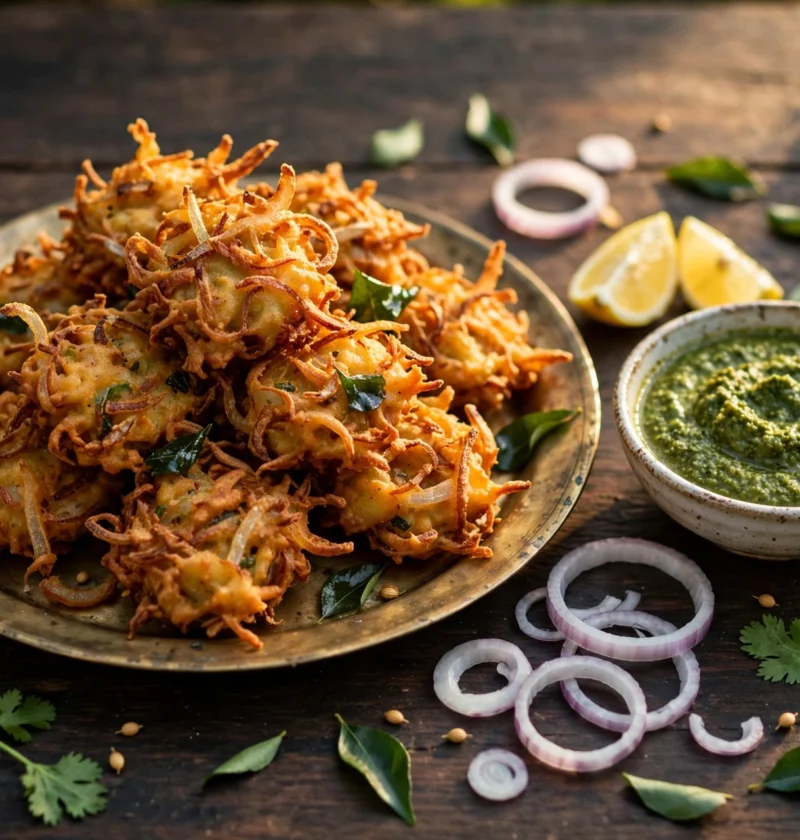
Take a small, loose handful of the onion mixture, roughly the size of a golf ball, and drop it into the oil without packing it tight. The craggy shape is the point: the gaps and edges are what turn extra crisp. Fry 4 to 5 clusters at a time for 2 to 3 minutes, turning them once with a slotted spoon, until they are deep gold all over and the sizzling quiets down. Lift them onto a wire rack so the air can circulate underneath and keep the crust brittle. Let the temperature recover between rounds, since a crowded kadhai cools quickly and leaves the next batch greasy instead of crisp.
Step 5: Season and serve immediately
Shower the hot pakoras with a pinch of chaat masala and a squeeze of lemon while they are still crackling from the rack. That last seasoning lands on the rough, warm surface and wakes up every spice in the coating. This onion pakora recipe is at its best in the first fifteen minutes, when the onion inside is sweet and just tender and the outside shatters between your teeth, so pile the pakoras onto a plate with mint chutney and lemon wedges and serve them straight away.
Serving Suggestions for This Onion Pakora Recipe
The first batch seldom survives the walk from stove to table in my kitchen. Somebody always drifts in while the rack is still full, and a handful vanishes before the second round is out of the oil. On the occasions the pakoras do arrive whole, I serve this onion pakora recipe with mint chutney, cool and sharp, which cuts the warmth of the spices nicely, plus lemon wedges for anyone who wants extra brightness. Masala chai alongside makes it the rainy-day ritual my family expects.
When friends visit, I lay out a small chaat board instead of a single plate: the pakoras, chutney bowls, onion slivers, lemon wedges, and papad, letting everyone assemble their own mix. Crumbled over kadhi they add crunch, and in a soft bun with chutney they make a quick street-style sandwich. For a table that already loves fried snacks, our vegetable pakora brings chunkier mixed vegetables next to these fine onion threads, and our paneer pakora adds soft, spiced cheese cubes for contrast. This onion pakora recipe also sits happily on a larger snack table without stealing attention from the other dishes.
Storage and Reheating
Honest truth first: these pakoras peak within minutes of leaving the oil, and no trick restores that first shattering bite once they cool. The strands are so fine that they relax quickly as steam escapes, and the crust loosens with them. Still, a leftover batch of this onion pakora recipe need not go to waste. Let the pakoras cool fully on the rack, then pack them in a single layer in an airtight tin and refrigerate for up to a day, keeping the chutney separate so moisture stays away from the crust.
Reviving this onion pakora recipe is simple enough: spread the pakoras on a tray and bake at 400°F for 5 minutes, flipping halfway, until the crust tightens again. An air fryer at 375°F for 3 minutes works just as well. Avoid the microwave, which turns the coating soft in seconds. Better still, the raw mixture holds in the fridge for a few hours, so mix ahead and fry fresh before guests arrive.
Onion Pakora Recipe FAQs
Why did my onion pakoras turn out soft instead of crisp?
The usual culprits are unsqueezed onions and a batter with too much water. Onion strands give up liquid as they fry, which steams the coating from inside, and a wet batter never crisps on something this thin. Salt and squeeze the onions well, add water only a spoonful at a time, and hold the oil near 350°F. Master those three habits and this onion pakora recipe turns out crisp nearly every time.
Can I make this onion pakora recipe in an air fryer?
Yes, though the texture differs a little from deep-frying. Form the mixture into loose, flat clusters, mist them well with oil, and cook at 400°F for 8 to 10 minutes, turning once, until deep gold. Keep the clusters in one layer with space between them, since touching pieces steam rather than crisp. The slicing, salting, and squeezing all stay the same, because those steps are what give this onion pakora recipe its character.
Can I add other vegetables to the onion mixture?
You can, but keep the onion in charge. Grated potato or shredded cabbage blends in nicely, provided you salt and squeeze those too. Spinach leaves are trickier, as they wilt and release liquid fast, so add them sparingly if at all. Once the mixture stops being mostly onion, you have wandered into a different pakora, and this onion pakora recipe loses the sweet, tender strands that make it special.
What chutney goes best with onion pakora?
Mint chutney is the pairing I reach for first, since its cool sharpness slices through the warm spice. Tamarind chutney is another strong match, darker and tangier, and lemon with chaat masala alone is plenty if you prefer simplicity. Skip heavy yoghurt-based dips, which sit too richly on such light clusters. Keep the chutney beside the pakoras rather than over them, so the crust of this onion pakora recipe stays crisp to the final bite.
Recipe Summary
Prep time: 20 minutes, including the onion salting. Frying: about 10 minutes in small batches. Total time: roughly 30 minutes. Serves 4 as a snack. Difficulty: easy, with the oil temperature as the main thing to watch. This onion pakora recipe takes thinly sliced onions, a light spiced chickpea coating, and properly hot oil, and turns them into golden, shattering clusters that vanish quickly on any rainy evening at my house. Make it once when the weather turns, and I suspect it will become a regular in your evening-snack rotation.
A little background for the curious: the onion has seasoned kitchens across Asia for thousands of years, valued for turning sweet and mellow in hot fat, while pakora belongs to a beloved family of spiced, batter-coated snacks sold by street vendors, home cooks, and tea stalls throughout South Asia. Frying sweet onion strands in a spiced chickpea crust brings a humble pantry staple together with one of the region’s favourite snacks, and that pairing is exactly the flavour of this onion pakora recipe.